Three Month Bocconi Test Plan: A 12-Week Schedule

Three Month Bocconi Test Plan: A 12-Week Schedule
Three months is enough time to prepare for the Bocconi Test if you work in phases. Spend weeks 1 and 2 on a baseline. Spend weeks 3 to 6 on weak topics. Spend weeks 7 to 10 on mixed, timed practice. Spend weeks 11 and 12 on full mocks and your test day setup. This guide gives you each phase, the weekly hours to aim for and the way to review your mistakes.
TL;DR
- Take a full 75-minute simulation in week 1. Your score by section sets the plan.
- Weeks 3 to 6 build skills by topic. Weeks 7 to 10 mix topics under time pressure.
- Review every mock. Log each error by cause: knowledge, speed or misreading.
- Learn the scoring rules. Wrong answers cost points, and omissions cost nothing.
- Prepare your room and your devices before the last week.
Table of Contents
- What the test asks of you
- The 12-week plan at a glance
- Weeks 1 and 2: find your starting level
- Weeks 3 to 6: build skills by topic
- Weeks 7 to 10: mixed, timed practice
- How to review a mock
- Weeks 11 and 12: final polish
- Practice on a limited budget
- Our perspective
- Start your three months with the full platform
- FAQ
- Sources
What the test asks of you
Know the format first. The plan only works if it matches the exam.
For the standard undergraduate route, the Online Bocconi Test has 50 multiple-choice questions in 75 minutes. There are 24 mathematics questions, 11 reading comprehension questions, 6 numerical reasoning questions and 9 critical thinking questions. The same page says the test is valid for any program. The separate Law test is only for legal-area programs.

The math is simple to do in your head: 75 minutes for 50 questions is an average of 90 seconds per question. Some questions will take 30 seconds. Others will take 3 minutes. Your plan must train you to tell the difference fast.
Bocconi’s page also says the questions are mixed by difficulty and topic. You must build topic skill. You must also learn to switch methods smoothly from one question to the next. That is why the plan moves from topics to mixed sets.
How scoring works
Bocconi’s scoring rules give +1 for a correct answer, 0 for an omission and −0.2 for a wrong answer. Some three-option critical thinking questions carry a −0.33 penalty (Bocconi).
This changes how you practice. You need a rule for when to answer and when to skip. Build that rule during your mocks, not on test day. Our guide to penalties and guessing tactics explains how to do it.
Why the score matters
Bocconi’s admissions page says selection uses the test score for 55% and your third-last and second-last year GPA for 45%. It says recommendation letters, motivation letters and CVs are not considered. Your grades are already set. The test is the part you can still improve. See how to turn your score into an admission benchmark.
The 12-week plan at a glance
| Weeks | Phase | Main goal | Weekly rhythm |
|---|---|---|---|
| 1–2 | Baseline | Find your starting level and weak spots | 1 full simulation, 1 review session, light topic work |
| 3–6 | Foundations | Close gaps by topic | Daily topic drills, 1 short timed set per week |
| 7–10 | Mixed practice | Switch topics under time pressure | 2 timed mixed sets, 1 full mock per week |
| 11–12 | Final polish | Full-length mocks and test day setup | 2 full mocks, error review, rest |
Aim for 6 to 10 hours per week if you can. Short daily sessions work better than one long weekend session. If your school workload is heavy, keep the same phases and lower the hours. Do not skip phases. For a second view of the same structure, read our 8 to 12 week study timetable.
Weeks 1 and 2: find your starting level
Start with a real simulation. Do not study first. You need an honest baseline.
Bocconi offers a free online simulation of 50 questions in 75 minutes. Questions appear three per page, and you cannot go back to a previous page. After the simulation, you can review correct, incorrect and unanswered questions. The score report arrives within 48 hours and includes your total score, subject-area scores, and the numbers of correct, wrong and unanswered items (Bocconi).
That report is your starting map. Write down:
- Your total score.
- Your score in each of the four areas.
- How many questions you left blank.
- How many wrong answers came from rushing.
Then do a second timed set on a practice platform with official past papers. Two data points are better than one. Compare how you handled the no-going-back rule.
Set your weekly targets
Pick your two weakest areas. Math carries 24 of 50 questions, so it often decides the outcome. Reading comprehension is the next largest block, with 11 questions. Give most of your time to the areas where you lose the most points, but keep touching all four every week.
Weeks 3 to 6: build skills by topic
This phase is slow on purpose. You work without the clock at first. Then you add time.
Mathematics (about 3 sessions per week)
Revisit the topics you missed in your baseline. Work through them one at a time. Do 15 to 25 problems per topic. After each set, redo the ones you got wrong without looking at the solution.
Use targeted drills. Our page on math exercises and timed mocks shows how to structure them. Word problems often cost the most time, so see the shortcuts for word problems. Calculators are not allowed on test day, so practice mental math from week 3 onward.
Reading comprehension (2 sessions per week)
Read one dense English text per day. Choose economics, science or opinion writing. Then answer questions on it. Practice finding the main claim of each paragraph in under a minute. Underline nothing at first. Instead, say the point of each paragraph in one sentence.
Numerical reasoning (2 sessions per week)
This block has only 6 questions, but they reward pattern speed. Work on tables, ratios, percentages and sequences. Time each question. If you pass two minutes, mark it as a miss and review why.
Critical thinking (2 sessions per week)
Practice spotting assumptions, flaws and conclusions that do not follow. For each question, say why the three wrong answers are wrong. This habit pays off most on the three-option questions, where the penalty is higher.
End each week with a short timed set
On day 6 or 7, take a 20 to 25 question set under time. Keep the same ratio of topics as the real test. Review it the next day.
Weeks 7 to 10: mixed, timed practice
Now the questions come mixed, like on the real test. This is where many students lose points. They know each topic but cannot switch fast.
Each week, do this:
- Two mixed sets of 25 questions in about 37 minutes.
- One full 50-question mock in 75 minutes.
- Two review sessions, one after each mock.
- One light day with only your weakest topic.
Take your mocks in test conditions. Use a computer, a quiet room, one pen and two blank sheets. Do not go back to earlier pages. For a worked example of a full session, see 3 worked exercises and a 75-minute mock plan.
Build a pacing rule
Set checkpoints. For example, at 25 minutes you should be near question 17. At 50 minutes you should be near question 33. Adjust the numbers to your own pace after two mocks. The goal is to never be surprised by the clock.
Decide when to skip
Your first pass should take the questions you can solve fast. If a question stalls you for more than about two minutes, make a choice: answer if you can narrow the options, or leave it blank. An omission costs nothing, while a wrong answer costs 0.2 points. Because you cannot return to a previous page, make that choice before you move on.
How to review a mock
A mock without a review wastes most of its value. Spend as long reviewing as you did taking it.
For each wrong or skipped question, tag the cause:
| Cause | What it means | Fix |
|---|---|---|
| Knowledge | You did not know the method | Go back to topic drills |
| Speed | You knew it but ran out of time | Timed sets, mental math |
| Misreading | You answered a different question | Slow the first read, underline the ask |
| Guessing | You guessed and lost points | Tighten your skip rule |
Keep a simple log with the date, score, section scores and the count of each cause. After three mocks, look at the pattern. One cause usually dominates. Fix that one first.
Track your progress in numbers, not feelings. A rising score across four mocks tells you more than one good day. Our article on practice over more hours explains why quality of practice matters more than total time.
Weeks 11 and 12: final polish
In the last two weeks, do not learn new topics. Sharpen what you have.
- Take two full mocks per week, at the same time of day as your real test slot.
- Redo every error from your log.
- Practice your skip rule until it is automatic.
- Sleep normally. Stop heavy study the evening before.
Prepare your room and devices
The test is taken online with remote proctoring, so your setup is part of the task. The 2027–28 rules say your desk may contain only the computer, an identity document, one pen or pencil, two blank A4 sheets, a permitted beverage and your test credentials.
The same rules prohibit calculators, notebooks, notes, formula sheets, online resources, extra internet-connected devices, headphones or earphones and secondary screens. They also require a recording of the complete room and workstation, and they prohibit room arrangements that prevent adequate monitoring.
So clear your desk the day before. Test your camera angle. Check your identity document. Our checklist on what to bring and set up covers the details. Check Bocconi’s official page for the current rules before your slot, because they are published each academic year.

Practice on a limited budget
Start with the free official simulation described above. It gives you a real format, a score report and a review of your answers. Use it twice: once at the start and once later in the plan, if Bocconi allows repeat attempts. Check the official page for the current terms.
Then add what you need. Free reading material for the reading section costs nothing. Free math exercises from your school books cover the basics. A structured platform helps most when you need realistic timed sets, corrections and tracking in one place. Prepadmit is built for this and is a cost-effective alternative to private coaching.
Our perspective
Most students do not fail the Bocconi Test because they lack ability. They fail to practice the way the test works.
The test mixes topics, limits your time and does not let you go back. We built Prepadmit around those facts. Our simulations use official past papers so the pace and the question style feel real. Our corrections explain each error, so you learn the method and not only the answer.
We also believe in numbers. Skill-specific modes let you drill a weak area. Progress tracking shows whether you improve. Peer ranking shows where you stand. Our experts come from HEC and Bocconi, and we designed the platform to make three months of work count.
Practice a lot. Understand your mistakes. Build confidence before the real day.
quentin
Start your three months with the full platform
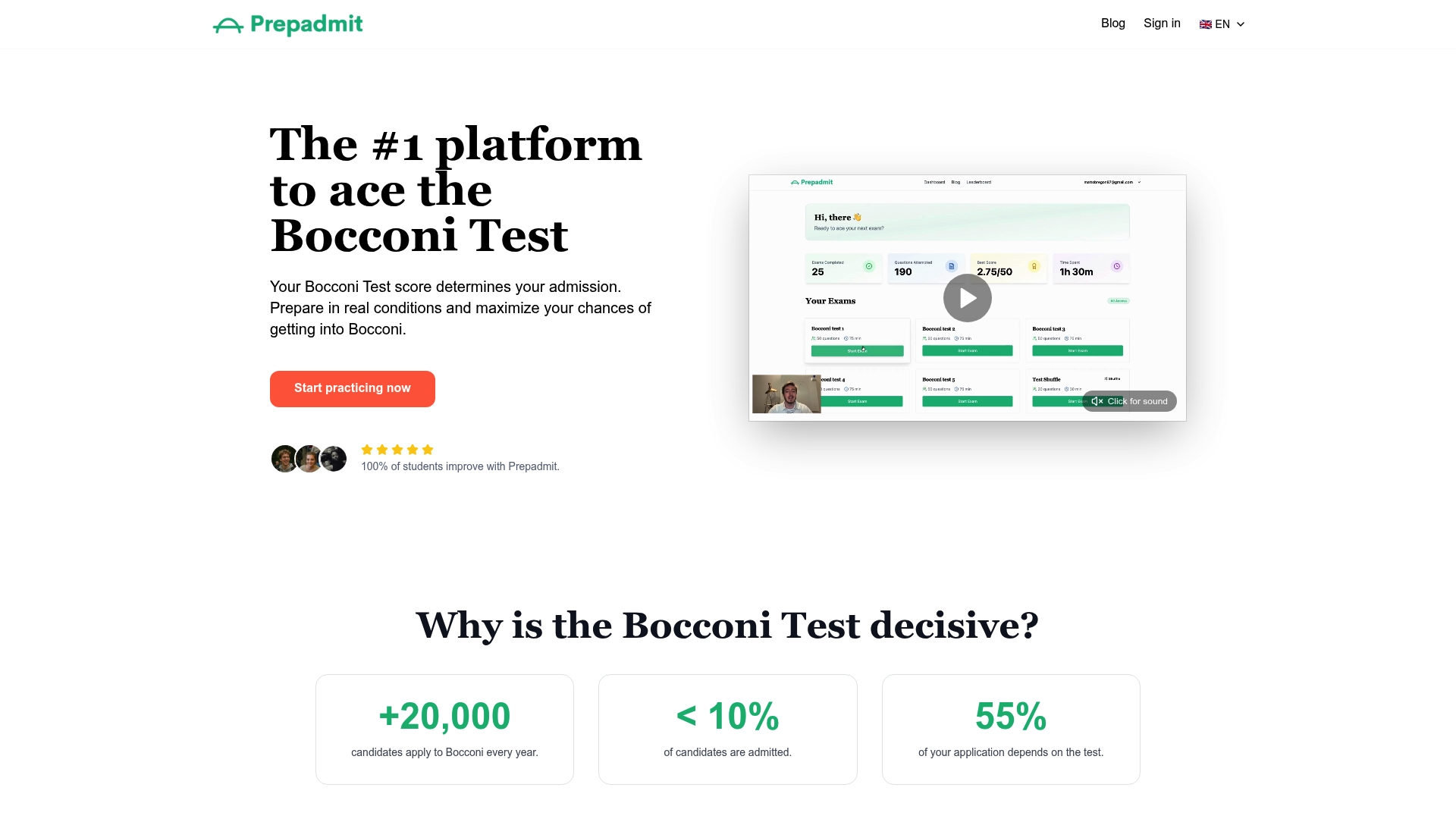
If you want one place for timed simulations, detailed corrections, skill drills, progress tracking and peer ranking, access the full Prepadmit preparation. It works on mobile and desktop, so you can fit short sessions into a school day. We offer a money-back guarantee and report an average score improvement of 34% among our users.
For a wider overview of the preparation steps, read our step-by-step preparation guide.
FAQ
Is three months enough to prepare for the Bocconi Test?
For most students, yes, if you practice steadily. Twelve weeks gives time for a baseline, topic work, mixed timed practice and final mocks. The key is regular sessions and a careful review of every mistake.
How many hours per week should I study?
Aim for 6 to 10 hours per week. Keep sessions short and regular. If school takes most of your time, reduce hours but keep all four phases of the plan.
How many full mocks should I take?
Take one baseline simulation in week 1. Take one full mock per week in weeks 7 to 10, and two per week in weeks 11 and 12. That is about ten full mocks, each followed by a full review.
Can I use a calculator on the test?
No. The 2027–28 rules prohibit calculators, notes, formula sheets and extra devices (Bocconi rules). You may have two blank A4 sheets and one pen or pencil. Practice mental math from the start.
Should I guess when I do not know the answer?
It depends on how many options you can remove. A wrong answer costs 0.2 points and a blank costs nothing. Set a clear rule during your mocks and use it on test day.
Sources
- Online Bocconi test | Bocconi University
- Admissions | Bocconi University
- Instructions and Rules of Conduct 2027-28 | Bocconi University
Recommended
Related articles
Ready to ace your admission test?
Discover PrepAdmit, the platform that helps you succeed at top university admission tests.
Discover PrepAdmit