34% Average Score Lift: Bocconi Test Practice, Not More Hours

34% Average Score Lift: Bocconi Test Practice, Not More Hours
Prioritize official-format timed simulations over generic practice, and pair every mock with a structured error review, not just more hours of drilling. Set a firm per-question time rule and a clear skip-and-return policy before you sit down. Then spend your remaining study time on the specific weak areas your mocks reveal, rather than spreading effort evenly across topics you’ve already mastered.
TL;DR:
- Focusing on timed simulations coupled with error reviews improves efficiency more than simply increasing practice hours or doing untimed questions.
- Adjust your question-by-question timing based on question type, with quick items taking under a minute and longer questions allocated more time.
- Log errors immediately after mocks to identify specific weaknesses and target drills, rather than relying solely on overall scores.
- Practice abandoning difficult questions early to avoid penalty-heavy mistakes and build confidence in strategic skipping.
- Use official Bocconi practice tools and run full technical trials before test day to prevent operational issues from affecting your performance.
Table of Contents
- Strategie Test Bocconi: Format, Scoring, and Attempt Rules
- Time Management Strategies and In-Test Tactics
- How to Use Simulations and Mocks Effectively
- Common Preparation and Test-Day Mistakes to Avoid
- Practical Study Plans: One-Month, Three-Month, and Six-Month Timetables
- Technical and Registration Checklist for Test Day
- Why This Method Works: Evidence Behind the Practice-First Approach
- How Prepadmit Puts This Strategy Into Practice
- A Note From the Author
- Official Pages and Resources to Consult Next
- Sources
Strategie Test Bocconi: Format, Scoring, and Attempt Rules
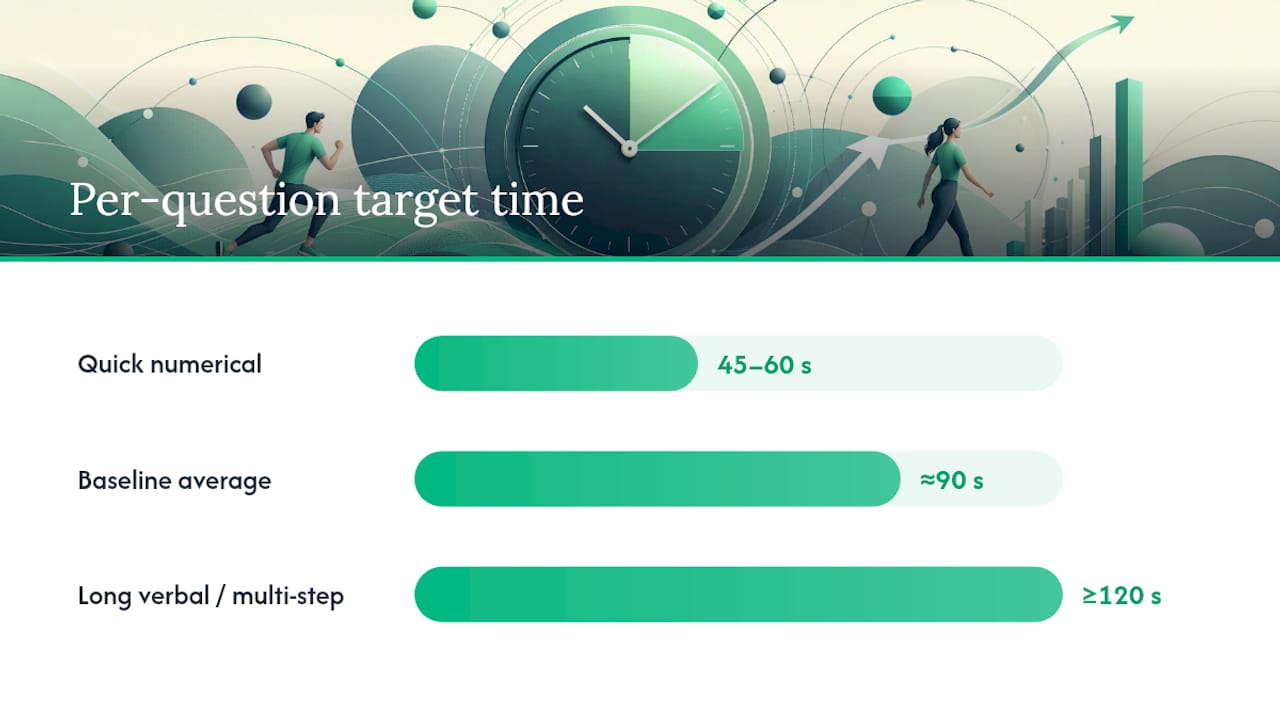
Before any strategy makes sense, you need the mechanics cold. The Bocconi online test runs 50 multiple-choice questions in 75 minutes, split across quantitative reasoning, verbal comprehension, and logical or critical-thinking sections. That’s roughly 90 seconds per question on average, though the real distribution should never be even.
Scoring rewards precision and punishes careless guessing. You get +1 for a correct answer, 0 for a blank, and a penalty for a wrong one. Most items carry a -0.2 penalty, but some three-option critical-thinking questions dock -0.33. There’s also a minimum usable score threshold; fall below it and your result won’t count toward selection, regardless of how the rest of the test went.
A few operational facts you need before you register:
- You can attempt each test type up to four times per academic year.
- Attempts cannot fall on the same day or on consecutive days, so plan your calendar early.
- Some programs, including certain master’s tracks, set area-specific minimum scores in addition to the overall threshold.
- The university’s official test structure and practice materials page, including a dedicated app and full-length simulations, is your first stop, since there’s no official textbook.
Learn the platform’s quirks through those official tools before you touch anything third-party.
Time Management Strategies and In-Test Tactics
Speed without a plan just means fast mistakes. The fix is a timing framework you rehearse until it’s automatic, not something you invent mid-exam.
Start with a baseline: roughly 90 seconds per question, but that number should shift by type. Quick numerical items, like basic arithmetic or single-step logic, deserve 45 to 60 seconds. Longer verbal passages or multi-step data questions can eat two minutes or more. The goal isn’t equal time. It’s matching effort to where points are actually won.
Here’s a practical in-test sequence to follow:
- Do a fast first pass. Answer everything you recognize immediately, skipping anything that needs more than 20 seconds of thought just to understand the question.
- Flag, don’t freeze. If a question isn’t clicking within your target time, mark it mentally and move on. Getting stuck on one high-penalty item can cost you three easier ones.
- Return with your remaining buffer. Use leftover minutes for flagged questions, starting with the ones you understood but ran out of time on.
- Apply a guessing rule. With a -0.2 penalty on most items, blind guessing on four options is close to break-even over many questions, but it’s still a losing bet on items where you have zero information. Only guess when you can eliminate at least one option, or when time is nearly gone and a blank guarantees zero anyway.
- Reset between sections. A short mental reset, even three seconds of deliberate breathing, keeps section-to-section fatigue from bleeding into your accuracy.
Training this rhythm matters more than memorizing it. Run drills where you deliberately switch between question types every 90 seconds, forcing your brain to shift gears the way the actual test demands.
Pro Tip: Practice abandoning a question mid-thought at least ten times before test day. Most candidates have never rehearsed quitting on purpose, and it feels wrong the first few times, which is exactly why you need the repetition.
How to Use Simulations and Mocks Effectively
A mock test only teaches you something if you treat it like data collection, not a dress rehearsal for anxiety. Every full simulation should replicate real conditions: sequential navigation with no jumping backward, the same device you’ll use on test day, and a strict 75-minute window with no pauses.
After each mock, log four things immediately, while the reasoning is still fresh:
- Time spent per question, especially anything over 90 seconds
- Error type: careless slip, misunderstood premise, or genuine knowledge gap
- Whether outside assumptions crept into a logic question that should have relied only on the given premises
- Your confidence level on each wrong answer, since low-confidence wrong answers point to guessing patterns worth fixing
Turn that log into a workflow rather than a pile of notes:
- Debrief within an hour, while you can still remember why you picked each answer.
- Sort every error into a category, not just “wrong.”
- Assign focused drills that target only that category for the next few days.
- Retest the same question type in your next mock to confirm the fix held.
Mock frequency should scale with how much runway you have. Early in prep, one full mock every two weeks is plenty, since you’re still building foundations. In your final month, shift to two or three full mocks per week, spaced to allow real review between each one. For a structured breakdown of what to log and how, a post-mock debrief workflow helps turn raw results into a repeatable habit rather than a one-off exercise.
Common Preparation and Test-Day Mistakes to Avoid
Most score plateaus trace back to a handful of repeatable errors. Fix these first before adding more study hours.
- Untimed, low-quality practice. Working through questions with no clock and no review teaches false confidence. Fix it with short timed drills, ten to fifteen questions under strict time limits, followed by a real review of every miss.
- Technical or scheduling failures. A last-minute device issue or a missed booking window can cost you an entire attempt. Run a full technical trial on your actual test device well before your session, and book with a buffer before application deadlines.
- Bringing outside knowledge into premise-based questions. The test measures reasoning from given information, not general knowledge, so inserting real-world assumptions into a logic puzzle produces confidently wrong answers. Drill premise-only reasoning specifically until it feels unnatural to add anything the question didn’t give you.
- Uneven study distribution. Spending 70% of your hours on your favorite section while ignoring a weak one wastes time. Build a weighted schedule that mirrors the test’s actual composition, then adjust weekly based on mock results.
Practical Study Plans: One-Month, Three-Month, and Six-Month Timetables
Your timeline should shape your strategy, not the other way around. Cramming a six-month plan into four weeks just produces burnout without retention.
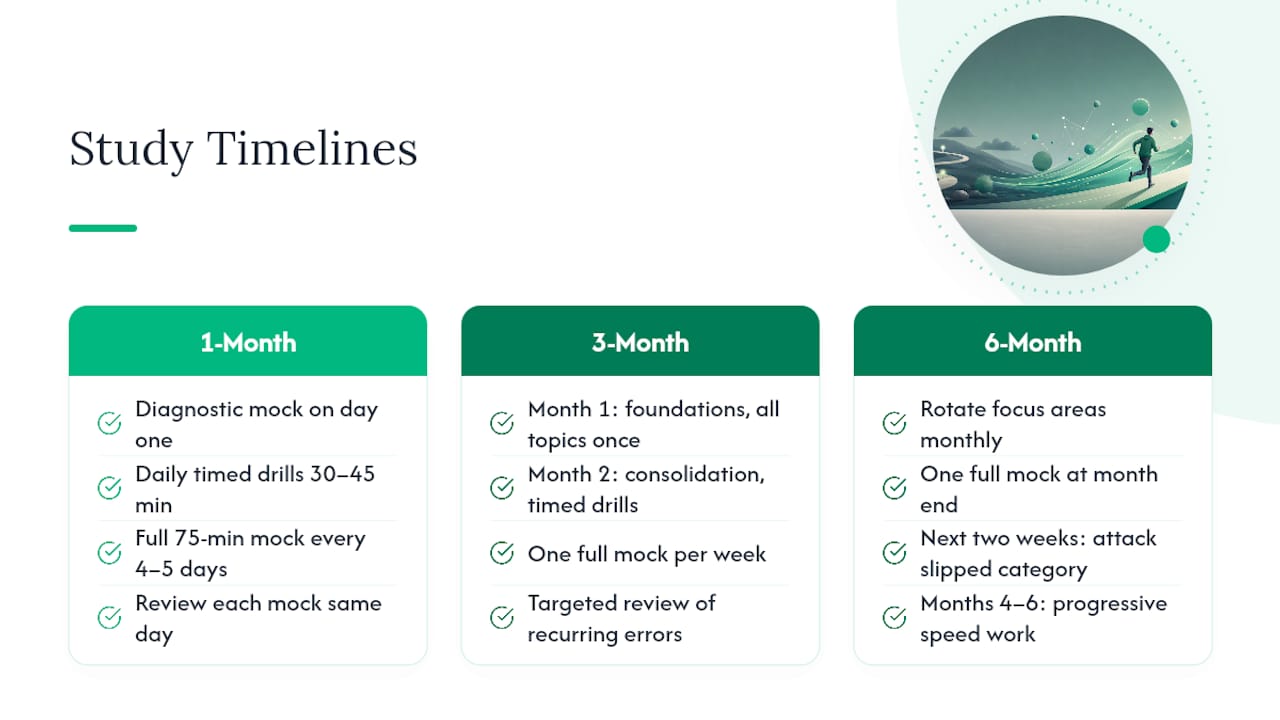
One month (intensive): Run a diagnostic mock on day one to find your baseline. Then do daily timed drills, 30 to 45 minutes, targeting your two weakest categories, with a full 75-minute mock every four to five days. Review every mock the same day it’s taken. By week three, you should be doing near-daily timed practice with minimal new content, just refinement.
Three months (balanced): Spend the first month on foundations, working through every topic area at least once without heavy time pressure. Month two shifts to consolidation: timed drills, one full mock per week, and targeted review of recurring error types. Month three ramps mock frequency to two or three per week, simulating real test conditions every time.
Six months (cyclical): Rotate focus areas monthly rather than trying to hold everything in your head at once. Run one full mock at the end of each month to track drift, then use the following two weeks to attack whatever category slipped. Progressive speed work, gradually tightening your per-question targets, belongs in months four through six, once accuracy is already solid.
Across any timeline, track three numbers: your mock score trend, your error rate by category, and how many topic areas you’ve drilled at least three times. A structured 4-week logic plan shows what a compressed, high-intensity schedule looks like in practice if your timeline is short. Preparation experts generally agree that a systematic pass across the full syllabus, followed by focused review of mistakes, beats piling on hours in whatever section feels comfortable.
Technical and Registration Checklist for Test Day
A perfect strategy falls apart if a login fails or a booking window closes. Handle the operational side early enough that it’s not competing with your nerves.
- Confirm device compatibility and run the official app or a full simulation on the exact device you’ll use for the real test.
- Book your attempt with a buffer before application deadlines. Remember, attempts can’t be scheduled on the same or consecutive days, so leave room for a retake if needed.
- The night before: confirm your ID, charger, and a backup internet connection are ready.
- An hour before: close other applications, silence notifications, and do a five-minute warm-up with two or three practice questions to settle in.
Pro Tip: Book your test slot for a time of day that matches when you actually feel sharpest, not whenever a slot happens to be open. If your mocks consistently score higher in the morning, don’t schedule your real attempt for 6 p.m.
Why This Method Works: Evidence Behind the Practice-First Approach
The logic here isn’t guesswork. It comes directly from how the test is built and how skill actually transfers under exam pressure. Prepadmit’s platform mirrors this exact philosophy: official-format mocks built from real past papers, detailed answer corrections that explain why an option is wrong, skill-specific drill modes for your weakest categories, and progress dashboards that turn raw scores into a visible trend line.
The gap between candidates who plateau and those who jump scores rarely comes down to talent. It comes down to whether they reviewed their mistakes or just repeated them.
Prepadmit reports an average score improvement of 34% among students who train this way, a figure that lines up with the core idea running through this entire guide: structured review, not raw volume, shortens the distance between where you are and where you need to be.
How Prepadmit Puts This Strategy Into Practice
Everything covered above, timed mocks, per-question pacing, error-tagged review, weighted study schedules, is exactly what Prepadmit was built to run for you automatically. Instead of assembling your own timer, spreadsheet, and question bank, you get official-format simulations, detailed corrections that explain the reasoning behind every answer, skill-specific drills for the categories dragging your score down, and a dashboard that tracks your trend over weeks, not just your last attempt.
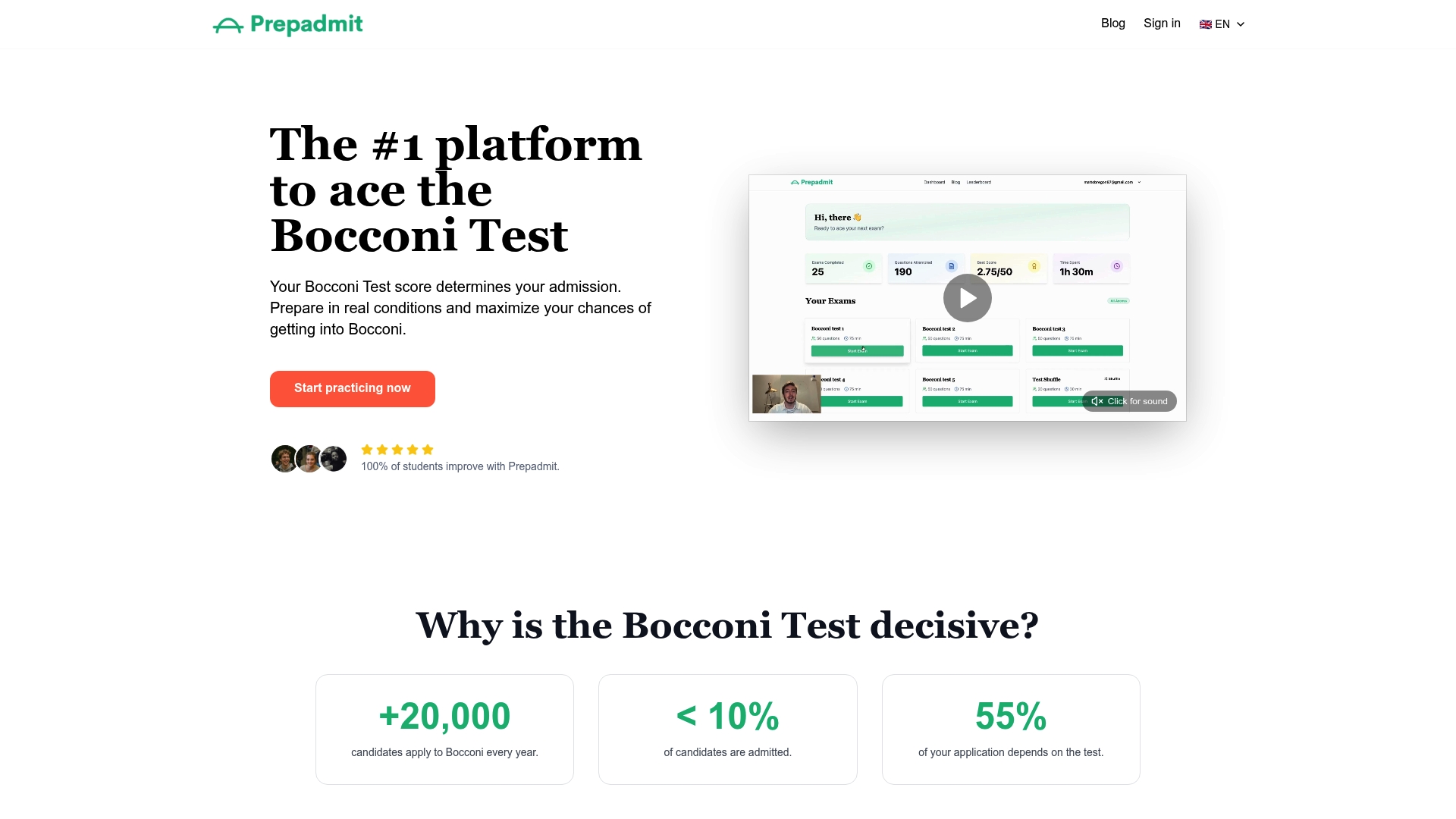
A sensible entry point is a diagnostic mock followed by a focused four-week plan built around whatever it reveals. You’ll see peer rankings on the leaderboard to gauge where you stand, and detailed breakdowns of exactly which question types are costing you points. Prepadmit backs this with a money-back guarantee and reports an average score improvement of 34% among students who train consistently on the platform, at a fraction of what private coaching costs. If you’re ready to stop guessing at your weak spots and start measuring them, run your first diagnostic mock today.
A Note From the Author
Run one timed 50-question mock this week. Log three error categories when you finish: careless slips, misread premises, and genuine gaps. That thirty-minute review will teach you more than another untimed practice session ever could.
Cramming feels productive because it’s busy. Structured review feels slower because it forces you to sit with your mistakes. Only one of those actually moves your score, and the data on the test’s own scoring rules backs that up: precision under a penalty system rewards candidates who understand why they got something wrong, not just candidates who saw the most questions.
— quentin
Official Pages and Resources to Consult Next
Start with the official Bocconi test overview for structure and scoring rules, then the test structure and subject areas page for downloadable practice tools. For targeted drilling, Prepadmit’s guides on numerical reasoning and a full preparation roadmap fill in the tactical details.
Recommended
Related articles
Ready to ace your admission test?
Discover PrepAdmit, the platform that helps you succeed at top university admission tests.
Discover PrepAdmit