Turn Three 75 Minute Mocks Into Score Gains: Bocconi Two Week Plan

Turn Three 75 Minute Mocks Into Score Gains: Bocconi Two Week Plan
Run a daily loop of a short retrieval warm-up, focused drills on one or two weak areas, a timed mixed set, and a review with reattempts. Front-load a diagnostic mock in the first two days, spend days three through ten on targeted drills, then stack full 75-minute mocks in the final four days. Research on retrieval and spacing, plus official Bocconi guidance, both point the same direction: practice tests beat rereading.
TL;DR:
- Focusing on targeted drills and spaced reattempts enhances long-term retention more effectively than rereading notes, especially after an initial diagnostic mock.
- Revisiting weak areas at least twice on separate days consolidates skill mastery and avoids abandoning problematic topics after a single drill.
- Running three full mocks within the two-week schedule, spaced 24 to 48 hours apart, provides valuable timing practice and error data for focused improvements.
- Tagging errors by type during mocks allows for specific follow-up drills, addressing knowledge gaps, misreads, reasoning errors, or rushing mistakes directly.
- Using platforms like PrepAdmit can streamline error tracking and skill-specific practice, reducing manual setup while providing realistic simulations and detailed corrections.
Table of Contents
- Two-week plan overview: phases, daily time budget, and choosing the right test version
- Day-by-day schedule (Days 1-14) with exact tasks and timings
- How to run mocks, read Bocconi score reports, and turn errors into targeted drills
- Why this plan works: the research on retrieval practice, spacing, and mixed practice
- What most students get wrong under time pressure
- PrepAdmit as a ready alternative for your two-week sprint
- Sources
- FAQ
Two-week plan overview: phases, daily time budget, and choosing the right test version
The plan has three phases. Days one and two are diagnostic: you take a full mock, set up an error log, and map where you lose points. Days three through ten are for targeted skill blocks, revisiting each weak area on more than one day so the learning has time to settle. Days eleven through fourteen shift to full mocks, pacing fixes, and lighter review.

Time commitment stays realistic. Weekdays with school or work can run two to four hours; heavier days, especially mock days, may need three to six hours split across a session and a review block. The schedule bends around your calendar. What matters is consistency, not marathon sessions.
Before you touch a single drill, confirm which version of the test applies to you. The bachelor and law version and the graduate version differ in area weighting and thresholds, and the official graduate test page lists a different allocation of verbal, data-insight, and quantitative questions for international graduate applicants. Drilling the wrong mix wastes days you don’t have.
- Phase 1 (days 1 to 2): diagnostic mock, error log, weak-area map.
- Phase 2 (days 3 to 10): targeted drills with spaced revisits.
- Phase 3 (days 11 to 14): full mocks, pacing refinement, light review.
Day-by-day schedule (Days 1-14) with exact tasks and timings
Each study day follows the same shape: a 10 to 15 minute retrieval warm-up, a 60 to 90 minute focused block, a 20 to 30 minute mixed timed set, and a 20 to 30 minute review where you reattempt what you missed.
- Day 1: Full 75-minute diagnostic mock under real test conditions. Start your error log and tag every miss.
- Day 2: Review the diagnostic. Reattempt missed items from memory before checking solutions, then plan your drill focus for the coming week.
- Day 3: Quant-focused block plus a mixed timed mini-set at the end.
- Day 4: Verbal-focused block, warm-up drawn from Day 1’s weak items.
- Day 5: Data insight or critical-thinking block, same warm-up and mixed-set structure.
- Day 6: Revisit the weakest quant sub-skill from Day 3, spaced two days later.
- Day 7: Revisit verbal weak points from Day 4, plus a short mixed set.
- Day 8: Mixed drill day covering all three areas in shorter blocks.
- Day 9: Second pass on data insight or critical thinking, spaced from Day 5.
- Day 10: Consolidation day: shorter drills, longer mixed timed set, full review.
- Day 11: Full 75-minute mock. Log every error by type.
- Day 12: Rest from full mocks; drill directly from Day 11’s error tags.
- Day 13: Second full mock, spaced 24 to 48 hours from Day 11.
- Day 14: Light mixed simulation, pacing review, then rest and sleep priority.
Each flagged weak skill gets revisited at least twice on separate days rather than drilled once and abandoned. That spacing is the point of the whole structure, not a scheduling convenience.
On mock days, book extra time. A 75-minute test needs a matching review block afterward, and rushing that review defeats the purpose of running the mock at all.

How to run mocks, read Bocconi score reports, and turn errors into targeted drills
A mock only helps if you treat it as data collection, not a grade. Simulate real conditions: same device, same time of day if possible, no pauses. Record more than your total score. Note per-area correct, wrong, and omitted counts, since the official score report breaks results down by area for exactly this reason.
Tag every miss by type:
- Knowledge gap: you didn’t know the concept.
- Misread: you understood the concept but misread the question.
- Reasoning error: your logic broke down mid-solution.
- Time pressure: you rushed and made an avoidable mistake.
- Avoidable guess: you skipped reasoning entirely under pressure.
Each tag points to a different fix. Knowledge gaps need a short lesson before drilling. Misreads need slower, deliberate reading practice. Time-pressure errors need pacing work, not more content review. Attempt each missed item from memory first, then check the solution, then schedule a reattempt about 48 hours later.
Pro Tip: Log the error type before you look at the correct answer. It forces you to diagnose your own thinking instead of just absorbing the right response.
Why this plan works: the research on retrieval practice, spacing, and mixed practice
The two-week structure isn’t arbitrary. A meta-analysis of practice testing found that practice tests produce larger learning gains than restudying the same material, which is why mocks and timed drills carry more weight in this plan than passive review.
Spaced retrieval practice is one of the most reliable levers for durable learning, according to a Nature Reviews Psychology analysis of spacing and retrieval research. That finding shapes the daily structure directly: weak areas get revisited on separate days instead of drilled once and dropped.
In a compressed 14-day window, spacing still works. Revisit a weak skill after a day or two rather than immediately, and keep retrieval attempts short rather than rereading notes at length. Full mocks train timing and topic-switching. Targeted retrieval sessions fix the specific error types a mock surfaces. Neither one replaces the other.
What most students get wrong under time pressure
The most common mistake is treating the two weeks as a content review sprint instead of a practice sprint. Rereading notes feels productive. It rarely moves your score the way a timed mock does.
Skipping the diagnostic is the second mistake. Without it, drills target guesses instead of actual gaps. Ignoring timed practice until the final days is the third: pacing under real time pressure is its own skill, separate from knowing the content.
Keep sleep consistent through the two weeks. Use scheduled breaks instead of pushing through fatigue. Trust the spaced reattempts even when a skill feels solved after one pass.
— quentin
PrepAdmit as a ready alternative for your two-week sprint
Building your own mocks, timing them accurately, and tagging every error by hand takes real effort on top of the studying itself. PrepAdmit offers exam simulations with detailed corrections, skill-specific practice modes, and peer rankings, all in one place at Prepadmit.
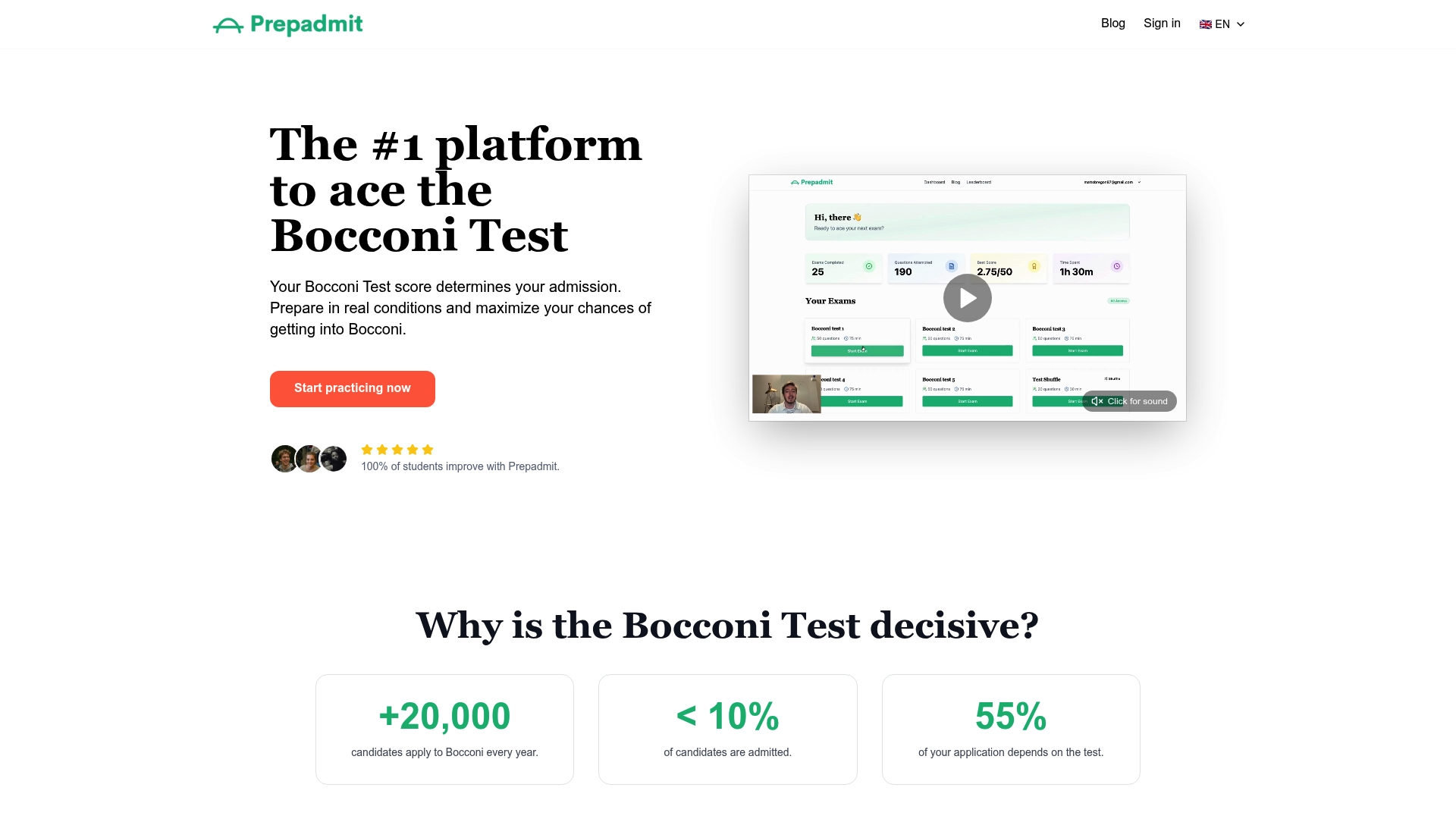
The platform reports a score improvement among users who follow its practice workflow and offers a money-back guarantee. You can also check where you stand against other applicants on the leaderboard as you progress through the two weeks.
- Official-paper simulations replace guesswork about question style.
- Built-in error tracking replaces a manual spreadsheet log.
- Skill-specific modes let you drill exactly the tag your last mock flagged.
| What you need | What PrepAdmit provides |
|---|---|
| Realistic mock conditions | Simulations based on official past papers |
| Error analysis | Detailed corrections by question |
| Targeted drills | Skill-specific practice modes |
| Progress tracking | Peer ranking dashboard |
Start with the diagnostic, then access the full preparation to run your remaining mocks and drills through the two weeks.
Sources
Bocconi’s own pages on the bachelor and law test and the graduate test cover format, timing, and score reports directly. The practice-testing meta-analysis, the Nature Reviews Psychology piece, and the spaced retrieval study cover the learning science behind the schedule. PrepAdmit’s error analysis workflow and math drills posts expand on execution details, and Examo offers additional timed quiz practice if you want a second source of drills.
- Rethinking the Use of Tests: A Meta-Analysis of Practice Testing
- The science of effective learning with spacing and retrieval practice | Nature Reviews Psychology
FAQ
How do I know which Bocconi test version to prepare for?
Check the official Bocconi applications pages for your program, since the bachelor and law version and the graduate version weight areas differently. Confirming this before you start drilling prevents wasted practice on the wrong question mix.
How many full mocks should I run in two weeks?
Three full 75-minute mocks is a workable target: one diagnostic early and two more spaced 24 to 48 hours apart in the final days. This mirrors the spacing pattern shown in retrieval practice research and gives you room to drill error tags between attempts.
What should I do the day before the Bocconi test?
Run a light mixed simulation rather than a full mock, review your pacing notes, and prioritize sleep over last-minute content review. A short, low-pressure session settles nerves better than a final marathon study day.
Can PrepAdmit replace building my own mocks and error logs?
PrepAdmit provides official-paper simulations, automatic error tracking, and skill-specific drills through its platform, which covers the same workflow this plan describes without the manual setup.
Recommended
Related articles
Ready to ace your admission test?
Discover PrepAdmit, the platform that helps you succeed at top university admission tests.
Discover PrepAdmit