Avoid 17/50 Disqualification: Bocconi Test Penalties and Guessing Tactics

Avoid 17/50 Disqualification: Bocconi Test Penalties and Guessing Tactics
Each correct answer earns +1 point, each omitted question earns 0, and each incorrect answer costs you -0.20 points. On certain three-option critical-thinking items, that penalty jumps to -0.33. Score below 17 out of 50 and Università Bocconi does not consider your test evaluable at all, regardless of how many questions you got right.
TL;DR:
- Achieving a score above 17 out of 50 is essential, but penalties heavily punish wrong answers, especially on three-option questions that may cost around 0.33 points each.
- Eliminating at least one answer before guessing significantly increases your expected value, making strategic guessing more effective than random answers.
- Program-specific minimums, such as 11 out of 24 in mathematics, are additional hurdles beyond the overall score threshold and vary by course.
- Practice should focus on penalty-aware simulations that mirror Bocconi’s scoring rules to improve decision-making under exam pressure.
- Attempts used, including those with technical issues, count toward your limit, so deliberate scheduling and targeted practice are key to avoiding score stagnation.
Table of Contents
- Understanding Bocconi Test Penalties: The Official Scoring Rules
- What Score Do You Need to Pass the Bocconi Test?
- How Penalties Should Shape Your Test-Taking Strategy
- Reading Your Test Score Report and Handling Irregularities
- How Many Times Can You Take the Bocconi Test?
- Practicing With Penalty-Accurate Simulations
- Why Elimination Skills Matter More Than Study Hours
- Practice Penalty-Accurate Simulations With Prepadmit
- Sources
- FAQ
Understanding Bocconi Test Penalties: The Official Scoring Rules
The rules above come directly from Università Bocconi’s own test page, and they apply to every question on the exam unless stated otherwise. Most questions follow the standard four-option format: get it right and you gain a point, leave it blank and nothing happens, guess wrong and you lose a fifth of a point. A smaller set of questions, usually the “critical thinking” items built around three answer choices instead of four, carry a steeper -0.33 penalty for wrong answers.
Why the difference? With only three options, a blind guess has better odds of landing correct by chance (roughly 33% versus 25%). Bocconi offsets that improved odds with a heavier penalty, keeping random guessing statistically unattractive across both formats.
Here’s how the rules translate into real numbers:
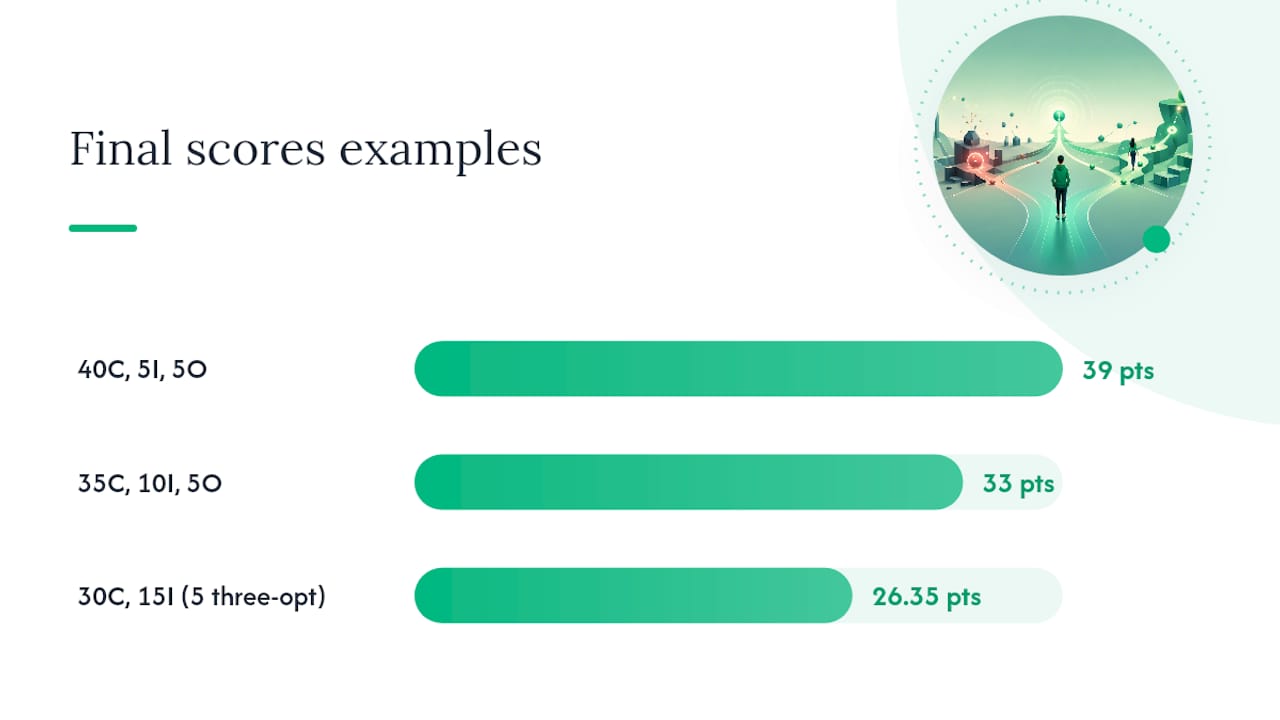
- 40 correct, 5 incorrect, 5 omitted (all four-option) = 40 minus (5 × 0.20) = 39 points
- 35 correct, 10 incorrect, 5 omitted (all four-option) = 35 minus (10 × 0.20) = 33 points
- 30 correct, 15 incorrect, 5 omitted, with 5 of those wrong answers on three-option items = 30 minus (10 × 0.20) minus (5 × 0.33) = 30 minus 2 minus 1.65 = 26.35 points
Pro Tip: Build your own scratch formula before test day: total score = correct answers minus (0.20 × standard wrong answers) minus (0.33 × three-option wrong answers). Practicing this arithmetic mentally saves you seconds you’ll need elsewhere.
Notice how quickly incorrect answers eat into your total compared to simply skipping a question you don’t know. Five wrong guesses on standard items only cost you a single point, but on three-option items that same five wrong guesses costs closer to 1.65 points. The Test Bocconi structure documented by TestBuddy confirms the exam runs 75 minutes across 50 total questions, which means every point lost to a careless guess is a point you can’t recover elsewhere in a tightly timed session.
What Score Do You Need to Pass the Bocconi Test?
Bocconi sets a hard floor: a total score under 17 out of 50, after penalties are applied, makes your test not evaluable. That’s not a low grade. It’s disqualification from that admission round entirely, confirmed on the official test page.
A few things matter here that candidates often miss:
- The 17/50 threshold factors in every penalty you’ve accumulated. A raw count of 25 correct answers means nothing if enough wrong guesses drag your net score below the line.
- Some programs layer on an additional area-specific minimum. The Bachelor in Mathematical and Computing Sciences for Artificial Intelligence, for example, requires at least 11 out of 24 in the mathematics section, separate from your overall total.
- Program-specific minima aren’t listed in one central place. Check the admissions page for your specific course, since requirements can shift year to year.
- Clearing both the general and program-specific minimum doesn’t guarantee a seat. It only means your test counts toward the ranking, which is competitive and depends on how other applicants scored.
Think of 17/50 as the entry ticket, not the finish line. You need it to be in the game, but the actual competition happens above that number.
How Penalties Should Shape Your Test-Taking Strategy
Penalties turn every uncertain question into a math problem, and doing that math in your head, under time pressure, is a skill you have to build before test day, not during it.
Here’s the expected-value logic in plain terms. On a standard four-option question, if you can eliminate at least one wrong answer, guessing among the remaining three gives you roughly a 33% chance of gaining a point against a 67% chance of losing 0.20. Run the numbers: (0.33 × 1) minus (0.67 × 0.20) equals a small positive expected value. Once you can eliminate two options, leaving a coin flip between two choices, the math tilts even further in your favor.
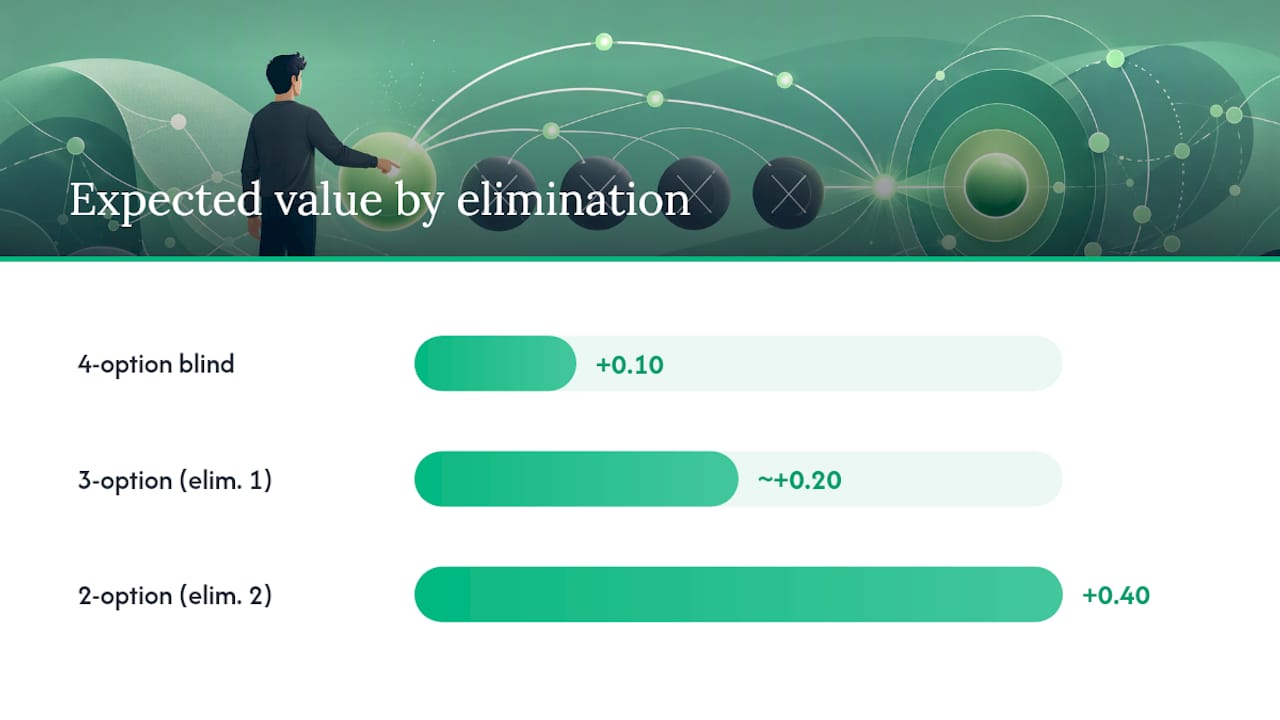
On three-option critical-thinking items, the calculation changes because the penalty is steeper. A blind guess among three options gives you a 33% chance at +1 and a 67% chance at -0.33. That works out close to break-even, meaning elimination skill matters even more before you commit to an answer.
Use these rules of thumb during practice and on test day:
- Eliminate before you guess. If you can rule out even one option on a four-option question, guessing among the rest usually beats leaving it blank.
- Treat pure blind guesses differently. With zero elimination and four options left, the expected value sits close to neutral. With three-option items and no elimination, it’s often safer to omit.
- Pace yourself across 75 minutes and 50 questions. That’s roughly 90 seconds per question on average, though verbal sections typically move faster than quantitative ones.
- Flag and move on. Don’t let one stubborn question eat the time budget for three easier ones later in the section.
Simulation practice matters more here than in exams without penalties, because random guessing under a penalty system actively hurts you rather than staying neutral. Prep resources across the board, including analysis from Alphatest, consistently point to the same conclusion: mocks scored with the exact penalty structure teach your brain when to commit and when to walk away from a question, which raw practice questions without scoring never will.
Pro Tip: Track your “penalty loss rate” per subject area during mocks. Divide penalty points lost by total questions attempted in that area. A high rate in quantitative reasoning but a low rate in reading comprehension tells you exactly where to drill elimination skills next, rather than guessing at your own weaknesses.
Reading Your Test Score Report and Handling Irregularities
Your Test Score Report appears in your webtesting area within 48 hours of finishing the exam, according to the official instructions and rules published by Bocconi. If it hasn’t shown up after two days, contact admissions support directly rather than assuming something went wrong on your end.
The report itself breaks down into a few specific fields:
- Your total score, already adjusted for every penalty
- Per-area scores, so you can see performance in each section separately
- Counts of correct, incorrect, and omitted answers within each area
- A reference number tied to your specific test attempt
That per-area breakdown is the most useful part of the report, and it’s worth analyzing the same way you’d analyze a mock exam. A low score in one area could mean you ran out of time, guessed too aggressively, or simply hit a knowledge gap. Each of those problems needs a different fix.
Irregularities are treated seriously. Proctoring failures or rule violations, whether accidental or deliberate, can lead to invalidation of that attempt. The consequences include losing the attempt fee without refund and, in more serious cases, exclusion from that selection round. If your webcam disconnects or your environment doesn’t meet proctoring requirements, document what happened immediately and reach out to support with specifics, since these situations are easier to resolve with evidence gathered close to the moment it occurred.
How Many Times Can You Take the Bocconi Test?
Bocconi allows multiple attempts within the platform’s testing window, but not unlimited ones, and the exact number available to you depends on the admission cycle and program you are applying to and may be limited. Check your program’s specific admissions page for the current cap before you schedule anything.
A few practical rules apply across attempts:
- Attempts you’ve used, including ones that ran into technical issues, generally count against your total unless Bocconi officially invalidates that specific attempt.
- Two attempts typically cannot be scheduled on the same day, so plan your calendar with enough space between sessions.
- Refund policies for attempt fees are limited and tied to specific circumstances, not general dissatisfaction with your score.
Space your attempts deliberately rather than rushing a retake. Pull your Test Score Report from the first attempt, identify which area cost you the most in penalties, and spend real practice time closing that specific gap before you sit down again. A retake without a targeted adjustment tends to produce a similar score, penalties and all.
Practicing With Penalty-Accurate Simulations
Knowing the scoring formula on paper is one thing. Applying it correctly under 75 minutes of real pressure is another, and that gap is exactly where structured practice earns its value.
Simulations that mirror Bocconi’s actual penalty structure, using official past papers rather than generic multiple-choice questions, let you rehearse the elimination-versus-omission decision until it becomes automatic. Detailed answer corrections that explain why a wrong choice was tempting, not just that it was wrong, help you spot the specific reasoning traps you fall for repeatedly. Skill-specific drill modes let you isolate a weak area, whether that’s the math section or a critical-thinking cluster with three-option penalties, instead of grinding through full-length tests every time.
Prepadmit reports an average score improvement of 34% among users who train this way, a figure the platform presents as evidence that structured, penalty-aware practice beats unfocused review. Progress tracking and peer ranking dashboards then show you exactly where that improvement is (or isn’t) showing up between attempts, which turns your simulated score reports into the same diagnostic tool the official Bocconi guidance recommends using with your real test results.
Why Elimination Skills Matter More Than Study Hours
Most candidates over-invest in content review and under-invest in the specific skill of deciding, in real time, whether a guess is worth the penalty. That decision, repeated fifty times in 75 minutes, determines more of your final score than an extra week of flashcards.
Pacing discipline and mock-based feedback loops, tracking where penalties actually bite, beat raw hours logged. Use your score reports and simulated results to point practice at the areas costing you points, not the areas that feel unfinished. The structured strategy work Prepadmit outlines reflects the same principle: measurable improvement comes from targeting weaknesses the data reveals, not from guessing at what needs work.
— quentin
Practice Penalty-Accurate Simulations With Prepadmit
Generic practice questions won’t teach you when a guess is worth -0.20 or -0.33. Prepadmit is built specifically around Bocconi’s actual scoring rules, using official past papers scored exactly the way the real exam scores them, so every mock session trains the same elimination-versus-omission judgment calls you’ll face on test day.
The platform pairs those penalty-accurate simulations with detailed answer corrections that explain why a wrong option was tempting, skill-specific drills for the areas costing you the most points, and progress tracking that shows whether your penalty losses are actually shrinking between attempts. The platform offers detailed answer corrections, skill-specific drills, and progress tracking, and is priced competitively compared to private coaching options. If you want your next mock exam scored exactly the way Bocconi scores the real thing, access the full preparation platform and start closing the gaps your last score report revealed.
Sources
FAQ
What Is the Minimum Score to Pass the Bocconi Test?
You need a net score of at least 17 out of 50, after all penalties are applied, for Bocconi to consider your test evaluable. Some programs also require a separate area-specific minimum, such as 11 out of 24 in mathematics for certain courses, so check your specific program page.
What Counts as a Disciplinary Violation on the Bocconi Test?
Proctoring failures and rule violations during the exam, from environment issues to deliberate interference with the testing system, can lead to invalidation of that attempt. Consequences range from losing the attempt fee to exclusion from that selection round, depending on severity.
How Many Times Can You Take the Bocconi Test?
Bocconi allows a limited number of attempts within each admission cycle, and the exact cap depends on your program and testing window. Attempts you’ve used generally count against that limit even if technical issues occurred, unless the university officially invalidates that specific attempt.
What Is the Acceptance Rate for Bocconi University?
Bocconi doesn’t publish a single fixed acceptance rate, since admission depends on your test score ranking against other applicants for your specific program and cohort. Clearing the 17/50 minimum and any program-specific area requirement only makes your score eligible for ranking; it doesn’t guarantee a place.
How Do Penalties on the Bocconi Test Actually Work?
Correct answers earn +1 point, omitted questions earn 0, and standard incorrect answers cost -0.20 points, with some three-option critical-thinking items carrying a steeper -0.33 penalty. Because of this, random guessing without any elimination often costs more than it gains.
Recommended
Related articles
Ready to ace your admission test?
Discover PrepAdmit, the platform that helps you succeed at top university admission tests.
Discover PrepAdmit