Bocconi Test Prep Around Maturità: Copy an 8–12 Week Plan

Bocconi Test Prep Around Maturità: Copy an 8–12 Week Plan
In the next 48 to 72 hours: check your eligibility, book a session window, run one diagnostic simulation, and block daily study slots in your calendar. The Bocconi online test costs €60 per attempt, with up to four attempts a year. Short daily practice, protected around your maturità schedule, works better than cramming either exam at the last minute.
TL;DR:
- Build preparation in three phases: review fundamentals, add timed work at 5 to 7 hours weekly, then reach 8 to 10 hours near test day.
- The test has 50 questions in 75 minutes: 24 math, 11 reading comprehension, 6 numerical reasoning, and 9 critical thinking, so practice pacing by section.
- School math supports Bocconi algebra, percentages, and geometry, while text analysis helps with reading and critical thinking; add drills for graphs, tables, and flawed logic.
- Wrong answers carry a penalty, omissions score zero, and candidates must meet a minimum threshold; verify current eligibility and session dates before booking.
- Space repeat attempts far enough apart to review errors and adapt your drills, rather than booking sessions on consecutive days.
Table of Contents
- An 8 to 12 Week Plan for Maturità and Bocconi Together
- Two Weekly Timetables You Can Copy Into Your Planner
- Study Techniques That Work for Both Exams
- Mapping Your Maturità Subjects to Bocconi Test Areas
- Bocconi Test Dates, Fees, and Format You Need to Plan Around
- Running Simulations So They Actually Help
- Handling the 48 to 72 Hours Before an Exam
- Keeping Your Mind and Body Steady Through Two Exam Tracks
- Studying With Others During Overlapping Exam Prep
- How Maturità and the Bocconi Test Ask Different Things of You
- Fitting Prepadmit Into a Maturità Study Schedule
- What Actually Works, Based on Watching Students Prepare
- A Practical Way to Add Bocconi Prep Without Overloading Your Week
- FAQ
- Sources
An 8 to 12 Week Plan for Maturità and Bocconi Together
Split your preparation into three phases. The early phase favors knowledge review: go back over math fundamentals and reading comprehension basics while your maturità subjects are still in a steady state. The middle phase shifts toward timed practice: more simulations, less pure review. The final phase before your chosen session is about timing, stamina, and error correction.
Weekly hours for Bocconi practice should stay modest during heavy maturità weeks and grow as your test date nears.
- Early phase: a few hours a week, spread across short sessions.
- Middle phase: 5 to 7 hours a week, including one full timed simulation.
- Final phase: 8 to 10 hours a week, with simulations every few days.
Booking strategy matters too. With up to four attempts per year available, space them out rather than clustering attempts on consecutive days. Leave time between attempts to review mistakes and adjust.
For a student with heavy school obligations, mornings before class might carry short quick drills, while weekends hold the longer simulation blocks. Our 8 to 12 week study timetable lays out a version of this schedule you can adapt directly.
Two Weekly Timetables You Can Copy Into Your Planner
During a heavy maturità period, keep Bocconi work light but consistent.
- Monday to Friday: short targeted drills after school, alternating between math and reading comprehension.
- Wednesday evening: a short critical thinking set.
- Saturday or Sunday: one longer timed simulation, ideally the full 75 minutes.
- One day fully off from Bocconi practice, reserved for maturità review or rest.
During a test-focused month, closer to your chosen session, the balance shifts.
- Monday to Friday: a short session of timed practice, rotating through all four question areas.
- Every third day: a full simulation under real time constraints.
- Maturità maintenance: a short daily review to keep oral exam material fresh, without starting new topics.
- Sunday: light review only, no new drills.
Slot classes and oral exam prep first in your calendar, then fit Bocconi sessions around them rather than the other way around. Weekend catch-up works best when it is planned in advance, not improvised after a rough week.
Pro Tip: Keep one full day a week free of both maturità and Bocconi work. A genuine recovery day prevents the burnout that erodes focus right when you need it most.
Study Techniques That Work for Both Exams
Active recall and spaced repetition apply equally to maturità subjects and Bocconi questions, as well as practical study techniques that help you organize your course notes into effective practice tests with structured templates and active-recall tools from Examo. Instead of rereading notes, close the book and try to reconstruct the answer from memory, then check it. Space repeated reviews a few days apart rather than reviewing the same material twice in one sitting.
Interleaving helps too: mix a maturità topic with a Bocconi question type in the same session instead of doing one subject for an hour straight. Your brain stays more alert when it has to switch gears.
- Timebox each session on school days, with a clear start and stop time.
- Keep an error log after every mock test or practice set.
- Review that log weekly and turn repeated mistakes into a short, targeted drill.
- Alternate between maturità flashcards and Bocconi question sets within a single study block.
Full timed simulations matter because they train you to work under the same conditions as the real exam. The Bocconi Online Test runs 50 multiple-choice questions in 75 minutes, and the university itself recommends practicing with timed simulations to replicate those conditions.
Mapping Your Maturità Subjects to Bocconi Test Areas
Your maturità math work overlaps directly with the quantitative section of the Bocconi test, especially algebra, percentages, and basic geometry. Italian and English text analysis, the kind you already do for maturità essays, builds the same muscles used in Bocconi reading comprehension and critical thinking questions.
Where most students need extra drills is numerical reasoning with graphs and tables, a format maturità rarely tests directly, plus critical reasoning questions that ask you to spot flawed logic rather than recall facts.
Run a short audit on your current maturità plan:
- Which subjects already cover quantitative or logical skills.
- Which Bocconi question types get no equivalent practice from school.
- Where you can swap one review session a week for a targeted Bocconi drill instead of adding new study time.
Bocconi Test Dates, Fees, and Format You Need to Plan Around
For Italian candidates, the Bocconi online test runs in three windows: Early Session in September, Winter Session from November to January, and Spring Session in April.
You can take the test up to four times a year, and each attempt costs €60. That fee applies per attempt, so spacing attempts out to study between them makes each one count.
- Format: 50 multiple-choice questions in 75 minutes.
- Area breakdown: Mathematics (24 questions), reading comprehension (11), numerical reasoning (6), and critical thinking (9), according to the Bocconi University test page.
- Scoring: correct answers earn a point, omitted answers score zero, and wrong answers carry a penalty, with a minimum threshold required to be considered, as described on the Laurea Magistrale test page.
If you are finishing maturità in 2026 or 2027, check your booking window early: session dates and eligibility rules are set by the university and do not flex around your school calendar.
Running Simulations So They Actually Help
Simulations only pay off when you treat them like the real test, not casual review.
- Run a full timed simulation of 50 questions in 75 minutes at least once a week during test-focused periods, following the university’s own recommendation for timed practice.
- Use short drills on regular school days, and increase simulation frequency as your session date approaches.
- After each simulation, check time spent per question and group your errors by type rather than just counting them.
- Turn each recurring error type into a short drill for the following week.
Before test day, confirm your setup works. Our technical checklist covers IDs, devices, and the webtesting platform requirements.
Handling the 48 to 72 Hours Before an Exam
Protect your sleep, move a little every day, and step away from social media in the final stretch before an oral exam or a Bocconi session.
- Taper practice 48 to 72 hours before any exam: shift from intensive drills to light review.
- Keep your normal sleep schedule, even if it feels like wasted study time.
- Check your test setup early using our prep checklist, so nothing technical surprises you on the day.
- Build in short breaks between review sessions rather than studying straight through.
Pro Tip: Before a simulation, try breathing in, holding your breath, and breathing out a few times. It may help steady your focus.
Keeping Your Mind and Body Steady Through Two Exam Tracks
Preparing for maturità and the Bocconi test at the same time asks a lot of your attention. Sleep is the first thing to protect: aim for a consistent schedule rather than catching up on weekends, since irregular sleep affects memory consolidation more than most students expect.
Light movement helps too. A short walk or a few minutes of stretching between study blocks resets focus better than scrolling a phone. Nutrition matters less than people assume, but skipping meals during long study days tends to backfire by the afternoon.
Watch for signs of overload: trouble concentrating, irritability, or dreading your study sessions. These usually mean it is time to scale back intensity for a day, not push through. A single rest day rarely sets you back, while weeks of low-grade exhaustion quietly erode both exam performance and motivation.
Keep some part of your week completely separate from exams, whether that is a sport, a hobby, or time with friends. It sounds counterproductive when deadlines are close, but a mind that gets no break eventually stops absorbing new material efficiently.

Studying With Others During Overlapping Exam Prep
Peer study groups work well for maturità, where discussing texts and solving problems together clarifies gaps you might miss alone. For Bocconi preparation, the benefit shifts: comparing timing strategies and discussing tricky question types with classmates can reveal approaches you had not considered.
Online forums and student communities focused on Bocconi admission often share experiences about session timing, question patterns, and pacing. Treat these as supplementary color rather than a primary study resource, since individual accounts vary and official test information always comes from the university itself.
A small study group can work better than a large one for accountability. Set a regular time each week to compare progress, discuss one tricky question type, or simply confirm you are all sticking to the plan.
How Maturità and the Bocconi Test Ask Different Things of You
Maturità exams reward depth: sustained reasoning on a single subject, written argumentation, and recall built over years of coursework. The Bocconi test asks for something closer to speed and pattern recognition across unrelated question types in a fixed 75 minute window.

That difference changes how you should study for each. Maturità rewards slow, cumulative review, building connections across a topic over weeks. Bocconi rewards drilling the same skill under time pressure until your response becomes close to automatic.
Switching between the two in one study session can feel jarring at first. Treat it as training for mental flexibility rather than a distraction: alternating a maturità essay plan with timed numerical reasoning can help you practice switching contexts.
Fitting Prepadmit Into a Maturità Study Schedule
We built Prepadmit around the idea that preparation should fit into a real school calendar, not compete with it.
- Use a weekly timed simulation, 50 questions in 75 minutes, to track progress without adding extra study hours.
- Run short, skill-specific drills between classes using detailed answer corrections to turn mistakes into targeted practice.
- Check progress tracking and peer ranking occasionally to see where more practice time actually helps.
For a deeper walkthrough of how to structure this alongside maturità, see our step-by-step 2026 guide.
What Actually Works, Based on Watching Students Prepare
Short, steady practice beats cramming, every time. Students who practice steadily may improve more than those who cram at the last minute. Expect slow, visible gains, not a sudden leap, and trust the process over the panic.
— Quentin*
A Practical Way to Add Bocconi Prep Without Overloading Your Week
We built Prepadmit for students juggling maturità and Bocconi prep at the same time. Our platform uses official past papers, detailed answer corrections, and peer ranking so your limited study time goes toward what actually moves your score.
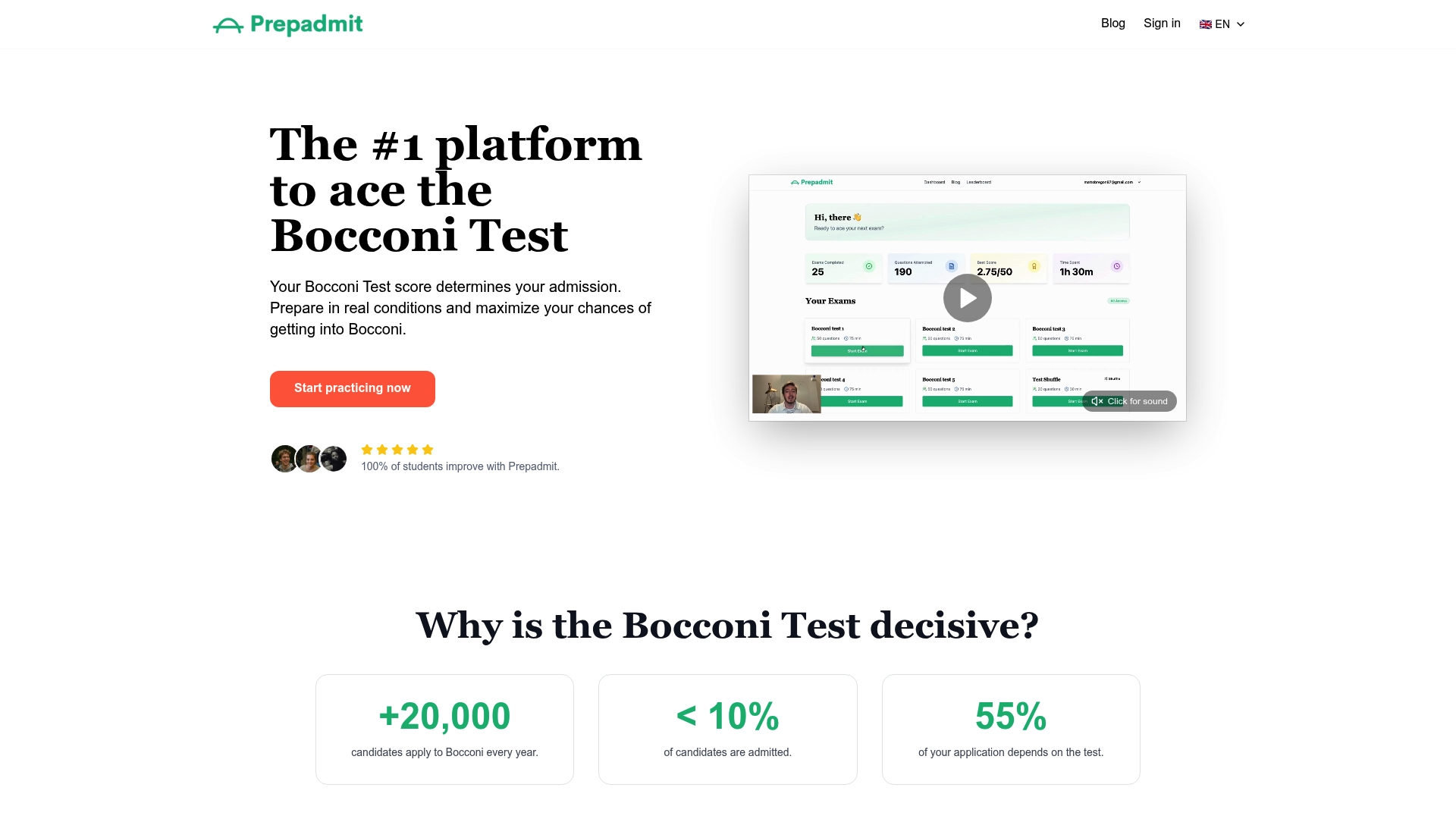
- Weekly timed simulations that match the real 75 minute, 50 question format.
- Skill-specific drills you can slot into short school-day sessions.
- Progress tracking that shows which question types need another pass.
If you want structured practice that fits around your maturità calendar, access the full preparation and start your first simulation this week.
FAQ
What do you need to get into Bocconi?
Admission combines your Bocconi test score with your school grades from the penultimate and antepenultimate years. Bocconi accepts the SAT, ACT, L-SAT, or its own online test, and you must have your diploma by July to matriculate.
When is the Winter session for the Bocconi test?
The Winter Session runs from November through January for Italian candidates, according to the official Bocconi test page. Booking windows open ahead of each session, so check dates early if you plan to sit this window.
How much does a Bocconi test attempt cost?
Each Bocconi online test attempt costs €60, and candidates can take up to four attempts per year. Pricing for Prepadmit’s full preparation platform is available on our access page.
How long is the Bocconi test?
The Bocconi online test lasts 75 minutes and includes 50 multiple-choice questions across math, reading comprehension, numerical reasoning, and critical thinking. Time management across all four areas matters as much as accuracy on any single question.
Recommended
Related articles
Ready to ace your admission test?
Discover PrepAdmit, the platform that helps you succeed at top university admission tests.
Discover PrepAdmit