8–12 Week Bocconi Study Timetable for the Three Question Screen

8–12 Week Bocconi Study Timetable for the Three Question Screen
Follow a structured 8 to 12 week tabella di marcia built around the test’s four scored areas: math, reading comprehension, data insights, and critical thinking. The Online Bocconi Test is composed of multiple-choice questions completed in a fixed time, delivered in sequential small groups that you cannot revisit, so your plan needs weekly targets for each area plus weekly timed mocks that mimic that exact format. Your first move this week: book a diagnostic mock and reserve your test slot early, since seats fill fast.
TL;DR:
- A 12-week study plan offers a gradual build-up of skills, with early weeks focused on fundamentals and later weeks on timed practice and mock exams.
- The Bocconi test features 50 questions in 75 minutes, with math making up nearly half, and scoring involves a mild penalty for incorrect answers.
- Regular full-length mock exams are crucial, starting from week 4 in a 12-week plan or week 3 in an 8-week plan, to improve speed and decision-making under timed conditions.
- It is essential to schedule your first mock before starting serious study to create realistic deadlines and track progress effectively.
- Proper technical preparation, early booking, and adhering to proctoring rules are vital for valid test attempts, with resources like Prepadmit aiding targeted practice and error analysis.
Table of Contents
- Two Ready-to-Copy Study Timetables
- What’s Actually on the Test (And How It’s Scored)
- Turning Study Hours Into Speed and Accuracy
- Sample Weekly Schedules for Each Phase
- Registration, Sessions, and Your Proctoring Checklist
- How Prepadmit Fits Your Study Timetable
- Why a Written Plan Beats Studying by Feel
- Official Bocconi Resources to Verify Before You Book
- Sources
- FAQ
Two Ready-to-Copy Study Timetables
Pick the version that matches how much runway you have before test day.
The 12-week template
This version gives you room to build skills before you race the clock.
- Weeks 1 to 3 (foundation): relearn math fundamentals and reading strategy; 45 to 60 minutes daily, no timer yet.
- Weeks 4 to 6 (technique): layer in data insights and critical thinking; start light timed drills, 60 to 75 minutes daily.
- Weeks 7 to 10 (timed practice): weekly full-length mocks under real 75 minute conditions, plus daily 30 minute drills on your weakest area.
- Weeks 11 to 12 (final mocks): two mocks per week, error review sessions, and a proctoring dry run.
The 8-week template
Compressed, and heavier on hours from day one.
- Weeks 1 to 2: foundation and technique combined, 75 to 90 minutes daily.
- Weeks 3 to 5: timed drills plus your first full mock by week 3, not week 7.
- Weeks 6 to 7: two mocks weekly with full error logs.
- Week 8: one light mock, rest days, and device checks.
If you have less than an hour a day, stretch the 8-week plan to 10 weeks rather than skipping mocks. If you’re starting less than four weeks out, skip the foundation phase entirely and go straight to timed mocks with targeted review. That’s a triage plan, not an ideal one, but it beats guessing which topics still need work.
Pro Tip: Lock your first full mock into the calendar before you start studying. A dated mock creates a deadline your brain actually respects, unlike a vague goal to “review math sometime this month.”
What’s Actually on the Test (And How It’s Scored)
The online Bocconi Test consists of 50 multiple-choice questions to be completed in 75 minutes, divided into four sections: Mathematics (24 questions), Reading Comprehension (11 passages), Numerical Reasoning (6 questions), and Critical Thinking (9 questions) Bocconi test page.
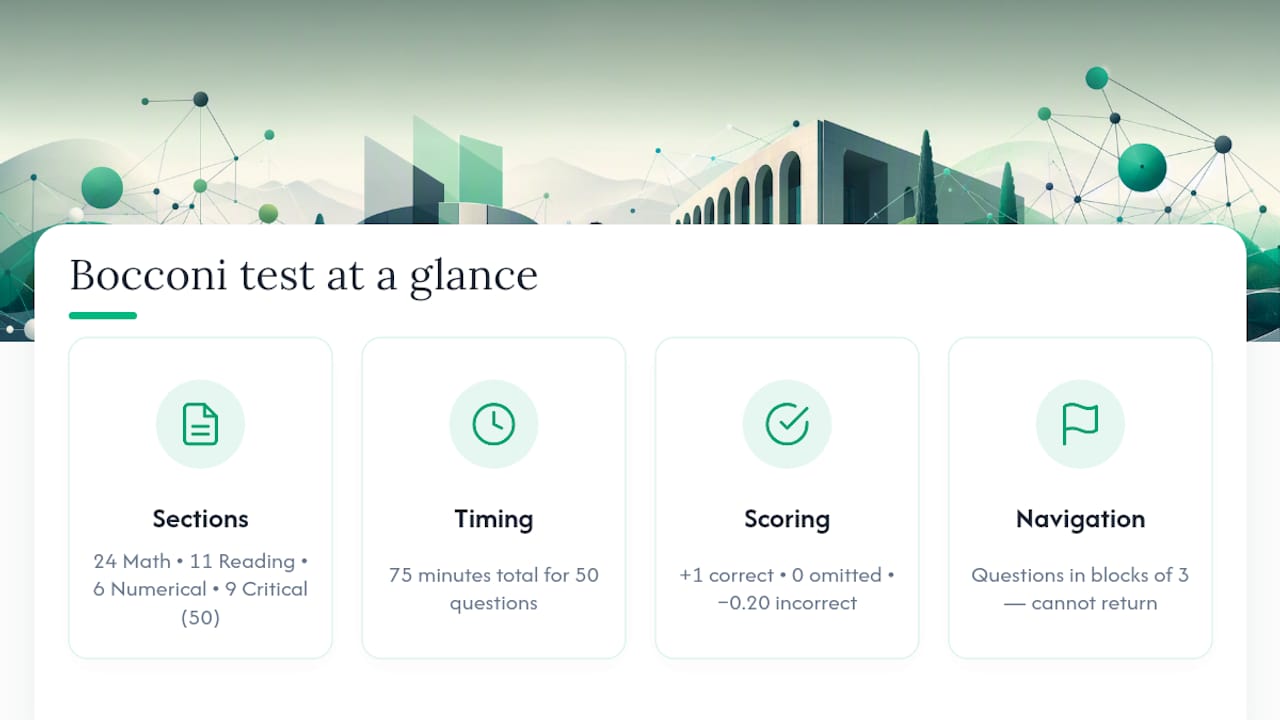
Math dominates the test at nearly half the questions, which is why most tabella di marcia templates weight math practice heaviest in early weeks.
Questions are presented in sequential blocks of three; once you advance past a block, returning is not possible Bocconi instructions. That single rule reshapes your whole approach: there’s no skimming ahead or returning to fix a rushed answer later.
Test scoring is +1 point for each correct answer, 0 for omitted answers, and −0.20 for incorrect answers Bocconi scoring guide. That penalty is mild enough that a reasonable guess (down to two options) usually beats leaving a question blank, but wild guessing across an entire block will cost you.
Turning Study Hours Into Speed and Accuracy
Content knowledge only gets you halfway. The other half is decision speed under a countdown you cannot pause, and that only comes from practicing the actual interface, not generic problem sets.
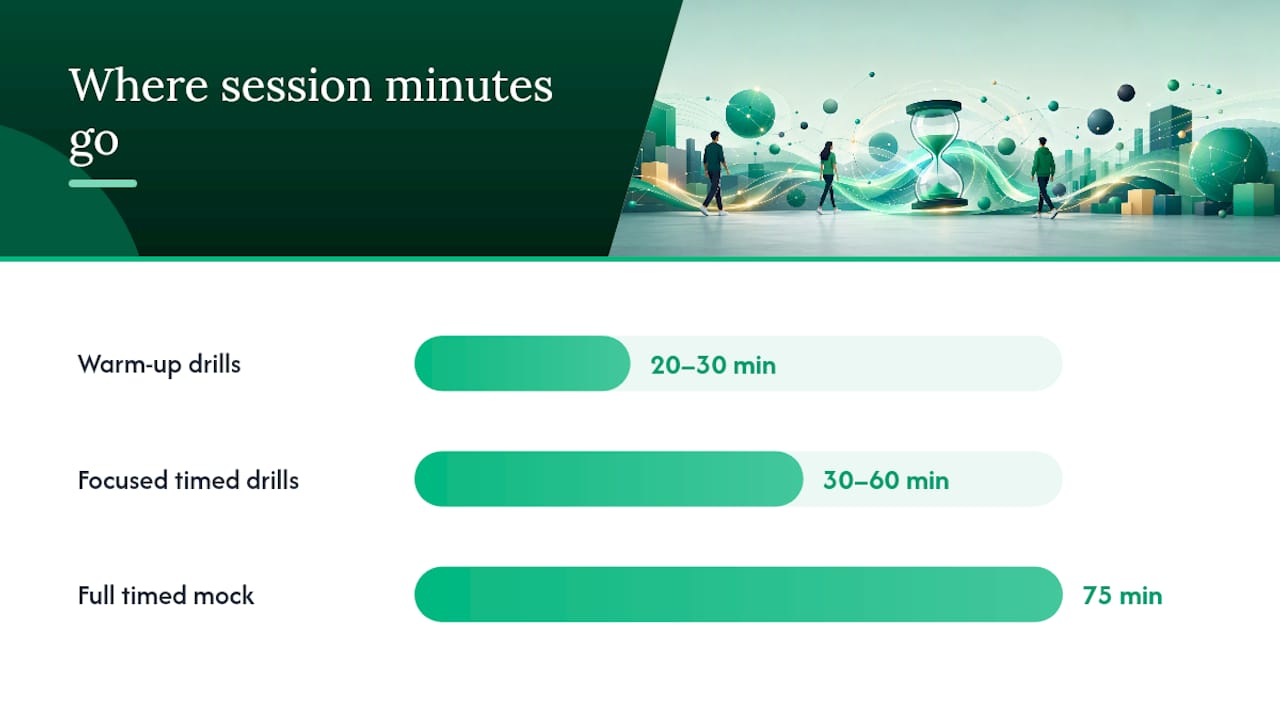
Structure every study session in three parts:
- Warm-up drills (20 to 30 minutes): easy, untimed questions in your weakest area to build confidence and shake off rust.
- Focused timed drills (30 to 60 minutes): one area at a time, under a strict clock, to build raw speed.
- Mixed mock or error review: on mock days, a full 75-minute timed mock; on other days, a review of yesterday’s mistakes sorted by error type.
Run one full mock per week starting around week 4 of a 12-week plan, then bump to two mocks weekly in your final two weeks. On an 8-week plan, pull your first mock forward to week 3.
Adopt a personal skip rule before you sit for real: decide now how long you’ll spend on a stuck question (60 to 90 seconds is a common threshold) before marking your best guess and moving to the next screen. Since navigation is sequential and irreversible, a skip rule you haven’t practiced under real time pressure will fall apart on test day.
Pro Tip: Keep an error log with three columns: question type, why you got it wrong (careless error vs. knowledge gap), and the fix. After three weeks, patterns jump out that a gut feeling never would.
A partner resource like ESS’s mock exam service can supplement your practice if you want additional timed sets beyond your core plan, and a resource such as PrepAdmit’s math drill guide targets the area worth the most points.
Sample Weekly Schedules for Each Phase
Here’s what a single week looks like at three different points in your prep.
Early phase (foundation, weeks 1 to 3)
Run 5 to 7 short sessions weekly, each built around one topic:
- Monday/Wednesday/Friday: 45 minutes of math fundamentals, untimed.
- Tuesday/Thursday: 30 minutes of reading comprehension strategy.
- Saturday: 30 minutes of critical thinking logic patterns.
- Sunday: rest, or a light 20-minute review of the week’s notes.
Middle phase (integration, weeks 4 to 9)
This is where timed practice takes over and a full guide like PrepAdmit’s step-by-step prep guide can help sequence your remaining weeks.
- Three sessions of mixed timed sets (15 to 20 questions, all areas blended).
- One full 75-minute mock, once weekly.
- Two review sessions focused entirely on your logged error types.
Final phase (peak, last 1 to 2 weeks)
Volume drops, precision rises.
- Two to three full mocks, spaced with at least one rest day between them.
- One proctoring dry run: test your camera, microphone, and room setup exactly as you would on test day.
- Light review only. No new content this close to the exam.
A pre-test checklist like PrepAdmit’s 7-day prep guide covers this final stretch in more detail if you want a day-by-day breakdown.
Registration, Sessions, and Your Proctoring Checklist
Bocconi runs the test across multiple windows, typically an early session, a winter session, and a spring session, according to Bocconi’s admissions page. Seat availability inside each window can be limited, so book your slot as early as your application timeline allows.
Booking your first attempt early also protects your option to retake within the same session if your score lands below target, since a late booking may leave no retake slots open. Check exact windows and cutoffs on PrepAdmit’s Bocconi test dates guide before you commit to a date.
Before any booked attempt, confirm the technical side:
- Test your camera and microphone together, not separately, since sync issues cause most invalidations.
- Clear your desk and room of notes, phones, and second screens.
- Sit somewhere with stable lighting and no background noise or movement.
- Have a backup device charged in case the platform asks for a second angle.
Bocconi’s own rules note that strict proctoring applies, and a missing audio or video stream, or detected background activity, risks having your attempt invalidated entirely. Run a full proctoring test the day before, not the morning of.
How Prepadmit Fits Your Study Timetable
Prepadmit is built specifically around the workflow this tabella di marcia demands: timed mocks that replicate the real three-question screen format, official past papers, and error analysis sorted by skill so you know exactly where your practice hours should go.
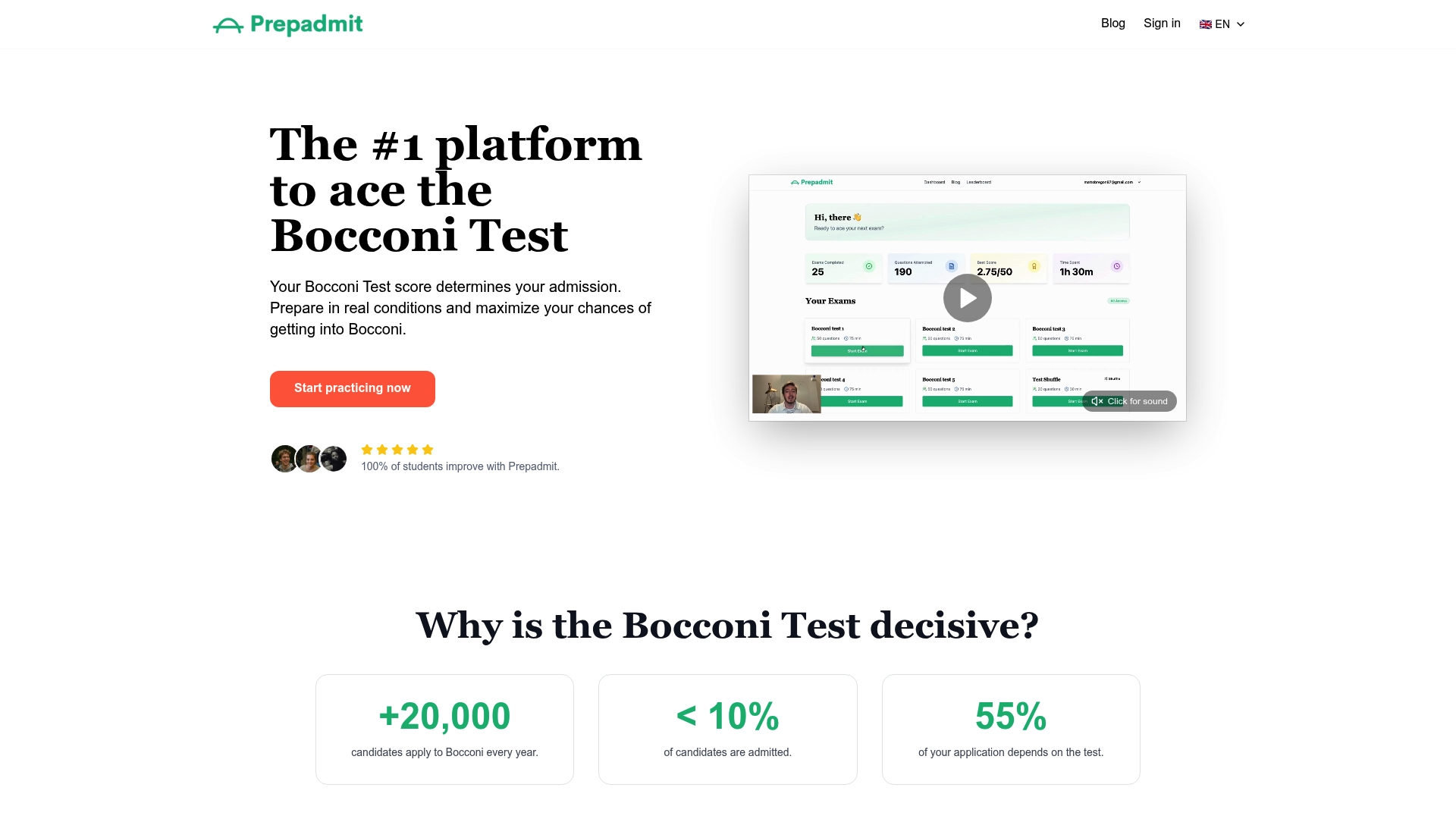
Where does it slot into the weekly templates above? Use Prepadmit for your weekly full mocks starting in week 4 of the 12-week plan (or week 3 of the 8-week version), and for the focused timed drills that fill your midweek sessions. The platform’s progress tracking and peer ranking give you a clearer read on whether you’re actually improving week over week, rather than guessing from how a session felt. It was built by experts from prestigious institutions and offers an affordable alternative to private coaching with a money-back guarantee.
Ready to turn this timetable into daily practice? Start your preparation with Prepadmit and run your first diagnostic mock this week.
Why a Written Plan Beats Studying by Feel
Most students who study without a written tabella di marcia default to whatever topic feels comfortable that day, which usually means avoiding the area they’re weakest in. A staged plan forces the opposite: it puts your weakest area on the calendar whether you feel like tackling it or not.
The bigger issue is pacing, not content. Students who only review material passively rarely build the split-second decision speed the sequential screen format demands, and that gap only shows up once it’s too late to fix it. Book your diagnostic mock this week and start week 1 on a real date, not “soon.”
— quentin
Official Bocconi Resources to Verify Before You Book
Confirm test structure and dates directly on Bocconi’s online test page and review proctoring rules in the official instructions PDF.
FAQ
How Is the Bocconi Test Score Calculated?
Each correct answer earns +1 point, an omitted question earns 0, and an incorrect answer costs −0.20 points, according to Bocconi’s scoring guidance. That mild penalty means an educated guess is usually worth the risk, but random guessing across many questions can still hurt your total.
How Hard Is the Bocconi Test?
It’s demanding mainly because of time pressure, not raw difficulty. You get 75 minutes for 50 questions across math, reading, data insights, and critical thinking, delivered in sequential three-question screens you can’t revisit, so pacing errors cost more than most students expect.
What’s the Minimum Score to Get Into Bocconi?
Bocconi doesn’t publish a fixed minimum passing score; your result is combined with other admission criteria and ranked against other candidates, with the test result contributing a substantial share of that overall evaluation. A stronger score always improves your relative ranking, so aim to maximize performance rather than hit a specific number.
How Many Times Can You Take the Bocconi Test?
Bocconi runs multiple session windows across the year, such as early, winter, and spring sessions, and candidates can typically attempt more than once across these windows. Book your first slot early, since seat availability inside a session can limit your ability to retake before that window closes, as detailed on Bocconi’s admissions page.
Recommended
Related articles
Ready to ace your admission test?
Discover PrepAdmit, the platform that helps you succeed at top university admission tests.
Discover PrepAdmit