4 Shortcuts That Halve Your Time on Bocconi Word Problems

4 Shortcuts That Halve Your Time on Bocconi Word Problems
Bocconi word problems are short applied-math items inside the Bocconi Online Test that measure quick quantitative reasoning under strict sequential timing. The fastest way to improve is timed, sequential practice paired with a small set of shortcut methods. The official sample test sets the baseline for style, and from there, proportional and rate shortcuts do the heavy lifting within the 75-minute limit.
TL;DR:
- Practicing with timed, no-retreat simulation sets improves pacing and helps develop quick proportional and rate shortcuts essential for speed.
- Answering each math word problem in under 90 seconds demands specific strategies like proportional scaling and work-rate inversion rather than full algebra.
- Recognizing common question themes such as relative speed, mixtures, and arrangements allows quick shortcut application and avoids typical mistakes.
- A 4- to 8-week focused schedule with incremental difficulty and targeted re-drills accelerates pattern recognition and reduces errors.
- Technical compliance with lockdown browser, camera, and room-scan rules is critical, since delays or invalidations can occur if setup is incomplete or late.
Table of Contents
- 1. What the Bocconi Online Test looks like
- 2. What Bocconi word problems actually test and typical traps
- 3. How to budget your 75 minutes under sequential navigation
- 4. High-leverage techniques for Bocconi-style word problems
- 5. Where to practice: official samples, simulations, and smart review
- 6. A focused study schedule for word problems
- 7. Test-day technical and proctoring rules you must not ignore
- 8. Common mistakes on word problems and how to fix them fast
- 9. Detailed solution strategies for common Bocconi word problem types
- 10. How Bocconi word problems compare to other admission tests
- 11. How to interpret and simplify complex word problems quickly
- 12. Mental math techniques useful for Bocconi word problems
- 13. Frequently tested themes in Bocconi word problems
- 14. Why timed, targeted practice beats broad review
- How Prepadmit supports sequential, timed word-problem practice
- FAQ
- Sources
1. What the Bocconi Online Test looks like
The Bocconi Online Test contains 50 multiple-choice questions to complete in 75 minutes. Mathematics carries the largest share of the test, and word problems make up most of that section.
The format itself shapes how word problems are written. Questions appear three at a time per screen, and once you move forward, you cannot go back. This single rule changes everything about how you should train.
- Each screen holds three questions, and there is no way to revisit a screen once you leave it.
- Mathematics questions, roughly 24 of the 50 total, lean heavily on word problems rather than abstract computation.
- Pacing has to account for the full 75 minutes across all four sections, not just the math portion.
Practicing the math itself is not enough. If your training never mimics the three-per-screen, no-return structure, your pacing instincts will not transfer to test day.
2. What Bocconi word problems actually test and typical traps
Bocconi word problems test how fast you can translate a short paragraph into a solvable structure. The skills in play are proportional reasoning, rate and ratio setup, unit consistency, basic combinatorics, and percentage logic. None of these require advanced math. What they require is speed under pressure, since a problem that would take two minutes with full algebra needs to be solved in under 90 seconds here.
Many items include extraneous data on purpose. A problem might state three quantities when only two are needed, and spotting which numbers matter is itself part of the test. Distractor answers often come from applying the right numbers to the wrong operation, like adding rates instead of inverting them.
- Misreading units (minutes versus hours, grams versus kilograms) causes avoidable errors even when the method is correct.
- Misclassifying the problem type, treating a combination as a permutation or a work-rate problem as simple division, wastes time on a wrong setup.
- Overreliance on full algebraic systems, when a one-line proportional check would get there faster, eats into the time budget for later questions.
Short heuristics such as proportional scaling and unit-rate inversion can cut solution time roughly in half on many Bocconi-style word problems when applied correctly. That gap is often the difference between finishing the math section and running out of time before the last screen.
3. How to budget your 75 minutes under sequential navigation
Sequential navigation means you commit to an answer the moment you move to the next screen. There is no coming back to double-check a hunch, so every answer needs to be final before you advance. This changes the math on guessing: if a question is taking too long, guessing and moving on preserves time for questions you can actually solve, rather than losing both the point and the clock.
A reasonable per-question target across the test averages around 90 seconds, though word problems in the math section often need closer to 60 to 75 seconds once you have a shortcut ready. Reading comprehension items can run longer, so budget math time tightly to leave room there.
- Set a 60 to 90 second cap per math word problem during practice, and track how often you break it.
- When a problem is still unclear after 30 seconds of reading, assume it is a trap or a longer setup and switch to elimination rather than full computation.
- Escalate to a fast educated guess once you pass your time cap twice on the same problem type, then move on without hesitation.
- Train with staged difficulty: easy sets first to build speed, then mixed sets that force quick classification.
Pro Tip: Practice in blocks of three questions per screen with no backtracking allowed, even in low-stakes drills, so the no-return rule stops feeling unfamiliar on test day.
4. High-leverage techniques for Bocconi-style word problems
A handful of shortcuts cover most Bocconi word problems, and learning to recognize which one applies is faster than relearning algebra under pressure.
- Proportional scaling replaces full algebra in ratio and speed-distance-time problems: if a car covers 60 kilometers in 45 minutes, scaling to 1 hour (60/45 × 60) gives 80 kilometers per hour without setting up an equation.
- Work-rate inversion solves labor and work problems in one line: if one worker finishes a job in 4 hours and another in 6 hours, their combined rate is 1/4 + 1/6, so they finish together in 12/5 hours, or 2.4 hours.
- Alligation checks handle mixture and percentage problems quickly: for a mix of a 10% solution and a 30% solution to reach 22%, the ratio of amounts is (30-22):(22-10), or 8:12, simplified to 2:3.
- Counting heuristics separate permutations from combinations fast: if order matters (arranging people), use permutations, and if it does not (choosing a committee), use combinations, and a quick order-check before computing avoids the most common combinatorics error.
Pro Tip: Before solving any counting problem, ask out loud “does order matter here,” because that one-second check prevents the single most common combinatorics mistake on this test.
These four tools, applied consistently, cover the bulk of what numerical reasoning and math items on the test are built around.
5. Where to practice: official samples, simulations, and smart review
Start with the official sample test before anything else. Bocconi itself positions this sample as the baseline for style familiarity, and third-party simulations add volume and targeted drilling after that foundation is set.
Once the format feels familiar, simulations that enforce the same sequential navigation and strict timing matter more than raw question count. A free-navigation practice set teaches content but not pacing, and pacing is half the battle here.
- Take the official sample first, specifically to absorb question phrasing and the three-per-screen navigation.
- Move to timed simulations that block backtracking, so your instincts match the real interface.
- After each mock, sort errors into categories: misread, misclassified, calculation slip, or ran out of time, and let the largest category drive next week’s drills.
- Re-drill only the weak category rather than repeating a full mock every time, since targeted repetition closes gaps faster than generic review.
This cycle, mock, categorize, drill, repeat, is what turns scattered knowledge into consistent speed.
6. A focused study schedule for word problems
A 4-week intensive plan works for most applicants, and a 7 to 8 week paced version suits those starting earlier. Both follow the same weekly shape: technique drills early in the week, a mixed timed set midweek, one full sequential mock on the weekend, and targeted re-drills afterward based on the errors that mock revealed.
- Week 1: Learn the four core heuristics (proportional scaling, work-rate inversion, alligation, counting checks) and drill each in isolation.
- Week 2: Mix heuristics in timed sets of 10 to 15 questions, aiming for under 90 seconds per item on average.
- Week 3: Run full sequential mocks under test conditions, then spend the following day re-drilling your largest error category.
- Week 4 (or weeks 5 to 7 in the paced version): Increase mock frequency to two or three per week, then taper to one lighter review session in the final two days before test day.
A worked example and full pacing plan appear in this 75-minute mock walkthrough, which pairs well with this schedule.
7. Test-day technical and proctoring rules you must not ignore
The test runs under a lockdown browser with camera and room-scan checks, as described in the Instructions and Rules of Conduct for Academic Year 2027/28. Skipping the technical setup can delay or invalidate your attempt, so check these items before the scheduled start.
- Install and test the required lockdown browser in advance, not on the morning of the test.
- Confirm your camera, microphone, and internet connection meet the stated requirements.
- Clear your desk and room ahead of the environment scan, since incomplete scans can stall the start.
- Keep support contact details on hand in case of a technical interruption during the session.
The same rules note that your score report becomes available within 48 hours through the webtesting platform, including a subject-area breakdown.
8. Common mistakes on word problems and how to fix them fast
Most point losses come from habits that are easy to correct once you notice them.
- Stop over-structuring simple problems. If a one-line proportional check gets you the answer, a full equation is wasted time.
- Run a two-line check before answering: confirm the units match and confirm you used every number the problem actually requires, not more.
- If a problem is still unsolved past your time cap, make an educated guess based on elimination and move to the next screen immediately.
Pro Tip: Treat any word problem that takes more than 90 seconds as a signal to guess and move, since the sequential format punishes hesitation more than it punishes a wrong answer.
9. Detailed solution strategies for common Bocconi word problem types
A speed-distance-time problem usually gives two of three variables and asks for the third. Write the relationship as distance equals rate times time, plug in what you have, and solve for the missing piece in one step, no system of equations needed.
A work-rate problem almost always asks how long two or more agents take working together. Convert each agent’s time into a rate (1 divided by their individual time), add the rates, then invert the sum to get the combined time, exactly as shown in the work-rate inversion technique.
A mixture problem gives two concentrations and a target, and alligation turns this into a simple ratio instead of a system of equations. Set up the ratio as the distance from each concentration to the target, then simplify.
A combinatorics problem hinges on one decision: does order matter? Permutation problems (arranging, ranking, assigning distinct roles) use factorial-based formulas. Combination problems (selecting a group with no internal order) use a smaller count because arrangements within the group do not matter. Misclassifying this is the single most common error type on these items, so always ask the order question first.
A percentage or proportional-change problem often disguises a simple ratio behind extra wording. Strip the sentence down to “what fraction of what,” and the arithmetic usually takes seconds once the relationship is clear.
10. How Bocconi word problems compare to other admission tests
Bocconi word problems sit closer to quick-logic puzzles than to advanced math. The underlying content, ratios, rates, basic percentages, and combinatorics, rarely exceeds a typical high school curriculum. What distinguishes the test is not difficulty of concept but density of time pressure: 24 math questions inside a shared 75-minute window with other sections, and three-per-screen sequential navigation that blocks revision.
Many university admission tests in other countries allow free navigation within a section, letting candidates skip and return to hard questions. Bocconi’s format removes that safety net entirely. The practical effect is that a student who is strong at algebra but slow under pressure may underperform relative to one who knows fewer formal techniques but has trained specific shortcuts for this exact format. Readiness here depends less on mathematical ceiling and more on pattern recognition built through repeated, timed, sequential practice.
11. How to interpret and simplify complex word problems quickly
The fastest way to simplify a dense word problem is to extract only the numbers and the relationship between them, ignoring descriptive language entirely on the first read. A sentence describing a train, its speed, and a delayed departure usually reduces to one equation once the narrative is stripped away.
Underline or mentally flag the quantity the question actually asks for before reading the rest of the setup. This prevents the common trap of solving for the wrong variable after a correct calculation. If a problem names three or more quantities, check whether all three are needed. A good number of Bocconi items include a deliberately irrelevant figure to test whether you can identify the minimal data required for a solution. If removing a number from your scratch work does not change the setup, it was never needed.

12. Mental math techniques useful for Bocconi word problems
Fast mental math on this test relies on a few repeatable moves rather than raw calculation speed. Rounding to friendly numbers, like treating 48 minutes as roughly 0.8 hours, speeds up rate problems without meaningfully harming accuracy when the answer choices are spread apart.
Cross-multiplication shortcuts work well for proportion problems: when comparing two ratios, multiplying diagonally and comparing products is often faster than solving for a common denominator. Estimating before computing exactly also pays off, since many answer choices are spaced far enough apart that a rough estimate eliminates two or three options before you finish the precise calculation.
13. Frequently tested themes in Bocconi word problems
Across practice sets, certain contexts reappear often enough to warrant specific familiarity. Speed-distance-time problems frequently involve two moving objects, trains or vehicles, meeting or overtaking each other, which calls for relative speed rather than treating each object separately. Work-rate problems often involve pipes filling a tank or workers completing a task, framed with slightly different wording each time but solved the same way.
Mixture and percentage problems commonly involve diluting a solution or blending two priced goods to hit a target price or concentration, which is where alligation saves the most time. Combinatorics problems tend to involve seating arrangements, committee selection, or simple probability tied to counting outcomes, and the order-matters question resolves most of them quickly.

Recognizing the theme within the first sentence or two, before fully parsing the numbers, lets you select the right shortcut immediately instead of discovering the structure halfway through a calculation. Reviewing categorized problem sets by theme, rather than solving them in random order, builds this recognition faster. Dedicated drill sets organized by these exact math problem themes make this kind of theme-based repetition easier to structure.
14. Why timed, targeted practice beats broad review
Pattern recognition under a clock is a trainable skill, and it responds faster to repeated, timed simulation than to open-ended review of math concepts you already understand. The gap between knowing a technique and applying it in 60 seconds under sequential pressure is where most points are lost or won.
— quentin
How Prepadmit supports sequential, timed word-problem practice
We built our platform around the exact constraint this test creates: speed under sequential pressure, not just correct math. Our simulations use exam-style questions, sequential navigation that blocks backtracking, and targeted drill modes for the techniques covered above.
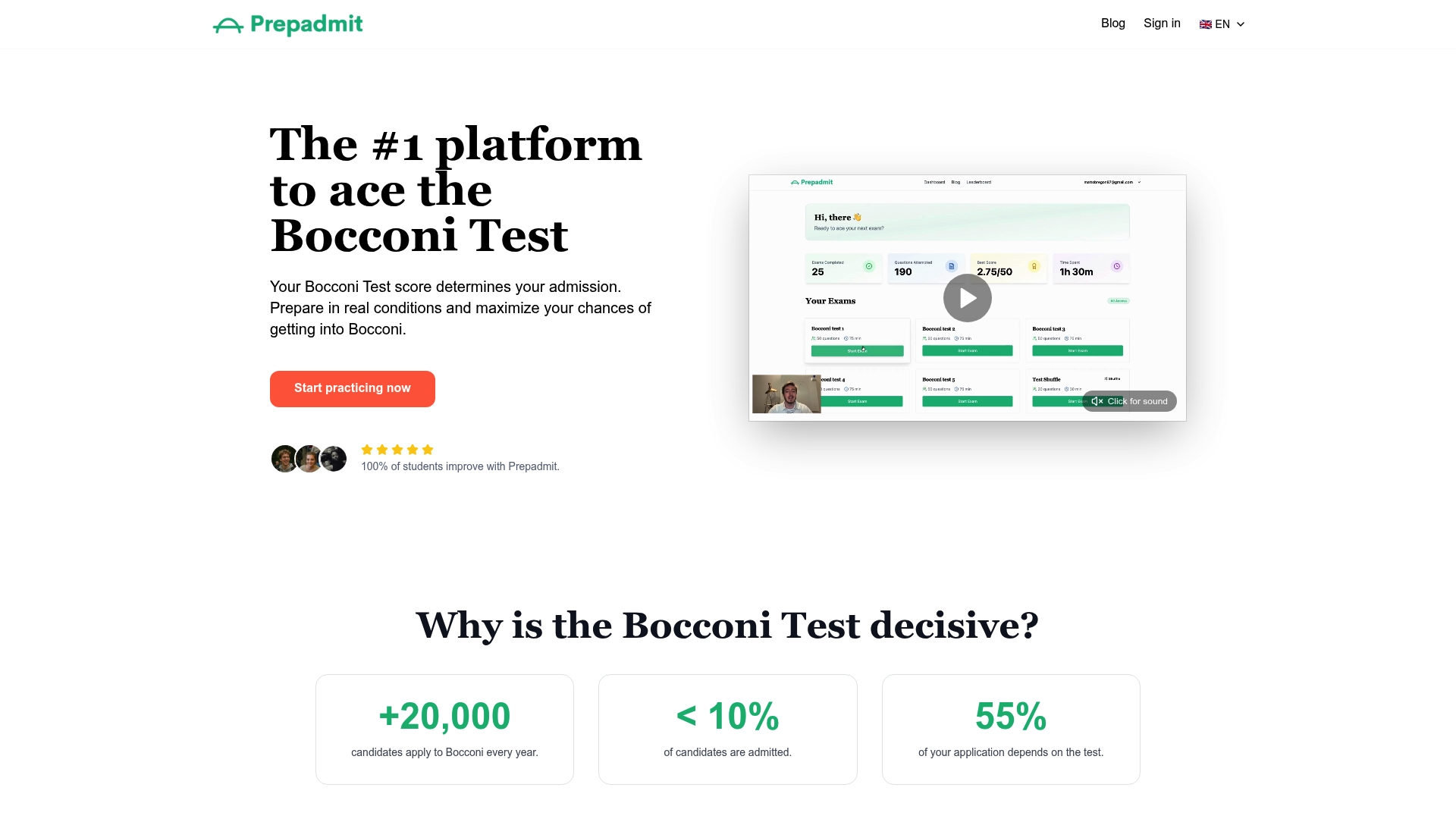
- Exam-style simulations that mirror the real test’s question style and difficulty.
- Sequential navigation mode that trains no-return pacing similar to the test environment.
- Targeted technique drills, detailed answer corrections, and progress dashboards to help identify error categories to focus on.
Start with the official sample for style, then use an online preparation platform for volume, weak-area drills, and measurable progress. Access the full preparation when you are ready to move from scattered review to structured, timed practice.
For a workflow that pairs structured drilling with AI-assisted recall, some applicants also use tools like the ones covered in this AI exam preparation overview alongside timed mock sessions.
FAQ
How many math questions are on the Bocconi Online Test?
The math section typically includes about 24 questions out of the 50 total questions on the Bocconi Online Test. The full test runs 75 minutes across mathematics, reading comprehension, numerical reasoning, and critical thinking sections.
Can you go back to a previous question on the Bocconi test?
No. The Bocconi Online Test uses sequential navigation with three questions per screen, and once you move forward, you cannot return to a previous screen. This makes final-answer confidence more important than it would be on a test that allows free navigation.
What is the best way to practice Bocconi word problems?
Start with the official sample test to learn the style and navigation, then move to timed simulations that enforce the same sequential format. Our platform at Prepadmit is built specifically for this kind of structured, timed, sequential drilling.
What technical setup does the Bocconi test require?
The test requires a lockdown browser along with a camera and room scan, as outlined in the official Instructions and Rules of Conduct. Testing your setup in advance and confirming your connection avoids delays on test day.
How soon do you get Bocconi test results?
Score reports become available within 48 hours through the webtesting platform, according to the official Instructions and Rules of Conduct. The report includes a subject-area breakdown along with counts of correct, omitted, and incorrect answers.
Recommended
Related articles
Ready to ace your admission test?
Discover PrepAdmit, the platform that helps you succeed at top university admission tests.
Discover PrepAdmit