Bocconi Math Exercises: Targeted Drills and Timed Mocks

Bocconi Math Exercises: Targeted Drills and Timed Mocks
Start with algebra, functions, and analytic geometry drills today. These three topics carry the heaviest weight in the mathematics section (the largest section of the test) of the Bocconi Test, and targeted practice there moves your score faster than anything else.
Here are four actions to take right now:
- Targeted drill: Pick one topic (start with algebra) and complete a focused 10-question set timed at 9 minutes.
- Timed mini-test: Run a 24-question math-only mock in 36 minutes to simulate real section pressure.
- Error log: After every session, write down each wrong answer, its topic, and why you missed it (concept gap, careless error, or time pressure).
- Re-drill: Within 24 hours, redo a fresh set of 5 questions on every topic you logged.
The test is multiple-choice questions in a limited time period. Math is the largest section at 24 questions. Getting math right is the single highest-leverage move available to you.
Key Takeaways
Targeted math practice across all 12 official topics, combined with weekly timed mocks and a disciplined error-review cycle, is the most reliable way to raise your Bocconi Test score.
| Point | Details |
|---|---|
| Math is the largest section | 24 of 50 questions are math; gains here move your total score the most. |
| Prioritize algebra and functions | These topics appear most heavily; start every week’s drills with them. |
| Wrong answers cost points | A −0.2 penalty applies; skip questions you cannot partially eliminate. |
| Error classification beats volume | Sort mistakes into concept gaps or careless errors and drill the fix within 24 hours. |
| Prepadmit for structured mocks | Official-format simulations and per-topic analytics replace guesswork with a clear improvement path. |
Table of Contents
- What does the Bocconi math test actually look like?
- Which math topics should you drill for the Bocconi Test?
- How to run effective timed practice sessions
- Worked examples with step-by-step solutions
- A 4-week study plan you can follow right now
- Where to find Bocconi math exercises and build your own sets
- What actually separates students who improve from those who plateau
- Prepadmit gives you official-format mocks and targeted corrections in one place
- Sources
What does the Bocconi math test actually look like?
The Online Bocconi Test is 50 multiple-choice questions completed in 75 minutes, with no per-section timer. Mathematics accounts for 24 of those questions, making it the dominant section by a wide margin.
24 out of 50 questions are math. Concentrated gains in math accuracy produce the largest point improvements of any section on the test.
Three question types appear inside the math section. Standard numeric problems ask you to compute or manipulate an expression directly. Data-sufficiency items present a question followed by two statements, A and B; your task is to decide which statement or combination is sufficient to answer the question, without necessarily solving it fully. Table and graph reading questions require careful attention to the data presented rather than heavy calculation.
Scoring carries a penalty: wrong answers carry a small penalty, so random guessing is not a safe strategy. Leave a question blank if you cannot eliminate at least two options. With no section timer, you control pacing across all 50 questions, which means a disciplined two-pass strategy (easy questions first, return to harder ones) is worth practicing explicitly.
For a full breakdown of recent format changes, the Bocconi Test Format 2026 guide covers what shifted and how to adjust your preparation.
Which math topics should you drill for the Bocconi Test?
The official Bocconi mathematics syllabus covers 12 primary topic areas. Algebra and functions consistently appear most heavily across sample distributions and deserve the most practice time.
- Algebra (high priority): equations, inequalities, systems. Drill: solve 5 mixed equations in 8 minutes. Sample: Solve for x: 2x² − 5x + 2 = 0.
- Functions (high priority): domain, range, composition, inverse. Drill: sketch and analyze 3 function graphs in 10 minutes. Sample: For f(x) = √(x − 3), what is the domain?
- Analytic geometry (high priority): lines, parabolas, circles, intersections. Drill: find the intersection of a line and parabola in under 5 minutes. Sample: Where does y = x + 1 meet y = x²?
- Logarithms and exponentials: log rules, exponential equations. Drill: 5 log equations in 8 minutes. Sample: Solve log₂(x) + log₂(x − 2) = 3.
- Trigonometry: sin, cos, tan values, identities, equations. Drill: 4 trig equations in 7 minutes.
- Plane geometry: area, perimeter, similar triangles, circles. Drill: 4 geometry problems in 8 minutes.
- Discrete math and combinatorics: permutations, combinations, counting principles. Drill: 4 counting problems in 6 minutes.
- Probability: basic probability, conditional probability, independent events. Drill: 3 probability problems in 6 minutes.
- Statistics: mean, median, mode, standard deviation. Drill: 3 data-set problems in 5 minutes.
- Sets: union, intersection, complement. Drill: 3 Venn diagram problems in 5 minutes.
- Numbers and unit conversions: percentages, ratios, proportions. Drill: 5 percentage problems in 6 minutes.
- Problem solving: multi-step word problems combining several topics. Drill: 2 word problems in 8 minutes.
How to run effective timed practice sessions
Setting up a realistic simulation
Replicate test conditions precisely. Use a single device, no calculator (check the official calculator rules before your first mock), no interruptions, and a visible countdown timer. For a full mock, set 75 minutes for 50 questions. For a math-only drill, set 36 minutes for 24 questions.

Data-sufficiency tactics
Data-sufficiency items reward methodical statement testing rather than full solutions. Work through this sequence: read the question stem and identify exactly what information would answer it; test statement A alone; test statement B alone; then test both together only if neither alone is sufficient. Stop as soon as you reach a conclusion. Solving the problem fully wastes time and is never required.
Error review cycle
| Error type | Cause | Corrective action |
|---|---|---|
| Concept gap | Missing formula or rule | Review the concept, then redo 3 fresh items |
| Careless error | Arithmetic or sign mistake | Slow down on that step; add a check step |
| Time pressure | Ran out of time | Practice that topic in shorter timed sets |
Pro Tip: Log every wrong answer immediately after a session. Classify it in under 30 seconds using the three categories above. Then schedule the corrective drill for the next day, not the same session.
Worked examples with step-by-step solutions
Algebra: quadratic equation
Solution: Use the quadratic formula: x = (7 ± √(49 − 24)) / 4 = (7 ± √25) / 4 = (7 ± 5) / 4. So x = 3 or x = 0.5.
- Common mistake: Forgetting to divide the full numerator by 2a, not just the discriminant. Write the full fraction before simplifying.
Functions: graph reading
Problem: A graph shows f(x) = x² − 4. For which values of x is f(x) < 0?
Solution: Set x² − 4 < 0, so x² < 4, meaning −2 < x < 2.
- Common mistake: Reading the graph visually and guessing the interval instead of translating the graph condition into an inequality and solving it algebraically.
Analytic geometry: line meets parabola
Using the quadratic formula: x = (2 ± √8) / 2 = 1 ± √2. The two intersection points are x = 1 + √2 and x = 1 − √2.
- Common mistake: Stopping after finding x values and forgetting to substitute back to find the y coordinates when the problem asks for the full coordinates.
Data-sufficiency: divisibility
Problem: Is integer n divisible by 6? (A) n is divisible by 2. (B) n is divisible by 3.
Solution: Statement A alone: not sufficient (n = 4 is divisible by 2 but not 6). Statement B alone: not sufficient (n = 9 is divisible by 3 but not 6). Both together: sufficient, because divisibility by both 2 and 3 guarantees divisibility by 6. Answer: both statements together are sufficient.
- Common mistake: Concluding from statement A alone that n could be divisible by 6, without testing a counterexample.
A 4-week study plan you can follow right now
This plan follows the recommended approach of combining topic drills with weekly full mocks. Adjust the pace if your test date is closer.
- Week 1: Algebra and functions. Daily 30-minute drills on algebra and functions. End the week with one 24-question timed math mock. Log all errors and classify them.
- Week 2: Geometry, trigonometry, and logs. Daily 30-minute drills on analytic geometry, trigonometry, and logarithms. End the week with a second 24-question math mock. Compare accuracy per topic against week 1.
- Week 3: Mixed timed practice. Daily 45-minute sessions mixing all 12 topics. Run two full 50-question mocks this week, spaced at least 3 days apart. Focus on pacing: first pass for easy questions, second pass for harder ones.
- Week 4: Full mocks and targeted re-drills. Run a full mock every other day. On non-mock days, drill only the topics where your accuracy is below 70%. Track average time per question and aim for under 90 seconds per math item.
Progress checkpoint: after each mock, calculate accuracy per topic and average time per question.
Where to find Bocconi math exercises and build your own sets
The highest-value source is Bocconi’s own official download area, which provides sample tests and short exercises that match real test-style items. The official sample PDF includes worked solutions alongside standard and data-sufficiency questions.
To build a realistic 24-question math practice set, use this distribution as a starting point:
For each session: select questions, set a timer, work in silence, then review every wrong answer before moving on. Numerical reasoning items with tables and graphs reward careful reading over calculation speed, so include at least two per practice set.
What actually separates students who improve from those who plateau
Most students practice math for the Bocconi Test by doing lots of questions. That is not wrong, but it is incomplete. The students who improve fastest are the ones who treat every wrong answer as a data point, not a setback.
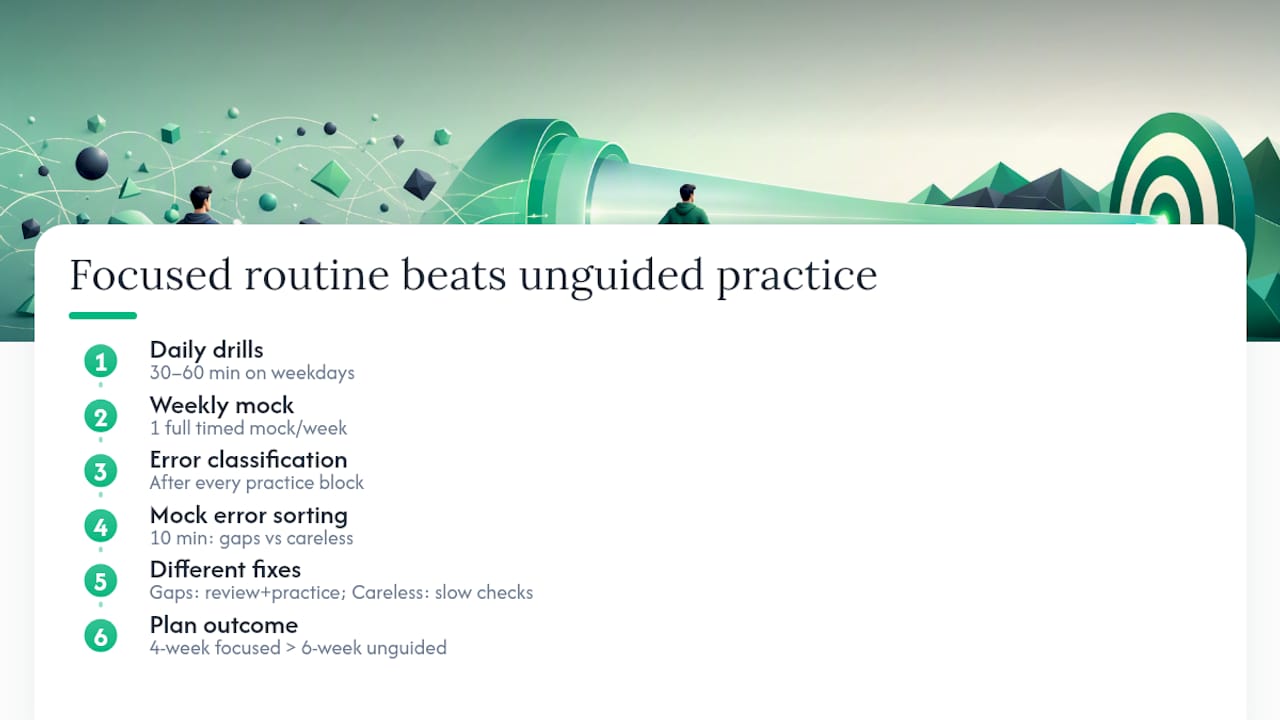
The routine that works is simple: 30 to 60 minutes of focused drills on weekdays, one full timed mock per week, and an error classification session after every practice block. The classification step is what most students skip. Without it, you repeat the same mistakes across sessions and your score stalls.
One habit worth building early: after each mock, spend 10 minutes sorting your errors into concept gaps versus careless mistakes. Concept gaps need review and fresh practice. Careless mistakes need a slower, more deliberate check step on that specific calculation type. Treating both the same way wastes time and misses the actual fix.
Persistence matters, but direction matters more. A focused 4-week plan with weekly mocks and daily error review will outperform six weeks of unguided question sets every time.
Prepadmit gives you official-format mocks and targeted corrections in one place
Structured practice is faster than assembling your own sets from scratch. Prepadmit is built specifically for the Bocconi Test: it offers official-format 50-question simulations, skill-specific drills for each of the 12 math topics, step-by-step answer corrections, and a progress dashboard that shows your accuracy per topic and average time per question.

Inside the 4-week plan above, Prepadmit fits naturally: use the skill drills for weeks 1 and 2, switch to full mocks in weeks 3 and 4, and use the analytics to decide which topics need extra drill time. The platform was developed by experts with HEC and Bocconi backgrounds, and it costs a fraction of private coaching.
Start your Bocconi math preparation on Prepadmit and run your first official-format simulation today.
Sources
- Online Bocconi test | Bocconi University
- Bocconi Test Mathematics: Full Syllabus, Formulas & Study Plan
Recommended
- Bocconi Test Prep — Official Practice Exams & Score Booster | Prepadmit
- Bocconi Test Simulation: What a Real Mock Looks Like (2026) — PrepAdmit Blog
- Role of mock exams in test success for Bocconi aspirants — PrepAdmit Blog
- How to Prepare for the Bocconi Test: A Step-by-Step 2026 Guide — PrepAdmit Blog
Related articles
Ready to ace your admission test?
Discover PrepAdmit, the platform that helps you succeed at top university admission tests.
Discover PrepAdmit