Beat the Clock on Bocconi Mental Math: 75 Minutes, No Going Back

Beat the Clock on Bocconi Mental Math: 75 Minutes, No Going Back
For Bocconi quantitative questions, the fastest route to improvement is focused mental-calculation drills paired with regular 75-minute timed simulations. The Bocconi online test rewards speed and triage more than advanced math, and we built our practice system around that reality.
TL;DR:
- The test lasts 75 minutes and has 50 multiple choice questions, shown three per screen; advancing permanently closes earlier questions.
- Prioritize percentages, ratios, unit conversions, basic algebra, and chart reading; train in 30 to 60 second bursts, checking labels and units before calculating.
- Schedule daily 10 to 30 minute drills, two to three mixed sessions weekly, and a full 75 minute mock followed by error review.
- Aim for roughly 90 seconds per question, but if an unfamiliar problem remains unclear after 20 seconds of reading, make your best guess and move on.
Table of Contents
- What the Bocconi quantitative and numerical sections actually test
- Core mental-calculation techniques to learn and drill
- A 2-week and 4-week timed drill plan
- Worked example problems you can try right now
- Running realistic simulations and reading your score report
- Why realistic simulation plus targeted drills works
- What actually moves your score
- How we help you practice for the Bocconi test
- FAQ
- Sources
What the Bocconi quantitative and numerical sections actually test
The Bocconi online test runs 75 minutes and includes 50 multiple-choice questions spread across quantitative, verbal, numerical reasoning or data insight, and critical thinking areas. Numerical reasoning and data insight items typically ask you to reason with tables and charts rather than solve complex equations, so the real challenge is finding the relevant number fast, not computing it.
For mental-calculation training, prioritize:
- Percentages, including percent-of and percent-change problems.
- Ratios and proportional reasoning.
- Unit conversions between currencies, measurements, or time.
- Basic algebra manipulations, like solving for a single variable quickly.
- Table and graph interpretation, including spotting irrelevant rows or columns.
Scoring and navigation rules shape how you should practice, not just what. The official rules of conduct confirm that questions appear three per screen and you cannot return to a previous screen once you move forward. That constraint means guessing strategy and time allocation matter as much as raw calculation skill, because a skipped question is gone for good.
Core mental-calculation techniques to learn and drill
A handful of techniques cover most of what shows up on test day. Learn these first, then drill each one until it feels automatic.
- Decomposition: Break a number into friendlier parts before multiplying or adding. For example, 48 x 7 becomes (50 x 7) minus (2 x 7).
- Multiplication shortcuts: Use the nine-times trick (multiply by 10, then subtract the original number) and doubling or halving to simplify awkward factors.
- Fast percentage methods: Find 10% first, then scale up or down. For percent change, estimate the difference as a fraction of the original value before converting.
- Fraction-decimal conversions: Memorize common equivalents (1/8 = 0.125, 3/4 = 0.75) so you can switch formats without pausing.
- Bounding and rounding: Round inputs to eliminate answer choices before computing an exact figure, especially on multiple-choice items where close answers rarely both survive rounding.
Table and graph questions need a different kind of shortcut. Check units before you touch numbers: a chart in thousands behaves very differently from one in millions. Scan column and row labels first, then decide which cells actually matter, since many data-insight questions include extra information designed to slow you down.
Pro Tip: Practice in 30 to 60 second bursts per question, then gradually mix in short data-interpretation items so your brain shifts between pure calculation and reading comprehension without losing speed.
For more worked drills built around these exact shortcuts, our Bocconi math exercises page walks through timed practice sets.
A 2-week and 4-week timed drill plan
Structure beats intensity here. A short, consistent routine builds automaticity faster than occasional long study sessions.
Daily micro-drills, 10 to 30 minutes:
- Day type A: 15 minutes of percentage and ratio problems, timed at 30 seconds each.
- Day type B: 15 minutes of table-reading questions, focused on identifying relevant cells quickly.
- Day type C: 20 minutes mixing both question types to simulate the test’s unpredictability.
Weekly structure:
- Two to three short mixed drill sessions, 20 to 30 minutes each.
- One full 75-minute mock under realistic conditions.
- A brief review session the day after each mock, focused on error patterns rather than content.
In a 2-week plan, front-load technique drills in week one and shift to full mocks plus review in week two. A 4-week plan adds a second mock in week three and a lighter, confidence-building week four with shorter sets and no new material.
Inside each mock, set a rough target of 90 seconds per question and decide in advance when to skip. If a question looks unfamiliar after 20 seconds of reading, mark your best guess and move on, since the test’s no-return rule means hesitation costs more than a wrong answer.

Worked example problems you can try right now
These mirror the format and difficulty of real Bocconi quantitative items. Work through them mentally before checking the solution.
- A product costs $80 and is discounted by 15%. Find 10% ($8), then half of that for 5% ($4), subtract both from $80: $68.
- A ratio of 3:5 represents 240 units total. Divide 240 by 8 (the sum of parts) to get 30, then multiply by 3 for the first group: 90.
- Convert 2.5 hours into minutes and find 20% of that value. 2.5 hours is 150 minutes; 20% of 150 is 30.
- A table shows quarterly revenue rising from 120 to 150. The percent increase is (150 minus 120) divided by 120, or 25%.
- A graph lists five regions by sales volume, but the question asks only about the two smallest. Scan the labels first, isolate the two lowest bars, then compare only those values instead of calculating all five.
That last example shows the core data-insight skill: eliminate irrelevant rows before doing any arithmetic. When a worked problem feels slow the first time, turn it into a repeatable drill rather than moving on, since repetition under time pressure is what builds speed. Our worked Bocconi exercises and mock plan page includes a fuller set with step-by-step breakdowns.
Running realistic simulations and reading your score report
A simulation only helps if it matches real test conditions. Set up a quiet space, use a working webcam, and commit to the full 75 minutes without pausing, since the official test rules describe a three-questions-per-screen layout with no return to earlier screens, and the platform may request additional recordings during a session.
Checklist for a realistic mock:
- Full 75 minutes, no breaks, no backtracking once a screen advances.
- Three questions per screen, matching the real layout.
- Score reports become available within 48 hours, so build review time into your schedule.
When your report arrives, separate mistakes into three categories: concept gaps, calculation slips, and time-pressure errors where you knew the method but ran out of time. Pick one drill per recurring category, practice it for a few days, then retest on similar items.
Pro Tip: Treat omitted questions as their own category. A high omission count usually points to pacing problems, not knowledge gaps.
Why realistic simulation plus targeted drills works
Preparation experts consistently recommend full-length timed simulations paired with focused error analysis, and that combination is what our own platform is built around. We offer official past papers, skill-specific drill modes, and a progress-tracking dashboard, and we report an average score improvement of 34% among students who use the system consistently. Each feature maps directly to a recommendation above: timed mocks build pacing instinct, drill modes build the specific techniques, and the dashboard turns error patterns into a concrete study plan.

What actually moves your score
The biggest misconception we see is that students treat the calcolo mentale section as a math problem to solve with better formulas. It is really a speed and triage problem. Most applicants already know the arithmetic; what separates a strong score from an average one is how fast they recognize which shortcut applies and how quickly they decide to skip a question that is not worth the time.
Conventional advice tends to overemphasize content review, long study sessions covering every possible topic, when the test rarely asks for anything beyond percentages, ratios, and basic table reading. That advice wastes hours on material that rarely appears.
If we had to pick one priority, it would be this: spend more time on timed, mixed drills than on untimed topic review, and consider taking a career strengths assessment quiz to align your skills with your study focus. Automaticity under pressure is the skill being tested, and it only develops under the same pressure you will face on test day.
— quentin
How we help you practice for the Bocconi test
We give you realistic, timed simulations built on official past papers, so your practice matches the actual test format down to the screen layout.
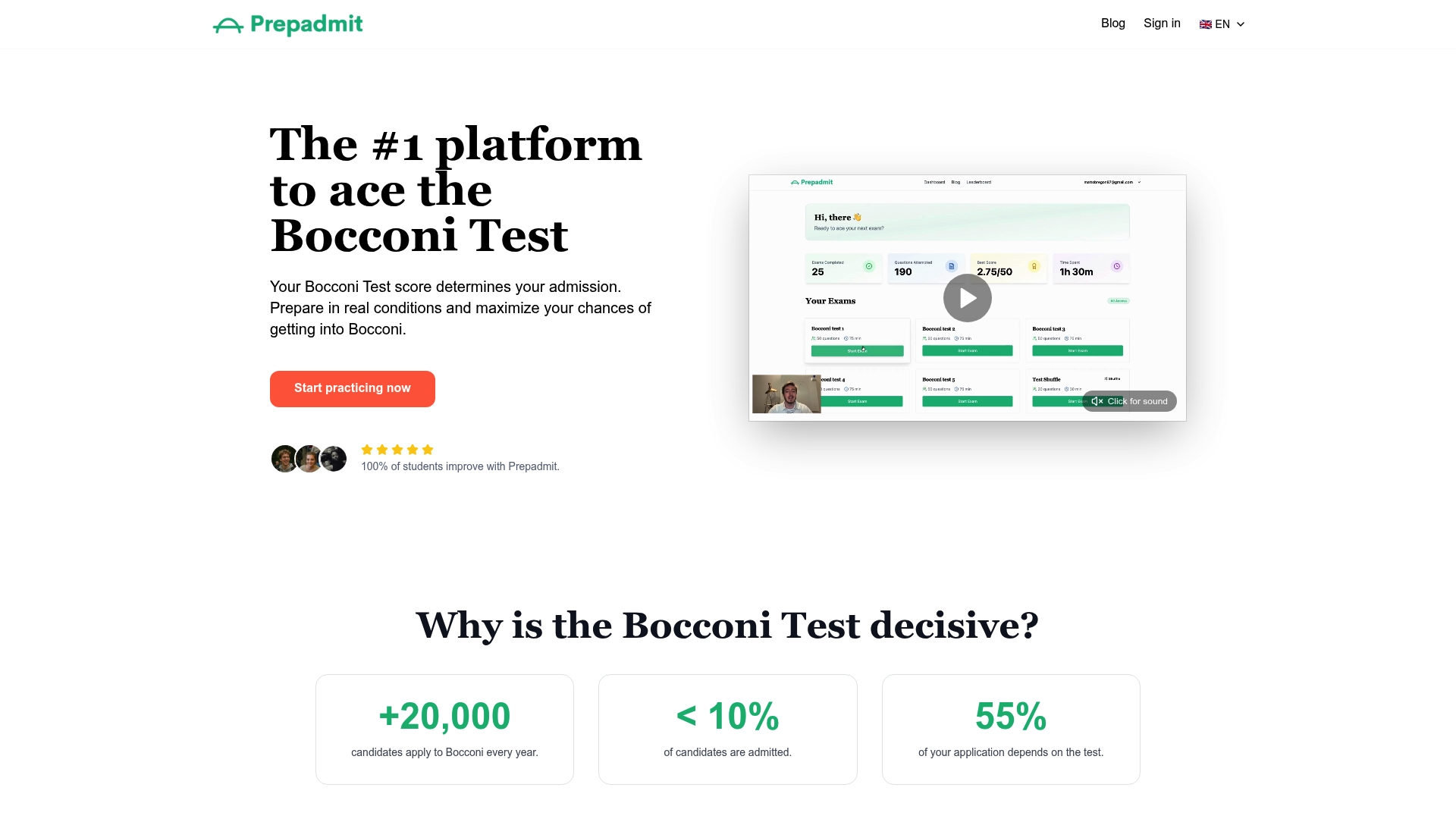
Three things set our platform apart for this kind of prep: full 75-minute mocks that mirror real timing, skill-specific drill modes for the exact techniques covered above, and a progress dashboard that turns your mistakes into a targeted study plan. We also back the platform with a money-back guarantee. If you are ready to put a real plan behind your practice, you can access the full preparation today.
| What you need | How we address it |
|---|---|
| Realistic timing | Full 75-minute simulations with official past papers |
| Targeted skill drills | Skill-specific practice modes for calculation and data reading |
| Progress tracking | Error-analysis dashboard and peer ranking |
FAQ
When is the early test for Bocconi admission held?
Bocconi publishes its testing windows directly on its official admissions pages, and exact dates shift by year and program. Check the Bocconi online test page for the current schedule before planning your study timeline.
How can you train mental math for a timed test?
The most effective approach combines short daily drills, 10 to 30 minutes on specific techniques like percentages and decomposition, with weekly full-length timed mocks. Preparation guidance consistently points to this mix of targeted practice and realistic simulation as the fastest way to build speed.
What score do you need on the Bocconi test to gain admission?
Scoring thresholds and requirements vary by program and are set directly by Bocconi, so the only reliable source is the university’s own admissions pages for your specific course. We recommend checking the official program page you are applying to rather than relying on a general figure.
How much does the Bocconi entrance test cost?
Bocconi sets and publishes its own test registration fees directly on its admissions pages, so costs vary by program and testing session. For preparation costs, access to our full practice platform is available through our product page, where pricing details are listed.
Recommended
Related articles
Ready to ace your admission test?
Discover PrepAdmit, the platform that helps you succeed at top university admission tests.
Discover PrepAdmit