55/45 Rule: Convert Your Bocconi Test Into an Admission Benchmark

55/45 Rule: Convert Your Bocconi Test Into an Admission Benchmark
The admission composite is primarily based on selection test performance and school record, with the test weighted more heavily. A Bocconi online test score below the minimum eligibility threshold makes you ineligible regardless of your GPA, as do correspondingly low SAT or ACT scores. Check your test report and third-last/second-last year grades now against these thresholds before you plan anything else.
TL;DR:
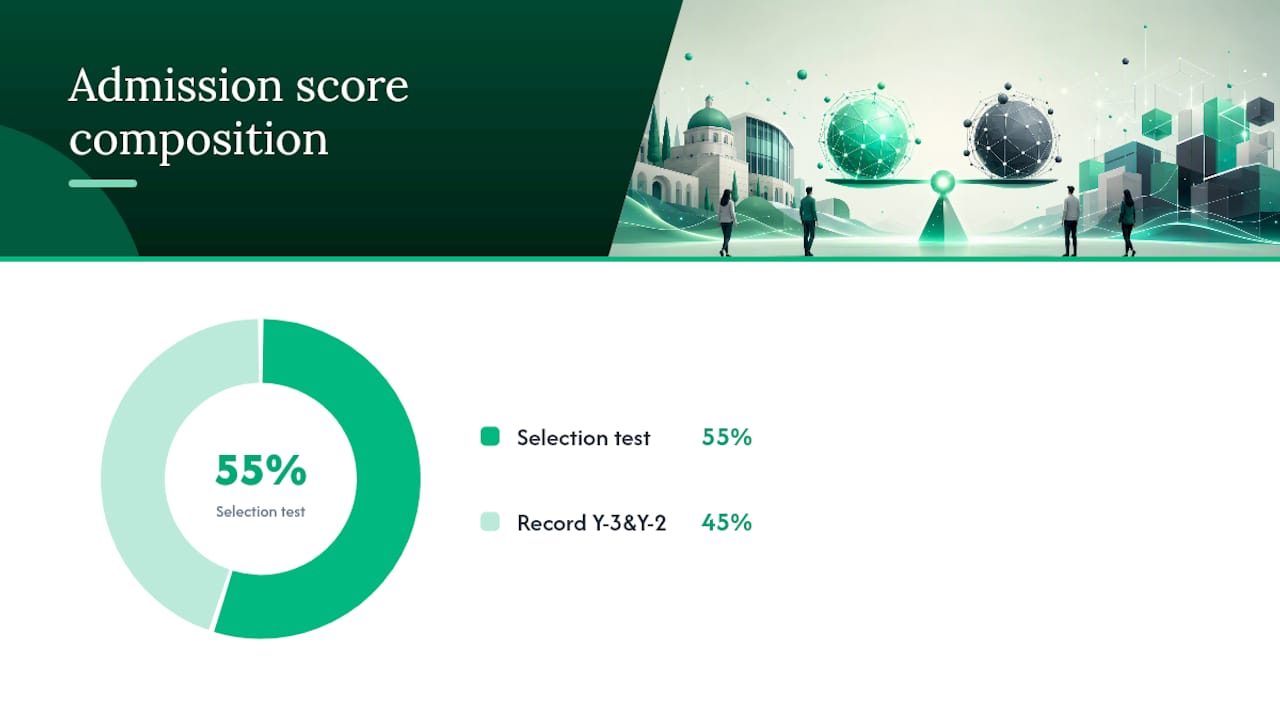
- The final admission score combines 55% test performance and 45% GPA from the last two years of secondary school, normalized for different grading systems.
- Bocconi does not publish its SAT or ACT conversion table; percentile rank and internal scoring methods determine the composite, making precise cross-test conversion unreliable.
- High-demand programs often need scores in the upper range of the typical applicant pool, with minimum thresholds serving only as eligibility lines, not as competitive benchmarks.
- Targeted preparation focusing on weak sections, timed practice, and understanding your score report can significantly improve chances of reaching the desired admission band.
Table of Contents
- How Does Bocconi Calculate the Admission Score?
- What Are the Minimum Score Thresholds for Admission?
- How Is the Bocconi Test Scored?
- How Does Bocconi Rank Applicants and Fill Seats?
- How Do You Turn Your Test Report Into a Realistic Benchmark?
- What Prepadmit’s Practice Data Shows About Closing the Gap
- Why Most Applicants Misjudge Their Own Chances
- Ready to Close the Gap Between Your Score and the Benchmark?
- Sources
How Does Bocconi Calculate the Admission Score?
Bocconi builds every applicant’s final admission score from two components, weighted 55% for the selection test and 45% for the school record, according to the university’s own admissions page. The school record covers your grades from the third-to-last and second-to-last years of secondary school, not your final year. That detail catches a lot of applicants off guard. Your senior year performance matters for graduation, but it doesn’t touch this particular calculation.
If you submit multiple test results, either two attempts at the online Bocconi test, or a mix of the online test with an SAT or ACT score, Bocconi considers the highest overall composite, not the highest raw test score in isolation. The university also runs an internal equalization process across the SAT, ACT, and its own online test, using conversion tables and percentile analysis rather than a fixed public formula, a point worth flagging because Bocconi’s own SAT and ACT guidance confirms the tables aren’t published in full. That means chasing a precise cross-test conversion is largely a guessing game. Your energy is better spent maximizing performance on whichever test you’ve already committed to.
Here’s how the math actually works, step by step:
- Take your raw test score (for example, 38 out of 50 on the online Bocconi test).
- Convert your GPA from the relevant two years into whatever standardized scale your school uses, since Bocconi normalizes different national grading systems into a comparable metric.
- Multiply your test performance by 0.55 and your normalized GPA score by 0.45.
- Add the two weighted figures together to get your estimated composite.
A student scoring 38/50 on the test with a strong two-year GPA equivalent to roughly 90% might land a composite somewhere in the mid-to-high range relative to peers, but the exact number depends entirely on how Bocconi’s internal scale treats that raw score that year. Alphatest’s breakdown of the calculation walks through similar worked examples if you want a second reference point.
One caveat matters more than any other: Bocconi does not publish the exact conversion table it uses to translate SAT or ACT scores into its internal scale. Percentile rank against other test takers plays a role, which is why two students with identical SAT totals from different testing years could theoretically land slightly different equalized scores. Treat any online “converter” you find with skepticism; only Bocconi’s internal process decides the final number.
What Are the Minimum Score Thresholds for Admission?
Fall below certain thresholds and your application gets excluded before the ranking process even starts, no matter how strong your grades are. Bocconi publishes these floors clearly on its HEC-Bocconi Double Degree admissions page, and they apply broadly across programs.
- Online Bocconi test: below 17/50 means automatic ineligibility.
- SAT: total score below 1,040, or a section score below 520 in either Evidence-Based Reading and Writing or Math, disqualifies the application.
- ACT: a composite below 19 is not considered.
- Program-specific minima: some tracks set higher bars. The Artificial Intelligence program, for instance, requires a higher SAT Math threshold (600) than the general minimum.
These are floors, not targets. Meeting the bare minimum on the online test or the SAT doesn’t put you in contention for a seat, it just keeps your application in the pool. A 17/50 clears the eligibility bar but sits well below what most admitted students actually score. Think of these numbers as the line between “considered” and “rejected outright,” not as a benchmark to aim for.
How Is the Bocconi Test Scored?
The online Bocconi test runs 50 multiple-choice questions covering math, verbal reasoning, numerical reasoning, and critical or logical thinking, split across several timed sections, according to Bocconi’s own test structure page. The exact mix of question types shifts slightly by year, but the scoring rules are fixed and worth memorizing before you sit the test.
- Correct answers earn positive points.
- Omitted answers do not affect the score.
- Wrong answers cause a small penalty, with a larger penalty on certain critical thinking questions with fewer options.
That asymmetry changes your guessing math. On a three-option critical thinking item, the odds shift again since a wrong guess costs more per miss. Blind guessing rarely pays off, but educated guessing, where you’ve eliminated at least one or two options, usually still beats leaving a question blank.
Some programs have additional section minimum scores that applicants must meet, such as a higher math score requirement for the Artificial Intelligence track.
Pro Tip: Don’t spread your review time evenly across every section. If your target program has a published section minimum, drill that section until you can clear it comfortably, then spend remaining time on your weakest area overall.
How Does Bocconi Rank Applicants and Fill Seats?
Admission isn’t pass or fail against a fixed score. It’s a ranking exercise. Bocconi orders every eligible applicant by composite score within each program and admits from the top down until seats run out, a mechanism confirmed on the university’s application and admissions overview. That means your actual cutoff shifts every year based on who else applied and how they scored, not on some fixed passing grade.

Scale matters here. Bocconi’s total undergraduate intake consists of several thousand places across programs for the 2027-2028 cycle, with typical class sizes usually exceeding one hundred students, though this varies by program., per the university’s admissions data. A program with 115 seats and 2,000 applicants behaves very differently from one with 115 seats and 600 applicants, even if both publish the same 17/50 minimum.
Rough benchmark bands, based on how competitive different tracks tend to run:
| Ambition level | Online test score range | What it signals |
|---|---|---|
| Conservative (meets minimum) | Low range scores | Eligible, but likely below the competitive range for high-demand programs |
| Realistic (mid-pack) | Moderate range scores | Competitive for most programs with average GPA support |
| Ambitious (top-tier) | High range scores | Strong positioning even for the most oversubscribed tracks |
- Identify how many seats your target program offers relative to typical applicant volume.
- Treat high-demand programs as requiring scores in the upper band, not the middle.
- Remember that clearing the minimum threshold only guarantees consideration, never a seat.
How Do You Turn Your Test Report Into a Realistic Benchmark?
Your Bocconi test report gives you more than a single number. It breaks down your total score, your performance by subject area, and your counts of correct, wrong, and omitted items, as detailed on Bocconi’s test information page. Reading that report properly is the fastest way to figure out where you actually stand.
- Convert your raw score into context. Note your total out of 50, then check it against the minimum threshold and the realistic band for your target program.
- Combine it with your GPA. Apply the 55/45 split from your test score and your normalized third-last/second-last year grades to estimate your composite.
- Compare against benchmark ranges. Line your estimated composite up against the conservative, realistic, and ambitious bands for your specific program, not a generic average.
- Identify your weakest section. Use the correct/wrong/omitted breakdown to see whether a single section is dragging your total down, since fixing one weak area often moves your score faster than broad review.
If you’re sitting in the conservative band, aim to raise your raw score by at least 8 to 10 points before a retake, focusing on whichever section your report flags as weakest. If you’re already in the realistic band and targeting a competitive program, closing the gap to the ambitious band usually means tightening accuracy rather than attempting harder material. Retakes are worth it when your report shows a specific, fixable pattern (say, consistently missing numerical reasoning items). They’re less worth it if your score is already solid and your GPA is the weaker half of the equation, in which case dossier strength deserves more of your attention.
Pro Tip: Track your omitted-answer count across practice sessions. A high number of blanks usually means timing problems, not knowledge gaps, and that’s a fixable issue with timed practice rather than more content review.
What Prepadmit’s Practice Data Shows About Closing the Gap
Prepadmit built its platform around the exact benchmarks covered above: realistic timed simulations using official past papers, skill-specific drills for weak sections, progress tracking, and peer-ranking dashboards so you can see where your score sits against other applicants. Students who follow a structured plan under Prepadmit reports meaningful average score improvements, a signal that targeted section work moves raw scores meaningfully. A typical prep window runs four to six weeks before a retake, split between full simulations and focused drills on the sections your report flags as weakest.
Why Most Applicants Misjudge Their Own Chances
Applicants consistently overestimate the value of guessing and underestimate how much weight the GPA component carries. A student who nails 45/50 but has a mediocre two-year academic record often ends up ranked lower than they expect, because that 45% curriculum weight isn’t a rounding error, it’s nearly half the composite. Before deciding to retake the test, ask honestly whether your report shows a fixable pattern or whether your dossier needs the real attention. Timed practice under real conditions, tracked over multiple sessions, tells you far more than a single practice run ever will.
— quentin
Ready to Close the Gap Between Your Score and the Benchmark?
Once you know your target band, the real question is how fast you can move toward it. Prepadmit gives you a direct way to close that gap: full-length simulations built on official past papers, section-specific drills targeting exactly the weak spots your report reveals, and a peer-ranking dashboard so you’re not guessing where you stand relative to other applicants.

The platform comes with a money-back guarantee, so testing it against your own current benchmark carries little downside. If numerical reasoning is your weak section, Prepadmit’s dedicated numerical reasoning practice is worth starting with, and applicants weighing SAT submission can also review SAT-specific resources before deciding which test path to pursue. Start with a full simulation on Prepadmit to see your current score against the bands covered here, then build your study plan from there.
Sources
- Admissions | Bocconi University
- Test e curriculum scolastico: ecco come viene calcolato il punteggio di ammissione in Bocconi
Recommended
Related articles
Ready to ace your admission test?
Discover PrepAdmit, the platform that helps you succeed at top university admission tests.
Discover PrepAdmit