First Bocconi Diagnostic: A Weekly Plan for Busy High Schoolers

First Bocconi Diagnostic: A Weekly Plan for Busy High Schoolers
A first diagnostic is the most efficient way to begin preparing for the Bocconi test. It gives you a clear score breakdown across verbal, data insight, and quantitative reasoning, the same areas the real test covers, and shows exactly where to focus your study hours. We cover how diagnostics work, how to read the results, and how to turn them into a weekly study plan.
TL;DR:
- Use a timed full simulation for a baseline across all 50 questions; choose a sectional diagnostic when you already know which area needs work.
- Because the test supplies 55% of the admissions evaluation, track section scores, timing, and error types rather than treating one raw score as decisive.
- Devote 60–70% of focused study time to your two weakest areas, reserve 30–40% for stronger sections, and retest after 8–12 targeted hours.
- Practice with strict timing and strategic skipping, since wrong answers carry a penalty; the official test costs €60 per attempt and allows three attempts annually.
- In the final two weeks, shift toward full timed simulations to rebuild stamina for the test’s 75-minute format, rather than relying on drills.
Table of Contents
- Types of first diagnostics and why each format helps
- What a first diagnostic shows: breakdown, timing data, and peer signals
- Turn diagnostic output into a study plan: prioritized actions, weekly schedule, and retest timing
- Practical checklist to run a realistic first diagnostic
- Why Prepadmit’s diagnostic is the recommended first step
- Author’s perspective: best uses and common mistakes with diagnostics
- How to start: try our diagnostic
- FAQ
- Sources
Types of first diagnostics and why each format helps
Not every diagnostic serves the same purpose. The format you choose depends on how much time you have before the test and what you already know about your weak spots.
A timed full simulation is the closest match to the real online Bocconi test. It runs all 50 questions under the same time pressure and non-backtrackable, three-question-per-page format the official test uses. This format measures your overall readiness and tells you how you perform when the clock is running and you cannot go back to check earlier answers.
A sectional diagnostic isolates one area: verbal reasoning, data insight, or quantitative reasoning. This works well when you already suspect a weak area and want a focused read on it without spending 75 minutes on a full test. Students with limited time before a deadline often start here.
Adaptive topic drills and quick spot diagnostics suit the final stretch before test day. They surface a handful of questions on a specific skill, such as reading comprehension or ratio problems, and give you a fast signal without the time cost of a full simulation.
The scoring method matters as much as the format:
- Instant auto-scoring gives you a number right after you finish, useful for quick progress checks between study sessions.
- Diagnostics with detailed corrections show you why each answer was right or wrong, which matters more for actual improvement than the raw score.
- Full simulations with per-question timing data reveal where you lose time, not just where you lose points.
- Sectional diagnostics let you repeat a weak area multiple times in a week without the fatigue of a full test.
If you are new to the test, start with one full simulation to get a baseline. If you have already taken one and want to confirm progress on a specific area, a sectional diagnostic or topic drill is the faster choice. Either way, the goal is the same: convert a score into a plan, not just a number to compare against classmates.
What a first diagnostic shows: breakdown, timing data, and peer signals
A useful diagnostic reports more than a single score. It breaks performance down by area, tracks how you spent your time, and flags the kind of mistakes you made.
The area breakdown should mirror the real test structure: verbal reasoning, data insight, and quantitative reasoning, each scored separately. This breakdown matters because the selection test score accounts for 55% of the undergraduate admissions evaluation, with school GPA making up the remaining 45%. A weak section pulls down more than a third of your overall admissions weight, so knowing exactly where points are slipping away is worth acting on early.

Timing metrics tell you where you are losing minutes, not just points. If your quantitative section shows long average times per question compared to verbal, that section is your bottleneck, even if your quantitative score looks acceptable. Bottleneck sections eat into time you need for easier questions later in the test.
Error types separate conceptual gaps from careless mistakes. A wrong answer from a rushed misread is a different problem than one from not knowing the method, and the fix for each is different: review and slow down for the first, targeted study for the second.
- Area breakdown by section shows which of the three Bocconi test areas needs the most attention.
- Timing data flags which section is consuming disproportionate time relative to its question count.
- Error patterns separate careless mistakes from genuine knowledge gaps.
- Peer ranking and percentile data put a raw score into context against other test-takers.
A diagnostic score of 30 out of 50 can mean different things depending on the session and the group taking it, which is why Bocconi’s official guidance points candidates toward repeated practice rather than reading a single result as a fixed judgment. Progress across attempts tells you more than any one score in isolation.
Turn diagnostic output into a study plan: prioritized actions, weekly schedule, and retest timing
A diagnostic is only useful once it becomes a plan. Here is a process that converts your results into weekly actions without requiring you to give up school, sports, or sleep.
- Triage your weak areas into three tiers. Urgent: any section scoring well below your target, or one with heavy time loss. Medium: a section with a mix of conceptual and careless errors. Maintenance: a section already near your target score.
- Allocate weekly hours by tier. Based on official guidance, 60 to 70% of focused study time should go to your top two weakness areas, with the remaining 30 to 40% spent maintaining stronger sections so they do not slip.
- Mix practice types across the week. Pair timed sectional practice with untimed review sessions where you study your corrections slowly, then close the week with one mixed timed set.
- Set a retest trigger, not a calendar date. Plan to retake a full diagnostic after roughly 8 to 12 focused hours on a targeted skill, or after two weeks of mixed practice, whichever comes first.
A realistic weekly recipe for a student balancing high school coursework looks like two timed sectional drills, one review session focused on corrections, and one short topic drill, totaling roughly 4 to 6 hours. In the final two weeks before test day, shift toward full timed simulations to rebuild stamina for the 75-minute format.
Pro Tip: Keep a simple log of your diagnostic scores and timing data after each attempt, so a retest shows a trend line instead of a single number you have to interpret from memory.
Retake a full simulation when you hit a tier-one milestone, such as closing a 10-point gap in your weakest section, or when two weeks have passed without a check-in. Retesting too often without changing your study habits wastes a diagnostic slot; retesting too rarely means you might be practicing the wrong thing for weeks before you find out.

Practical checklist to run a realistic first diagnostic
A diagnostic only tells you the truth if it mimics real test conditions. The official instructions and rules of conduct lay out the technical requirements for the actual test, and matching them during practice avoids surprises later.
- Create your test account early and review the registration process for the Bocconi entrance test so booking a slot does not become a last-minute scramble.
- Confirm your device runs a compatible operating system and browser; official guidance names Chrome as the default and requires installing the exact software versions listed in your personal area, since other versions can void the test.
- Install and test the Safe Exam Browser and proctoring app ahead of time rather than on test day, since these lock down your screen and monitor the session.
- Set up your room the way you would for the real test: a quiet space, a stable internet connection, and any required devices nearby, as detailed in this pre-test device and setup checklist.
- Practice the penalty rule by timing yourself strictly and skipping questions that take too long, since the official format penalizes wrong answers and rewards strategic skipping over guessing.
On cost: the official test carries a fee of €60 per attempt, with a cap of three attempts per test type per academic year. Running a diagnostic through a practice platform before spending one of those official attempts is a lower-cost way to find out where you stand first.
If you are also researching general international curriculum support alongside Bocconi prep, resources like IB and IGCSE courses cover a different but related need for students juggling multiple academic tracks.
Why Prepadmit’s diagnostic is the recommended first step
We built our platform specifically for students preparing for the Bocconi test, with practice based on official past papers and on-demand tests that simulate real exam conditions rather than generic aptitude questions.
Our diagnostic output includes detailed answer corrections to help you understand why an answer was wrong, not just that it was wrong. We also offer skill-specific practice modes that let you drill verbal reasoning, data insight, or quantitative reasoning separately, along with progress tracking and peer ranking so you can see how a score compares to other candidates preparing for the same test. You can read more about how this structured prep and feedback system fits into a broader preparation plan.
Our content was built by people with backgrounds from institutions including HEC and Bocconi, which shapes how closely our practice questions and corrections track the real test’s style and difficulty.
Author’s perspective: best uses and common mistakes with diagnostics
A diagnostic is a tool for directing practice, not a verdict on how smart you are. Treating one result as a final judgment is the most common mistake we see: a single bad score under rushed conditions tells you less than a pattern across two or three attempts.
The second mistake is practicing without a timer, or using a calculator where the real test does not allow one. Untimed practice hides the exact problem the real test creates: pressure. If your diagnostic is not timed and does not mirror the actual rules, the skills it builds will not transfer.
Look for a trend across attempts rather than chasing one strong score. A single good result can be a lucky guess run; a repeated pattern is a skill.
— quentin
How to start: try our diagnostic
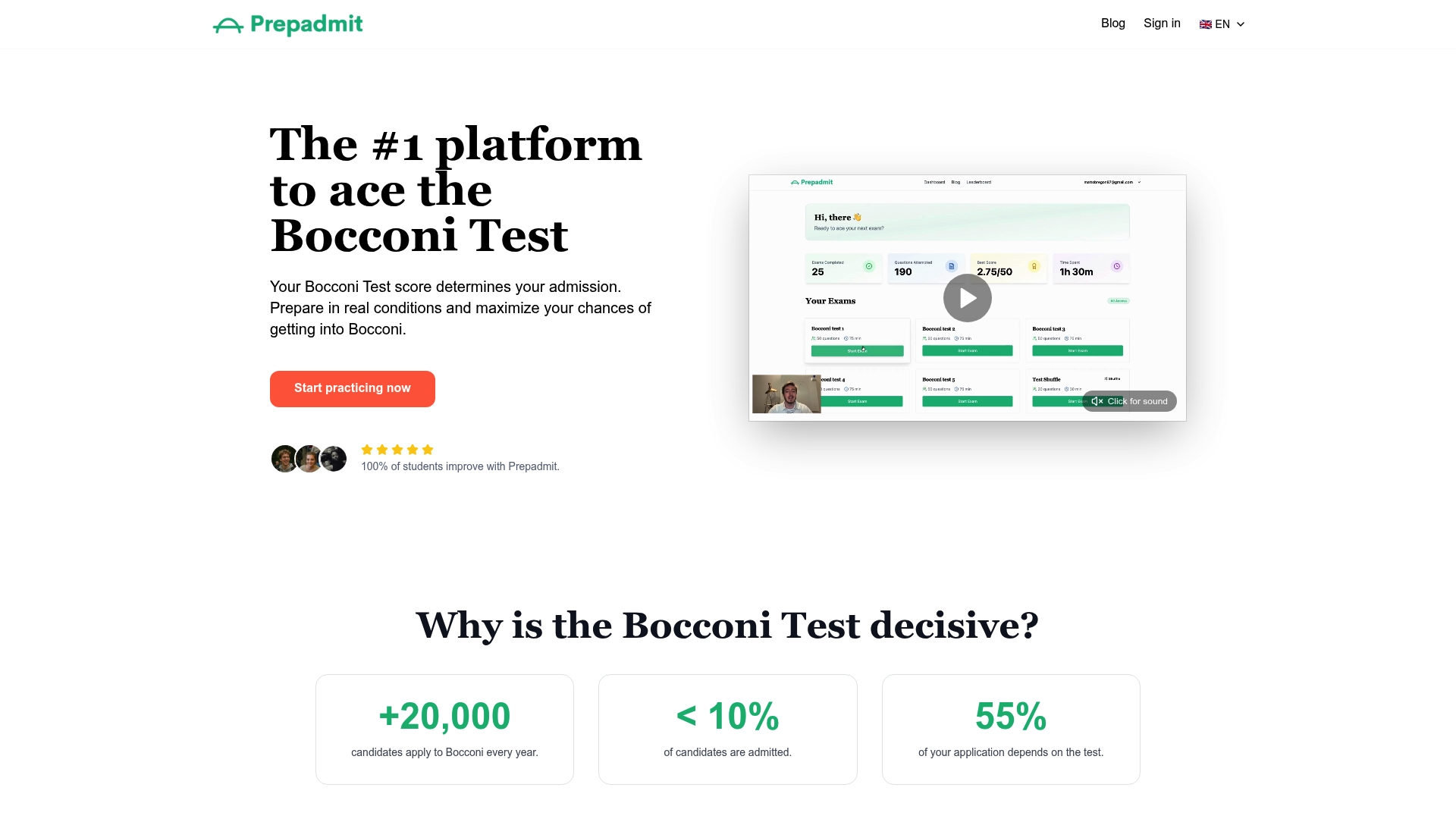
We give you an instant breakdown by area, detailed corrections on every question, and progress tracking so you can watch a trend build across attempts instead of guessing at your readiness.
- Run a first diagnostic to get your baseline across verbal, data insight, and quantitative reasoning.
- Follow the triage and weekly schedule from this guide to turn that baseline into focused study time.
- Retake a diagnostic after your first milestone to confirm the gap is closing.
Access the full preparation to get started with realistic simulations built around the real Bocconi test.
FAQ
How much does it cost to take the Bocconi test?
The official Bocconi test fee is €60 per attempt, with a maximum of three attempts per test type allowed each academic year. Running a diagnostic on a practice platform first is a lower-cost way to check your readiness before spending one of those official attempts.
What score is considered strong on the Bocconi test?
A strong score depends on the admissions cycle and the pool of candidates in a given session, since the selection test contributes 55% of the admissions evaluation alongside school GPA. Rather than chasing a fixed target number, track your percentile and your progress across diagnostic attempts to judge where you stand.
How should I prepare for the Bocconi test?
Start with a full diagnostic simulation to get a baseline score across verbal, data insight, and quantitative reasoning, then build a weekly plan that puts most of your hours into your weakest areas. Mix timed practice with slower review sessions where you study your corrections, and retest after meaningful study blocks rather than daily.
When is the early admission test offered for Bocconi?
Booking windows and session dates vary by applicant category and change each academic year, with registration typically opening in the summer before the test cycle. Check your personal candidate area on the official Bocconi site for the exact dates that apply to your category, since early slots tend to fill quickly.
Recommended
Related articles
Ready to ace your admission test?
Discover PrepAdmit, the platform that helps you succeed at top university admission tests.
Discover PrepAdmit