Bocconi Test Practice Resources That Actually Work

Bocconi Test Practice Resources That Actually Work
Finding the right bocconi test practice resources is harder than it sounds. Most students waste weeks on materials that barely resemble the real exam. The Bocconi Test is 50 questions in 75 minutes, with a penalty scoring system that punishes careless guessing. Because it accounts for 55% of your admission decision, what you practice with matters as much as how much you practice. This article breaks down the best resources available, how to compare them, and how to build a study plan that actually moves your score.
Table of Contents
- Key takeaways
- 1. The best Bocconi test practice resources: what to look for first
- 2. The CISIA portal: your official starting point
- 3. Prepadmit: structured prep with feedback built in
- 4. Zulassungscoach prep bundle: theory plus timed practice
- 5. Reddit, YouTube, and peer-compiled resources
- 6. Comparison of the top Bocconi test practice resources
- 7. How to build your study plan around these resources
- 8. Strategic guessing and penalty scoring in practice
- 9. No calculators: practice the right way from day one
- 10. Budget-friendly and lesser-known alternatives
- My honest take on Bocconi test prep
- Start your Bocconi test prep the right way with Prepadmit
- FAQ
Key takeaways
| Point | Details |
|---|---|
| Official resources first | The CISIA portal is the only fully verified free resource covering all Bocconi test subject areas. |
| Start with a diagnostic | Take a baseline test before studying to know exactly where your weak spots are. |
| Timed practice is non-negotiable | Full-length timed mock exams train the pacing and decision-making the real test demands. |
| Error analysis beats repetition | Reviewing every wrong answer teaches more than doing three extra tests ever will. |
| Start at least 6 weeks out | The ideal prep window is 6 to 12 weeks, starting with diagnostics and ending with full mock sessions. |
1. The best Bocconi test practice resources: what to look for first
Before you open any website or download any PDF, you need a clear checklist. Not all practice materials are built the same.
Official endorsement matters. The CISIA portal is the only platform sanctioned by Bocconi itself. It offers free timed simulations and topic-specific question banks that cover all four subject areas: math at 48%, reading comprehension at 22%, critical thinking at 18%, and numerical reasoning at 12%. Any resource that does not match this distribution is training you for a different test.
Look for these features when you evaluate any resource:
- Full-length timed tests that mirror the actual 75-minute format
- Penalty-aware scoring so you practice with the real point system
- Detailed answer explanations, not just answer keys
- Topic-level feedback so you know which subject areas need more work
- Accessibility without needing an instructor to interpret results
Pro Tip: Avoid resources that only offer practice by topic in isolation. You need full mixed-format exams to build the mental switching speed the real test requires.
Cost is real, but free does not always mean useful. A free resource with 30 outdated questions is less valuable than a paid platform with 500 current questions and detailed scoring analytics. Evaluate resources by quality per practice session, not just price.
2. The CISIA portal: your official starting point
The CISIA portal is the only resource you can trust completely on format accuracy. It is run by the same organization that administers the test, so the question style, difficulty calibration, and timing are authentic.
What you get for free: timed full-length simulations, question banks sorted by topic, and a basic score report. What you do not get: detailed error analysis, progress tracking over time, or guidance on what your score means relative to other applicants.
Use the CISIA portal to set your baseline. Run one full timed test before you do any other studying. Your first score tells you where you actually stand, not where you hope you stand. Then return to it in the final two weeks of prep to run full-length simulations under real test-day conditions.

3. Prepadmit: structured prep with feedback built in
Prepadmit was built specifically for Bocconi Test candidates. It goes further than the CISIA portal by adding what most students need most: structure, feedback, and a way to measure progress.
The platform includes video tutorials by subject area, on-demand mock tests that replicate real exam conditions, personalized error breakdowns after every session, and peer ranking so you know where your score sits relative to other applicants. That last feature matters more than people realize. Scoring 38 out of 50 sounds decent. Knowing that 38 puts you in the top 20% of all practice test takers tells you something specific and motivating.
Prepadmit users see an average score improvement of 34%, which reflects what happens when you combine targeted practice with systematic error review. The platform costs a fraction of private tutoring and comes with a money-back guarantee.
Pro Tip: Use Prepadmit’s peer ranking feature after every mock exam. If your score on math is below the median for your peer group, that is where your next study block should go. Let the data direct your effort.
4. Zulassungscoach prep bundle: theory plus timed practice
The Zulassungscoach bundle integrates theory explanation with practice drills and time management exercises. It works well for students who feel they need conceptual grounding before jumping into full practice tests.
The bundle covers all Bocconi test subject areas and includes time management drills that train you to triage questions quickly. Item triage is the skill of deciding in under ten seconds whether to attempt, skip, or guess on a question. With only 1.5 minutes per question on average, this skill separates students who finish from students who run out of time.
The resource is best used in the middle phase of your prep, after you have completed a diagnostic and identified your weak subjects.
5. Reddit, YouTube, and peer-compiled resources
Free community resources exist, and some of them are genuinely useful as supplements. Reddit threads in university admissions communities sometimes include real past questions, student-shared walkthroughs, and score reports that give you a realistic sense of what competitive scores look like.
YouTube has walkthrough videos of mock Bocconi tests. Some creators go question by question and explain their reasoning. This is useful for understanding how experienced test-takers approach tricky logic problems.
The limitation is consistency. These resources are fragmented. A Reddit thread from two years ago may reference an older test format. A YouTube video may skip the penalty scoring strategy entirely. Use them to supplement structured resources, never as your primary preparation method.
6. Comparison of the top Bocconi test practice resources
| Resource | Subject coverage | Timed full tests | Error analysis | Cost | Official status |
|---|---|---|---|---|---|
| CISIA Portal | All four areas | Yes, free | Basic only | Free | Official |
| Prepadmit | All four areas | Yes, full mock exams | Detailed with peer ranking | Paid, affordable | Endorsed platform |
| Zulassungscoach | All four areas | Yes, with drills | Moderate | Paid | Third-party |
| Reddit/YouTube | Partial, inconsistent | No | None | Free | Unofficial |
The table makes the choice straightforward. If budget is your constraint, start with CISIA and supplement with community resources. If you want the most efficient path to a competitive score, Prepadmit gives you everything in one place.
7. How to build your study plan around these resources
A random pile of practice tests is not a study plan. Here is how to structure your prep across six to twelve weeks:
- Week 1: Diagnostic phase. Take one full timed test on the CISIA portal without any prior review. Record your score by section. This is your baseline.
- Weeks 2 to 4: Focused subject practice. Spend 30 minutes per day on math and logic, the two highest-weighted areas. Use topic-specific question banks to drill weak areas.
- Weeks 5 to 8: Mixed practice and error review. Run partial mock tests combining all subject areas. After every session, spend equal time reviewing wrong answers. Do not move on until you understand why each mistake happened.
- Weeks 9 to 12: Full timed simulations. Run complete 75-minute exams under real conditions. No phone. No breaks. Score every test with the actual penalty system.
- Final week: Review only. Do not start new material. Review your error log and practice mental math estimation.
Pro Tip: Set up your bocconi timed practice test setup at home to mirror real test-day conditions. Sit at a desk, use a timer, and do not allow any interruptions. The more your practice environment matches the real test, the more your brain recalls that preparation under pressure.
Mock exams play a specific role in your final preparation phase. They are not just score checks. They train your nervous system to perform under time pressure and help you refine your item triage strategy before the real day.
8. Strategic guessing and penalty scoring in practice
Most students do not practice penalty scoring properly. The Bocconi test penalizes wrong answers at either 0.20 or 0.33 points depending on question type, while omissions score zero. That means guessing randomly is not neutral. It costs you.
In math and numerical reasoning, the expected value of a random guess is roughly neutral given five answer choices. In reading comprehension and critical thinking, where the penalty is 0.33, you need to eliminate at least two answer choices before guessing makes statistical sense.
Build this into your practice from the start. When you run any mock test, track not just your score but your guessing accuracy. If you are losing points on wrong guesses in critical thinking, your guessing strategy needs work. This is exactly the kind of insight a good bocconi test result interpretation comes from: not just your total, but what drove each component of it.
9. No calculators: practice the right way from day one
Calculator use is prohibited on test day. This sounds obvious, but most students violate this rule during practice and then struggle on the actual exam.
Every time you reach for a calculator during practice, you are training a skill you cannot use. Instead, train estimation and mental math from your first practice session. Round numbers aggressively. Use benchmarks. Practice order-of-magnitude thinking. Most math questions on the Bocconi Test are designed so that precise calculation is unnecessary if your estimation is clean.
This is also a time management strategy. Mental math at speed is faster than working through precise arithmetic, especially under 1.5 minutes per question.
10. Budget-friendly and lesser-known alternatives
Not every student can spend money on a premium platform immediately. Here are lower-cost options that still add value:
- CISIA portal: Free, official, and sufficient for establishing a baseline and final simulation practice
- YouTube walkthroughs: Search for Bocconi mock test walkthroughs. Some creators provide detailed reasoning, not just answers
- Peer study groups: Practicing with other applicants and explaining your reasoning aloud is one of the most underused prep strategies
- Self-made question logs: After every practice session, write down every question you got wrong in plain language. Reviewing your own mistake log beats re-reading any textbook
The risk with free resources is coverage gaps. Most community-sourced materials focus heavily on math and ignore critical thinking. You need balanced preparation across all bocconi test subject areas. If your free resources are leaving out 40% of the test, they are not actually free. They are costing you points.
My honest take on Bocconi test prep
I have seen how students approach test preparation, and the single biggest mistake I observe is waiting too long to start practicing. Students spend weeks reading theory and watching tutorial videos before they ever sit down and do a timed test. That order is backwards.
In my experience, sitting down with a timer and attempting a real test early, even before you feel ready, is the single fastest way to understand what the test actually demands. The test structure and difficulty level become real to you in a way that reading about them never can. You cannot intellectually simulate the pressure of watching 15 questions remain with 8 minutes left.
I also think error analysis is treated as optional when it is the core of the work. Students check their score, feel good or bad about it, and move on. The students who improve dramatically are the ones who treat every wrong answer as a case study. They want to know the exact moment their reasoning went wrong.
One more thing: candidates can take the test up to four times per year. Use your first attempt early, even if you do not feel fully ready. Real test conditions teach you things that no practice setup can replicate.
Consistent daily practice beats cramming every time. Thirty minutes of focused work six days a week, for eight weeks, will outperform three all-day sessions in the final week before the test. Build the habit, track the progress, and trust the process.
— quentin
Start your Bocconi test prep the right way with Prepadmit
If you want one platform that covers every Bocconi test subject area, tracks your progress, and tells you exactly where to focus next, Prepadmit is built for that.
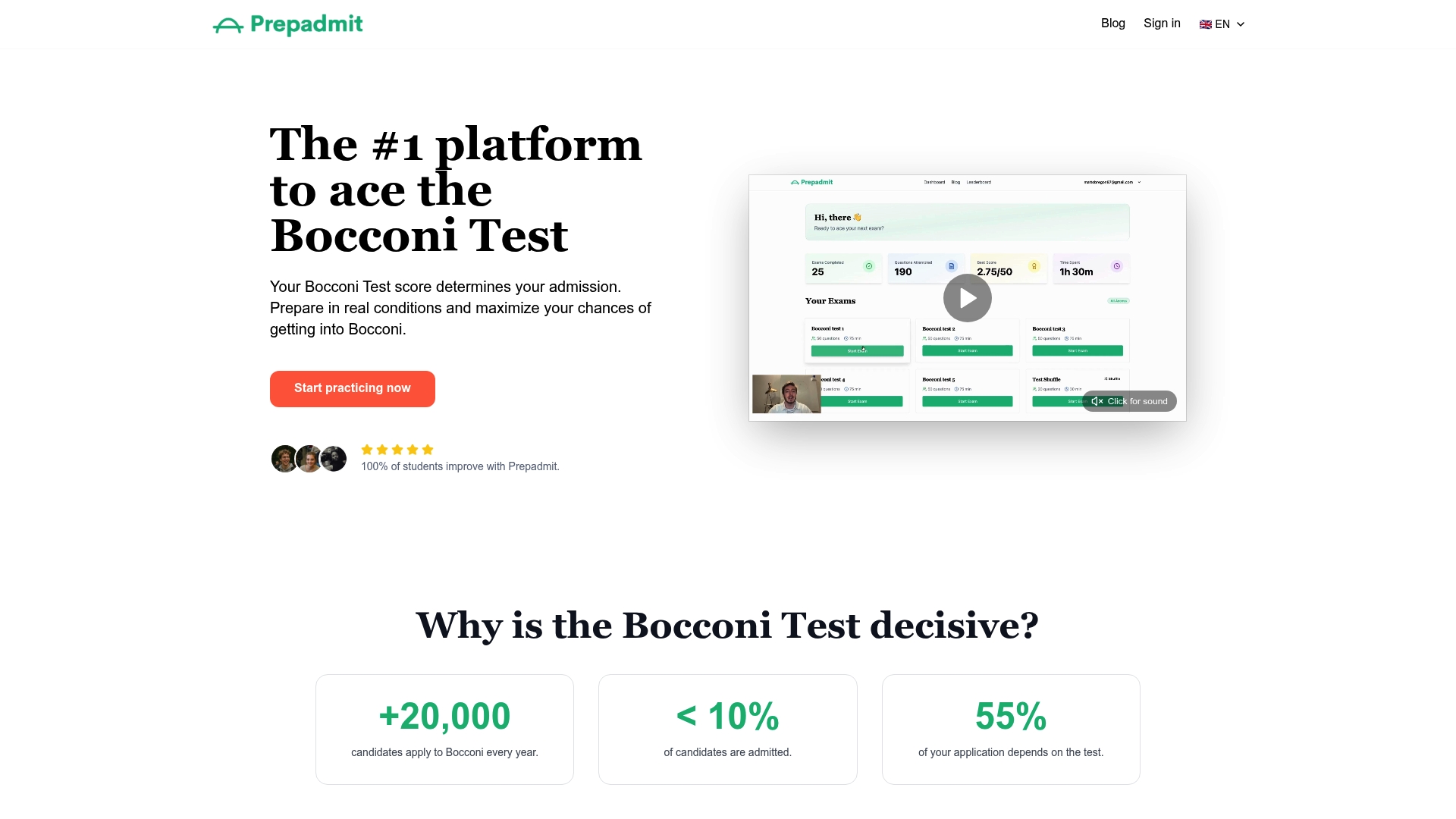
Prepadmit gives you access to full mock exams with real penalty scoring, detailed error breakdowns, peer ranking, and video tutorials by subject. You can study at your own pace and measure improvement session by session. The platform was developed by graduates of Bocconi and HEC, so the content reflects what the test actually requires, not a generic approximation of it. Prepadmit costs a fraction of private tutoring and comes with a money-back guarantee. Students using Prepadmit improve their scores by 34% on average. If you are serious about your 2026 admission, this is where to begin your preparation.
FAQ
What are the best free Bocconi test practice resources?
The CISIA portal is the best free option. It offers official timed simulations and topic-specific question banks that mirror the real exam format at no cost.
How many questions are on the Bocconi Test and how long is it?
The test includes 50 multiple-choice questions to be completed in 75 minutes, averaging 1.5 minutes per question across all subject areas.
Does wrong guessing hurt your Bocconi test score?
Yes. Wrong answers are penalized at 0.20 or 0.33 points depending on question type, so random guessing without eliminating options first is a losing strategy.
How early should I start practicing for the Bocconi Test?
Start at least 6 weeks before your test date. The most effective prep window is 6 to 12 weeks, beginning with a diagnostic test and ending with full timed mock exams.
Can I use a calculator on the Bocconi Test?
No. Calculators are not permitted. All math and numerical reasoning must be solved using mental math and estimation, so practice without any calculator from your first session onward.
Recommended
Related articles
Ready to ace your admission test?
Discover PrepAdmit, the platform that helps you succeed at top university admission tests.
Discover PrepAdmit