Bocconi Test Counting Principles: Rules, Examples, Practice

Bocconi Test Counting Principles: Rules, Examples, Practice
Counting principles are a small, learnable part of the Bocconi Test math section. Bocconi’s own syllabus lists them, so you can expect questions on them. You need four tools: the sum rule, the product rule, permutations and combinations. You also need one habit: ask whether order matters. The fastest way to make this automatic is to solve many timed questions in exam conditions, which is what we built Prepadmit to let you do.
TL;DR
- Bocconi’s 2027–28 syllabus names permutations and combinations with and without repetition, plus simple counting with the sum and product rules.
- Multiply when you make successive choices. Add when you choose between alternatives that cannot overlap.
- Order matters: permutation or arrangement. Order does not matter: combination.
- Two traps cost most points: choices that depend on earlier choices, and overlapping cases counted twice.
- The test has 50 questions in 75 minutes, 24 of them math, so speed matters as much as the formula.
Table of Contents
- What the Bocconi Test expects
- The two basic rules: multiply or add
- Order matters or not: permutations and combinations
- Solving a question step by step
- Common mistakes and how to catch them
- Practice questions with solutions
- How to practice counting for the test
- Practice counting under real exam conditions
- FAQ
- Sources
What the Bocconi Test expects
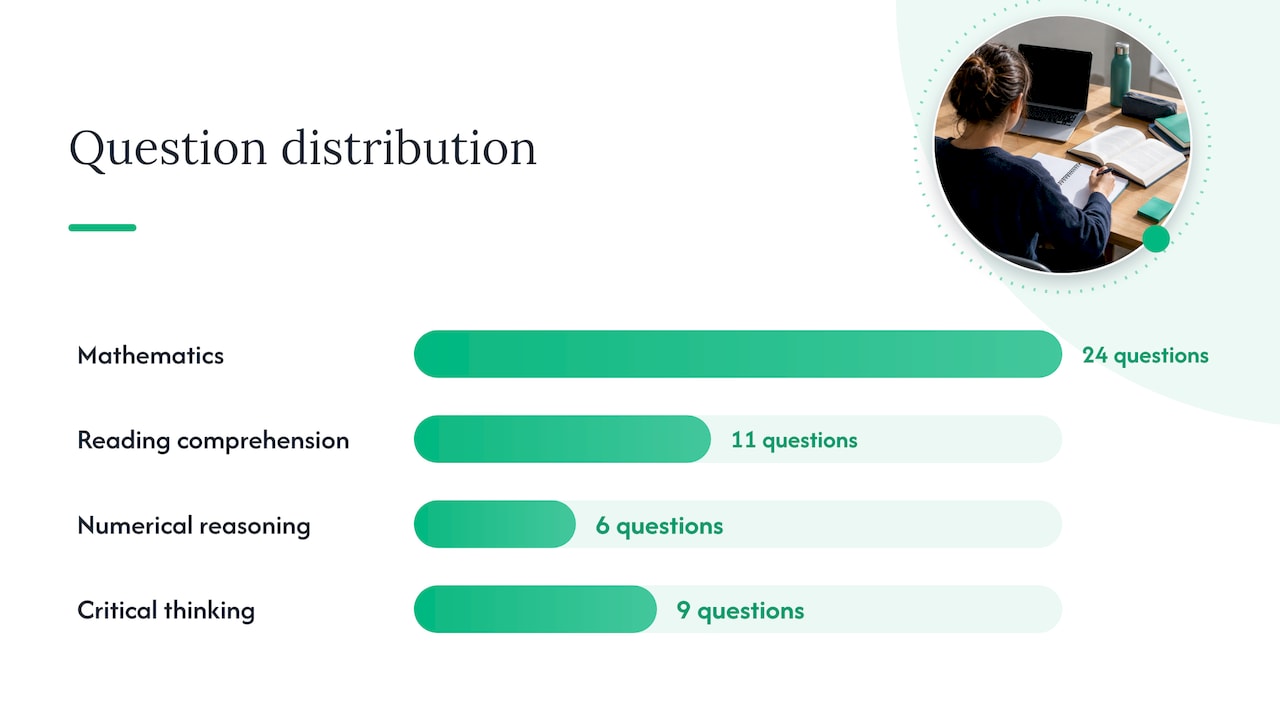
For 2027–28, Bocconi lists 50 questions in 75 minutes: 24 mathematics, 11 reading comprehension, 6 numerical reasoning and 9 critical thinking. The same page says questions are mixed by topic and difficulty, so you switch subjects constantly.
The math syllabus includes counting. The English page says permutations and combinations with and without repetition, and simple counting problems using the sum and product rules. The Italian page uses the word disposizioni (arrangements) for ordered selections, alongside permutations and combinations. If you studied in Italy, you know these terms. If you studied abroad, treat disposizioni as ordered selections of some items from a larger set.
The questions are “simple” counting problems. You will not need advanced combinatorics. You need to pick the right rule in a few seconds and compute cleanly.
The two basic rules: multiply or add
Product rule: successive choices
When you make one choice after another, multiply the number of options at each step. OpenStax College Algebra gives a meal with 2 appetizers, 3 entrées and 2 desserts: 2 × 3 × 2 = 12 possible meals.
Exam-style version: a code has 2 digits followed by 1 letter from 26. With digits 0 to 9 and repetition allowed, you get 10 × 10 × 26 = 2,600 codes.
Sum rule: alternatives
When you pick one option from groups that share nothing, add. In the same OpenStax chapter, an entrée can be 1 of 2 vegetarian dishes or 1 of 5 meat dishes, so there are 2 + 5 = 7 choices.
A quick test: the word “and” between steps usually signals multiplication. The word “or” between separate categories usually signals addition.
Overlaps: subtract what you counted twice
If two groups overlap, adding them counts the shared outcomes twice. The University of Victoria counting guide explains inclusion–exclusion: add the sizes, then subtract the overlap.
Example: in a class of 30, 18 study French and 14 study German, and 5 study both. Students studying at least one language: 18 + 14 − 5 = 27.
Order matters or not: permutations and combinations
This is the decision that drives most counting questions. Ask: if I swap two chosen items, do I get a different outcome?
Ordered: permutations and arrangements
OpenStax uses a club of six people choosing a president, vice president and treasurer. The roles are different, so order matters: 6 × 5 × 4 = 120 possibilities. Another OpenStax example awards first, second and third place among 9 swimmers: 9 × 8 × 7 = 504.
The pattern is to multiply a shrinking number of options, because nobody can hold two roles. In factorial form, choosing k ordered items from n is n! / (n − k)!. Arranging all n items is n!.
With repetition allowed, the options do not shrink. A 4-digit PIN from 10 digits has 10 × 10 × 10 × 10 = 10,000 possibilities.
Unordered: combinations
When you only pick a group, divide out the orderings. OpenStax’s example chooses 2 side dishes from 5: C(5,2) = 10. The formula is C(n, k) = n! / (k! (n − k)!).
Quick way to compute it by hand: C(5,2) = (5 × 4) / (2 × 1) = 10. Write k factors on top, k factors on the bottom, and cancel. This is faster than expanding full factorials under time pressure.
A decision table
| Question asks about | Order matters? | Repetition? | Tool |
|---|---|---|---|
| Podium, roles, ranking | Yes | No | n × (n−1) × … (k factors) |
| PIN, license plate, code | Yes | Yes | n^k |
| Committee, team, hand of cards | No | No | C(n, k) |
| Lining up all items | Yes | No | n! |
Solving a question step by step
- Read for the structure. Is the outcome a sequence of choices, a group, or a choice between categories?
- Model it as steps. The Victoria guide advises treating the outcome as a sequence of choices and picking a useful order for the steps.
- Decide on order and repetition. Use the table above.
- Compute with cancellation. Do not expand large factorials.
- Sanity check. Is the answer plausible in size? A group count should never exceed the matching ordered count.
Worked example with a restriction
Five friends, including Anna and Marco, line up for a photo. How many lines have Anna and Marco next to each other?
Treat Anna and Marco as one block. You now arrange 4 units: 4! = 24. The block can be AM or MA: 2 ways. Total: 24 × 2 = 48.
Compare with all lines: 5! = 120. So 48 is plausible.
Worked example with “at least”
A committee of 3 is chosen from 4 women and 5 men. How many have at least one woman?
The Victoria guide suggests counting the complement when it is simpler. All committees: C(9,3) = 84. Committees with no women, so 3 men: C(5,3) = 10. Answer: 84 − 10 = 74.
Counting the cases directly (1, 2 or 3 women) also works, but needs three calculations. The complement needs one.
Common mistakes and how to catch them
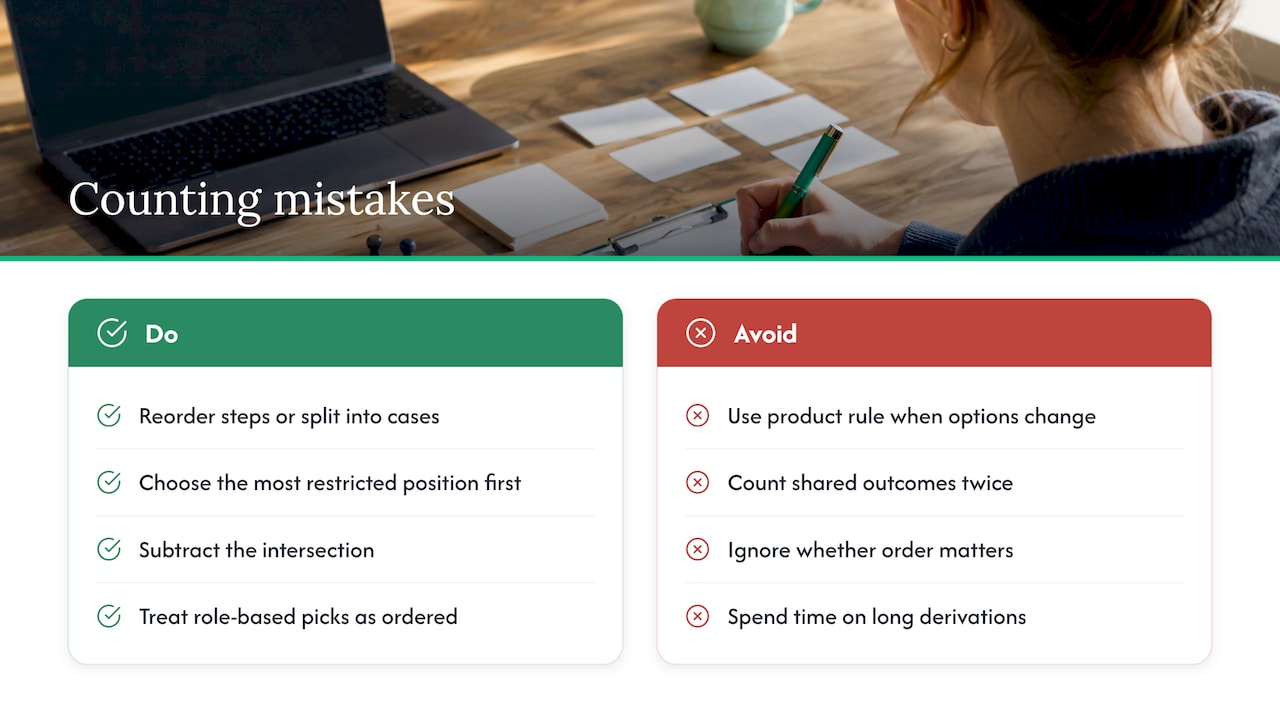
Using the product rule when options depend on earlier choices. The Victoria guide says the product rule is valid only when the number of options at each step is not changed by previous choices. If it is, reorder the steps or split into cases.
Example: how many 3-digit numbers with distinct digits? If you start with the first digit, you have 9 options (not 0), then 9 for the second (10 minus the one used, including 0 now), then 8. Total: 9 × 9 × 8 = 648. Starting with the last digit instead would make the count of the first digit depend on whether you used 0, which is messy. Choose the most restricted position first.
Counting overlaps twice. If categories can share outcomes, subtract the intersection.
Mixing up order. If you pick “2 representatives” without roles, it is a combination. If one is “leader” and one is “deputy”, it is ordered.
Forgetting the clock. With 24 math questions in 75 minutes, you cannot afford long derivations. Our guide on mental math under time pressure covers the speed side, and four shortcuts for word problems helps with translating text into a model.
Practice questions with solutions
Try each before reading the answer.
- A café offers 4 drinks, 3 sandwiches and 2 desserts. How many menus have one of each? Answer: 4 × 3 × 2 = 24.
- A student must read either 1 of 6 novels or 1 of 4 essays. How many choices? Answer: 6 + 4 = 10.
- Eight runners race. How many ways to award gold, silver and bronze? Answer: 8 × 7 × 6 = 336.
- How many ways to pick 3 volunteers from 8? Answer: C(8,3) = (8 × 7 × 6) / (3 × 2 × 1) = 56.
- A lock has 3 digits, each from 0 to 9, repetition allowed. How many codes? Answer: 10³ = 1,000.
- Of 40 students, 22 play football, 15 play basketball and 6 play both. How many play at least one? Answer: 22 + 15 − 6 = 31.
Notice the gradient. Questions 1 to 3 use multiplication, question 4 adds the order decision, and question 6 adds overlap. Real test questions often wrap these in a short story, so practice reading quickly.
How to practice counting for the test
Learn the five patterns above, then stop reading and start solving. Counting is a skill of recognition: after 50 or 100 problems, you see “order matters” or “complement” at once. Do short drills on this single topic, then mix it with other math topics in timed sets, because the real test mixes everything.
Timing also matters over the whole process. Bocconi allows up to four attempts, and booking windows differ for Italian and international applicants, so plan your calendar early. Our timeline guide lays it out, and the test format article explains the structure. Check Bocconi’s official page for the current booking dates.
For more math practice, see our post on targeted drills and timed mocks and the worked exercises with a 75-minute mock plan.
Our view on counting
We build Prepadmit on one idea: counting is not about memorizing formulas, it is about recognizing the structure of a problem fast. A formula sheet takes an hour to learn. Recognition takes repetition, with feedback on every mistake.
That is why our platform combines official past papers and on-demand tests with detailed answer corrections and skill-specific modes. You can drill counting alone, then see it inside a full simulation where it competes for time with reading and logic questions. Progress tracking shows whether your counting accuracy actually improves.
Our content was developed by experts with backgrounds from HEC and Bocconi. Students who practice this way, understand each error and repeat, are the ones behind our 34% average score improvement.
quentin
Practice counting under real exam conditions
Prepadmit gives you official past papers, on-demand tests, answer corrections that explain each mistake, drill modes by skill, progress tracking and a ranking against other candidates, on mobile and desktop. It is designed as a cost-effective alternative to private coaching, and it comes with a money-back guarantee. Access the full preparation and start with the counting questions today.

FAQ
Are counting questions really on the Bocconi Test?
Yes. Bocconi’s official syllabus lists permutations and combinations with and without repetition, and simple counting problems using the sum and product rules. They sit within the 24 math questions of the 50-question test.
What is the difference between a permutation and a combination?
In a permutation, order matters, as with first, second and third place. In a combination, order does not matter, as with choosing a group of three people. A combination is the permutation count divided by the number of ways to reorder the chosen items.
When do I add and when do I multiply?
Multiply when you make one choice after another. Add when you pick from separate categories that share no outcomes. If categories overlap, add them and subtract the overlap.
What is the quickest way to handle “at least” questions?
Count the opposite case and subtract it from the total. For “at least one woman” in a committee, compute all committees minus those with only men.
Sources
- Online Bocconi test, Bocconi University
- Test online Bocconi, Università Bocconi
- 9.5 Counting Principles, College Algebra 2e, OpenStax
- Counting, University of Victoria
Recommended
Related articles
Ready to ace your admission test?
Discover PrepAdmit, the platform that helps you succeed at top university admission tests.
Discover PrepAdmit