Raise Your Bocconi Score in 8–12 Weeks for Applicants Short on Time

Raise Your Bocconi Score in 8–12 Weeks for Applicants Short on Time
The fastest way to raise your Bocconi test score comes down to three moves: run realistic timed mocks, drill math relentlessly since it carries 24 of 50 questions, and analyze every wrong answer until the pattern behind it disappears. Bocconi scores each question +1, 0, or a penalty for wrong answers, and the test counts for about half of your admission evaluation. Start with a diagnostic mock this week. It tells you exactly where those three levers matter most for you.
TL;DR:
- Focusing on improving math questions yields nearly twice the score gain compared to balancing efforts across all sections.
- Guessing only makes sense if you can eliminate at least one answer choice, due to the weighted penalties for wrong answers.
- Retaking the test is valuable only if your score hasn’t already met your target and you have time to improve before application deadlines.
- Mock exams should be full-length, timed, and followed by detailed error analysis to identify patterns and build pacing skills.
- Proper technical setup and early accommodations requests are essential to avoid test invalidation on test day.
Table of Contents
- What Actually Improves Your Bocconi Test Score
- How Are Points Awarded and Penalized on the Bocconi Test?
- How Much Does the Test Score Actually Count Toward Admission?
- Building an 8 to 12 Week Study Plan That Moves Your Score
- Turning Your Score Report Into Your Next Study Block
- What Kinds of Questions Actually Show Up in Each Area?
- Which Study Materials Are Worth Your Time?
- Why Test Anxiety Costs You More Points Than You Think
- Common Scoring Mistakes That Quietly Lower Your Result
- How Does the Bocconi Test Compare to Other Entrance Exams?
- Technical Rules and Accommodations You Need to Know Before Test Day
- Why Simulation Beats Raw Study Hours
- Try a Realistic Bocconi Mock Before You Study Blind
- Sources
What Actually Improves Your Bocconi Test Score
Score improvement on the Bocconi test isn’t about studying more hours. It’s about studying the right 50 questions in the right order. The online Bocconi test splits into four areas, and they are not weighted equally in terms of raw points available:
- Mathematics: 24 questions
- Reading comprehension: 11 questions
- Numerical reasoning: 6 questions
- Critical thinking: 9 questions
You get 75 minutes to answer all 50. Questions from different areas are mixed together rather than grouped in blocks, and difficulty is randomized within each section, so you can’t predict when a hard question is coming. That unpredictability is deliberate. It tests whether you can stay composed under shifting difficulty, not just whether you know the material.
Here’s the practical implication: math alone is worth nearly half your total points. If your diagnostic mock shows weak reading comprehension but strong math, don’t rebalance your hours evenly across all four areas. Push harder on math first, since each math question you fix moves your score more than a comparable fix in numerical reasoning, which only has six questions total.
How Are Points Awarded and Penalized on the Bocconi Test?
Every question follows the same math: +1 for a correct answer, 0 for a question you skip, and a deduction for a wrong answer. Bocconi’s official scoring rules set that deduction at -0.20 for most questions, but some critical-thinking items with only three answer options carry a steeper -0.33 penalty.
The Guessing Math: On a standard four-option question, guessing blind gives you a 25% chance of +1 and a 75% chance of -0.20. Run that four times and your expected value is roughly break-even, slightly negative. Skip it four times instead and you score a flat zero. Guessing only pays off once you can eliminate at least one wrong answer, which shifts the odds enough to beat skipping.
That math changes on three-option critical-thinking questions. A -0.33 penalty combined with better odds (one in three instead of one in four) makes calculated guessing riskier per wrong answer but potentially still worthwhile if you’ve ruled out one option. Practice this calculus by section, not as a blanket rule.
There’s also a minimum-valid threshold. Score below it, and your result won’t be considered in the selection process at all, regardless of how the rest of your application looks. That penalty structure is why blind guessing across the board is one of the most common ways students quietly lose points they didn’t need to lose.
How Much Does the Test Score Actually Count Toward Admission?
Bocconi blends your test result with your school record to build the ranking used for admission, known as the graduatoria. Guides tracking the official weighting consistently report the test at roughly 55% and your curriculum at roughly 45%.
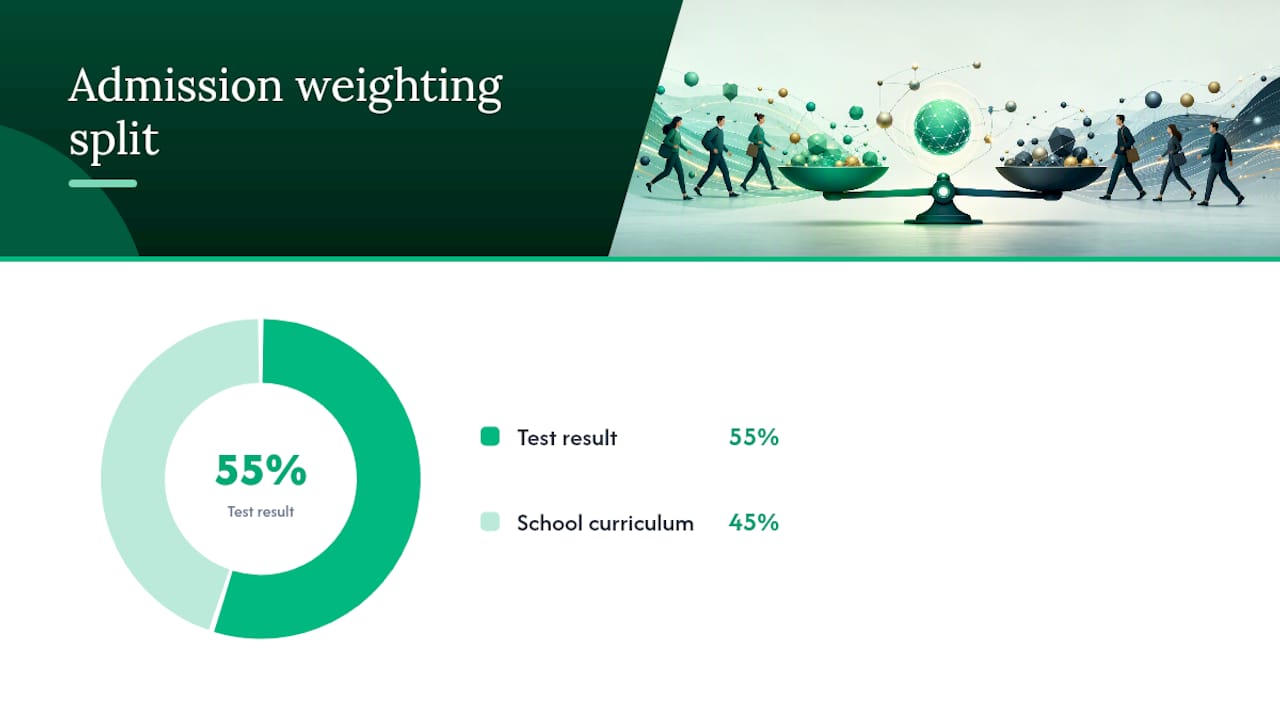
That split matters for how you set targets. A strong test score can offset a modest grade average, but it can’t fully substitute for years of school performance; the reverse is also true. If your curriculum score is already solid, a marginal test improvement often moves your combined rank more than an equivalent grade bump would, simply because there’s more room to gain.
A few practical notes on strategy:
- Bocconi generally considers your best attempt if you sit the test more than once across sessions (Early, Winter, Spring).
- There’s no single universal passing score published for every course. Competitiveness shifts year to year and program to program.
- Set targets conservatively. Aim to beat your own diagnostic baseline by a specific margin rather than chasing a number you saw on a forum.
Building an 8 to 12 Week Study Plan That Moves Your Score
Improvement here follows a sequence, not a pile of random practice. Skipping the diagnostic step and jumping straight to drills is the single most common way students waste their first few weeks.
- Take a full timed diagnostic mock in week one. Use official-format questions under real time pressure. This is your baseline, and it tells you which of the four areas needs the most attention.
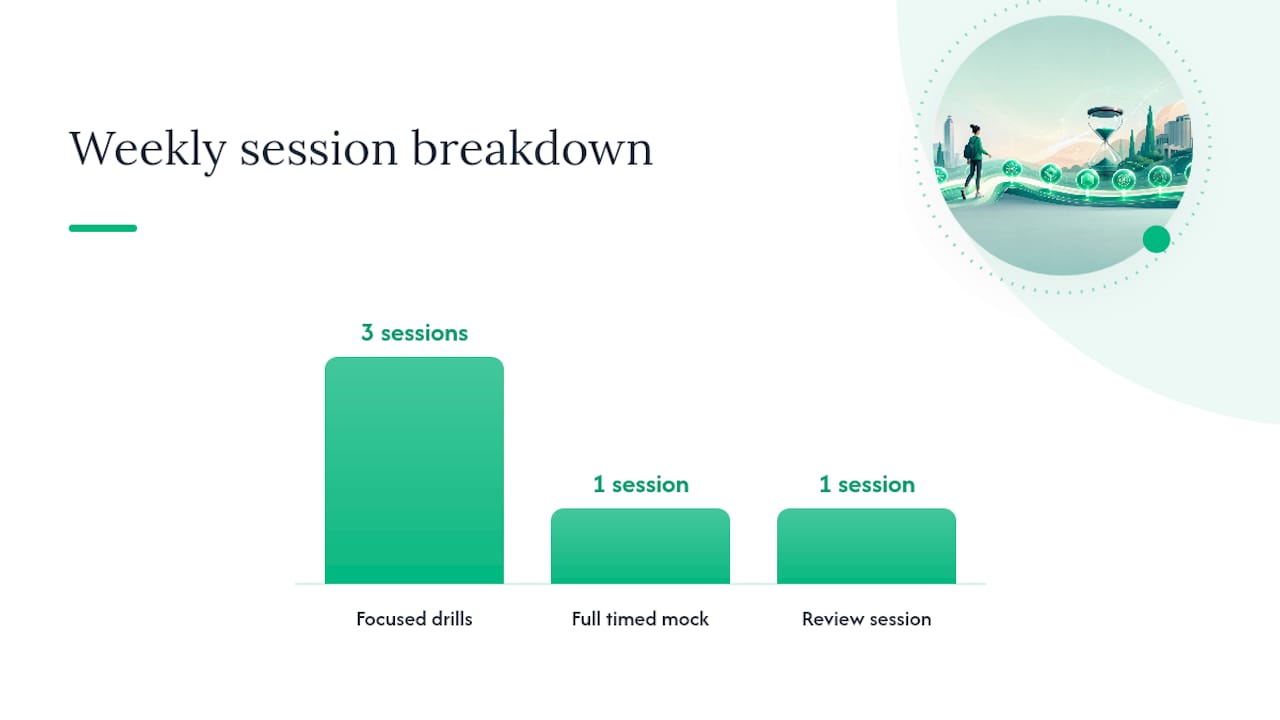
- Build a weekly rhythm you can sustain. A workable structure is three focused drill sessions on your weakest areas, one full timed mock, and one review day dedicated entirely to error analysis.
- Scale intensity as test day approaches. Early weeks favor untimed drills where you focus on accuracy. The final two to three weeks should shift almost entirely to timed, full-length mocks that mimic real conditions.
- Run targeted drills by question type. Chunk math practice into topic clusters (algebra, geometry, percentages) instead of mixed sets. Practice active reading by summarizing each paragraph in one line before answering. Build templates for recurring numerical reasoning patterns. Map common critical-thinking traps like false-cause and overgeneralization.
- Train time management directly. Practice 90 second per question limits on math, and drill the skill of abandoning a stuck question after two attempts rather than burning three minutes on it.
- Classify every mistake you make. Was it a careless error, a knowledge gap, or a timing failure? Build a small follow up drill set for whatever category shows up most, then retest that specific pattern until your error rate on it drops.
- Rehearse the technical setup before test day. Confirm your device meets platform requirements and that you understand behavioral rules, since non-compliance can invalidate a high score regardless of how well you answered.
Realistic mocks do double duty here: they surface your weak points and they get you comfortable with the actual test platform’s rules, which lowers your risk of a technical slip on the real day. A structured week-by-week preparation guide can help you sequence this without guesswork, and a resource focused specifically on math section drills is worth prioritizing given how many points that section holds.
Pro Tip: Log every abandoned question during mocks in a separate list. If you’re abandoning the same question type repeatedly, that’s not a timing problem, it’s a knowledge gap wearing a timing disguise.
Turning Your Score Report Into Your Next Study Block
Bocconi releases your score report within 48 hours of your attempt, and it breaks down your total score along with area-by-area counts of correct, wrong, and unanswered questions.
Use it with a simple three-step check:
- Identify your weakest area by percentage, not raw count. A 60% score in a 6-question section reveals a bigger gap than a 60% score in a 24-question section, but requires less total fix time.
- Set a micro-goal for your next mock. Instead of “improve reading,” aim for something specific like “cut wrong answers in reading from five to two.”
- Decide on a retest only after weighing your timeline. If you have another session before application deadlines close and your diagnostic shows a fixable gap, retesting is often worth it. If your score already clears your target range, another attempt adds risk without much expected upside.
What Kinds of Questions Actually Show Up in Each Area?
Math questions on the Bocconi test skew toward algebra manipulation, geometry (areas, volumes, angle relationships), percentages and ratios, and basic probability. Expect word problems that require translating a scenario into an equation before you can solve anything, which is often where students lose time rather than accuracy.
Reading comprehension passages tend to run 200 to 400 words on academic or argumentative topics, followed by questions asking you to identify the main idea, an author’s implied stance, or the meaning of a word in context. The trap here is answering from memory instead of the text. Always re-check your choice against the specific sentence it comes from.
Numerical reasoning leans on pattern recognition: sequences, matrix logic, and quantitative comparisons where you judge which of two values is larger without full calculation. These questions reward speed templates over raw computation.
Critical thinking questions typically present a short argument and ask you to spot the assumption it depends on, identify a logical flaw, or judge which additional fact would strengthen or weaken the claim. This is the section most likely to include those three-option questions with the steeper penalty, so recognizing flawed reasoning patterns (correlation mistaken for causation, small sample overgeneralization) pays off directly.
Which Study Materials Are Worth Your Time?
Official past papers are your highest-value resource, since they match the actual phrasing style and difficulty calibration Bocconi uses. Generic aptitude test books can help build foundational skills, but they won’t replicate the specific mix of question types you’ll face.
Beyond official materials, prioritize resources that give you three things: timed conditions, detailed answer corrections (not just an answer key, but reasoning for why an option is wrong), and some way to track your progress over multiple attempts. A single practice test tells you where you stand today. A tracked series of tests tells you whether your studying is actually working, which matters more the closer you get to test day.
Skill-specific drill sets, where you practice only algebra or only critical-thinking traps for a stretch, tend to close gaps faster than mixed practice sets early in your prep. Save the mixed, full-length format for your final weeks, when the goal shifts from building skill to building stamina and pacing under real conditions.
Why Test Anxiety Costs You More Points Than You Think
Anxiety doesn’t just feel bad. It has a measurable cost on a timed, penalty-based test like this one, because panic pushes students toward two opposite mistakes: rushing into careless errors or freezing on a question and burning minutes you can’t recover.
The most reliable fix is exposure. Students who’ve run five or six full timed mocks under realistic conditions report far less panic on the actual test day than those who only studied material without ever simulating the clock. Familiarity with the format itself removes a huge share of the anxiety, because the unknown is usually scarier than the actual difficulty.
A few specific tactics help in the moment. Decide in advance how long you’ll spend on any single question before moving on, so you’re not making that decision under pressure mid-test. Practice a short breathing reset (a few slow breaths before starting) as part of every mock, so it becomes a habit rather than something you remember only when you’re already stressed. And reframe a hard question correctly: struggling with one question tells you nothing about how the rest of the test will go. Treat each question as its own event, not a referendum on your performance.
Common Scoring Mistakes That Quietly Lower Your Result
The costliest pattern is uneven guessing discipline: answering confidently on math while blind-guessing on critical thinking just to finish in time. That approach concentrates penalty risk exactly where the stakes (steeper -0.33 deductions on some items) are highest.
A second pitfall is misreading time pressure as an argument for speed over accuracy in the early sections. Rushing math to “save time” for reading often produces avoidable arithmetic slips, since math carries the most points on the test. Protect accuracy there first.
A third mistake is skipping error analysis entirely and just retaking mock after mock, hoping repetition alone fixes the gap. Repetition without diagnosis tends to reinforce whatever habits you already have, good or bad, rather than correcting them.
Finally, some students misjudge the minimum-valid threshold and treat every question as safe to guess on, not realizing a string of penalties can drag a otherwise decent performance below the line where it counts at all. Know that threshold before test day, not after seeing your report.
How Does the Bocconi Test Compare to Other Entrance Exams?
Most Italian and international university entrance tests share a similar backbone: multiple-choice format, strict time limits, and some penalty for wrong answers to discourage blind guessing. The Bocconi test’s structure, four areas with math dominating the question count, is consistent with that broader pattern, but its penalty mechanics are distinctive.
The mixed -0.20 and -0.33 penalty rates depending on question type is less common than a flat penalty across all questions, which is what many standardized admission tests use. That variability means a guessing strategy that works well on one exam format can actually backfire on Bocconi’s critical-thinking section specifically.
Time pressure is also comparatively tight. Fitting 50 questions across four distinct skill areas into 75 minutes leaves less room per question than some entrance exams that dedicate more total time to fewer questions. Pacing drills matter more here than they would on a slower-paced format, which is one reason dedicated pacing techniques built for other high-pressure, multiple-choice exams translate reasonably well to Bocconi prep, even though the subject matter differs.
Technical Rules and Accommodations You Need to Know Before Test Day
The Bocconi test happens online under monitored conditions, and the platform enforces specific technical and behavioral requirements. Bocconi’s instructions and rules document for the current admission cycle lays out what’s expected, and it’s worth reading in full rather than skimming, since noncompliance can invalidate your result even if your raw score was strong.
Practical setup matters more than students expect: a stable internet connection, a compliant device and browser, a quiet space free of prohibited materials, and correct camera positioning if the test requires remote proctoring. Test this setup well before your scheduled session, not the morning of.
Students with a diagnosed learning difference (DSA) or disability can request accommodations, which may include extended time or format adjustments. These requests go through Bocconi’s official admissions channels and typically require documentation submitted ahead of your test date, so start that process early rather than close to a session deadline. Don’t assume accommodations are automatic. Confirm the specific request process and required paperwork directly through Bocconi’s own admissions materials for your session.
Why Simulation Beats Raw Study Hours
The instinct to just “study more” is understandable, but it misreads what the Bocconi test actually measures. It’s not testing whether you’ve reviewed enough material. It’s testing whether you can apply that material accurately under a strict clock with a penalty structure working against careless guesses. Those are different skills, and only one of them improves through simulation.
Realistic mocks built from official-style questions do something pure content review can’t: they generate the specific data you need, which question types you miss, which sections you rush, where your guessing instinct backfires, to prioritize the next study block. Platforms like Prepadmit built their entire approach around that idea, pairing official past papers with progress tracking so students see their own error patterns rather than guessing at them.
— quentin
Try a Realistic Bocconi Mock Before You Study Blind
Every strategy in this guide depends on knowing your actual weak points first, and that’s exactly the gap Prepadmit was built to close. Instead of studying broadly and hoping it overlaps with what the real test covers, you get official past papers, full timed mock exams, and detailed answer corrections that show you why an answer was wrong, not just that it was.
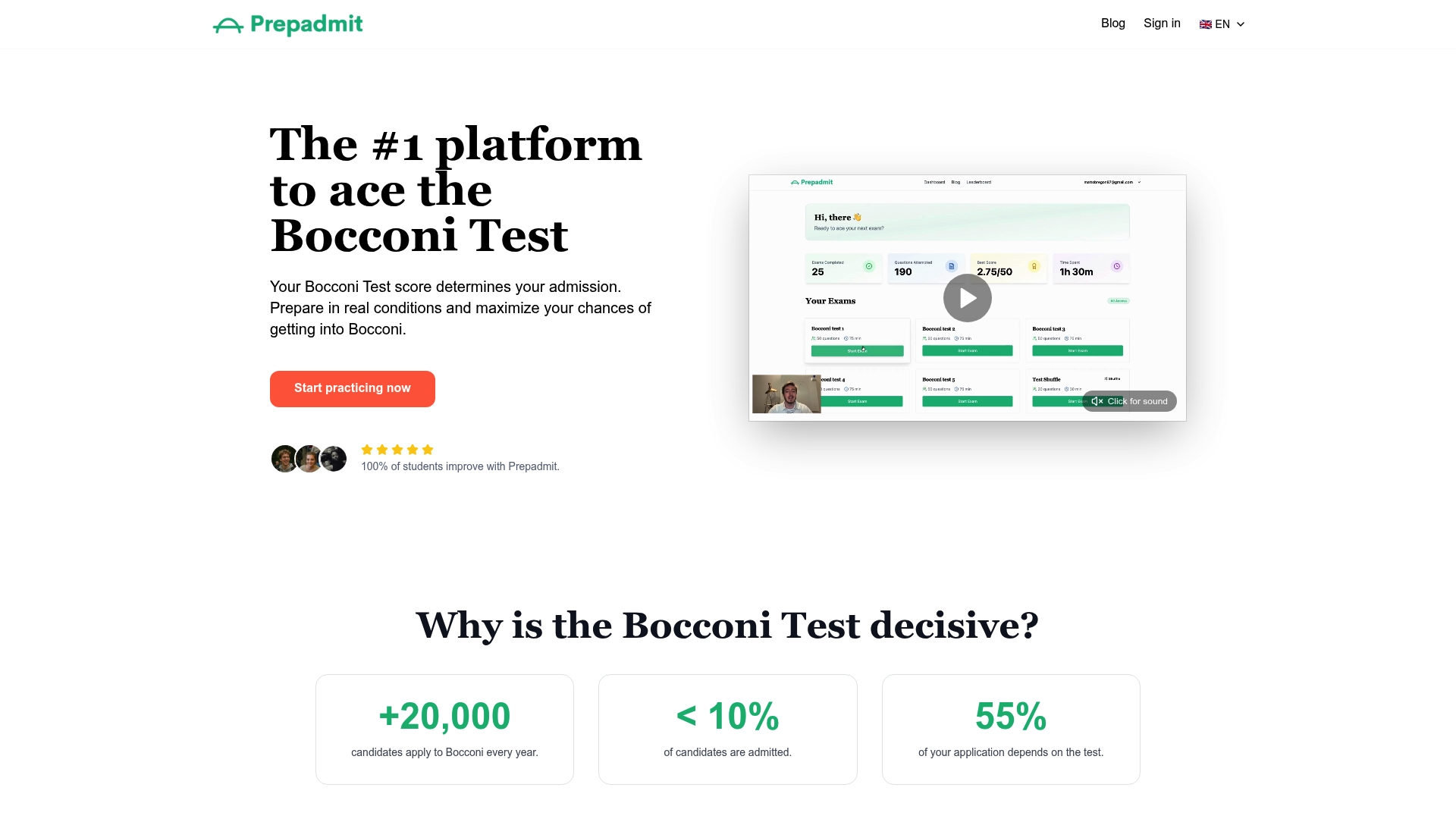
The platform tracks your progress across attempts, allowing you to monitor improvements and focus your study efficiently. Students who benefit most are the ones who want a measurable, structured path rather than open-ended review. If that’s you, start with a diagnostic mock on Prepadmit and let your own results decide what to study next. For a broader sense of how mocks fit into a full prep timeline, the role of mock exams in Bocconi success is worth a read too.
Sources
Recommended
Related articles
Ready to ace your admission test?
Discover PrepAdmit, the platform that helps you succeed at top university admission tests.
Discover PrepAdmit