Bocconi Test Warm-Up: What to Do Before You Start

Bocconi Test Warm-Up: What to Do Before You Start
A good Bocconi Test warm-up is a short, timed, realistic session, not a cram. Do a few mixed questions under the real clock, check your setup, and walk into the 75 minutes already used to the pace. Prepadmit gives you official past papers and on-demand tests so that this rehearsal feels like the real exam.
TL;DR
- The test has 50 questions in 75 minutes. Your warm-up should copy that rhythm.
- Do your last full mock about a week out. In the final days, drill short sets only.
- Check your computer, ID, room and desk the day before, not the morning of.
- Review mistakes by skill. Do not just redo questions you got wrong.
- On test day, eat, set up early and do a few easy questions, not a new mock.
Table of Contents
- What you are warming up for
- The rules that shape your warm-up
- When to warm up: a simple timeline
- How to run a warm-up session
- Warm up your setup, not only your brain
- Warm-up on test morning
- Do not waste your attempts
- Where Prepadmit fits
- Our view
- FAQ
- Sources
What you are warming up for
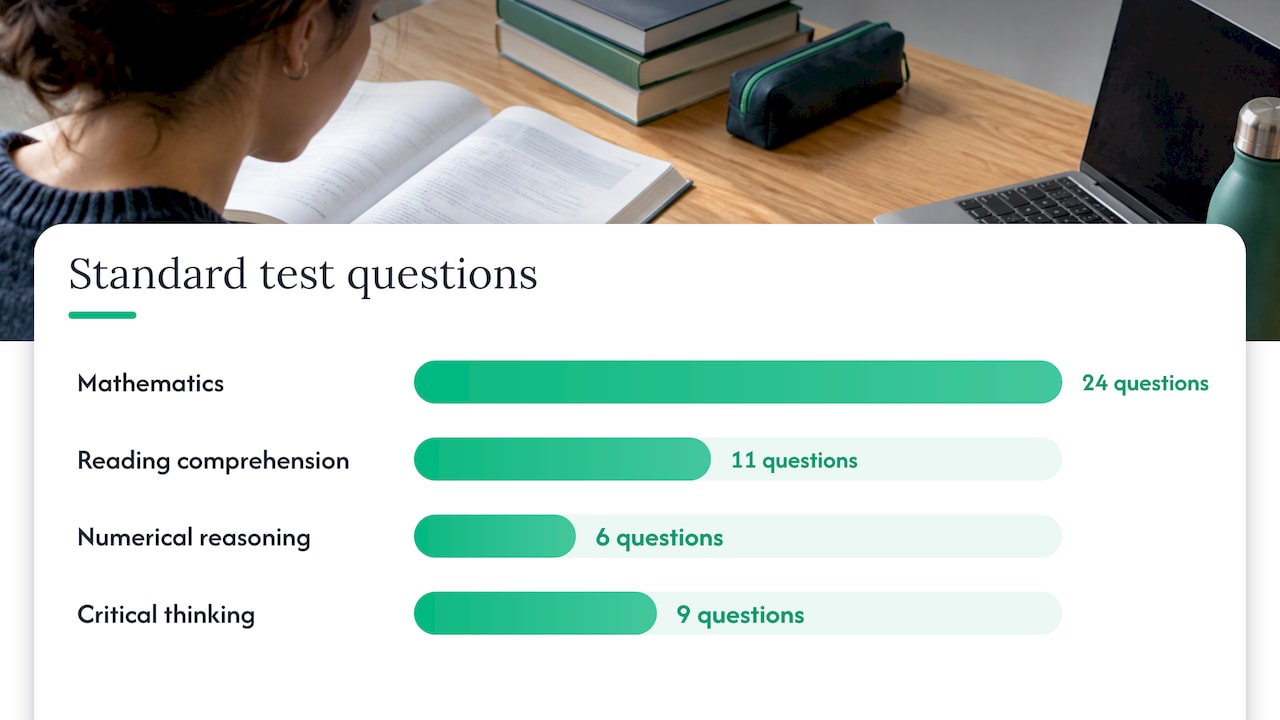
A warm-up only works if it matches the exam. Bocconi’s official test page says the standard online test has 50 multiple-choice questions in 75 minutes. The mix is Mathematics 24, Reading comprehension 11, Numerical reasoning 6 and Critical thinking 9. Questions are mixed by difficulty and topic.
The Law test uses a different split: 5, 11, 6, 18 and 10 questions, in the same order of areas as the page lists them.
Scoring matters for pacing. A correct answer gives +1, a blank gives 0 and a wrong answer costs 0.2 points. Critical thinking questions with three options cost 0.33. The same page says a score below 17 is not considered, and some programs ask for at least 11 of 24 in Mathematics.
So a warm-up should train one habit: answer what you can, and skip what you cannot solve in a reasonable time. Random guessing has a cost.
For a deeper look at what changed this year, see our guide to the Bocconi Test format.
The rules that shape your warm-up
The rules of conduct for 2027/28 change how you should practice:
- Questions appear three per screen.
- Navigation is one way. Once you click Next, the previous screen is gone.
- The test closes automatically when time ends, and your total score shows immediately.
- You can take it between 12:00am and 11:59pm Italian time on the booked date.
This means your warm-up must include one skill many students forget: deciding on a screen of three questions before you move on. If you practice on paper with free flipping back and forth, you build a habit the real test does not allow.
When to warm up: a simple timeline
There are three moments. Each has a different goal.
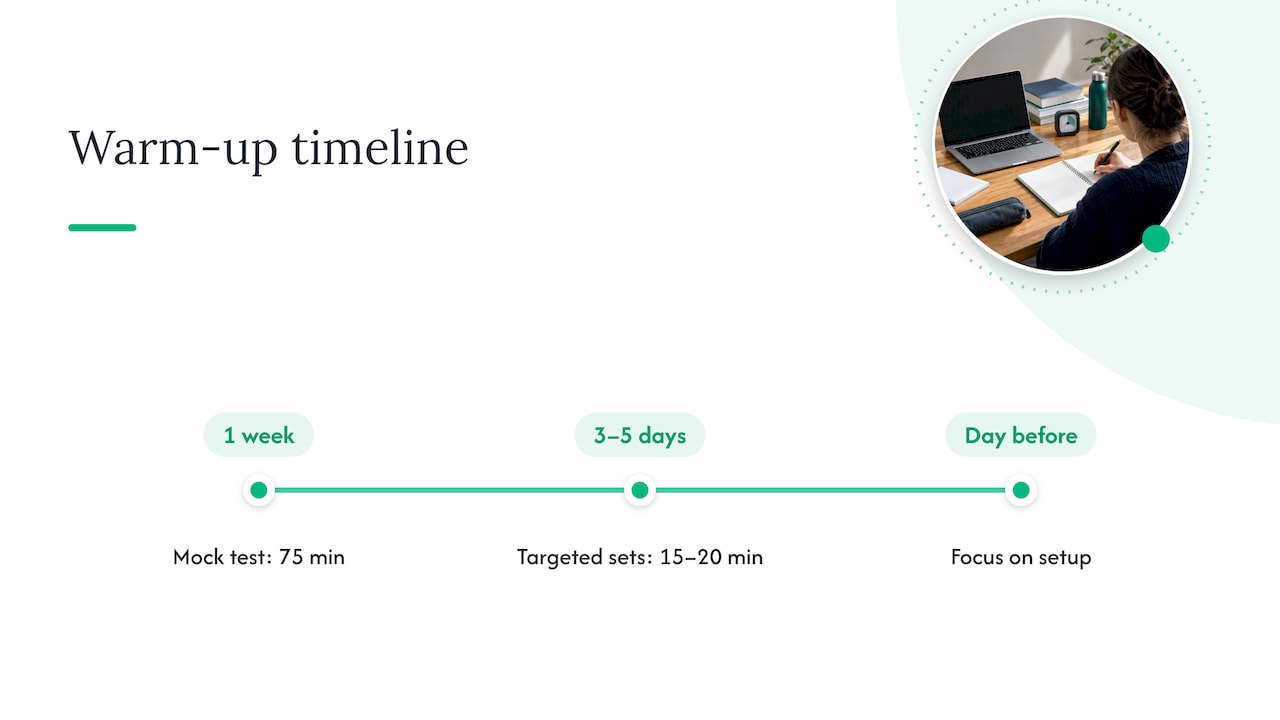
One week before: the last full mock
Sit one complete 75-minute simulation under real conditions. Same time of day as your booked slot if possible. No phone, no pauses. Bocconi offers a free simulation that, according to its page, replicates the real test: 50 questions in 75 minutes, three per page, no going back and a visible timer. It also shows a review of correct, incorrect and unanswered questions afterward.
Prepadmit adds official past papers, adaptive on-demand tests and detailed corrections, so you can see why an answer was wrong, not only that it was. Our seven-day plan shows how to spread this out.
Three to five days before: short, targeted sets
Stop taking full mocks. Take 15 to 20 minute sets on your weakest area. If numerical reasoning is slow for you, work only on that. Our page on numerical reasoning explains what to expect from those six questions.
Skill-specific drill modes are built for this stage. You fix one habit at a time, which is less tiring than another full exam.
The day before: setup, not studying
Use the evening to check logistics. Do one light set of 10 questions at most, and stop early. Sleep matters more than one extra problem.
How to run a warm-up session
- Set the clock first. Use a visible timer. Aim for roughly 90 seconds per question on average. Mathematics will take more, reading less.
- Work in screens of three. Decide, answer or skip, then move on. Do not return.
- Mark each question as sure, guessed or blank. This tells you more than the score.
- Stop at the buzzer. Finishing late teaches the wrong pace.
- Review within 24 hours. While the logic is fresh, sort errors by cause.
Reading your mistakes
Most errors fall into four types:
| Error type | What it looks like | Fix |
|---|---|---|
| Knowledge gap | You did not know the formula or concept | Short drill on that topic |
| Misreading | You solved a different question | Slow down on the final line of the question |
| Time loss | You spent four minutes on one item | Set a skip limit |
| Careless slip | Right method, wrong arithmetic | Write steps on your scratch sheet |
Because a wrong answer costs points, the fix for time loss is often to leave a question blank. Practice that decision during warm-ups so it feels normal in the exam.
We walk through examples in three worked Bocconi exercises with a 75-minute plan.
Warm up your setup, not only your brain
The Bocconi test is taken at home, online and recorded. The official rules say the session is audio and video recorded, with a room scan before you start. The recordings are reviewed by the University, not by automated decisions.
Only these items are allowed on the desk: a computer, your identity document, one pencil or pen, two blank A4 sheets, a beverage in a glass or unlabelled bottle, and your credentials. Calculators, wireless peripherals, second screens and other devices are prohibited.
So your checklist the day before is:
- Computer charged and plugged in, with the technical requirements verified on the official page.
- A quiet room you can scan, with a clear desk.
- Your ID document ready.
- Your credentials noted down.
- Two blank sheets and one pen.
On the day, you access the webtesting platform, complete identification and room scans, and launch the lockdown browser. The score shows at the end, and the full report arrives within 48 hours, according to the official page.
If you want to plan the computer, room, documents and camera in good time, this guide to booking early for proctored online exams covers the same preparation habits. Our own list is in what to bring to the Bocconi Test.
Note one rule that protects you: you can change the test date or language up to 24 hours before the scheduled date through your personal area. If your setup is not ready, you have time to move it.
Warm-up on test morning
Keep it light. Do not take a mock. Do not learn new formulas.
- Wake up early enough to set up without rushing.
- Eat breakfast and drink water.
- Do five to ten easy questions to get your brain moving, ideally in one area you like.
- Open the platform early, then wait for the scan steps.
- Take three slow breaths before the timer starts.
The point is to start calm. The first screen sets your pace for the other 74 minutes.
Do not waste your attempts
Each attempt costs €60. Applicants can take up to four per test type, but not on the same or consecutive days, and at least 24 hours must pass between purchases, according to the official rules. One more rule matters: if you scroll through every question without answering, you lose any refund and the attempt still counts.
That is why warm-up practice should happen on a practice platform, not on a real attempt. Bocconi’s page also lists booking windows: Italian applicants from 13 July 2026 to 20 April 2027, and international applicants from 13 July 2026 to 19 January 2027. Check the official page for the schedule that applies to you. Our guide on booking dates and the attempt timeline help you plan.
Where Prepadmit fits
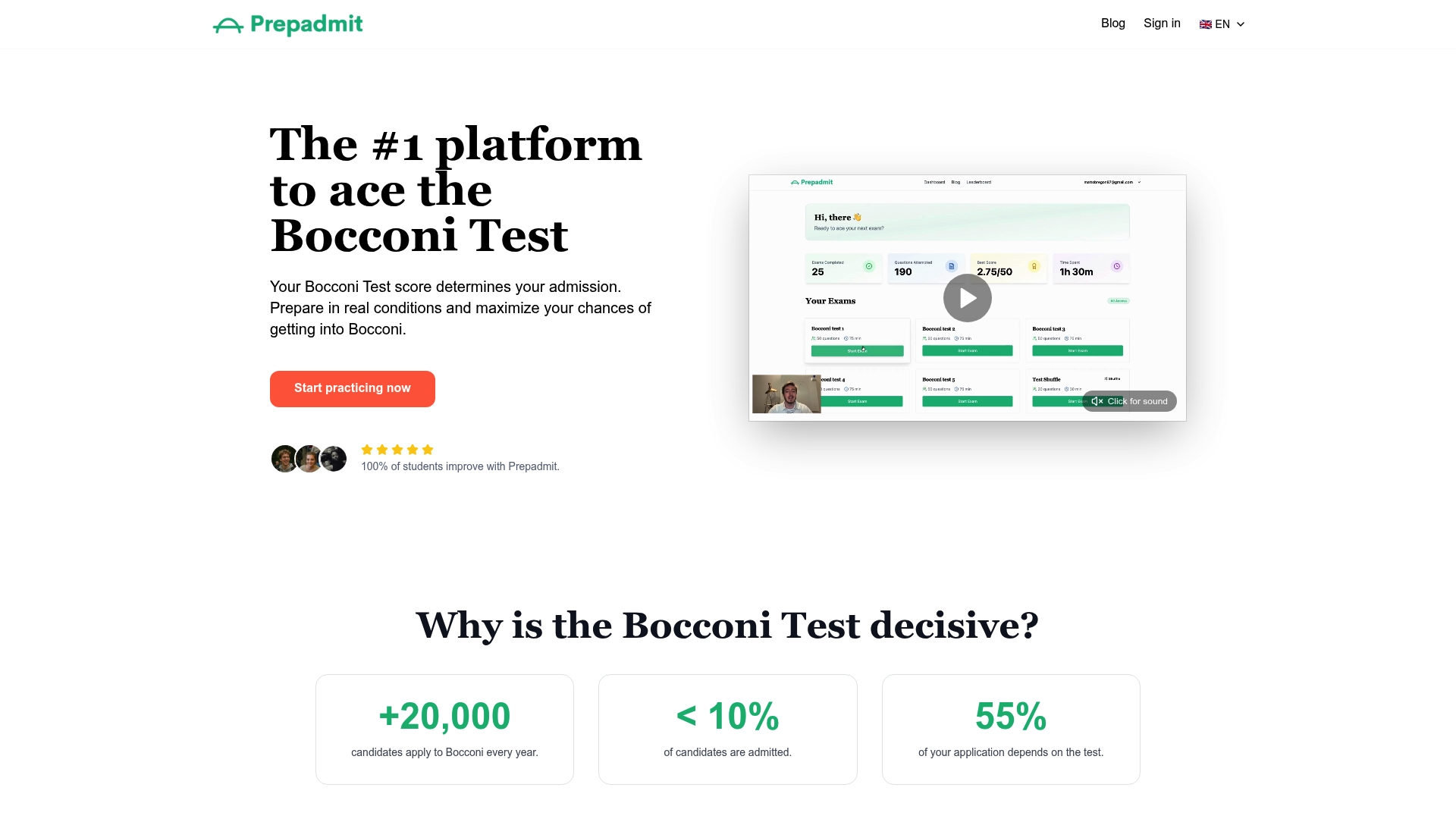
Prepadmit is an online platform for the Bocconi Test. It includes simulations based on official past papers, on-demand adaptive practice tests, detailed answer corrections, skill-specific drill modes, progress tracking and peer ranking dashboards, on mobile and desktop. It was developed by experts with backgrounds from HEC and Bocconi. We offer a money-back guarantee, and our students see an average score improvement of 34%.
For a warm-up, that means you can run a full mock a week out, drill one skill a day later, and see where you rank among other applicants. You can read more about what a real mock looks like and why practice quality beats hours.
Ready to start? Access the full preparation on Prepadmit.
Our view
We think a warm-up should be small and exact. The students who feel calm in the exam are rarely the ones who studied the most hours. They are the ones who have already lived the 75 minutes several times.
That is why we build Prepadmit around official past papers, realistic timing and clear corrections. Each mock should feel like the real screen, and each mistake should lead to one specific thing to practice. Affordable access matters too: good rehearsal should not depend on the price of private coaching.
Warm up like you will perform: timed, one-way, calm.
quentin
FAQ
How long should a Bocconi Test warm-up be?
On test day, 10 to 15 minutes of easy questions is enough. In the final week, one full 75-minute mock plus short 15 to 20 minute drills works better than daily full exams.
Can I use a calculator in the warm-up?
Not in the real test. Calculators and other devices are prohibited under the official rules, so practice with only pen and two blank sheets.
Should I take a full mock the day before?
No. A full mock is tiring and the review takes time. Use the day before for setup checks, a light set of questions and sleep.
What if I am not ready on my booked date?
You can change the date or the test language up to 24 hours before the scheduled time through your personal area, according to Bocconi’s rules. Do it early rather than risk a wasted attempt.
Sources
- Online Bocconi test, Bocconi University
- Instructions and Rules of Conduct 2027/28, Bocconi University
Recommended
Related articles
Ready to ace your admission test?
Discover PrepAdmit, the platform that helps you succeed at top university admission tests.
Discover PrepAdmit