7 Day Bocconi Plan: Targeted Exercises and Weekly 75 Minute Mock

7 Day Bocconi Plan: Targeted Exercises and Weekly 75 Minute Mock
Start with targeted drills in math, logic, and reading comprehension, then lock in one full 75-minute mock every week. That combination, not extra hours of unfocused reading, is what raises Bocconi test scores fastest. Prepadmit’s simulator setup already runs on this exact model, pairing skill-specific practice with realistic timed mocks.
TL;DR:
- Focusing on timed, skill-specific drills and full-length mocks is essential, with at least one 75-minute exam per week under real conditions.
- Proper error review, labeling mistake types, and retesting similar questions three days later significantly improve scores over simple practice.
- Practice should be evenly split across math, logic, reading comprehension, and critical thinking, with additional resources like official past papers and simulators.
- Progress tracking of scores, time per question, and repeated errors helps optimize study focus and avoid plateauing.
- Maintaining consistency in structured practice and mock simulations more effectively raises scores than increasing total study hours without targeted review.
Table of Contents
- Esercizi Mirati Bocconi: Which Exercises Train Each Skill
- How to Structure a Practice Schedule That Actually Works
- A Sample 7-Day Practice Plan You Can Copy
- Why Prepadmit Fits This Exact Practice Plan
- What Actually Moves the Needle, in Plain Terms
- Start Practicing With Prepadmit Today
- Where to Go Next for Practice and Official Details
- Sources
- FAQ
Esercizi Mirati Bocconi: Which Exercises Train Each Skill
The Bocconi admission test runs 50 questions in 75 minutes, split across math, logical reasoning, reading comprehension, and numerical reasoning. Scoring rewards precision: one point for a correct answer, zero for a skipped question, and a 0.2 penalty for a wrong guess. That penalty structure changes how you should practice. Guessing wildly on questions you haven’t drilled costs you more than skipping them.
Each section needs its own kind of exercise, not generic study time.
- Math and quantitative reasoning: short problem sets on algebra, percentages, and ratios, plus timed drills pulled from official past math questions.
- Logical reasoning: pattern recognition, syllogisms, and sequence completion under a visible countdown, since Bocconi rewards speed as much as accuracy.
- Reading comprehension: short passages paired with inference and main-idea questions, practiced in isolation before you ever attempt a full mock.
- Critical thinking and data interpretation: multi-step case questions that mirror the kind of applied reasoning shown in Bocconi’s own quantitative course materials.
For resources, official past papers and simulazioni are the closest match to real question style and scoring, so they belong at the center of your plan rather than on the side. Printed manuals from publishers like Alpha Test bundle 1,800 practice quiz items with commented solutions, and many include an access code for an online simulator, which lets you mix paper study with timed digital practice. Online drill banks and mobile micro-quizzes fill the gaps between longer sessions. Aim for a substantial number of targeted drill items per week, split roughly evenly across the four skill areas, and adjust the total down if your weekly study time is tight.
How to Structure a Practice Schedule That Actually Works
A single strong session beats three scattered ones. Structure each practice block the same way every time: 15 minutes of warm-up on easy items, 30 to 45 minutes of focused drills on one skill, then 15 to 20 minutes reviewing what you missed.
Across a full week, the rhythm should look like this:
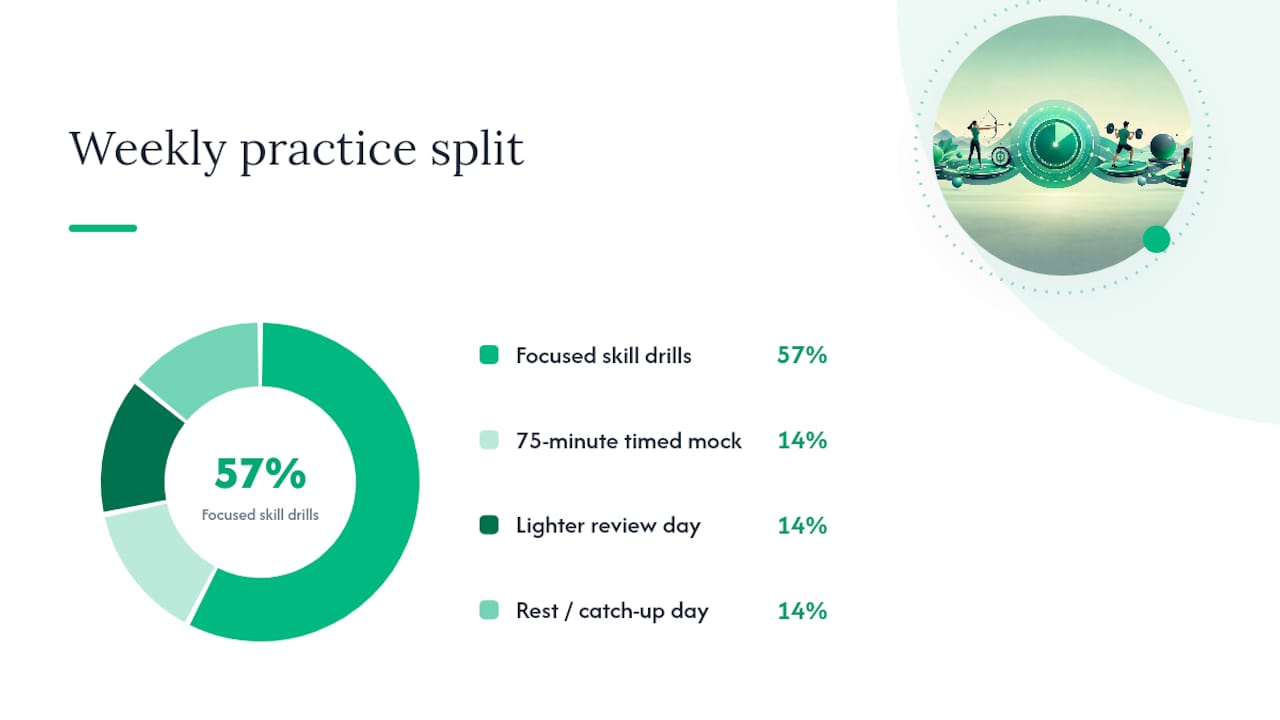
- Four days of focused skill drills, one section per day, rotating through math, logic, reading, and critical thinking.
- One full 75-minute timed mock under real exam conditions.
- One lighter review day spent only on mistakes from that week’s mock.
- One rest day, or a targeted catch-up session if a skill area is lagging.
When you run the 75-minute mock itself, split your time deliberately rather than letting the clock run out on one section. Allocate roughly 35 minutes to math and numerical reasoning, 25 minutes to reading comprehension, and the remainder to logic and critical thinking, adjusting slightly based on where you’re weakest. Sit somewhere quiet, use a real timer, and treat the mock as the actual exam, not a casual practice round.
Error review is where most of the score gain happens. For every wrong answer, label the mistake type, write one or two sentences explaining why you got it wrong, then drill five similar items before retesting the same concept three days later. This error-classification approach turns a mock from a score snapshot into an actual diagnostic tool. Track your average mock score, your time per question, and the percentage of repeated errors’ week over week, and let those three numbers decide what you drill next.
Pro Tip: Don’t re-read a wrong answer’s explanation and move on. Close the book, wait a day, and solve a fresh version of the same problem type from memory. If you can’t, you haven’t actually fixed the gap.
A Sample 7-Day Practice Plan You Can Copy
Here’s a full week built around 45 to 90 minutes of daily study, designed to hit every Bocconi section before your first full mock.
- Day 1: Math drills, 60 minutes, focused on percentages and ratios.
- Day 2: Logical reasoning, 60 minutes, pattern recognition and sequences under a timer.
- Day 3: Reading comprehension, 45 minutes, two short passages with inference questions.
- Day 4: Critical thinking and data interpretation, 60 minutes, multi-step case questions.
- Day 5: Mixed review, 45 minutes, revisiting the worst-performing skill from days 1 through 4.
- Day 6: Full 75-minute mock under real exam conditions, using official past papers where possible.
- Day 7: Error review only, 60 to 90 minutes, applying the label-drill-retest method to every mock mistake.
If you’re short on time, a 30 to 60 minute alternate version works: cut warm-up time, drill only your two weakest sections during the week, and keep the Day 6 mock at full length. The mock itself is non-negotiable, since it’s the only exercise type that trains pacing under real pressure. For a detailed walk-through of what a realistic simulation session looks like, Prepadmit’s mock simulation guide breaks down the checklist step by step.
Why Prepadmit Fits This Exact Practice Plan
Every piece of the plan above maps to a specific Prepadmit feature, which is part of why the platform was built this way rather than as a generic quiz bank.
- Official past papers and on-demand simulations reproduce the real 75-minute exam, question style, and scoring included.
- Detailed answer corrections turn each mock into the error-analysis routine described above, without you building spreadsheets by hand.
- Skill-specific drill modes let you isolate math, logic, reading, or critical thinking on any given day.
- Progress tracking and peer-ranking dashboards show your average score, time per question, and repeated-error rate over time.
Prepadmit reports an average score improvement of 34% among users who follow this drill-and-mock structure consistently.
What Actually Moves the Needle, in Plain Terms
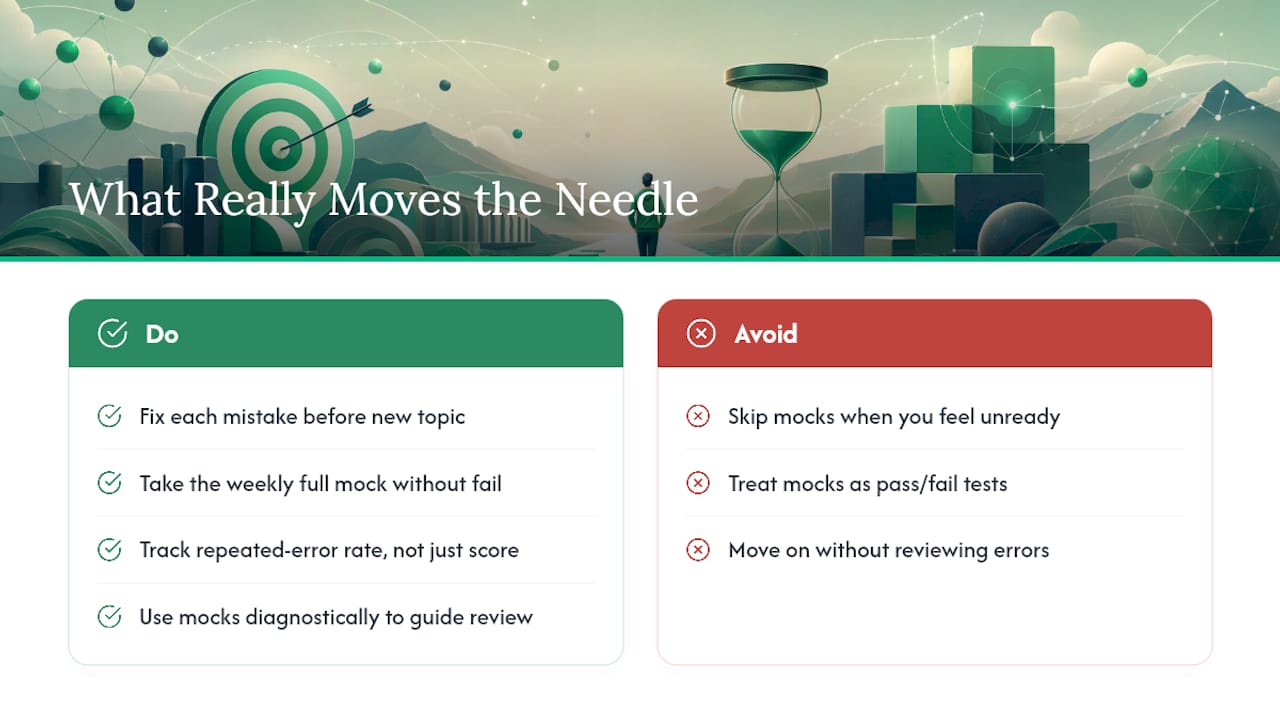
Two rules matter more than any study hack: fix the error you just made before you move to a new topic, and never skip the weekly full mock, even when you feel unready for it. Everything else is secondary.
Progress on the Bocconi test rarely feels linear. You’ll plateau for a week, then jump five or six points after a single focused error-review session. Measure yourself by your repeated-error rate, not just your raw score, since that number tells you whether the plan is working before the score catches up. Students who treat mocks as diagnostic tools rather than pass/fail tests tend to improve faster, simply because they stop repeating the same mistake for weeks at a time.
— quentin
Start Practicing With Prepadmit Today
The platform provides official past papers, on-demand 75-minute mocks, detailed answer corrections, and progress tracking in one place, which means you skip the work of assembling drills and timers from multiple sources. It’s built specifically around the practice plan outlined above, not a generic quiz app repurposed for Bocconi prep, and it costs a fraction of private coaching.
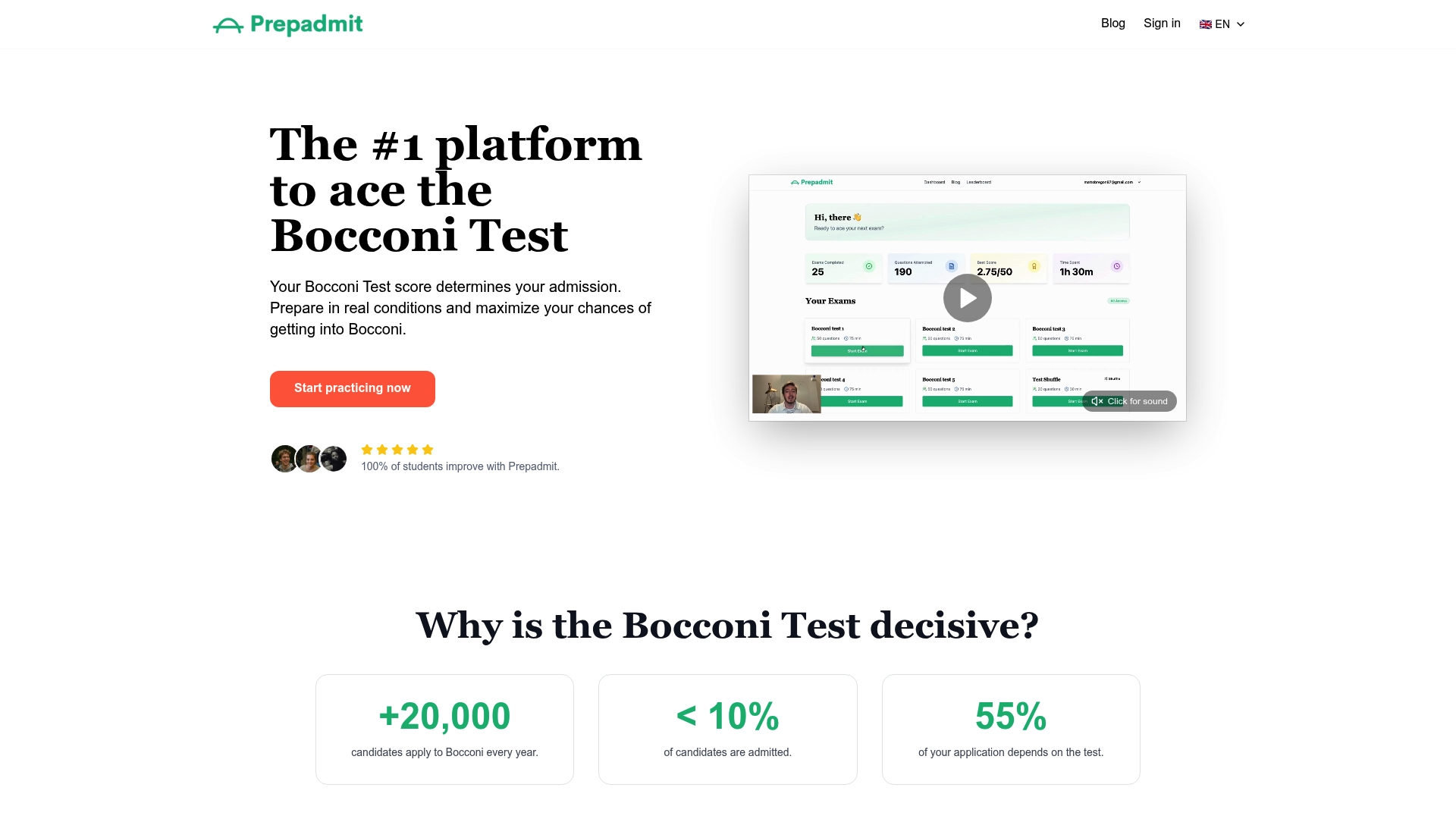
If test anxiety is part of what’s slowing you down, running realistic mocks early removes most of the surprise on exam day… To begin, visit the Bocconi test prep platform and start your first diagnostic mock this week. Students who want a longer runway before test day can also read Prepadmit’s step-by-step preparation guide for a full multi-week plan built on the same principles.
Where to Go Next for Practice and Official Details
For official test format and scoring, start with Edises’ commented exercise guide. For worked examples and a ready-made mock routine, see Prepadmit’s 75-minute mock plan. Students weighing majors before committing to Bocconi prep can also try this free major-choice quiz.
Sources
- Teoria ed esercizi commentati per la preparazione ai test di ammissione (Edises demo PDF)
- Course 2024-2025 a.y. - Universita’ Bocconi (Financial modelling course page)
FAQ
Where can I find exercises for the Bocconi test?
Official past papers and simulazioni are the most reliable source, since they match real question style and scoring. Prepadmit’s on-demand simulations and skill-specific drill modes offer the same format for repeated timed practice.
What GPA do I need to graduate from Bocconi with a 110?
Graduating with the top mark in the Italian university system generally requires consistent high performance across exams throughout your degree, though exact thresholds vary by program and are set by Bocconi itself rather than by any external guide.
Is Bocconi really that difficult?
Bocconi’s admission test and coursework are demanding, largely because of the pace: 75 minutes for 50 questions leaves little room for hesitation. Structured, error-focused practice narrows that difficulty gap more than raw study hours do.
How long should a Bocconi mock exam session last?
A full mock should run exactly 75 minutes, matching the real exam’s time limit and question count. Shorter timed drills on individual sections are useful between mocks but shouldn’t replace the full-length simulation.
How do I stop making the same mistakes on practice tests?
Label each wrong answer by mistake type, write a short reason for the error, drill five similar items, then retest the same concept three days later. This error-classification method is what turns repeated mocks into real score gains.
Recommended
Related articles
Ready to ace your admission test?
Discover PrepAdmit, the platform that helps you succeed at top university admission tests.
Discover PrepAdmit