Bocconi Test Myths: What the Official Rules Say

Bocconi Test Myths: What the Official Rules Say
Most Bocconi Test myths fall apart when you read the official rules: the test is short, the scoring is fixed, and you can retake it. What matters is knowing the format and practicing under real conditions. That is the approach we built Prepadmit around, with official past papers, timed simulations and detailed corrections.
TL;DR
- The test has 50 questions in 75 minutes, and wrong answers cost points, so blind guessing is not free.
- A total score below 17, penalties included, means Bocconi does not consider your application.
- Admission is based on two things only: the test (55%) and your school GPA (45%). Letters and CVs are not read.
- You can take the test up to four times per type, and the portal uses your best score.
- Online tests are reviewed after the fact, so a clean setup matters as much as a good score.
Table of Contents
- Myth 1: “The test is impossible to finish”
- Myth 2: “Guessing always pays off”
- Myth 3: “Any score above zero keeps you in the race”
- Myth 4: “Bocconi reads your motivation letter”
- Myth 5: “One bad attempt ruins everything”
- Myth 6: “The SAT and the Bocconi test are different worlds”
- Myth 7: “Online means easy and unsupervised”
- Myth 8: “Paying the fee signs you up”
- How to prepare without falling for myths
- Practice that matches the real test
- Our view
- FAQ
- Sources
Myth 1: “The test is impossible to finish”
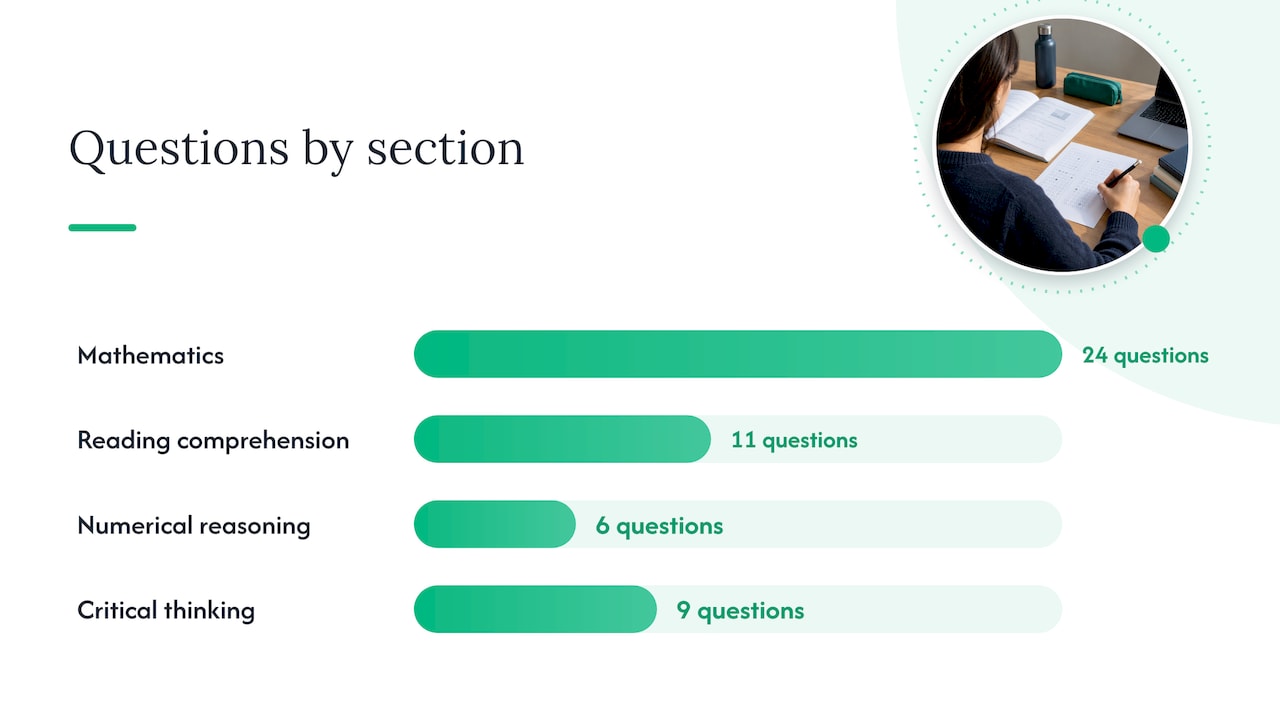
The format is demanding but fixed. According to Bocconi’s official test page, the Bocconi Online Test has 50 multiple-choice questions in 75 minutes. It is SAT-oriented and splits into 24 Mathematics, 11 Reading comprehension, 6 Numerical reasoning and 9 Critical thinking questions.
That gives you about 90 seconds per question. Questions are mixed by difficulty and topic, so you cannot rely on easy ones coming first. The skill to train is pacing: knowing when to move on. Timed simulations teach this far better than untimed study. Our platform recreates the exam with official past papers and on-demand tests, so you learn your own time per section before the real attempt.
If you want a deeper look at what changed in the format, see our guide to the Bocconi Test format and how to practice it.
Myth 2: “Guessing always pays off”
The scoring rule is the part students most often get wrong. Per the same official page, a correct answer gives +1, a blank gives 0, and a wrong answer costs -0.2. On three-option critical thinking questions, a wrong answer costs -0.33.
A worked example
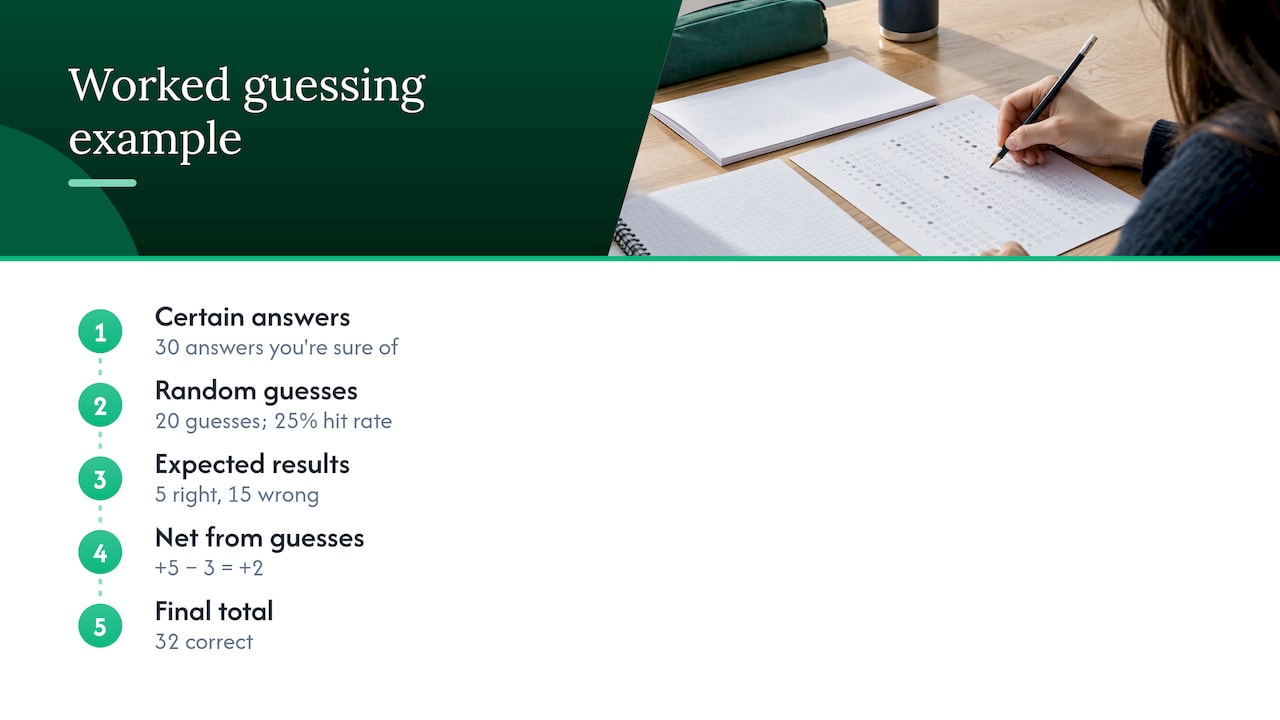
Suppose you are sure of 30 answers, and you answer 20 more at random with a 25% hit rate on four-option questions. You get about 5 right and 15 wrong: +5 - 3 = +2 net from those 20. Your total is 32. That is positive, but only when you can eliminate options. With no elimination, the gain is small and the variance is large.
On three-option questions, a random guess is right a third of the time, which breaks even at the -0.33 penalty only on average. The rule of thumb: guess when you can remove at least one option, skip when you cannot. Our article on penalties and guessing tactics goes through this in more detail.
Myth 3: “Any score above zero keeps you in the race”
It does not. The official page states that a total score below 17, penalties included, means the applicant is not considered. That is the real floor, and it is on a net score, not on the number of questions you answered.
Treat 17 as a safety line, not a target. Competitive programs rank applicants against each other, so you want a margin well above it. Prepadmit’s ranking dashboard shows where you stand against other users, and the platform tracks progress by skill, so you can see whether Mathematics or Critical thinking is dragging you down.
Myth 4: “Bocconi reads your motivation letter”
The admissions page says selection is based solely on two elements: the selection test score at 55% and your third-last and second-last year GPA at 45%. Recommendation letters, motivation letters, CVs and résumés are not considered.
This changes how you spend your time. Weeks spent polishing a CV will not move your ranking. The test is the part you can still change, and it carries more than half the weight. For the GPA side, read how the 55/45 split works.
Myth 5: “One bad attempt ruins everything”
Official rules allow up to four attempts per test type, and the cost is €60 per attempt according to the test page. If you hold several results, such as the Bocconi test and an SAT, you can upload all of them and the portal picks the highest for the final ranking.
Two practical points follow:
- Do not use your first paid attempt as practice. Use the free official simulation first, then realistic mock tests.
- Plan attempts around the deadlines. Booking needs 48 hours’ notice for international applicants, and slots depend on availability. Check the official admissions page for the current session dates, and see our attempts timeline and booking windows guide.
Myth 6: “The SAT and the Bocconi test are different worlds”
They are treated as equivalent. Bocconi says SAT and ACT scores and Bocconi test results are compared through an internal percentile-based conversion. The SAT has minimums of 1040 total and 520 per section (Math 600 for the AI program), and pre-2022 SAT scores are not considered.
So a 1400 SAT is a question about percentile, not a direct pass mark. If you are weighing options, the Bocconi test is the one you can prepare for with exact-format material.
Myth 7: “Online means easy and unsupervised”
The online format is supervised after the fact. Bocconi’s 2026-27 instructions say audio and video recordings are reviewed after the test, not live. Missing streams caused by technical problems outside your control lead to invalidation, but the test can be retaken free of charge. The score report is informational: Bocconi may invalidate a test after results or during enrollment, and serious breaches can bar future attempts.
The same document warns that using different or outdated versions of the required software can interrupt recording and lead to invalidation. That is a safe-use point: install the required software early, test your camera and microphone, and follow the rules to the letter. Our guide on what to prepare for the test setup covers ID and devices.
Myth 8: “Paying the fee signs you up”
Paying and applying are separate. Bocconi lists a €60 test fee per attempt and a separate €100 application fee per School, non-refundable once submitted. Taking a test does not enter you into a selection round: you must submit the application through Apply2B by the deadline, and scores are not pulled automatically from the testing platform, as the admissions page explains. Our registration guide walks through the order of steps.
How to prepare without falling for myths
Bocconi offers free tools: a subject overview, a Faculty app with questions by topic, and a free simulation of 50 questions in 75 minutes with three questions per page and no going back. Use the simulation first as a diagnostic: find weak areas, time each section and compute your score net of penalties.
Then move to targeted practice. That is where we come in.
Practice that matches the real test
Prepadmit is an online platform for the Bocconi Test. It includes simulations based on official past papers, on-demand tests, skill-specific modes, detailed answer corrections, progress tracking and peer ranking, on mobile and desktop. It was developed by experts with backgrounds from HEC and Bocconi. We claim an average score improvement of 34%, and we offer a money-back guarantee. Access the full preparation and start with a timed simulation.
You can also read about percentiles and timed simulations and the non-EU applicant guide if you apply from abroad.
Our view
Most myths share one effect: they send students to the wrong place. Some skip the penalties and guess. Others polish a CV that is never read.
The test is 55% of the ranking, and it is the same format every time. That makes it trainable. We built Prepadmit so that every session looks like the real thing, and every mistake is explained.
Practice a lot, understand your errors, and arrive confident.
quentin
FAQ
How much does the Bocconi test cost?
The official fee is €60 per attempt, with up to four attempts per test type. The application fee is separate: €100 per School. See the official test page.
Is the Bocconi test harder than the SAT?
They are different in format, but Bocconi describes its test as SAT-oriented and converts SAT and Bocconi results through percentiles. The Bocconi test is shorter: 50 questions in 75 minutes. Exam-style practice is the best way to get comfortable.
How do I prepare for the Bocconi test?
Start with the free official simulation to find weak areas and your pace. Then do timed, topic-specific practice and review every mistake. Prepadmit gives you official past papers, corrections and progress tracking in one place.
Can a Bocconi test result be cancelled?
Yes. The score report is informational, and Bocconi may invalidate a test after results if irregularities are found. Follow the instructions and use the required software versions to avoid problems.
Sources
- Online Bocconi test | Bocconi University
- Admissions | Bocconi University
- SAT and ACT | Bocconi University
- Online admission test instructions AY 2026-2027 | Bocconi University
Recommended
Related articles
Ready to ace your admission test?
Discover PrepAdmit, the platform that helps you succeed at top university admission tests.
Discover PrepAdmit