75 Minute Bocconi: 7 Day Prep With Official Checks and Platform Sims

75 Minute Bocconi: 7 Day Prep With Official Checks and Platform Sims
In the final week before the Bocconi Online Test, prioritize timed, full-length simulations and logistics checks over learning new material. The exam consists of multiple questions completed in a timed session, which rewards speed and error correction, not fresh content. Run one official-style mock today, then verify your device, camera, and internet setup before continuing practicing.
TL;DR:
- Prioritize full-length, timed practice exams over learning new material in the final week, focusing on speed, error correction, and logistics.
- Run two to three simulations under test-like conditions, reviewing time per question and error clusters, to build stamina and identify weak areas.
- Complete technical checks of devices, internet, and proctoring setup several days before the exam to prevent disqualification due to technical issues.
- Focus on consolidating known formulas and mental readiness in the last 48 hours, avoiding new content and emphasizing rest and routine preparation.
- Use flexible pacing strategies during the exam, flag questions exceeding 90 seconds, and revisit missed items in a second pass to maximize efficiency.
Table of Contents
- What Does the Bocconi Test Cover in the Settimana Prima Test Bocconi?
- Your Seven-Day Bocconi Test Prep Schedule
- How to Get the Most Out of Timed Full-Length Simulations
- Technical Checklist to Avoid a Bocconi Test-Day Disqualification
- The Last 48 Hours Before Your Bocconi Test
- How to Pace Yourself During the 75-Minute Bocconi Test
- Common Last-Week Mistakes Students Make Before the Bocconi Test
- Why the Final Week Is About Discipline, Not Discovery
- Practice Bocconi Test Simulations With Prepadmit
- Official Bocconi Resources to Check Right Now
- Sources
- FAQ
What Does the Bocconi Test Cover in the Settimana Prima Test Bocconi?
The Bocconi Online Test consists of a set number of multiple-choice questions completed in a strict time window, split across four areas: Mathematics, reading comprehension, numerical reasoning, and critical thinking. There is no official textbook, so your review this week has to come from practice tools that mirror the real interface.
The distribution matters more than most students realize:
- Mathematics: 24 questions (nearly half the test)
- Reading Comprehension: 11 questions
- Numerical Reasoning: 6 questions
- Critical Thinking: 9 questions
With math carrying almost half the weight, your last-week hours should skew heavily toward quick-recall formulas and speeded numerical drills, not toward deep new theory. Reading comprehension and critical thinking, by contrast, respond better to pacing practice than to content review since the skill is speed of interpretation, not memorization. This is exactly the kind of prioritization the question types described for Bocconi’s graduate applicants point toward: data sufficiency and verbal reasoning items reward pattern recognition built through repetition, not last-minute cramming.
Your Seven-Day Bocconi Test Prep Schedule
A week gives you enough time to consolidate weak spots and build test stamina, but only if you follow a structure instead of studying whatever feels urgent that day.
- Days 7 to 5: Targeted topical review paired with short timed drills. Spend 45 to 60 minutes per day on your two weakest question types, using 10 to 15 question sets under a countdown timer.
- Day 4: One full-length simulation at the exact test time of day you’ll sit the real exam, followed by a deep error review lasting at least an hour.
- Days 3 to 2: Lighter sessions focused only on the specific error patterns your Day 4 simulation exposed. No new topics.
- Day 1: Logistics, a light 20-minute review of formulas, and rest. No drills, no simulations.
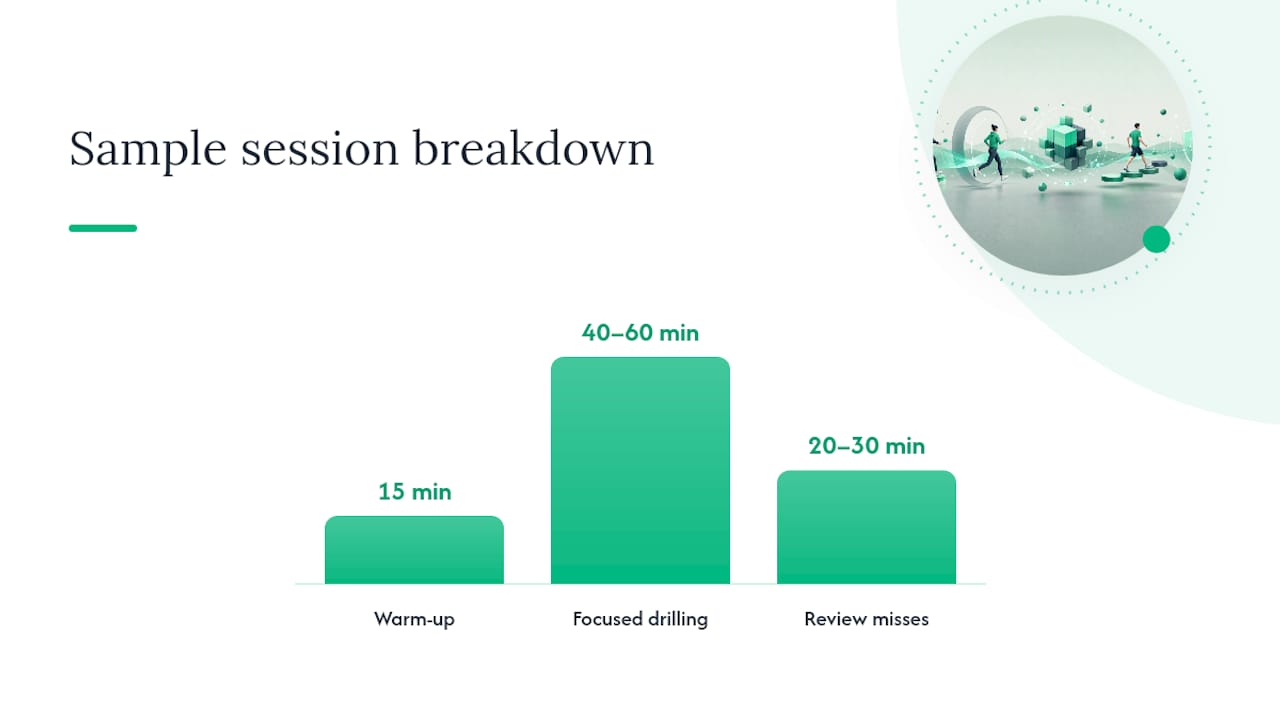
A sample session on Days 7 through 5 should run: 15 minutes of warm-up questions to activate recall, 40 to 60 minutes of focused drilling on one weak area, then 20 to 30 minutes reviewing every miss line by line.
Pro Tip: Study tips for Bocconi test week almost always underrate rest days. Building one lighter day into the middle of the week (not just Day 1) prevents the fatigue that quietly tanks Day 4’s simulation score.
How to Get the Most Out of Timed Full-Length Simulations
A simulation only works if it behaves like the real test. That means no notes nearby, the same device and browser you’ll use on test day, and a proctoring setup that matches Bocconi’s actual conditions as closely as you can replicate at home. Treat the timer as non-negotiable. Pausing defeats the entire point of the exercise.
After each run, review three things:
- Time per question, flagging anything that took longer than 90 seconds
- Error clusters by topic, not just a raw score
- Error type, distinguishing careless mistakes from genuine knowledge gaps
Build a one-page corrective plan from that breakdown before your next session. Full-length timed simulations under identical conditions are widely regarded as the single most effective way to build speed and stamina in the days before a proctored exam. Two to three full simulations across the week is typically enough. Beyond that, returns drop and fatigue starts working against you.
Technical Checklist to Avoid a Bocconi Test-Day Disqualification
Read the official “Instructions and Rules of Conduct” before you do anything else this week. It lists the permitted devices and the behavior rules enforced under remote proctoring, and violating them can invalidate your attempt regardless of how well you scored.
Three to four days out, run this checklist:
- Test your camera, microphone, and internet connection together, not separately
- Confirm your room has plain lighting, a neutral background, and no one else present during the window
- Save screenshots of your ID and test confirmation somewhere you can find them fast
- Charge your primary device fully and identify a backup (a second laptop, a hotspot) in case something fails
Candidates who test their full technical stack several days ahead consistently report less day-of anxiety, mostly because the unknowns get resolved while there’s still time to fix them.
Pro Tip: Bocconi test week schedule planning should treat the technical dry run as seriously as a content review session. A dropped connection mid-exam is a logistics failure, not a knowledge gap, and it’s entirely preventable.
The Last 48 Hours Before Your Bocconi Test
No new topics. At this point, new material only crowds out what you already know well.
Instead:
- Skim formula sheets and quick heuristics you’ve already drilled, not fresh ones
- Prepare your ID, confirmation documents, and whatever you’ll wear on test day
- Protect your sleep window and eat a normal, familiar meal the night before. This is not the time to experiment with new routines
- Run one short, low-stakes mock if it settles your nerves, but treat rest as the priority over the final hours
- On the morning of the test, use a five-minute mental warm-up: a few easy practice questions, not a full section, just enough to activate recall without inducing panic
- Have a contingency plan ready (backup device, alternate internet source) in case your connection drops during the exam
How to Pace Yourself During the 75-Minute Bocconi Test
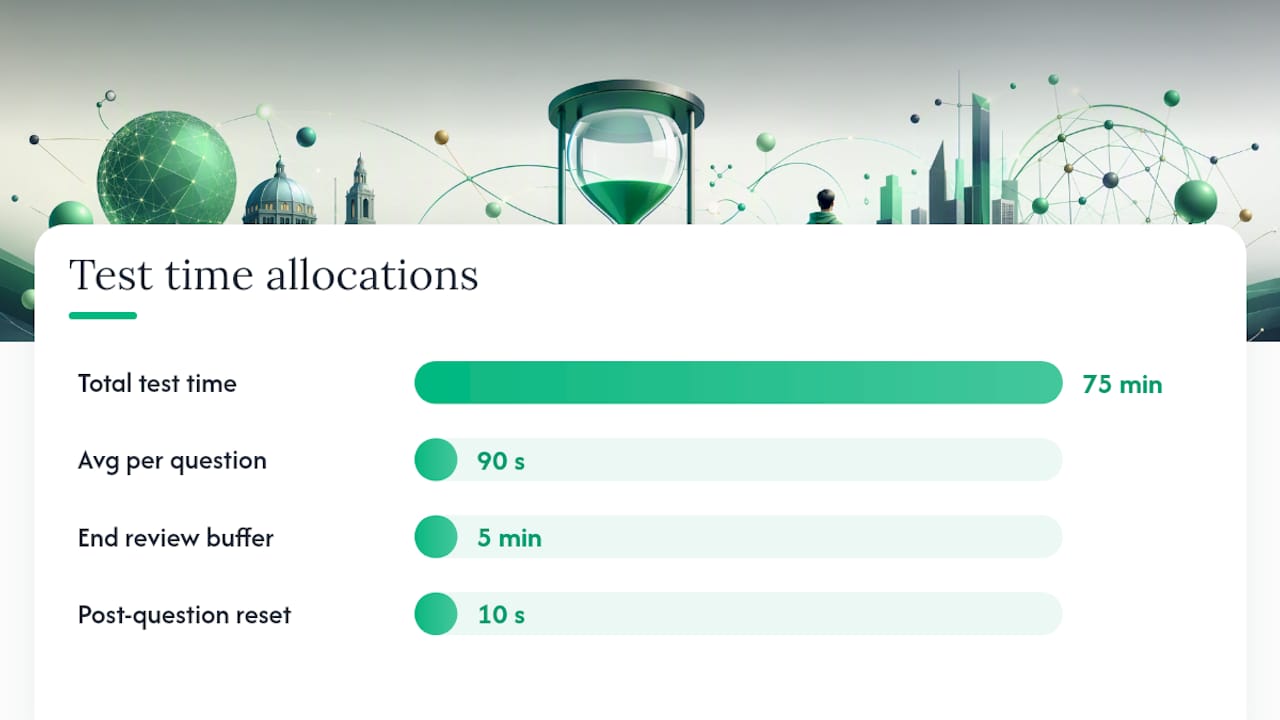
Fifty questions in 75 minutes works out to roughly 90 seconds per question on average, but the smart approach isn’t uniform pacing. Math questions often take longer than reading comprehension items, so budget accordingly rather than splitting time evenly across all 50.
- Set a personal flag threshold. Any question taking longer than 90 seconds gets flagged and skipped, not fought over.
- Return to flagged questions in a second pass once you’ve cleared every question you can answer quickly.
- Build in a five-minute buffer at the end for a final review pass, not for solving new problems.
- Use a ten-second reset after a tough question: one slow breath, shoulders down, eyes off the screen for a beat before moving on.
A skip-and-return routine tuned by your own simulation data beats generic pacing advice, since your slow spots are specific to you, not a universal pattern.
Pro Tip: Bocconi exam strategies that rely on rigid per-question timing often fall apart under real pressure. A flexible flag-and-return system adapts when one section runs long.
Common Last-Week Mistakes Students Make Before the Bocconi Test
The same errors show up every test week:
- Cramming new topics instead of consolidating what you already know. Fix: cut study hours, not increase them, and schedule a mock test instead
- Skipping the technical dry run until the night before. Fix: run the device check three to four days out, not the day before
- Ignoring timed practice in favor of untimed review. Fix: every practice session this week should have a clock running
- Sacrificing sleep for one more study hour. Fix: protect the sleep window; a tired brain loses more points than an extra hour of review gains
Why the Final Week Is About Discipline, Not Discovery
Most students treat the last week like a smaller version of the last month, just more intense. That’s backwards. The final week works best as a discipline exercise: sticking to a schedule, respecting the timer, and trusting the preparation already done. The BLUF holds up because it’s grounded in the test’s own mechanics: 75 minutes leaves almost no room for hesitation, and a strong content base loses value fast if execution falls apart. Run one full mock today, confirm the rules tonight, and give your brain the rest it needs to perform.
— quentin
Practice Bocconi Test Simulations With Prepadmit
Prepadmit gives you what a generic study guide can’t: official-format simulations built to match the real exam’s timing and structure, detailed answer corrections that show exactly where and why you lost points, and progress tracking that turns this week’s mocks into a corrective plan instead of a guessing game.
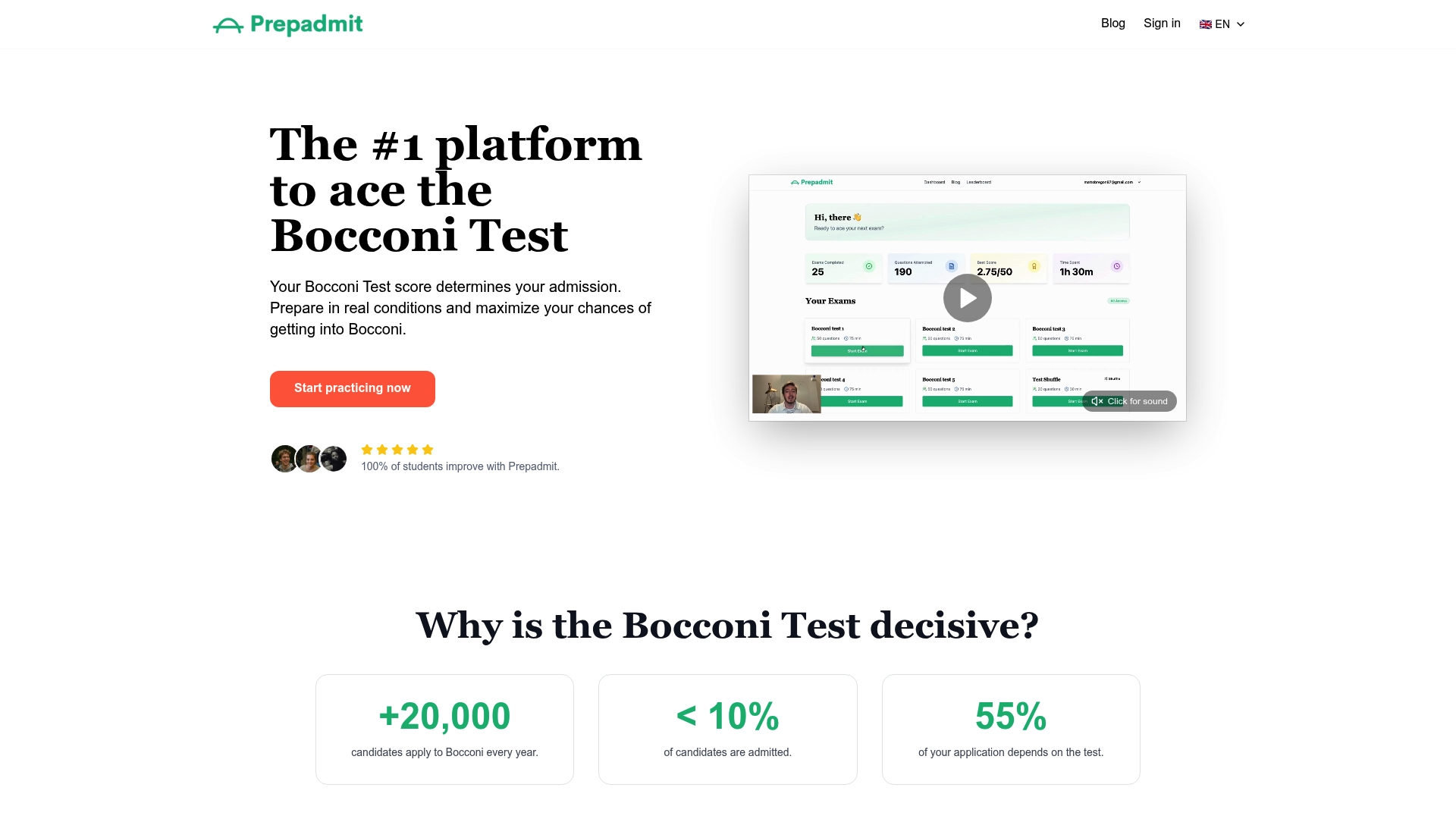
The platform is designed to support score improvement through targeted, realistic practice rather than raw study hours. If your last-week schedule includes the full-length simulations this article recommends, running them on a platform that mirrors the real test format removes one more variable from test day. Trying the platform this week carries little downside if you’re still deciding how to spend your remaining study hours. Visit the Prepadmit test prep platform now and run your first timed simulation before the day ends.
Official Bocconi Resources to Check Right Now
Confirm the exam structure on the official Bocconi test page, then read the Instructions and Rules of Conduct PDF for device and proctoring rules. Check the WebTesting platform for booking windows, since it typically closes before application deadlines.
Sources
FAQ
What Are the Bocconi Test Session Dates?
Session dates and booking windows are published on the official Bocconi admissions page, and the WebTesting platform typically closes a few days before each application deadline, so book early rather than waiting.
How Hard Is the Bocconi Test?
The test compresses 50 questions across math, reading comprehension, numerical reasoning, and critical thinking into 75 minutes, which makes speed and time management as decisive as raw content knowledge.
What Counts as a Good Bocconi Test Score?
Bocconi doesn’t publish a universal “good score” threshold since results are evaluated within each admission cycle’s applicant pool, so the more useful benchmark is your own improvement across full-length practice simulations in the weeks before test day.
How Should I Prepare for the Bocconi Test in the Final Week?
Focus on timed full-length simulations, targeted drills on your weakest question types, and technical setup checks rather than new content. Platforms like Prepadmit are built specifically for this kind of realistic, last-week practice.
Recommended
Related articles
Ready to ace your admission test?
Discover PrepAdmit, the platform that helps you succeed at top university admission tests.
Discover PrepAdmit