Numerical Reasoning at the Bocconi Test: What to Expect

Numerical Reasoning at the Bocconi Test: What to Expect
The numerical reasoning section on the Online Bocconi Test consists of just 6 questions out of 50 total, spread across a 75-minute exam. Despite the modest question count, this section trips up more candidates than any other, mostly because it looks like a math test and behaves like a data-reading test. You’re not solving equations. You’re extracting the right number from a chart, table, or short passage before the clock runs out.
Two things to do right now, before you read another paragraph:
- Take a full 50-question simulation under real timing to see where you currently stand.
- Start daily 15 to 30 minute chart-reading drills, even before you touch a single formula.
The real skill being tested isn’t algebra. It’s speed and precision in pulling the correct figure out of a table full of distractors, then doing simple arithmetic. Bocconi’s own guidance backs this up directly: the official test page notes that computations are generally simple, and the difficulty lies in identifying which data actually matters.
Key Takeaways
Success on the Bocconi numerical reasoning section depends less on math ability and more on fast, accurate data extraction under a strict per-question time budget.
| Point | Details |
|---|---|
| Know the section size | Only 6 of 50 questions test numerical reasoning, so mastering pacing matters more than mastering advanced math. |
| Target 60 to 90 seconds | Budget less time on straightforward items and more only when the chart genuinely requires careful reading. |
| Drill chart reading daily | Spend 15 to 30 minutes a day identifying the correct series, label, and base before calculating anything. |
| Practice with full timed mocks | Mixed-section simulations expose whether your numerical pacing holds up once fatigue sets in. |
| Review every wrong answer | Detailed corrections after each mock reveal recurring error patterns faster than repeated blind practice. |
Table of Contents
- What Does Ragionamento Numerico Test on the Bocconi Exam?
- Solved Practice Questions With Fast Answer Methods
- How Much Time Should You Spend on Each Question?
- Turning Practice Into a Measurable Score Gain
- Mistakes That Cost the Most Points on Test Day
- Where to Go for Official Rules and More Practice
- Why the Solved-Example Approach Beats Generic Math Review
- Frequently Asked Questions
- Sources
What Does Ragionamento Numerico Test on the Bocconi Exam?
Numerical reasoning on the Bocconi Test rarely asks you to calculate something complicated. It asks you to find the right number, fast, inside a display designed to slow you down.
The question formats repeat across test cycles, which means you can prepare for them specifically rather than studying math in the abstract. Expect to see:
- Bar charts asking for a share of total or a percentage difference between two categories.
- Line charts tracking a trend over several years, often with a “which year had the highest growth” twist.
- Pie charts requiring you to convert a visual slice into a percentage or absolute value.
- Tables with multiple rows and columns where only two cells actually matter for the question.
- Short numeric passages, a paragraph with two or three figures embedded in text, that function like a mini word problem.
- Data-sufficiency style prompts that ask whether enough information exists to answer, without asking you to compute the final number.
Underneath these formats sits a fairly narrow syllabus. Bocconi’s own guidance lists percentages, unit conversions, ordering of real numbers, and basic arithmetic operations as the core competencies, alongside ratios and simple growth calculations. None of this requires calculus or advanced statistics. It requires fluency.
Here’s what separates a strong score from an average one:
- Correctly identifying which row, column, or label the question is actually asking about.
- Ignoring numbers that look relevant but belong to a different category or year.
- Converting units (thousands to millions, percentages to raw figures) without losing a decimal place.
- Recognizing when a chart’s axis starts at a nonzero value, which can make small differences look dramatic.
Bocconi’s guidance frames this explicitly as a test of numerical critical reasoning rather than pure math ability. That framing matters for how you prepare for the Bocconi test: drilling long division won’t help you nearly as much as practicing fast, accurate chart reading under a ticking clock.
Solved Practice Questions With Fast Answer Methods
Reading about numerical reasoning strategy only gets you so far. What moves your score is working through the same item types you’ll face on test day, with a method you can repeat under pressure. Below are ten exercises modeled on the common formats Bocconi uses, each with a fast solution path and a speed tip you can reuse.
1. Share of total from a bar chart
A company’s revenue by region: North $120,000, South $80,000, East $60,000, West $40,000. What percentage of total revenue comes from the South?
Fastest path: Add the four regions ($300,000), then divide South’s figure by the total. Skip converting to decimals until the final step.
Solution: $80,000 / $300,000 = 26.7%.
Speed tip: Round $300,000 to a clean denominator mentally before dividing. Estimating 80/300 as roughly “a bit more than a quarter” gets you to the right answer choice without touching a calculator.
2. Percentage change year over year
Sales rose from 240 units in 2024 to 300 units in 2025. What was the percentage increase?
Fastest path: Find the difference (60), then divide by the original value, not the new one.
Solution: 60 / 240 = 25%.
Speed tip: The single most common trap here is dividing by the wrong base. Always divide the change by the starting figure, never the ending one.
3. Discount plus VAT
An item costs $200 before a 15% discount, then 22% VAT is applied to the discounted price. What is the final price?
Fastest path: Apply the discount first (200 x 0.85 = 170), then apply VAT to that new figure (170 x 1.22).
Solution: $207.40.
Speed tip: Never add the discount and tax percentages together. They apply sequentially, not as a single combined adjustment.
4. Unit conversion inside a table
A table lists production in metric tons per quarter. Q1 shows 4,500 kg. Convert to metric tons and identify what fraction of the annual total (18 metric tons) Q1 represents.
Fastest path: Convert 4,500 kg to 4.5 metric tons first, then compare to the annual figure.
Speed tip: Do the unit conversion before any other math. Mixing units mid-calculation is where most errors creep in.
5. Simple compound growth
An investment of $1,000 grows at 10% annually. What is its approximate value after two years?
Solution: $1,000 x 1.10 x 1.10 = $1,210.
6. Data-sufficiency style prompt
A chart shows total company expenses but not the breakdown by department. Can you answer with the data given?
Fastest path: Check whether the department breakdown appears anywhere in the display.
Solution: No, the information is insufficient without the departmental figures.
Speed tip: Data-sufficiency questions reward recognizing what’s missing faster than what’s present. Don’t waste time trying to estimate an answer that isn’t calculable.
7. Ratio comparison across two tables
Table A shows a company’s staff count (150) and Table B shows its revenue ($3 million). A second company has 200 staff and $3.6 million revenue. Which company has higher revenue per employee?
Fastest path: Divide revenue by staff count for both companies rather than comparing raw totals.
Solution: Company A: $20,000 per employee. Company B: $18,000 per employee. Company A is higher.
Speed tip: Whenever a question compares two entities of different sizes, convert to a per-unit rate before comparing anything.
8. Reading the correct series from a multi-line chart
A line chart shows three products’ sales over five years. The question asks about “Product B” specifically. Which line do you read?
Fastest path: Confirm the legend before reading any values, not after.
Solution: Underline or mentally flag the correct legend entry, then trace only that line.
Speed tip: This is less a math problem than an attention problem. Bocconi’s guidance notes this kind of misidentification is the single most common source of numerical reasoning errors.
9. Percentage of a percentage
What percentage of the total sample is both a Product X preference and under 25?
Fastest path: Multiply the two percentages directly rather than converting to raw numbers first.
Speed tip: Percentage-of-a-percentage questions almost always require multiplication, not addition. Adding the two figures is the most frequent wrong-answer trap.
10. Rounding and estimation under pressure
A table shows quarterly revenue figures with several decimal places. The question asks for an approximate annual total.
Fastest path: Round each quarter to the nearest whole number before adding.
Solution: Add the rounded figures for a fast, accurate-enough estimate.
Recognizing these instantly, instead of dividing manually, can shave several seconds off nearly every numerical item.
The pattern across all ten: identify the correct base, isolate the relevant data, and round early rather than chasing decimal precision. That’s the entire game.
How Much Time Should You Spend on Each Question?
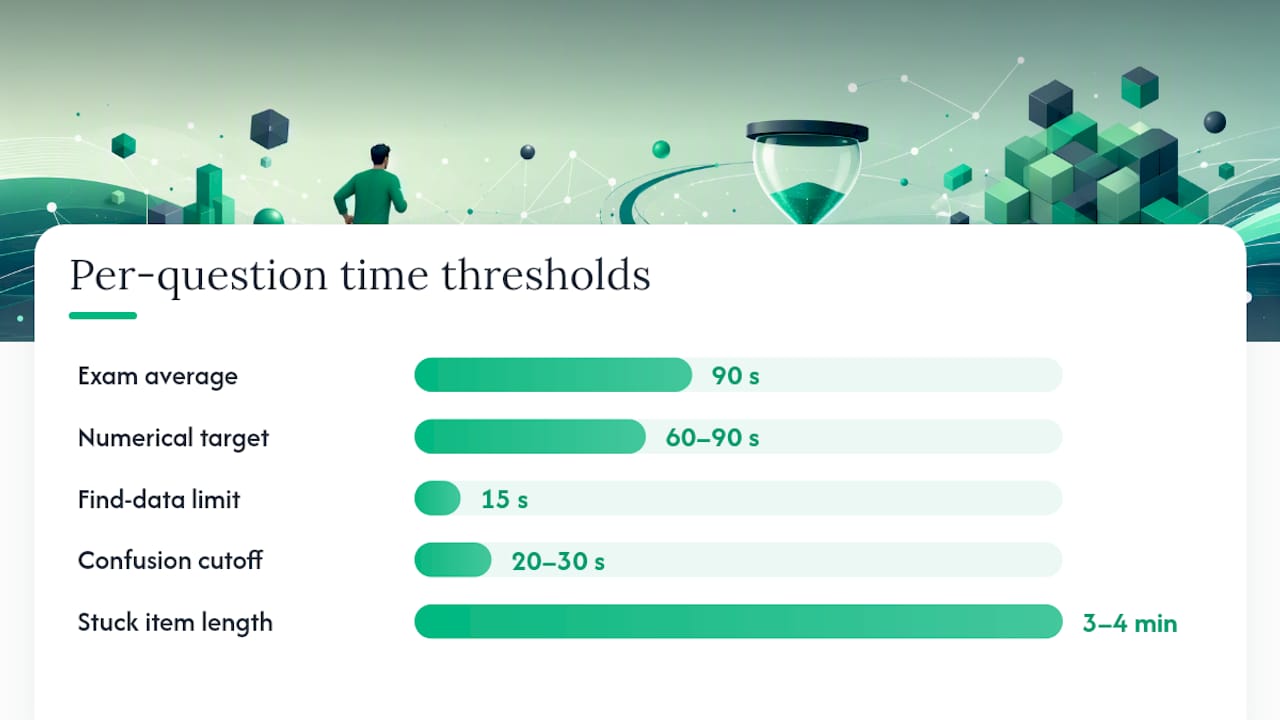
With 50 questions in 75 minutes, the exam averages out to about 90 seconds per question across every section combined. Numerical reasoning items, because they involve reading a chart before you can even start calculating, deserve a slightly tighter internal budget: aim for 60 to 90 seconds depending on how complex the display looks at first glance.
That budget isn’t arbitrary. It’s a direct consequence of the exam’s overall structure, and treating every question as equally worth your time is one of the fastest ways to run out of clock before you reach the end.
Time reality check: At 75 minutes for 50 questions, you have almost no room for a single item that eats three or four minutes. One stuck question can cost you two or three others you would have answered correctly.
A workable skip strategy looks like this:
- If you can identify the right data within 15 seconds, proceed and solve.
- If the chart is genuinely confusing after 20 to 30 seconds, mark it and move on rather than staring at it.
- Return to marked questions only after finishing the rest of the section, using leftover time.
- Calibrate your personal skip threshold in practice mocks: if you answer correctly more than 70% of the time when you feel confident, trust that instinct on test day rather than second-guessing every response.
Practicing this pacing only works if you do it under real conditions. Mixed-section timed mocks, not isolated numerical drills, are what expose whether your 90-second budget actually holds up when fatigue and section-switching enter the picture. Running full simulations and reviewing sectional diagnostics afterward tells you whether your numerical reasoning pace is the bottleneck or whether another section is quietly eating your time. It’s also worth checking whether a calculator is permitted during the exam, since that changes how much mental arithmetic fluency you need to build in advance.
Turning Practice Into a Measurable Score Gain
Reading about strategy builds awareness. Repetition under realistic conditions builds speed. The gap between those two is where most candidates lose points they were fully capable of earning.
Prepadmit was built specifically to close that gap for the Bocconi Test, using official past papers and skill-specific drill modes rather than generic aptitude-test material. Here’s how to structure your use of the platform around the numerical reasoning section specifically:
- Run official past-paper simulations first to establish your true baseline, not your assumed one.
- Switch to skill-specific drill mode for chart and table reading once you know which item type is costing you the most time.
- Track your accuracy and speed over time using the platform’s progress dashboards, and compare your pace against peers on the ranking leaderboard.
- After every mock, review the detailed answer corrections line by line. A wrong answer without a reviewed explanation teaches you almost nothing.
A realistic 4 to 8 week plan built around this cycle looks like 15 to 30 minutes of daily targeted drills (charts one day, percentages the next, unit conversions after that) combined with one full timed simulation each week. This mirrors the pacing recommended in longer 12-week Bocconi study plans, compressed for candidates working with a shorter runway. If your numerical reasoning practice is consistently landing you below your target, it’s also worth cross-training with dedicated math exercises to shore up the underlying arithmetic fluency before returning to timed chart drills.
Pro Tip: Don’t just track your overall score. Track accuracy by question type (chart reading vs. percentages vs. unit conversions) so you know exactly which 15-minute drill session will move your score the most.
Prepadmit was developed by a team with backgrounds from institutions including HEC and Bocconi itself, and the platform reports an average score improvement among users who complete its full practice program. It’s positioned as a lower-cost alternative to private coaching, backed by a money-back guarantee for candidates who put in the practice and don’t see results.
Mistakes That Cost the Most Points on Test Day
Three errors account for the overwhelming majority of lost points in this section, and every one of them is fixable with a habit change rather than more math study.
Mistake: confusing the percentage base. Candidates frequently divide by the new value instead of the original one, or by the wrong row entirely.

Correction: Before you touch a calculator, say out loud (mentally) what the base is and what units it’s in.
Mistake: reading the wrong series from a chart. With multiple lines, bars, or table columns on screen, it’s easy to solve the right math on the wrong data.
Correction: Underline or circle the exact label the question references, then cross-check your final answer against the total shown elsewhere on the chart.
Mistake: over-calculating under time pressure. Chasing three decimal places on a question that only needs a rough estimate wastes seconds you don’t have.
Correction: Round early, use elimination among the answer choices, and trust an estimate that’s clearly closest to one option.
Pro Tip: When two answer choices are close, don’t recalculate from scratch. Instead, check which direction your rounding pushed you and adjust toward the nearer choice.
Where to Go for Official Rules and More Practice
Start with Bocconi’s own official test page for the current syllabus and any official simulation tools. For worked examples beyond what’s covered here, sample question sets offer additional practice with similar item types. For structured, timed practice built specifically around the Bocconi format, Prepadmit’s platform provides past papers, drills, and corrections in one place. If you want a broader look at pacing strategy from a different but related aptitude-test tradition, this logical reasoning strategy guide covers similar time-management principles.
Why the Solved-Example Approach Beats Generic Math Review
Most advice on this topic treats numerical reasoning like a math refresher: brush up on percentages, review ratios, done. That misses what actually separates high scorers from everyone else. The six numerical questions on the Bocconi Test aren’t measuring whether you remember how percentages work. They’re measuring whether you can find the right number in a cluttered table in under a minute while your brain is also tracking four other sections.
Generic math review is not wasted time, but it’s the smaller half of the problem. The bigger half is pattern recognition: knowing instantly what a share-of-total question looks like versus a percentage-change question, so you’re not reasoning from first principles every single time. That’s a skill built through repetition on realistic material, not through textbook chapters.
If there’s one thing worth prioritizing above everything else in this article, it’s timed practice on the actual item formats, not isolated math drills done at your own pace. Speed under pressure is the bottleneck for almost every candidate. Fix that first, and the arithmetic mostly takes care of itself.
Frequently Asked Questions
How many numerical reasoning questions are on the Bocconi Test? The Online Bocconi Test includes 6 numerical reasoning questions out of 50 total questions, within a 75-minute exam window.
Is the math on the numerical reasoning section difficult? No. Bocconi’s own guidance states that computations are generally simple. The real challenge is identifying the correct data inside a chart or table quickly, not performing complex calculations.
How is Bocconi’s numerical reasoning different from tests like the GMAT or SHL assessments? Bocconi’s version leans more heavily on data interpretation, reading charts, tables, and percentages, with lighter arithmetic demands than the GMAT’s quantitative section, which often includes more abstract algebra and problem-solving. It’s closer in spirit to an SHL-style numerical test, which also emphasizes data extraction speed over advanced computation.
Can I use a calculator during the numerical reasoning section? Calculator policy details are covered in Bocconi’s official test rules. It’s worth confirming the current calculator policy before your test date, since it affects how much mental math fluency you should build in advance.
How long should I spend preparing specifically for numerical reasoning? A focused 4 to 8 week plan with daily short drills and weekly full timed simulations is typically enough, since the section only accounts for 6 questions. Candidates on a longer runway sometimes follow 12-week study plans that integrate numerical practice with the rest of the exam.
What score improvement can I realistically expect from focused practice? Results vary by starting point and practice consistency, but platforms built around targeted, timed drills report measurable gains for users who complete a full practice program rather than sporadic review.
Sources
Recommended
Related articles
Ready to ace your admission test?
Discover PrepAdmit, the platform that helps you succeed at top university admission tests.
Discover PrepAdmit