Book Early, Use Four Attempts: Timeline for Bocconi Applicants

Book Early, Use Four Attempts: Timeline for Bocconi Applicants
You get up to four attempts per test type each academic year, but the booking window closes days before every application deadline, so slots disappear fast. Book your first attempt as soon as the platform opens. Space any retakes with at least a two-day gap and wait at least 24 hours between purchases, so every attempt you make stays valid for the round you’re targeting.
TL;DR:
- Booking opens months before each application deadline but closes a few days prior, so early scheduling is crucial to avoid missing the round.
- You can take up to four attempts per test type annually, with at least 48 hours’ lead time and 24 hours between purchases, making last-minute cram strategies ineffective.
- The system accepts multiple test scores and automatically selects the highest, so early attempts serve as diagnostic tools rather than final efforts.
- Structuring your testing cycle around targeted review and timed practice is more effective than unstructured studying, especially given Bocconi’s scoring and attempt policies.
- Using a dedicated preparation platform that simulates official conditions and tracks progress can lead to significant score improvements, optimizing the limited attempt window.
Table of Contents
- Cronologia Tentativi Bocconi: When the Platform Opens and Closes
- Official Rules: Attempt Limits, Spacing, and Fees
- How Bocconi Uses Your Scores Across Rounds
- Building Your Attempt Schedule: A Practical Timeline
- Booking Checklist: What to Confirm Before You Pay
- Treat Every Attempt as a Staged Experiment
- A Preparation Platform Built Around This Exact Timeline
- Sources
- FAQ
Cronologia Tentativi Bocconi: When the Platform Opens and Closes
The webtesting platform opens for a specified period each cycle, then shuts down a few days before each application deadline, and reopens only for the next round. Missing that closure date means missing your shot at that round entirely, regardless of how many attempts you have left on paper.
For the 2027/28 cycle, booking is expected to open in mid-July, with Italian applicants generally seeing a window spanning several months, though the exact dates depend on your applicant category. International and Italian booking windows don’t always align, so check which category applies to you before assuming a date is correct.
A few concrete examples make this easier to plan around. The Online Bocconi Test page lists an Early Session example where the last bookable attempt fell around September 24, 2026, and a Winter Session example with a final available date around January 21, 2027. Treat these as illustrations of how tight the margin gets, not as fixed dates for your own cycle.
What this means for your planning:
- Booking windows open months before the actual deadline, but they don’t stay open until the deadline itself.
- The platform typically closes several days before the deadline, not on the deadline.
- You need at least one completed attempt before that closure to be eligible for the round.
- Always verify current dates on the official admissions page before locking in a schedule, since cutoffs shift slightly year to year.
Official Rules: Attempt Limits, Spacing, and Fees
Bocconi treats each test type as its own separate quota. Here’s what governs how many times you can sit the exam and how you have to space those sittings out:
- You get up to four attempts per test type each academic year, with BOT and BOT-Law counted separately.
- You cannot take two attempts on the same or consecutive days. There has to be a gap.
- Booking requires a lead time of at least 48 hours before the test date.
- If purchasing multiple attempts, at least 24 hours must pass between purchases.
- Fees and scheduling details vary by applicant category, so applicants should check their specific terms.
Bocconi caps you at four attempts per test type each year, and every attempt needs a 48-hour booking lead time. That single fact eliminates the option of a same-week cram-and-retake strategy. If you wait until three weeks before a deadline to book your first attempt, you may only get one or two shots before the window closes, not four.
The test itself runs 50 questions in 75 minutes, with scoring that rewards correct answers, leaves blanks neutral, and penalizes wrong answers on some question types. That pacing, roughly 90 seconds per question, is worth practicing under timed conditions long before your actual attempt.
How Bocconi Uses Your Scores Across Rounds
You don’t have to pick your “best” attempt yourself. The admissions portal accepts multiple test results and automatically selects the most competitive score when ranking your application. A weaker early attempt doesn’t drag down a stronger later one.
There’s a second layer that matters just as much: a test taken within a booking window generally counts for that selection round, and can often carry forward to later rounds too. That means an attempt made for Early Session isn’t wasted if you end up applying in a later round instead.
A few practical implications follow from this:
- Taking an attempt sooner rather than later gives the system more scores to choose from, not fewer options.
- There’s little downside to testing early since a low score simply gets replaced by a better one later.
- Applying during Early Session may improve your admission chances and provide earlier access to financial aid, according to Bocconi admissions guidance.
If you’re weighing whether to wait and prepare longer or test now and retest later, the scoring system favors testing now.
Building Your Attempt Schedule: A Practical Timeline
Spacing attempts appropriately is important; recommendations suggest several weeks between full attempts to allow time for improvement while using the available attempts effectively.
- Book your first attempt as a diagnostic. Don’t wait until you feel “ready.” Your first sitting exists to show you where you actually stand, not to be your best score.
- Review every wrong answer within 48 hours of getting results. Sort mistakes into categories: careless errors, timing pressure, or genuine knowledge gaps. Each category needs a different fix.
- Set a measurable target for the next attempt. “Improve logic score by 15%” beats “do better” because you can actually track it.
- Spend the weeks between attempts on timed simulations of the real format, 50 questions in 75 minutes, plus drills on your two or three weakest skill areas.
- Book the next attempt with enough lead time to hit the 48-hour rule comfortably, rather than scrambling against the closure date.
Pro Tip: Treat your first attempt like a lab test, not a final exam. The goal isn’t a good score, it’s a clear map of exactly where your points are leaking.
This is where structured practice tools earn their place. Simulating official-paper conditions and tracking your accuracy by skill area between attempts turns four vague chances into four measured improvements. A step-by-step preparation plan built around this cycle tends to outperform unstructured extra studying.
Booking Checklist: What to Confirm Before You Pay
Run through this before you commit to a booking date:
- Confirm your applicant category (Italian resident vs. international), since booking windows differ.
- Check that your chosen date falls at least 48 hours after today, per the official minimum.
- Verify 24 hours have passed since your last purchase if you’re booking a second or later attempt.
- Have payment ready and confirm your ID matches what’s required for verification.
- Test your device, browser, and internet connection ahead of time, not the morning of the exam.
- Keep a printer or scanner available in case supporting documents are requested.
If something goes wrong during booking or payment, use the designated support form in the official instructions PDF rather than a general admissions inbox. General email queues move slowly during peak booking weeks, and the specified channel routes technical issues faster. If the platform shows as closed for your target round, that closure is final for that round. Your only option is to plan for the next round’s reopening.
Treat Every Attempt as a Staged Experiment
Four attempts sound generous until you realize most applicants burn two of them without a real plan. The smarter approach treats each attempt as a stage: diagnose weaknesses first, then drill those specific gaps, then retest to confirm the fix actually worked.
Booking early matters less for the sake of urgency and more because it buys you room to fail productively. A disciplined review process between attempts beats random additional practice every time, since Bocconi’s best-score policy means your early attempts carry no risk beyond the time they cost.
— quentin
A Preparation Platform Built Around This Exact Timeline
Prepadmit gives you a way to actually act on the diagnostic-then-drill cycle instead of guessing at it. The platform runs official-paper simulations under real timed conditions, breaks down every wrong answer in detail, and lets you drill specific skill areas between attempts instead of restudying everything from scratch.
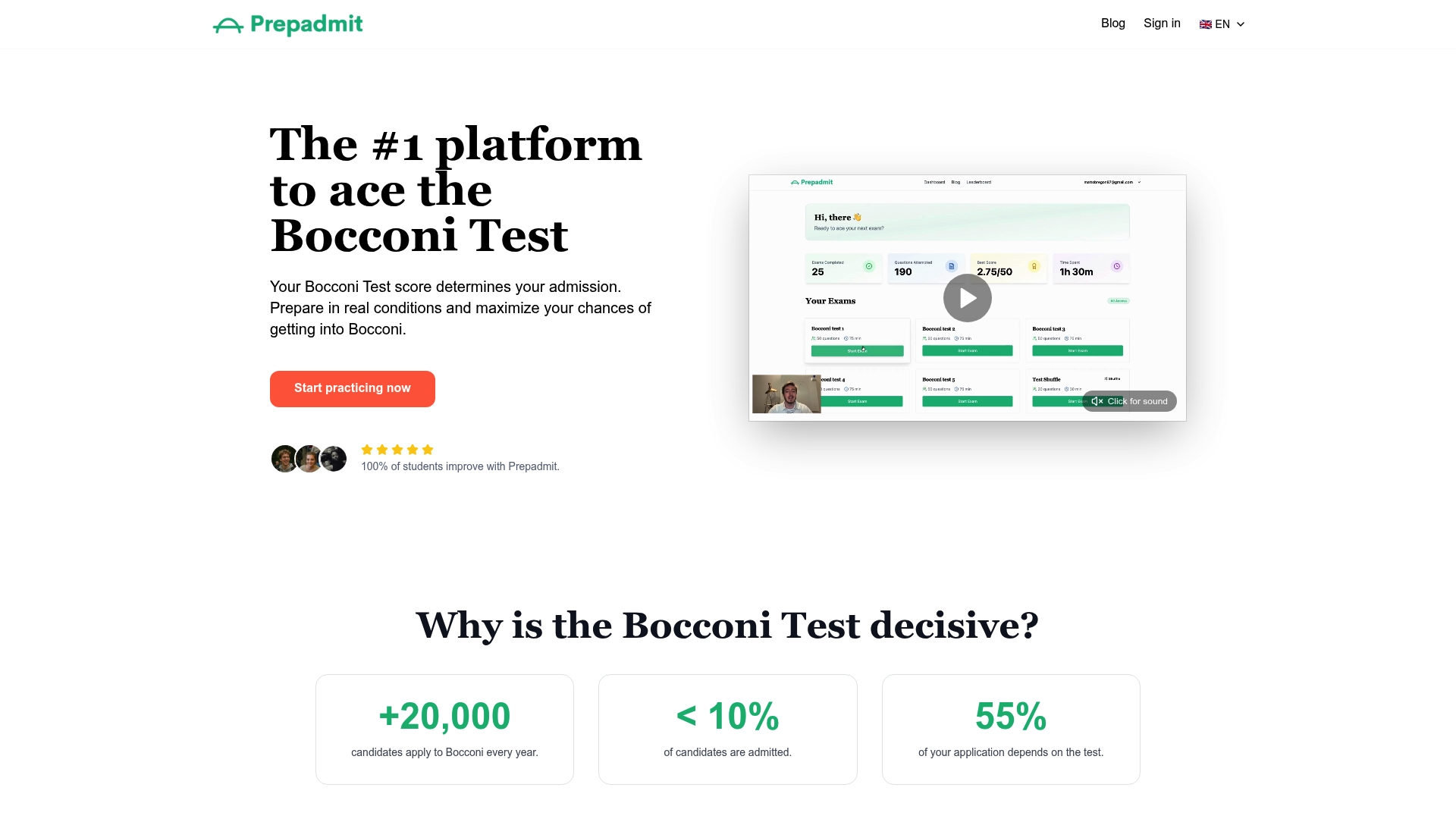
That structure maps directly onto the four-attempt limit and 4 to 6 week spacing described above. You take a diagnostic simulation, see exactly where points are slipping through progress tracking and peer ranking, then spend the weeks before your next booking fixing those specific gaps rather than reviewing at random. Prepadmit reports an average score improvement of 34% among users who train this way, developed by a team with backgrounds from HEC and Bocconi itself. If you want your next attempt to actually move the needle instead of repeating the last one, access the full preparation platform and start building your schedule around it.
FAQ
How Many Times Can I Take the Bocconi Test?
Up to four attempts per test type, per academic year, with BOT and BOT-Law counted as separate quotas.
Can I Take the Test Two Days in a Row?
No. Bocconi does not allow attempts on the same or consecutive days, and requires at least 48 hours between booking and test date.
Which Score Does Bocconi Use if I Take the Test Multiple Times?
The admissions portal automatically selects your most competitive score across all submitted attempts, so weaker early tries don’t count against you.
How Long Is the Bocconi Test?
The test comprises 50 questions to be completed in 75 minutes.
How Can I Improve Between Attempts?
Focused error review, timed simulations of the real format, and skill-specific drills work best. Prepadmit’s practice platform is built around exactly that improvement cycle.
Recommended
Related articles
Ready to ace your admission test?
Discover PrepAdmit, the platform that helps you succeed at top university admission tests.
Discover PrepAdmit