Three Questions at a Time: Bocconi Ratio and Proportion Drills

Three Questions at a Time: Bocconi Ratio and Proportion Drills
This page gives exam-style practice and step-by-step solutions for Bocconi ratios and proportions so you can convert knowledge into faster, safer answers on test day. We built it around the real Bocconi scoring rule, where a wrong answer costs you points. Start with the concept recap below, then move to the worked examples or jump straight to the timed drills if you already know the basics.
TL;DR:
- Reduce each ratio before calculating, convert proportions with cross multiplication, and use the unitary method when one part gives the quickest route to the answer.
- Bocconi shows three questions per screen and blocks backtracking, so commit before advancing and practice in three question sets under timed conditions.
- A correct answer earns one point, a wrong answer loses 0.2, and a skipped question earns zero; three option critical reasoning questions can deduct 0.33.
- Your score report arrives within 48 hours and breaks results down by thematic area, so use the weakest category to choose your next drill.
Table of Contents
- Core concepts: ratios, proportions, and percent conversions you must know
- Worked, exam-style examples with step-by-step solutions
- Timed drills and mini-simulations that mirror Bocconi navigation
- Bocconi-specific strategy for guessing, pacing, and using the score report
- A study mindset that actually moves your score
- Where to get more exam-like Bocconi practice
- FAQ
- Sources
Core concepts: ratios, proportions, and percent conversions you must know
A ratio compares two quantities, like 3:5. A proportion states that two ratios are equal, like 3:5 = 6:10. Bocconi questions often disguise one as the other, so recognizing the difference fast matters more than memorizing definitions.
Three conversions come up constantly:
- A ratio of 3:5 becomes the fraction 3/5, and that fraction becomes 60% when you divide and multiply by 100.
- To go from percent to ratio, write the percent over 100 and simplify: 40% becomes 40/100, which reduces to 2:5.
- Cross-multiplication solves most proportion equations: if a/b = c/d, then a times d equals b times c.
- The unitary method finds the value of one unit first, then scales up, which is often faster than setting up a full equation.
Simplify ratios immediately, before you do any other math. A ratio of 24:36 is much easier to work with once reduced to 2:3. Spotting the scale factor between two numbers (does 15 turn into 45 by multiplying by 3?) often skips several calculation steps entirely.
Worked, exam-style examples with step-by-step solutions
These four problems mirror the structure of items from the official Bocconi sample simulation, which includes ratio and proportion questions built around tables and short passages.
- Basic ratio to quantity. A bag contains red and blue marbles in a ratio of 3:7. There are 50 marbles total. How many are red? Add the ratio parts: 3 + 7 = 10. Divide the total by that sum: 50 ÷ 10 = 5. Multiply by the red share: 5 × 3 = 15 red marbles. Tip: always add the ratio parts first; skipping this step is the most common setup error.
- Proportional scaling. A table shows that Region A recycled 120 tons of material while Region B recycled 180 tons, a ratio shown in the official simulation materials. If Region C recycles at the same rate as Region A but handles 300 tons of raw input, how much does it recycle? Set up the proportion: 120/x corresponds to the same rate applied to 300. Since 300 is 2.5 times 120, multiply the recycled amount accordingly. Cross-multiplication confirms the scaled answer without needing the original rate written out as a decimal.
- Mixture problem. A solution mixes water and syrup in a 5:2 ratio. You need 1.4 liters of syrup. How much water do you need? Treat syrup as 2 parts equal to 1.4 liters, so 1 part equals 0.7 liters. Water is 5 parts, so 5 × 0.7 = 3.5 liters. Tip: convert to “1 part” value early, since most mixture questions hinge on that single number.
- Data sufficiency. You are told the ratio of managers to staff in a company is 1:8. Statement 1 gives the total number of employees. Statement 2 gives the number of managers alone. Does either statement alone let you find the number of staff? Statement 2 alone works, since staff equals managers times 8. Statement 1 alone also works, since you can split the total using the ratio sum of 9. Each statement is independently sufficient.
Pro Tip: Write the ratio sum in the margin before touching the rest of the problem. It turns a multi-step question into two multiplications.
Timed drills and mini-simulations that mirror Bocconi navigation
The official test rules confirm that Bocconi shows three questions per screen and does not allow going back once you advance. Drilling under that exact constraint matters more than untimed review alone.
- Drill A, speed set. Answer 6 ratio or proportion questions in 6 minutes, then score yourself using +1 for correct, 0 for skipped, and -0.2 for wrong, matching the real penalty structure.
- Drill B, accuracy review. Revisit every missed question from Drill A without a timer, and write one sentence explaining the exact step where the error happened.
- Drill C, screen simulation. Work through sets of 3 questions per screen, advancing only when you commit to an answer, since this is how the test actually behaves.
Log each drill’s results by error type: misread question, arithmetic slip, wrong setup, or ran out of time. This turns scattered mistakes into a pattern you can target directly.
A three-question screen with no backtracking changes how you should pace yourself, since the test interface removes the option to mark and return later. Our timed practice guide walks through building a full drill routine around this constraint.

Bocconi-specific strategy for guessing, pacing, and using the score report
Scoring on the Bocconi test works like this: a correct answer earns +1, a skipped question earns 0, and a wrong answer costs -0.2. Some three-option critical reasoning items carry a steeper -0.33 penalty. A total score below 17 leads to exclusion, so guessing decisions matter.
- Guess only when you can eliminate at least one option, since blind guessing on a four-option question has a negative expected value.
- On three-option critical reasoning items, the -0.33 penalty makes guessing riskier, so skip rather than guess unless you can rule out one choice.
- Budget your time evenly across the test, and if a ratio question is taking longer than a minute, move on and return only if the section allows it.
- After the test, your score report becomes available within 48 hours and breaks down results by thematic area, which tells you exactly where to focus further drills.
Pro Tip: Treat the score report as a diagnostic tool, not a final grade. A low numerical reasoning score with strong verbal results points you straight to ratio and proportion review.
A study mindset that actually moves your score
Passive review, reading explanations without redoing the problem, rarely sticks. Repeating exam-style questions under real constraints and logging why each mistake happened builds the pattern recognition the test rewards. Alternate timed simulation sessions with slower, untimed review of the same missed questions, since each mode trains a different skill. Students planning their next steps after admission may also find it useful to think through questions to ask before enrolling at any college, including Bocconi.
— quentin
Where to get more exam-like Bocconi practice
We built Prepadmit around the exact format described above: full-length simulations based on official past papers, detailed corrections that show where a ratio setup went wrong, and skill-specific drill modes for proportion-heavy question types. Progress tracking and peer ranking let you see whether your pacing on numerical reasoning is actually improving.
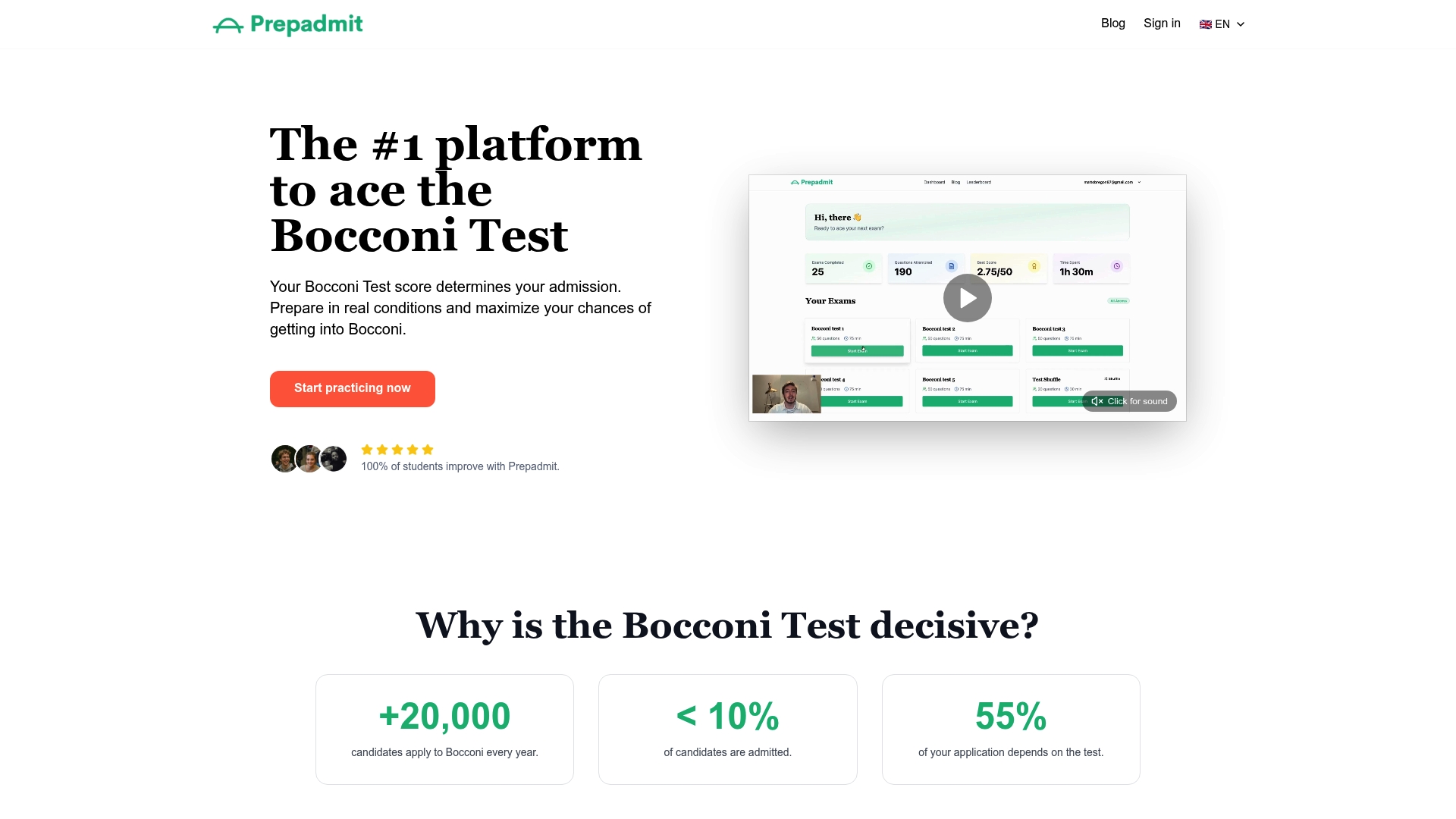
- Full exam simulations built from official Bocconi past papers, not generic practice questions.
- Answer corrections that explain the reasoning step, not just the final number.
- Skill-specific drills you can aim directly at ratios, proportions, or data sufficiency.
- Progress tracking and peer ranking so you know where you stand before test day.
We report that many students see meaningful score improvements when using the platform. Access the full preparation and start with a timed drill to see where your ratio skills stand today.
FAQ
What is the Bocconi penalty for a wrong answer?
A wrong answer costs -0.2 points, while a skipped question costs nothing, according to the official Bocconi test rules. Some three-option critical reasoning questions carry a steeper -0.33 penalty instead.
What is the fastest way to convert a ratio to a percent?
Write the ratio as a fraction, then divide and multiply by 100.
How do I use my Bocconi score report to improve?
Your score report becomes available within 48 hours in your personal area and shows totals broken down by thematic area, according to official Bocconi instructions. Use the weakest area shown there to decide which drill set to run next.
Where can I find timed practice that matches the Bocconi screen format?
Official sample materials show the three-question, no-backtracking screen format used on test day. Our own timed practice resources build drills around that same structure so you can practice the navigation, not just the math.
What is a data sufficiency question in ratio problems?
A data sufficiency question asks whether given information is enough to answer a question, without requiring you to solve it fully. These questions appear in the official Bocconi sample simulation and reward quick logical checks over heavy calculation.
Recommended
Related articles
Ready to ace your admission test?
Discover PrepAdmit, the platform that helps you succeed at top university admission tests.
Discover PrepAdmit