Beat Bocconi Timing: Finish All 50 With Penalty Aware Fast Reading

Beat Bocconi Timing: Finish All 50 With Penalty Aware Fast Reading
Pre-read the three questions before you touch the passage, mark two or three keywords per question, then skim only for those targets. That single move is what separates students who finish all 50 questions from those who run out of time on question 38. With 75 minutes on the clock and a penalty for every wrong guess, you cannot afford to read like it’s summer homework. Start this week: run one full 75-minute simulation and time yourself on the first ten questions alone.
TL;DR:
- Pre-reading the questions and highlighting key words helps you locate answers faster and avoid overreading the passage.
- Labeling paragraphs by role and taking concise micro-notes improve speed and accuracy during targeted skimming.
- Allocate about 100 to 110 seconds per question, and use skip or guess strategies for tougher items to maximize scoring without penalty risk.
- Practice under test-like conditions regularly with official-format simulations to build consistent speed and improve error categorization.
- Manage test-day stress with routine pre-test rituals and focus on micro-notes instead of rereading, to maintain clarity and confidence under pressure.
Table of Contents
- Pre-Read Checklist: How to Scan Questions Before You Read
- Targeted Skimming and Micro-Notes: Reading Fast Without Losing Accuracy
- Time Allocation and the Skip-or-Guess Rule
- Practical Practice Plan: Drills, Mocks, and Error Analysis
- Common Timed-Reading Mistakes and Quick Fixes
- Why This Method Holds Up (and How Prepadmit Backs It)
- Types of Passages on the Bocconi Test and How to Read Each
- Fast Reading Techniques Built for Bocconi Passages
- Strategies for Staying Sharp Under Time Pressure
- Recommended Resources and Tools for Practicing Reading Speed
- Tips for Managing Stress During the Reading Section
- A Two-Week Plan to Build This Habit Fast
- Practice the Real Format With Prepadmit
- Sources
- FAQ
Pre-Read Checklist: How to Scan Questions Before You Read
The instinct to start at the top of the passage and read straight through is the single biggest reason students run out of time on the Bocconi reading section. Flip the order. Read the questions first, then hunt the passage for exactly what they ask.
This works because Bocconi’s reading comprehension questions test both explicit facts and implicit meaning drawn from the passage, according to the official Bocconi test page. Once you know which kind of question you’re facing, you know how carefully to read each paragraph.
Here’s the four-step scan to run before you read a single line of the passage itself:
- Scan all three questions first. Note whether each one asks for a specific detail, an inference, or the author’s main point.
- Underline two or three signal words per question. Names, dates, qualifiers like “mostly” or “except,” and any word in quotation marks are your search targets.
- Classify the question type in two seconds. Explicit detail questions need a scan for a matching phrase. Inference questions need you to read the surrounding sentences, not just the line itself.
- Set a 30 to 40 second skim goal. Give yourself a hard limit to locate the passage’s structure before you start reading for answers.
This checklist takes longer to describe than to do. After ten or fifteen timed drills, it becomes automatic, and that’s the whole point. You’re not trying to memorize a system on test day. You’re trying to make it invisible.
Targeted Skimming and Micro-Notes: Reading Fast Without Losing Accuracy
Skimming isn’t reading faster. It’s reading selectively, and the skill that makes it work is spotting a paragraph’s job before you read its content in full.
Most Bocconi passages follow a predictable shape: an opening paragraph that states the claim, one or two middle paragraphs that support it with examples or data, and a closing paragraph that qualifies or restates the point. Once you can label a paragraph’s role in under five seconds, you know instantly whether it’s worth a close read or a fast pass.
Two habits make this concrete instead of theoretical:
- Mark each paragraph in the margin with a single letter: C for claim, E for example, D for data, Q for a qualifier or contrast.
- Jot a three or four word micro-note next to any fact you might need later, rather than rereading the sentence when the question arrives.
Slow down specifically when you hit contrast words (“however,” “yet,” “although”), numbers, or causal language (“because,” “as a result”). These are exactly where Bocconi likes to plant its trickier inference questions, and they’re also where careless readers lose points by skimming past a qualifier that flips the meaning of a sentence.
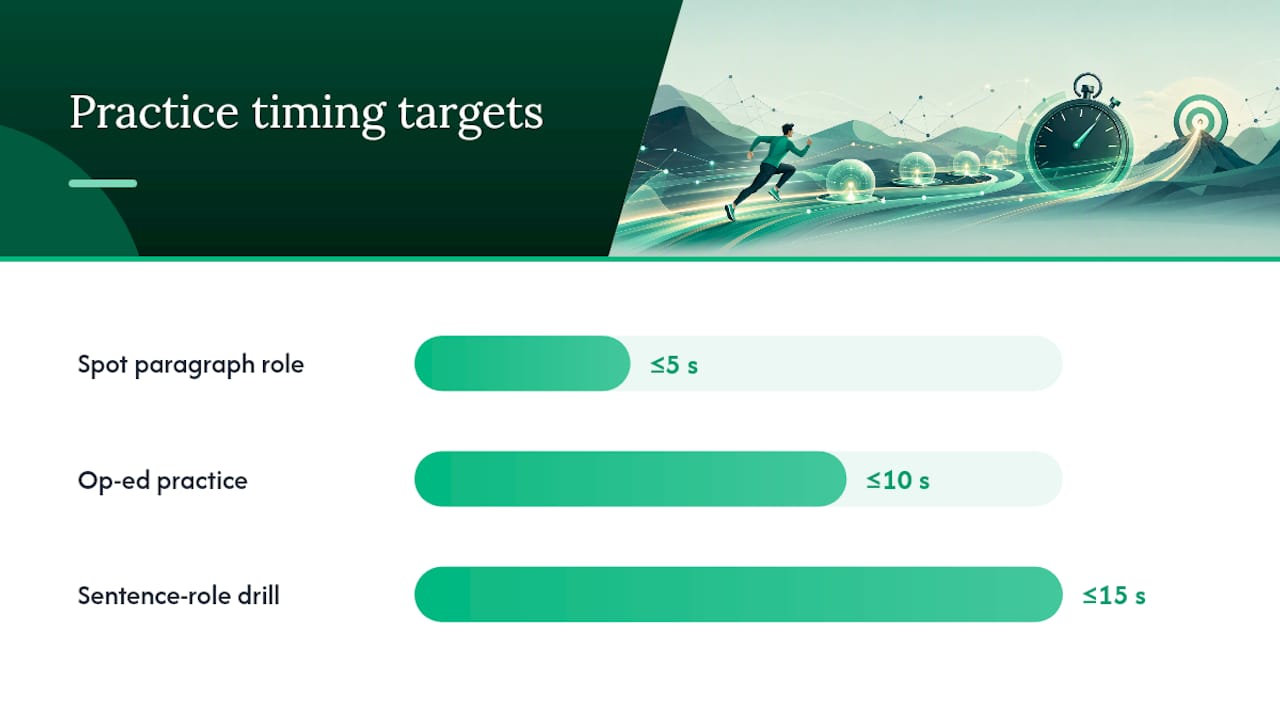
Pro Tip: Practice this on old newspaper op-eds before you touch a real Bocconi passage. Mark paragraph roles in under ten seconds each, then check yourself: did you correctly guess where the article’s counterargument would appear?
Two drills build this fast. First, take any 150-word paragraph and label its sentence roles in under 15 seconds. Second, take a full passage and try to answer one explicit-detail question using only your margin marks, without rereading the paragraph.
Time Allocation and the Skip-or-Guess Rule
The Bocconi online test gives you 50 questions in 75 minutes, which works out to 90 seconds per question on average. But reading comprehension items deserve slightly more time than quick math questions, so a realistic target is closer to 100 to 110 seconds per reading question, leaving a buffer for the faster sections.
The math that matters: a correct answer earns +1 point, an omitted question earns 0, and a wrong answer costs you points. Standard penalties run around −0.20, but some critical-thinking items with only three answer choices carry a steeper −0.33 penalty, according to Bocconi’s own test guidance.
That asymmetry changes how you should guess. If you’ve eliminated two of four options, guessing on the remainder is usually worth the risk. If you’re staring at a three-choice critical-thinking item with no idea, the steeper penalty means omitting is often the safer call, unless you can eliminate at least one option first.
One more structural detail matters for pacing: questions are often delivered in sequential groups, and once you move forward you cannot go back, based on the official test format description. That means banking time to revisit a tough question later isn’t an option. Budget your time per group of three, not per test, and finish each group before the clock nudges you to decide under pressure.
Practical Practice Plan: Drills, Mocks, and Error Analysis
A weekly rhythm beats a single marathon study session. Here’s a structure that builds speed first, then locks in accuracy once the technique feels automatic.
- Two full 75-minute simulations per week. Use the official Bocconi simulation or a platform that mirrors its timing and question count exactly. Sit somewhere quiet, set a real timer, and don’t pause it.
- Three short micro-drills between mocks. Ten minutes each, focused on one skill: pre-reading questions, paragraph-role marking, or answering under a strict per-question cap.
- One error-analysis session after every mock. Tag each miss as a content gap (you didn’t know the answer), a speed error (you knew it but ran out of time), or a careless mistake (you misread a qualifier or a number).
- Adjust the following week’s drills based on your tags. A content gap needs more untimed reading practice. A speed error needs faster micro-drills. A careless mistake needs slower, more deliberate marking, not more speed.
Phase your first two weeks around technique, not accuracy. Trying to nail every answer while you’re still learning to skim is how students burn out before test day. Once the pre-read and skim sequence feels natural, shift the focus toward accuracy and penalty-aware guessing.
Common Timed-Reading Mistakes and Quick Fixes
Most point loss on the reading section isn’t a knowledge problem. It’s a habit problem, and every one of these is fixable within a week of deliberate practice.
- Overreading the full passage before checking the questions. Fix it by reading topic sentences first, then scanning only for the keywords you marked during your pre-read.
- Freezing on a trap answer choice. Fix it by eliminating the two options you’re most confident are wrong, then choosing between what’s left instead of staring at all four.
- Passive highlighting that doesn’t help you find anything later. Fix it with the single-letter margin codes and short micro-notes described earlier, so every mark has a purpose.
- Losing focus mid-test after a hard question. Take three slow breaths, roll your shoulders once, and move to the next group. A ten-second reset costs less than the errors that come from rushing angry.
Why This Method Holds Up (and How Prepadmit Backs It)
None of this is guesswork stacked on top of generic study advice. The pre-read and targeted-skim sequence exists because Bocconi’s own test structure rewards it: 50 questions, 75 minutes, a real penalty for wrong guesses, and reading comprehension items built to test both stated facts and implied meaning, per the official Bocconi test description.
Prepadmit built its platform around that exact structure, running official-format simulations at the same 50-question, 75-minute pace, with detailed answer corrections and skill-specific drill modes attached to every attempt.
Practicing with realistic timing and reviewing every mistake by category, rather than just checking a score, is what turns a slow first attempt into a fast, confident one. Prepadmit reports an average user score improvement of 34% across its platform.
Progress tracking makes the error-analysis workflow concrete instead of vague. When you can see that your speed errors dropped from six per mock to two, you know the technique is sticking, not just that you’re studying harder.
Types of Passages on the Bocconi Test and How to Read Each
Bocconi’s reading section draws from a handful of recurring passage types, and each rewards a slightly different approach.
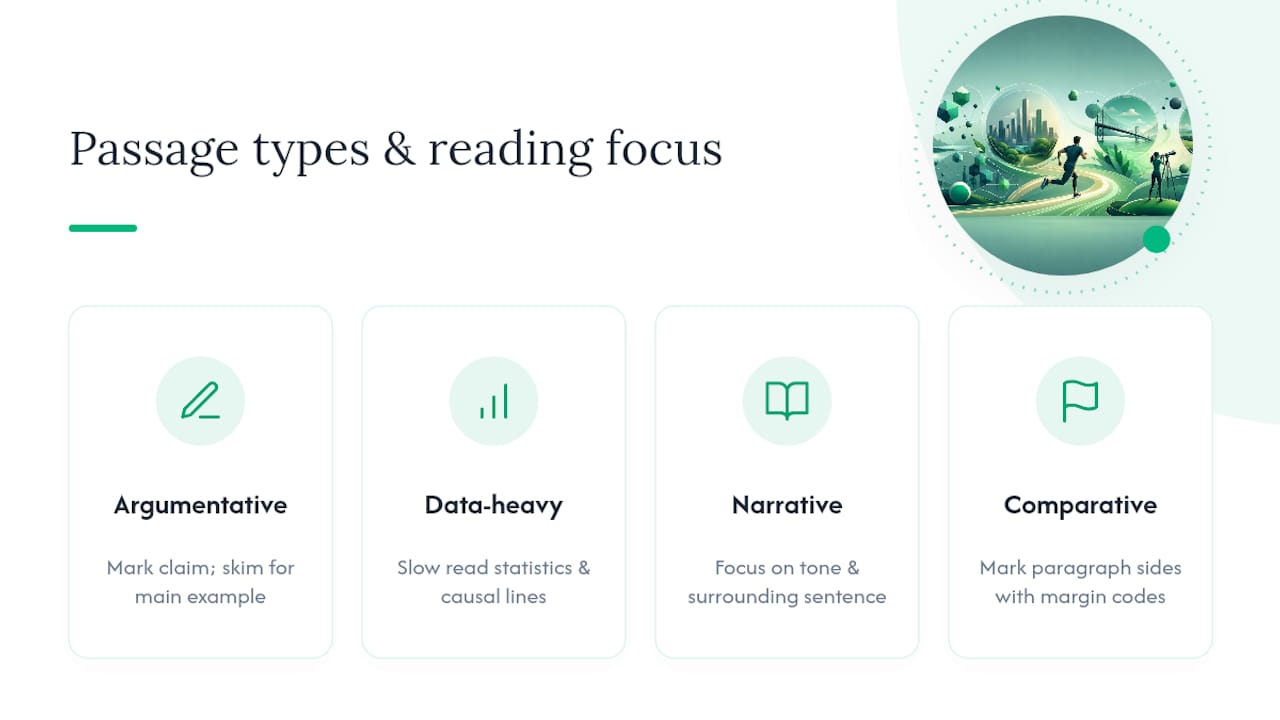
Argumentative or opinion passages state a claim early, back it with examples, and often include a qualifier near the end. Mark the claim in the first paragraph, then skim the middle for the strongest supporting example rather than reading every sentence.
Data-heavy or scientific passages lean on numbers, comparisons, and causal language. These deserve a slower read on any sentence containing a statistic or a phrase like “as a result,” since inference questions frequently hinge on exactly those lines.
Narrative or descriptive passages, drawn from essays or profiles, ask more inference questions about tone and implied meaning. Sample materials from Bocconi’s own simulation packet show this style paired with vocabulary-in-context questions, where you need the sentence around a word, not just the word itself.
Comparative passages weigh two ideas, studies, or positions against each other. Track which paragraph belongs to which side using your margin codes, because questions here often ask you to identify where the two views diverge.
Knowing the type in the first ten seconds tells you exactly where to slow down and where to keep moving.
Fast Reading Techniques Built for Bocconi Passages
Generic speed-reading advice, the kind built for skimming novels or news articles, doesn’t transfer cleanly to a penalty-scored exam. Bocconi rewards precision under time pressure, not raw words-per-minute.
Start with chunking, reading in phrases of three to five words instead of word by word. This cuts down the number of eye stops per line and speeds up passages without sacrificing comprehension, especially once you’ve already scanned the questions and know what you’re looking for.
Pair that with selective rereading, meaning you never reread a full sentence. If a question asks about a specific detail, reread only the clause containing the keyword you marked, not the paragraph around it.
Practice passage previewing: spend five seconds scanning the first and last sentence of each paragraph before reading anything else. This gives you the passage’s skeleton, so when you do read closely, you already know roughly where the answer to each question is likely to live.
Finally, drill with a hard cap. Give yourself five to eight minutes total per passage, including the pre-read, during practice sessions. That constraint forces the chunking and previewing habits to become automatic instead of optional, which is exactly the condition you’ll face on test day.
Strategies for Staying Sharp Under Time Pressure
Comprehension doesn’t fall apart because a passage is hard. It falls apart because the clock makes you rush past a qualifier or misread a number you’d have caught with more time.
The fix starts with your pre-read. If you already know a question is asking for an inference rather than a stated fact, you read the relevant paragraph more carefully instead of skimming past nuance you’ll need later.
Build in a two-second checkpoint after reading each answer choice: does this option match exactly what the passage says, or does it almost match but add something the passage never claimed? Bocconi’s trap answers are built on that gap, an option that sounds right but overstates or narrows what the text actually supports.
Keep your micro-notes short and specific rather than vague. A note like “para 2: cost dropped, not eliminated” holds more useful precision than a highlighted sentence you’ll have to reread anyway. The goal is to offload memory onto the page so your working memory stays free for the next question.
And when a question genuinely stumps you, don’t reread the whole passage a third time. Reread only the paragraph your margin codes point to. If you still can’t find the answer after one focused reread, apply your skip or guess rule and move on. Comprehension under pressure is less about reading harder and more about trusting the system you built during practice.
Recommended Resources and Tools for Practicing Reading Speed
Start with the source Bocconi itself provides: the official timed simulation, which mirrors the real 50-question, 75-minute format, though the public version doesn’t include the proctoring you’ll face on test day.
Beyond that, the most useful resources fall into three categories. Full-length timed mocks that match Bocconi’s exact question count and clock. Skill-specific drills that isolate one habit, like paragraph-role marking or keyword scanning, so you can practice it in short ten-minute bursts. And a review workflow that tags every mistake by type, so your next study session targets your actual weak point instead of repeating the same practice you already know works.
Prepadmit’s platform is built around exactly that structure: official-format simulations, detailed answer corrections, and skill-specific practice modes tied to progress tracking, so you can see which error type is shrinking week over week. For readers who want a worked walkthrough before diving into full mocks, three Bocconi worked exercises and a 75-minute mock plan breaks the process down step by step.
Whatever tools you choose, consistency matters more than variety. Running the same drill structure two or three times a week for a month builds more speed than sampling ten different resources once each.
Tips for Managing Stress During the Reading Section
Stress narrows your attention exactly when you need it wide open, which is why a panicked student often rereads the same sentence three times without absorbing it.
Build a short pre-test ritual and repeat it every single practice mock, so it feels routine rather than special on the real test day. Something as simple as three slow breaths and a quick shoulder roll before the timer starts can cue your brain that it’s time to focus, not time to panic.
During the test, watch for the specific moment stress spikes: usually right after a question you couldn’t answer confidently. That’s exactly when the temptation to reread the whole passage a third time is strongest, and exactly when you should apply your skip or guess rule instead and move forward.
If you feel your reading speed dropping mid-passage, that’s a signal to shift back to your micro-note system rather than trying to power through by rereading. Trust the marks you made. They exist so you don’t have to hold everything in your head while the clock keeps moving.
A Two-Week Plan to Build This Habit Fast
Two weeks is enough to make the pre-read and skim sequence automatic, if you’re consistent. Days one through four: drill paragraph-role marking for ten minutes daily on non-exam texts. Days five through ten: run one timed mock every other day, tagging every miss by type.
Use your first mock to set your personal skip or guess threshold: if you’re getting more than half of your two-option guesses right, keep guessing; if not, shift toward omitting when unsure. Before test day, repeat whatever pre-test ritual worked in practice. Confidence here comes from repetition, not luck.
— quentin
Practice the Real Format With Prepadmit
Reading advice only gets you so far without a clock that matches the real exam. Prepadmit is built specifically around that gap: official-format simulations that run the same 50 questions in 75 minutes as the real Bocconi test, paired with detailed answer corrections so you know exactly why each miss happened.
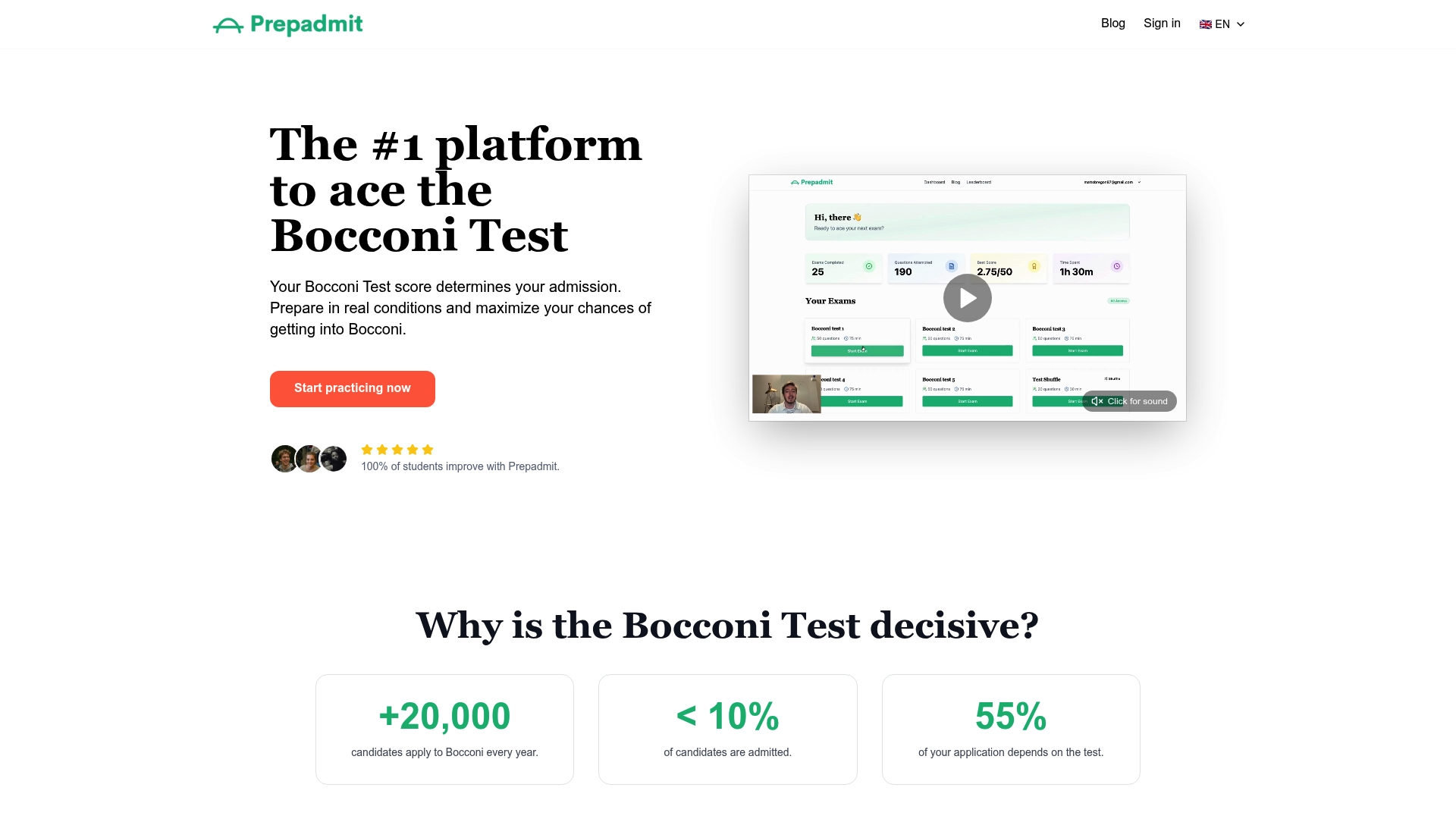
Every simulation feeds into skill-specific practice modes and progress tracking, so the error-analysis workflow described earlier isn’t something you have to build yourself with a spreadsheet. Prepadmit reports an average user score improvement of 34%, and the platform is positioned as an affordable alternative to private coaching, backed by a money-back guarantee. If you want a preview of what a real timed mock feels like before you commit, this walkthrough of a Prepadmit simulation shows the format in action.
Head to Prepadmit to access the full preparation and start your first timed simulation this week.
FAQ
What Is a Good Score on the Bocconi Test?
A strong score depends on the admission round and program, but consistently answering more questions correctly than you omit or miss, while avoiding careless penalty losses, is the baseline goal. Bocconi publishes minimum score thresholds for some rounds below which candidates aren’t considered, according to the official test guidance, so consistency across all 50 questions matters more than acing a handful and rushing the rest.
Where Can I Find an Official Bocconi Test Simulation?
Bocconi hosts an official timed simulation that matches the real 50-question, 75-minute format, though it doesn’t include proctoring. Platforms like Prepadmit also offer official-format simulations with added answer corrections and progress tracking for repeated practice.
How Hard Is the Bocconi Test?
The test is demanding mainly because of its strict timing and penalty scoring, not necessarily because the content is obscure. Fifty questions in 75 minutes, with a real point cost for wrong guesses, means pacing and a clear skip-or-guess rule matter as much as subject knowledge, per Bocconi’s own format description.
Where Can I Practice the Bocconi Reading Section Online?
Bocconi’s own simulation covers the reading section within the full test format, and Prepadmit offers skill-specific reading drills alongside full-length mocks that mirror the same timing. Running both, official practice for format familiarity and targeted drills for the pre-read and skim technique, covers the two things this section actually tests.
Recommended
Related articles
Ready to ace your admission test?
Discover PrepAdmit, the platform that helps you succeed at top university admission tests.
Discover PrepAdmit