Bocconi Admission Non-EU Student Guide for 2026

Bocconi Admission Non-EU Student Guide for 2026
Bocconi University admission for non-EU students is a purely numerical process: your weighted evaluation combines 55% standardized test score and 45% high school GPA, submitted through the Apply2B portal with a €100 application fee. No motivation letters, CVs, or recommendation letters factor into the decision. This bocconi admission non-EU student guide covers every step you need to know, from eligibility and documentation to test strategy and application timing, so you can build the strongest possible file before the deadline.
What are the eligibility criteria and documentation requirements for non-EU students?
Your secondary school diploma is the foundation of your application. Bocconi requires that your diploma meets national access standards for higher education in your country, with at least two full years of attendance at the issuing institution. If your diploma does not automatically satisfy Italian enrollment requirements, you may need a Statement of Comparability and Verification issued by CIMEA, the Italian agency that evaluates foreign credentials. Many non-EU students overlook this step and face delays at enrollment, so check with the Italian consulate in your country early.
Your GPA calculation follows specific rules. Bocconi excludes physical education, behavior, and religion grades from the GPA it uses for admission. That means your academic subject grades carry all the weight. If your school uses a grading scale other than a standard 10-point or 100-point system, you will need to convert your grades according to Bocconi’s official conversion tables, which are available on the Apply2B portal.

Language proficiency is a separate requirement. For English-taught programs, you must demonstrate English competency through accepted tests. The official English requirements include IELTS, TOEFL, and Cambridge qualifications, among others. Native English speakers from qualifying countries may be exempt, but you must verify your specific situation on the Bocconi website.
Required documents for your application:
- Valid passport copy (photo page)
- Recent passport-sized photographs
- Official secondary school transcripts and diploma (or predicted grades if not yet graduated)
- Standardized test scores (Bocconi Online Test, SAT, ACT, or LSAT for law programs)
- English language proficiency certificate (if applicable)
- CIMEA Statement of Comparability and Verification (if required for your country)
- Visa and residency documentation (required at enrollment, not application)
Gather these documents before you open the Apply2B portal. Uploading incomplete files is one of the most common reasons applications stall.
How to register and submit your application through Bocconi’s Apply2B portal
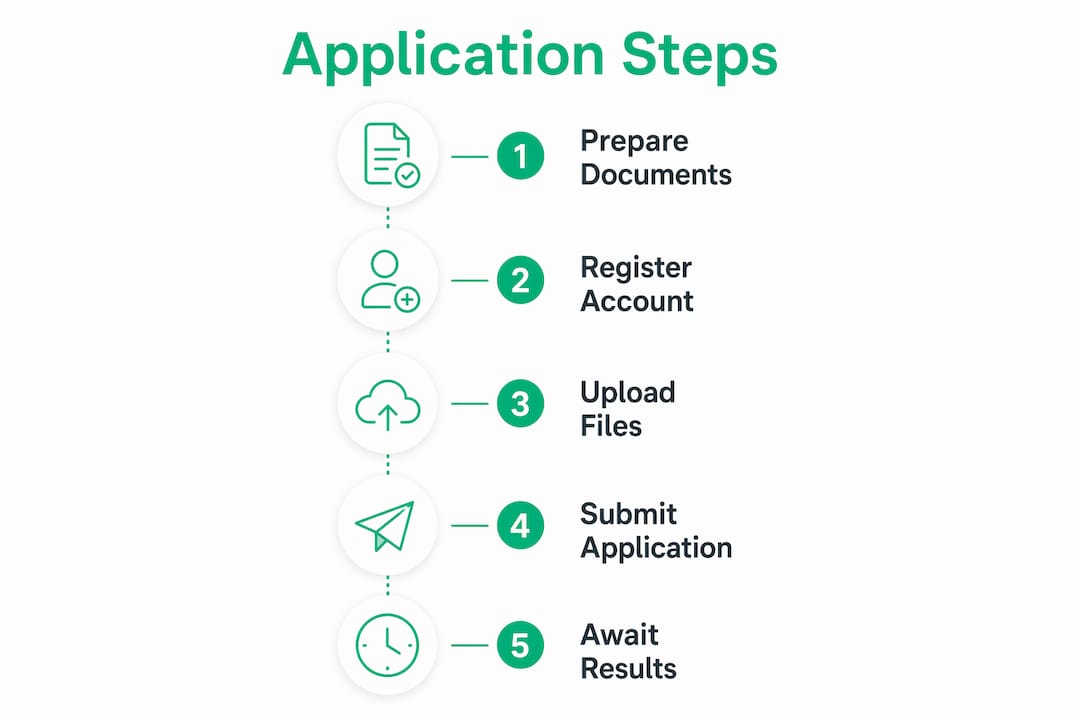
The Apply2B portal is the single platform for all Bocconi undergraduate applications. Every step from program selection to fee payment happens there, so creating your account early gives you time to understand the interface before deadlines arrive.
- Create your Apply2B account. Use a personal email address you check regularly. Bocconi sends all communications, including admission decisions, to this address.
- Select up to three bachelor’s programs. You rank them by preference. If you qualify for your first choice, Bocconi admits you there. If not, the system evaluates your second and third choices automatically.
- Enter your GPA. Input your grades according to the conversion instructions in the portal. Double-check the excluded subjects (physical education, behavior, religion) before you submit.
- Enter your test scores. If you have taken multiple tests, enter all of them. The portal selects the highest percentile score automatically, so submitting more scores never hurts you.
- Upload your documents. Follow the file format and size requirements exactly. PDFs are standard. Blurry scans or wrong file types cause rejections.
- Pay the €100 application fee. This fee is non-refundable and applies per application session. If you apply in multiple rounds, you pay again. Budget for this in advance.
- Submit and confirm. After submission, you receive a confirmation email. Save it. Check your application status regularly through the portal dashboard.
Pro Tip: Complete your application at least one week before the deadline. Portal traffic spikes in the final 48 hours, and technical issues during that window are your problem, not Bocconi’s.
For a detailed walkthrough of the online platform itself, the Apply2B platform guide covers interface specifics and common navigation errors.
What standardized tests can non-EU students submit and how to prepare effectively?
Bocconi accepts four standardized tests for undergraduate admission: the Bocconi Online Test, the SAT, the ACT, and the LSAT (for law programs only). Your test score accounts for 55% of your admission score, making it the single largest factor in your file. That weighting means a strong test performance can compensate for a GPA that is solid but not exceptional.
Choosing the right test
The Bocconi Online Test is designed specifically for Bocconi admission. It tests logical reasoning, numerical skills, and reading comprehension in a format built around the university’s own evaluation criteria. The SAT and ACT are broader tests familiar to most international students. For competitive admission, benchmark scores on the SAT sit at 1450 or above. On the Bocconi Online Test, your percentile rank against other applicants matters more than a raw number.
The smartest approach is to submit both the Bocconi Online Test and the SAT or ACT. The system uses the strongest percentile score from all your submissions. You cannot be penalized for submitting more tests. Taking both gives you a safety net and a potential advantage.
How to prepare effectively
| Preparation method | What it develops | Best used |
|---|---|---|
| Official past papers | Familiarity with real question formats | Throughout preparation |
| Timed mock exams | Speed and time management under pressure | Final 4–6 weeks before test |
| Skill-specific practice | Weak area identification and targeted improvement | Mid-preparation phase |
| Score tracking and peer ranking | Realistic performance benchmarking | Ongoing |
Time management is the skill most students underestimate. The Bocconi Online Test has strict time limits per section. Students who practice under real conditions consistently outperform those who study content alone. A step-by-step preparation plan built around timed practice is the most reliable way to raise your score.
Key preparation principles:
- Start at least three months before your target test date
- Review every wrong answer in detail, not just the correct answer
- Track your score trends across multiple mock exams to spot patterns
- Prioritize your weakest skill area in the first half of your preparation
Pro Tip: Prepadmit reports an average score improvement of 34% among students who complete its full preparation program. That kind of gain can move you from borderline to competitive.
When are the admission rounds and how do timing decisions affect your chances?
Bocconi runs three admission rounds: Early, Winter, and Spring. The timing of your application directly affects both your probability of admission and your access to scholarships.
The Early round offers the best conditions. Seats are plentiful and scholarship funds are at their maximum. The Winter round is still viable, but 90–95% of available seats are claimed by the time it closes. Spring applicants compete for a very small number of remaining places with almost no scholarship funding left.
What each round means in practice:
- Early round: Most seats available, full scholarship pool, lowest competition per seat
- Winter round: Competitive but still realistic, partial scholarship availability
- Spring round: Very limited seats, scholarship funds largely depleted, highest competition
Merit-based scholarships at Bocconi are awarded automatically based on your admission score. You do not submit a separate application for merit aid. That means your test score and GPA directly determine whether you receive funding. Need-based aid requires a separate income documentation process and has its own early deadline.
The practical implication is clear: applying in the Early round with a strong test score gives you the best shot at both admission and financial support simultaneously. Waiting until Spring to “improve your application” rarely pays off. The seats simply are not there.
Key takeaways
Bocconi admission for non-EU students is a formula-driven process where your test score and GPA determine everything, and applying early maximizes both your admission odds and scholarship access.
| Point | Details |
|---|---|
| Test score is the biggest lever | At 55% of your admission score, the Bocconi Online Test or SAT is your most controllable factor. |
| GPA excludes certain subjects | Physical education, behavior, and religion grades are not counted in your Bocconi GPA calculation. |
| Submit multiple test scores | The portal automatically uses your highest percentile, so taking both the Bocconi Test and SAT is a smart move. |
| Apply in the Early round | Over 90% of seats and most scholarship funds are gone by the end of the Winter round. |
| CIMEA verification may be required | Non-EU students should check diploma recognition requirements with Italian authorities before enrollment. |
What I’ve learned from watching non-EU students navigate Bocconi admissions
The single biggest mistake I see non-EU applicants make is treating the Bocconi application like a traditional university application. They spend weeks polishing a personal statement or gathering recommendation letters. Bocconi does not read any of that for undergraduate programs. The admission process is automated and purely numerical. Every hour spent on subjective materials is an hour not spent raising your test score.
The second mistake is timing. Students who apply in the Spring round often do so because they want more time to prepare. That logic sounds reasonable. In practice, they are competing for scraps. The seats are gone. The scholarship money is gone. Applying early with a good score beats applying late with a great score almost every time.
My honest advice: treat your test preparation as the core of your application strategy. Your GPA is largely fixed by the time you apply. Your test score is not. Three to four months of focused, timed practice on real past papers can move your score significantly. That movement translates directly into a better admission outcome and potentially free tuition through merit scholarships.
One more thing on scholarships: because merit aid is automatic, a strong test score is effectively a financial aid application. Students who score in the top percentiles receive funding without filling out a single extra form. That is a rare and valuable feature of the Bocconi system, and most applicants do not fully appreciate it until after the fact.
— quentin
How Prepadmit supports your Bocconi test preparation
Preparing for the Bocconi Online Test without realistic practice is a gamble you do not need to take.
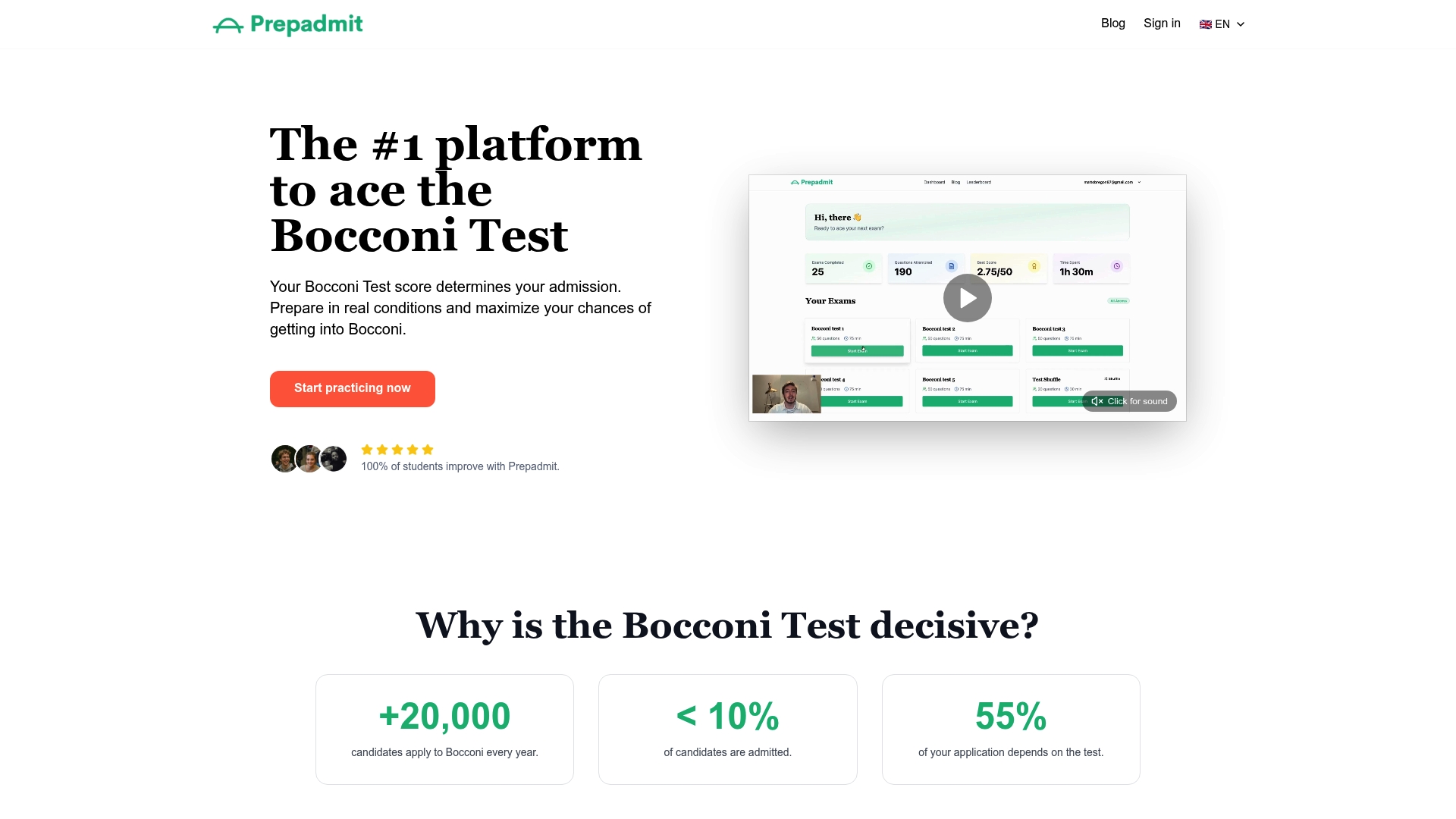
Prepadmit is built specifically for students targeting Bocconi admission. The platform gives you access to official past papers, timed mock exams, and detailed answer corrections so you understand exactly where your score is slipping. Skill-specific practice modes let you target your weakest areas directly. Progress tracking and the community leaderboard show you where you stand against other applicants in real time. Prepadmit was developed by experts from HEC and Bocconi, and the platform delivers an average score improvement of 34%. It costs a fraction of private coaching, and it comes with a money-back guarantee.
FAQ
What tests does Bocconi accept from non-EU students?
Bocconi accepts the Bocconi Online Test, SAT, ACT, and LSAT (for law programs). The portal automatically uses your highest percentile score if you submit multiple tests.
How is the Bocconi admission score calculated?
Your admission score is 55% standardized test score and 45% high school GPA, with physical education, behavior, and religion grades excluded from the GPA calculation.
Do non-EU students need CIMEA certification?
Some non-EU students need a CIMEA Statement of Comparability and Verification for enrollment, depending on their country’s diploma recognition status. Check with the Italian consulate in your country before applying.
When should a non-EU student apply to Bocconi?
Apply in the Early round. Over 90% of seats and most scholarship funds are allocated by the end of the Winter round, leaving Spring applicants with very limited options.
Are scholarships available for non-EU students at Bocconi?
Merit-based scholarships are awarded automatically based on your admission score, with no separate application required. Need-based aid requires separate income documentation and has its own early deadline.
Recommended
Related articles
Ready to ace your admission test?
Discover PrepAdmit, the platform that helps you succeed at top university admission tests.
Discover PrepAdmit