Bocconi Test Percentiles: Raise Yours With Timed Simulations

Bocconi Test Percentiles: Raise Yours With Timed Simulations
Percentiles alone don’t admit you. Admission runs on a weighted ranking: 55% test score, 45% high school GPA. There is no fixed passing percentile, since your standing depends on the applicant pool and the program you choose. Your next move is simple: check your score report, then run scenarios in the GPA calculator to see where you stand.
TL;DR:
- A score of 17 out of 50 only makes you eligible for consideration; some programs also require minimum scores in specific areas, including math.
- Correct answers earn one point, blanks earn zero, and wrong answers lose 0.2 points, or 0.33 on some critical thinking items, so avoid blind guesses.
- Because questions appear three at a time and cannot be revisited, practice timed screen groups and make each skip decision before moving forward.
- Calculate GPA using grades from the two school years before your final year, excluding physical education and religion, and confirm your grading scale with admissions.
- Retakes are subject to annual attempt limits for each test type, and Bocconi uses your best result, so check current booking rules before scheduling another session.
Table of Contents
- Bocconi test format: question counts, timing, and navigation rules
- Scoring rules, penalties, and how raw scores convert to percentiles
- How percentiles feed into the 55/45 formula
- A practical plan to raise your Bocconi percentile
- Why simulation-based practice moves percentiles faster
- Start measuring your Bocconi percentile today
- FAQ
- Sources
Bocconi test format: question counts, timing, and navigation rules
The Online Bocconi Test has 50 multiple-choice questions split across thematic areas. These typically cover mathematics, reading comprehension, numerical reasoning, and critical thinking, with the exact mix depending on the test variant you take. Knowing the breakdown matters because your percentile reflects performance across each area, not just your total score.
Navigation works in sequential groups. Questions appear three at a time per screen, and you cannot go back once you move forward. This changes how you should pace yourself. A question you skip is gone for good, so snap decisions carry weight.
A few practical details affect your scheduling and practice:
- You get a limited number of attempts per test type each academic year, so plan which sessions you treat as real attempts.
- You can choose your test language, which matters if you think faster in one language than another.
- Score reports are typically available within a couple of days of finishing the test.
Build your practice around these constraints from day one. Practicing untimed, with the ability to revisit questions, teaches habits that work against you on test day.
Scoring rules, penalties, and how raw scores convert to percentiles
Scoring is straightforward but unforgiving. A correct answer earns +1 point, a blank earns 0, and a wrong answer costs −0.2 points (some critical-thinking items carry a steeper −0.33 penalty). You need a minimum score of 17 out of 50 to be considered at all, and some programs set additional area-specific minima, such as a floor in the math section.

Your raw score alone tells you little. Bocconi converts scores from its own test, the SAT, and the ACT using internal tables that compare percentiles across each test’s applicant pool. A 40 out of 50 on one session can land in a different percentile than the same raw score on another, because the pool taking the test shifts from round to round.
This is why chasing a specific number misses the point. What matters is where that number places you relative to everyone else who sat the same test window.
How percentiles feed into the 55/45 formula

If you sit the test more than once, the admissions portal keeps your best result and uses that one in the calculation. A strong percentile can offset a weaker GPA, and the reverse holds too.
Getting your GPA right matters as much as getting your test score right. The GPA calculator FAQ walks through the mechanics:
- Enter grades from your third-last and second-last years of high school, excluding subjects like physical education and religion.
- Use your official grading scale; if your school’s scale isn’t listed, contact admissions before submitting rather than guessing.
- Double check every entry, since a GPA error changes 45% of your final ranking, not a small side detail.
Think in ranges rather than fixed outcomes. Raising your test percentile while holding GPA steady, or the reverse, shifts your combined ranking, but the size of that shift depends on where your competitors land that same cycle.
A practical plan to raise your Bocconi percentile
Progress comes from structured repetition, not scattered studying. A four-week cycle works well for most students:
- Take one full timed mock test each week under real test conditions, including the sequential, no-going-back navigation.
- Run two targeted drill sessions on your weakest area, whether that’s math, reading comprehension, or logic.
- Do short daily warm-ups, 15 to 20 minutes, to keep pattern recognition sharp.
- Review every mistake at the end of each week and log why it happened: timing, misreading, or a knowledge gap.
Reading comprehension and logic sections reward timed practice specifically, since untimed drills build skills you won’t use in a 50-question, sequential format. Structured timed practice from a source like IB ESS Paper 1 resources can help sharpen comprehension under a clock, even though the subject matter differs from Bocconi’s test.
On test day itself, a few tactics protect your score. Since a wrong answer costs more than a blank, skip a question fast when you’re unsure rather than guessing blindly. Budget your time per screen group, since you can’t return to a screen once you’ve moved past it. If your target program sets a math-area minimum, prioritize that section’s accuracy over speed.
Pro Tip: Track three numbers each week, your raw score, your section-by-section accuracy, and your estimated percentile trend, so you catch a plateau before it costs you a full cycle.
Why simulation-based practice moves percentiles faster
Realistic conditions change outcomes. Practicing with official past papers, under the same sequential, timed format as the real test, builds the instincts that untimed study never will. Skill-specific drills then let you isolate exactly where points are slipping away, instead of re-studying material you’ve already mastered.
Detailed answer correction closes the loop. Seeing why an answer was wrong, not just that it was wrong, is what turns a mistake into a lesson. Progress tracking and peer ranking give you a read on where you stand, which matters more than a raw score in a system built around relative ranking.
Treat any reported improvement figure as a starting hypothesis, not a guarantee. Run a diagnostic, follow a structured plan, and verify your own gains through repeated mock percentiles over several weeks.
— quentin
Start measuring your Bocconi percentile today
We built Prepadmit around official past papers, on-demand simulation tests, detailed corrections, skill-specific drills, progress tracking, and peer ranking, so you always know where you stand against other applicants.
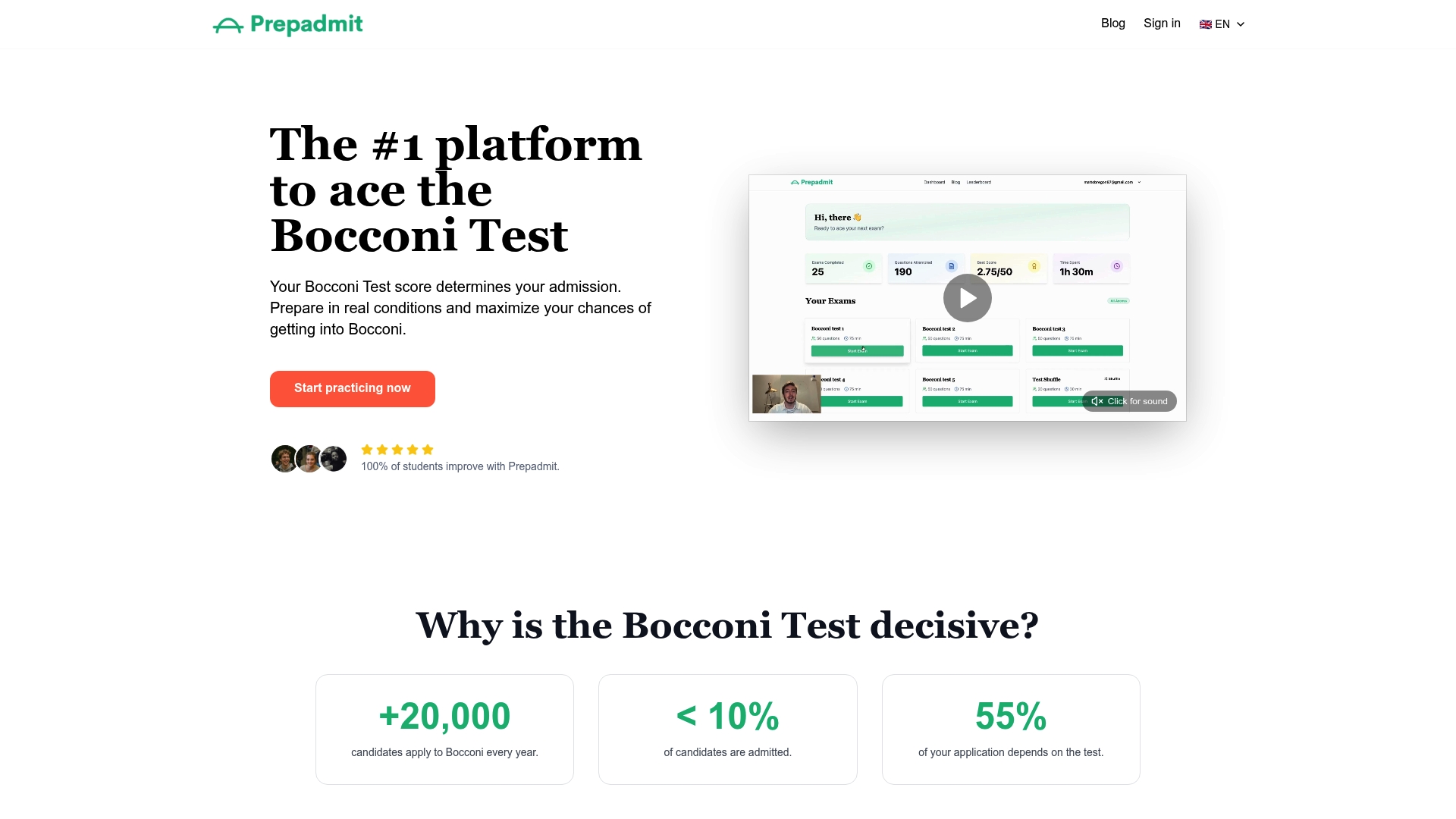
The safest first step is a diagnostic mock. It shows you the real score-report format and gives you an early percentile estimate before you commit to a full study plan. Our full access is backed with a money-back guarantee, and testimonials reflect results students have reported. Access the full preparation and start your first mock this week.
FAQ
How many students get admitted to Bocconi each year?
We don’t have a published, verifiable admission count to cite here. What matters more for your planning is your ranking within the applicant pool for your specific program and session, not a fixed national figure.
What is the average graduation grade at Bocconi?
This figure isn’t part of the admissions process and has no bearing on your test percentile or GPA calculation. Focus your attention on the 55/45 admission formula instead, since that’s what determines whether you’re admitted.
What is the minimum score needed to get into Bocconi?
The Online Bocconi Test requires a minimum of 17 out of 50 just to be considered, with some programs setting an additional area-specific minimum such as a math floor.
How does the Bocconi admission test work?
The test includes 50 multiple-choice questions across areas like math, reading comprehension, and logic, scored at +1 for correct answers, 0 for blanks, and a penalty for wrong answers. Your result then feeds into a weighted ranking alongside your GPA, with the test contributing 55% and GPA contributing 45%.
Can I retake the Bocconi test to improve my percentile?
Yes, within the attempt limits set for each academic year, and the admissions portal automatically uses your best result. Check the official test instructions for exact attempt limits and booking windows before you schedule a retake.
Sources
For deadlines, attempt windows, and score report details, go straight to the source and bookmark these pages:
- Admissions | Bocconi University
For continued practice, our guides on good Bocconi test scores, the 55/45 GPA requirement, score trends, and a worked mock plan go deeper into each topic covered here.
Recommended
Related articles
Ready to ace your admission test?
Discover PrepAdmit, the platform that helps you succeed at top university admission tests.
Discover PrepAdmit