The Role of Expert-Designed Prep Materials in Exam Success

The Role of Expert-Designed Prep Materials in Exam Success
Expert-designed prep materials are specially crafted study resources that improve university entrance exam scores by delivering structured content, personalized practice, and evidence-based learning strategies. The role of expert-designed prep materials goes far beyond simply organizing information. These resources apply cognitive psychology principles, including retrieval practice and spaced repetition, to produce durable learning gains. Research shows that students using structured expert guides improve their scores by 13–34% compared to those relying on unstructured or generic resources. That gap is not accidental. It reflects the difference between materials built by specialists who understand both the exam and the science of learning.
How do expert-designed prep materials improve learning efficiency?
Expert-designed prep materials improve learning efficiency by forcing active engagement rather than passive review. The distinction matters more than most students realize. Passive reading creates a false sense of familiarity. You recognize the material on the page, but recognition is not the same as recall under exam pressure.
The cognitive mechanism behind effective materials is retrieval practice. Active retrieval produces retention advantages with effect sizes of 0.50–0.60 compared to passive review. That means students who actively test themselves retain significantly more than those who simply reread notes. Expert materials build retrieval prompts directly into the content, so the practice happens automatically as you work through them.

Spaced repetition compounds this effect. A science-backed spaced repetition approach spaces review sessions across days and weeks, forcing your brain to reconstruct memories rather than refresh them. Expert guides schedule this spacing deliberately. Generic resources leave it to chance.
Desirable difficulty is the third principle. Expert materials deliberately make practice harder than the student finds comfortable. That friction is productive. It prevents the illusion of knowing, where students feel confident because the material looks familiar, not because they can actually reproduce it.
Pro Tip: After completing any section of an expert study guide, close the book and write down everything you remember. This single habit activates retrieval practice and reveals exactly which concepts need more work.
Key cognitive benefits of expert-designed study tools include:
- Retrieval practice prompts built into exercises rather than left to the student to create
- Spaced repetition scheduling that prevents cramming and supports long-term memory consolidation
- Interleaved practice that mixes topics to strengthen flexible thinking
- Desirable difficulty that challenges students beyond their comfort zone to build real mastery
What features distinguish expert study guides from generic resources?
Expert study guides differ from generic resources in three concrete ways: content selection, practice structure, and feedback quality. Generic resources cover everything. Expert guides cover what matters most on the specific exam you are taking.
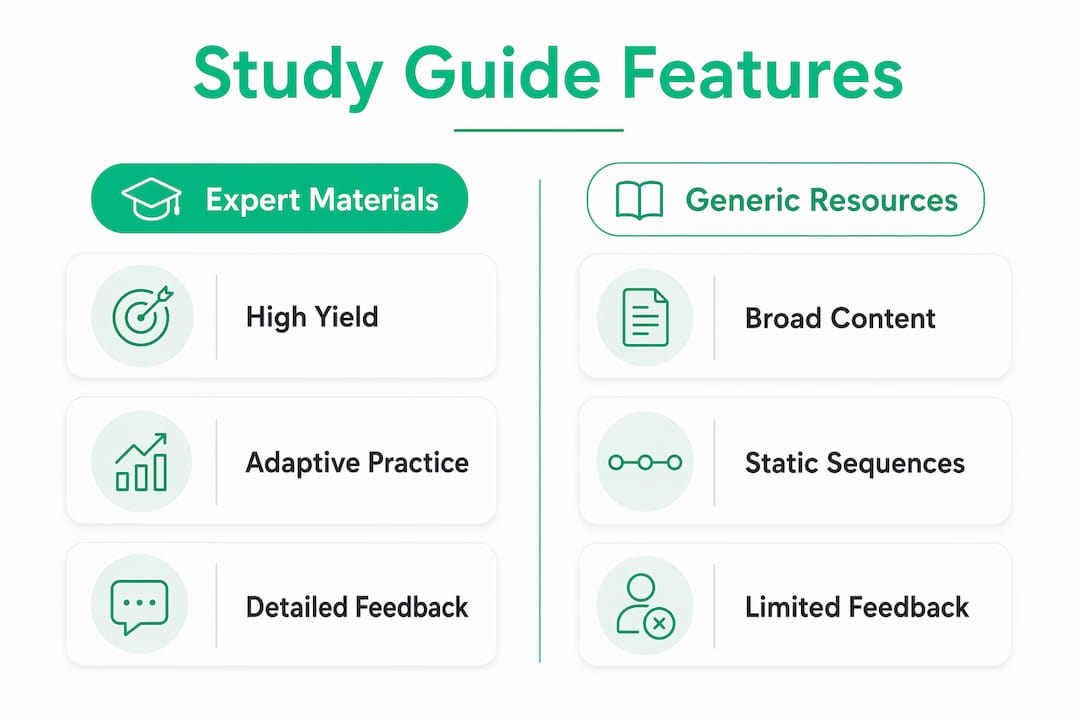
High-yield content curation filters out low-priority information and prevents cognitive overload. When you have six weeks before a university entrance exam, spending time on peripheral topics is a real cost. Expert materials make that prioritization decision for you, based on actual exam blueprints and historical question patterns.
Personalized practice sequences represent another key advantage. Adaptive practice sequences produce learning gains roughly 1.5 times greater than fixed sequences of equivalent length. That gain comes from directing more practice toward weak areas and less toward topics already mastered.
| Feature | Expert-designed materials | Generic resources |
|---|---|---|
| Content selection | Exam-aligned, high-yield topics only | Broad coverage, often unfocused |
| Practice structure | Adaptive or sequenced by difficulty | Fixed or random order |
| Feedback quality | Detailed explanations per question | Answer keys with minimal context |
| Active engagement | Built-in retrieval prompts and exercises | Primarily passive reading |
| Progress tracking | Skill-level diagnostics and gap analysis | Little to no tracking |
The feedback loop inside expert materials separates them further. When you answer a practice question incorrectly, a well-designed guide explains not just the right answer but why your reasoning failed. That explanation targets the specific misconception, not just the surface error. Generic answer keys rarely provide that depth.
How to use expert prep materials effectively for entrance exams
The most common mistake students make is treating expert study guides as textbooks. They read them cover to cover, highlight passages, and call it studying. Passive reading of official guides leads directly to knowledge gaps under exam pressure. The material needs to be worked, not read.
A practical approach to getting the most from professional prep resources follows four steps:
- Map the guide to the exam blueprint. Before studying any section, identify which exam skills or question types it covers. A university entrance exam revision plan built around the actual test structure prevents wasted effort on low-weight topics.
- Complete all active exercises before checking answers. Resist the urge to peek. The struggle to retrieve an answer is where learning happens. Looking up the answer immediately short-circuits that process.
- Schedule spaced repetition sessions. After completing a topic, return to it after two days, then after five days, then after two weeks. This spacing forces memory reconstruction and dramatically improves retention before exam day.
- Track your performance by skill area. Record which question types you get wrong consistently. High-quality prep materials focus study on weak domains. Use that data to direct your next study session, not to repeat what you already know.
Pro Tip: Combine your expert study guide with timed practice tests. Timed practice conditions train your brain to retrieve answers under pressure, which is exactly what the real exam demands.
Avoid the trap of resource overload. Students who rely on multiple uncoordinated resources risk shallow coverage and confusion. One expert guide used deeply beats five generic resources used superficially.
Do expert prep materials outperform self-study with generic resources?
Expert prep materials produce measurably better outcomes than self-directed study with generic resources across three dimensions: score improvement, completion rates, and time efficiency.
On score improvement, the data is clear. Students using structured expert guides gain 13–34% higher scores compared to unstructured study. That range reflects differences in how consistently students apply the materials, not differences in material quality.
Completion rates tell a similar story. Structured courses and expert guides achieve completion rates of 60–75%, compared to 30–40% for self-study. Students who do not finish their prep materials cannot benefit from them. Structure creates accountability that self-study rarely sustains.
Time efficiency is the third advantage. Expert-designed materials compress learning timelines by eliminating the trial-and-error phase common in self-directed study. Students who build their own study plans from scratch spend weeks figuring out what to study and in what order. Expert materials solve that problem before the student opens the first page.
The combination of active practice with structured guides amplifies all three benefits. 68% of candidates who combine expert study guides with active practice show better diagnostic scores than those using passive methods alone. Passive study feels productive. The data says otherwise.
Key advantages of expert materials over generic self-study:
- Score gains of 13–34% with structured expert resources
- Completion rates nearly double those of unguided self-study
- Faster time to exam readiness by eliminating content guessing
- Better diagnostic accuracy through built-in skill tracking
Key Takeaways
Expert-designed prep materials outperform generic resources because they apply retrieval practice, spaced repetition, and high-yield content curation to produce score gains of 13–34% and completion rates nearly double those of self-directed study.
| Point | Details |
|---|---|
| Retrieval practice drives retention | Active retrieval produces effect sizes of 0.50–0.60, far exceeding passive review. |
| Adaptive sequences accelerate learning | Personalized practice produces 1.5x greater gains than fixed-sequence study. |
| High-yield curation saves time | Expert guides filter low-priority content, preventing cognitive overload on tight timelines. |
| Completion rates double with structure | Structured materials achieve 60–75% completion versus 30–40% for self-study. |
| Active use is non-negotiable | Combining expert guides with active practice improves diagnostic scores for 68% of students. |
What I’ve learned watching students prepare the wrong way
Most students I’ve observed do not fail because they lack intelligence or effort. They fail because they study the wrong things in the wrong order for too long. The pattern is almost always the same: a student collects five different resources, reads through them passively, highlights everything that looks important, and then panics two weeks before the exam when nothing sticks.
The uncomfortable truth about prep materials is that quality beats quantity every time. One expert guide, used with discipline and active engagement, will outperform a stack of generic textbooks every single time. The students who improve the most are not the ones who study the longest. They are the ones who use their materials correctly.
The other mistake I see constantly is over-studying comfortable material. Students gravitate toward topics they already understand because it feels good to get answers right. Expert materials force you away from that comfort zone by tracking your performance and directing you toward your weakest areas. That redirection is uncomfortable. It is also exactly what produces results.
My honest advice: pick one expert resource aligned to your specific exam, commit to it fully, and use every active exercise it contains. Resist the urge to supplement with random videos or unrelated guides. Depth beats breadth in exam preparation, every time.
— quentin
Prepadmit: expert prep built for the Bocconi Test
Students targeting Bocconi University need more than a generic study guide. The Bocconi Test has a specific format, question style, and scoring logic that generic resources simply do not address.
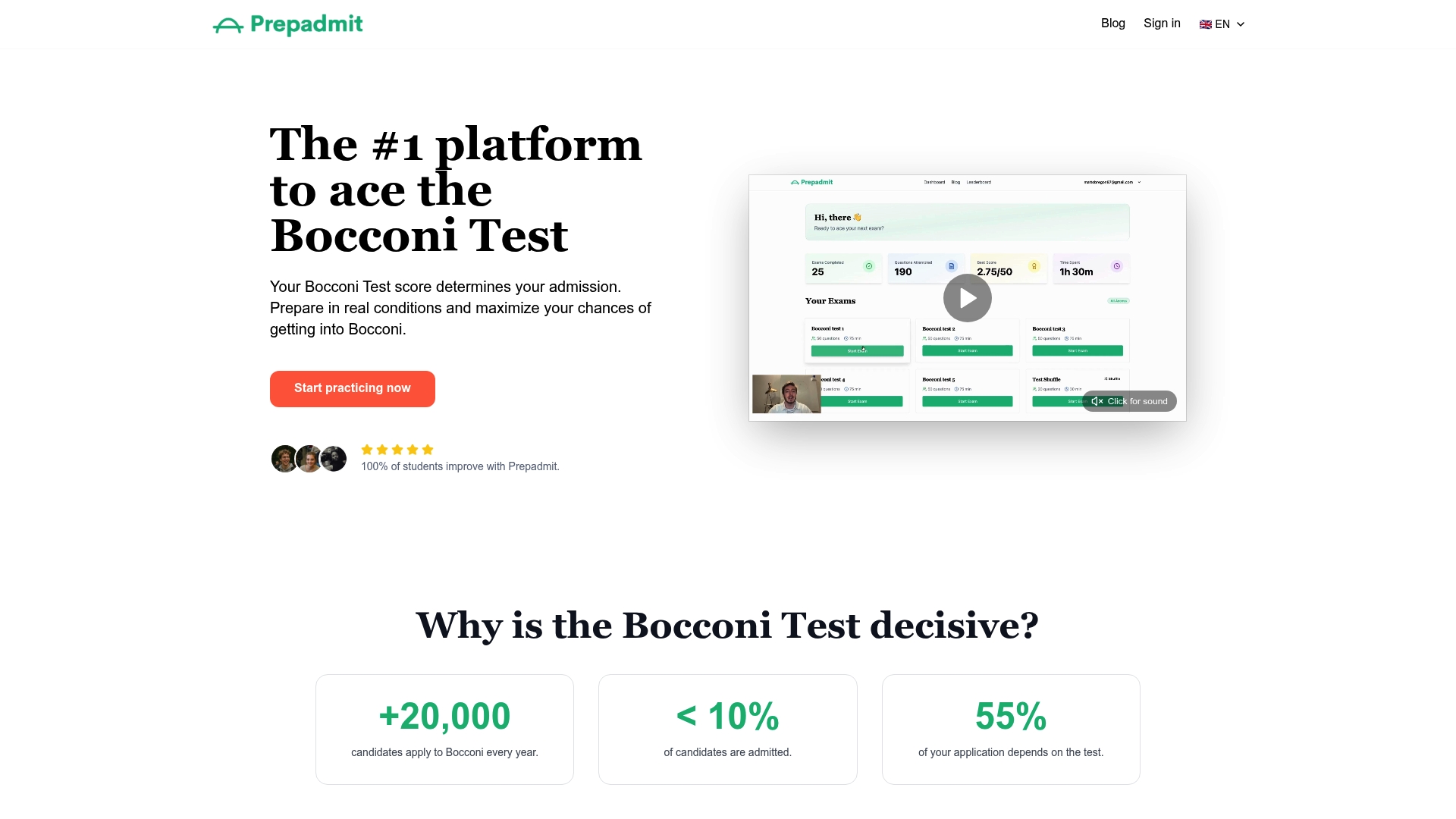
Prepadmit is built specifically for this exam. The platform was developed by graduates of HEC and Bocconi, and it delivers official past papers, on-demand practice tests, and detailed answer corrections aligned to real exam conditions. Students track their progress by skill area, practice weak domains in targeted sessions, and benchmark their scores against other candidates on the leaderboard. Prepadmit reports an average score improvement of 34%, with a money-back guarantee that reflects confidence in those results. If you are preparing for the Bocconi Test, start your prep on the platform built for exactly that exam.
FAQ
What are expert-designed prep materials?
Expert-designed prep materials are structured study resources created by specialists who understand both the target exam and the science of learning. They incorporate retrieval practice, spaced repetition, and high-yield content selection to improve exam performance.
How much can expert prep materials improve my exam score?
Students using structured expert guides improve their scores by 13–34% compared to those using unstructured or generic resources. The improvement depends on how consistently and actively the materials are used.
Why do expert study guides outperform generic resources?
Expert guides apply adaptive sequencing, built-in retrieval prompts, and exam-aligned content curation. Personalized practice sequences produce learning gains roughly 1.5 times greater than fixed-sequence study of equivalent length.
How should I use expert prep materials to get the best results?
Combine active exercises with spaced repetition sessions and timed practice tests. Avoid passive reading. Track your performance by skill area and direct study time toward your weakest topics, not the ones you already know.
What is the Bocconi Test and how does Prepadmit help?
The Bocconi Test is the entrance exam for Bocconi University in Italy. Prepadmit is a specialized platform offering official past papers, adaptive practice, and skill tracking built specifically for this exam, with an average score improvement of 34% reported across its students.
Recommended
Related articles
Ready to ace your admission test?
Discover PrepAdmit, the platform that helps you succeed at top university admission tests.
Discover PrepAdmit