Why Timed Practice Tests Matter for Exam Success

Why Timed Practice Tests Matter for Exam Success
Timed practice tests are defined as full or partial exam simulations completed under strict time limits that mirror real test conditions. They build the three skills that determine exam day performance: time management, decision-making under pressure, and mental stamina. Research by Roediger and Butler on retrieval practice confirms that testing improves long-term retention far more than passive review. Understanding why timed practice tests matter is the difference between students who freeze on exam day and students who perform at their best when it counts.
Why timed practice tests matter more than untimed study
Untimed study builds knowledge. Timed practice builds the ability to use that knowledge under pressure. These are two different skills, and confusing them is one of the most common mistakes students make.

Retrieval practice improves scores by 10–25% over passive methods like rereading or highlighting. That gap exists because retrieving information from memory under realistic conditions strengthens neural pathways in ways that passive review simply does not. The struggle to recall an answer before time runs out is not a sign of weakness. It is the mechanism that makes the memory stick.
Timed practice also exposes the “fluency illusion.” Students who study passively often feel confident because the material looks familiar. Sitting down with a timer destroys that false confidence quickly. A student who can explain a concept in their notes may still fail to apply it correctly in 90 seconds. Timed conditions train working memory to perform under stress, which is exactly what the real exam demands.
“The discomfort of struggling to retrieve an answer under time pressure is not a problem to avoid. It is the core mechanism of durable learning.”
- Timed practice forces real decisions: skip, attempt, or guess.
- It prevents students from spending 10 minutes on one question and running out of time.
- It reveals which topics slow you down, not just which topics you do not know.
- It builds the mental endurance needed for two or three hour exams.
Pro Tip: Start each study session with 15 minutes of untimed review, then finish with a short timed drill on the same material. This sequence builds knowledge first and then tests your ability to apply it under pressure.
Does timed practice reduce test anxiety?
Test anxiety is not just nervousness. It is a cognitive load problem. When stress spikes during an exam, working memory capacity drops, and students cannot access knowledge they actually have. The solution is not to relax more. The solution is to make the exam feel familiar.
Simulating real exam conditions during practice, including sitting at a desk, removing all distractions, and using a consistent timer, conditions the brain to perform under timed stress. Familiarity with the format, the pacing, and the pressure reduces the novelty that triggers anxiety. Students who have completed 10 timed mocks before exam day are not walking into an unknown situation. They are repeating a known routine.
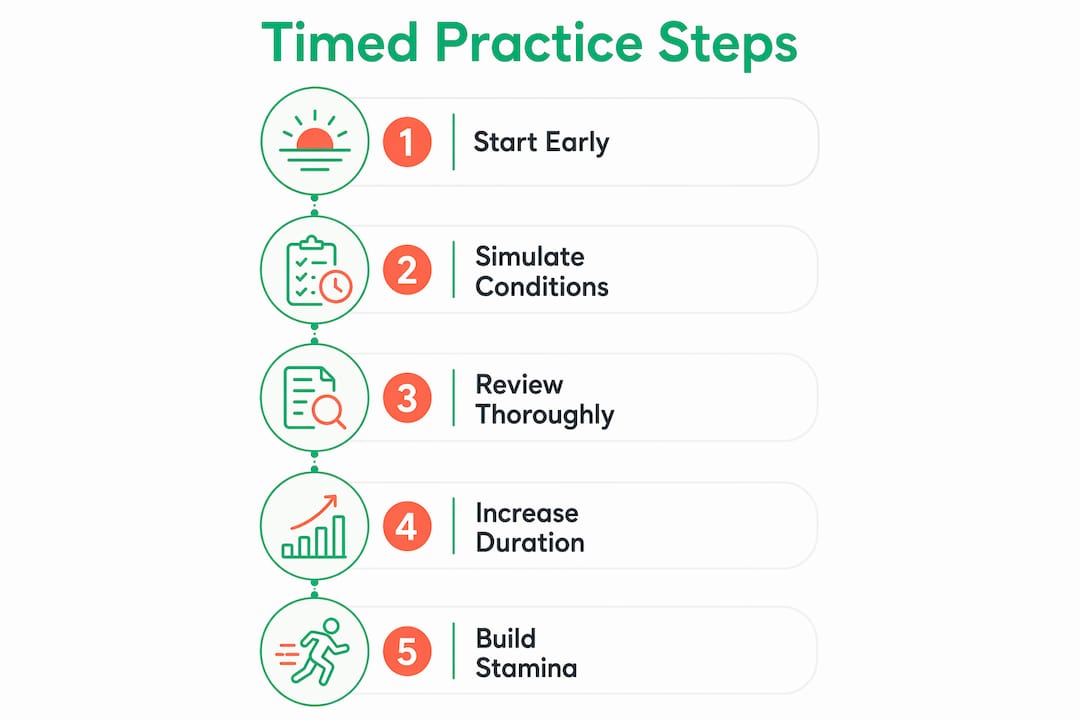
One important caution: early timed practice before conceptual mastery can actually increase anxiety and reduce effective learning. Students who attempt full timed mocks before they understand the material tend to panic rather than practice. The sequence matters. Build knowledge first, then introduce timing.
Pro Tip: If full timed mocks feel overwhelming early on, start with timed sections of 20–30 minutes. Gradually increase the duration over several weeks. This gradual exposure builds confidence without triggering the anxiety spiral that comes from premature full-length testing.
Repeated timed practice also builds what researchers call exam stamina. A student who has never sat through a two-hour timed test will experience mental fatigue at the 90-minute mark on exam day. A student who has trained under those conditions will not. Physical and cognitive endurance are trainable, and timed practice is the training.
When should you schedule timed practice tests?
Timing the timing correctly is one of the most underrated parts of exam preparation. The sequence below reflects the most effective preparation structure supported by current research.
- Weeks 6–8 before the exam: Focus entirely on untimed study. Read, review, and build conceptual understanding. Do not introduce timed pressure yet. This phase is about filling knowledge gaps, not testing under pressure.
- Weeks 3–5 before the exam: Introduce timed section practice. Work through individual sections or topics under time constraints. Use these sessions to identify which areas slow you down.
- Days 7–14 before the exam: Complete your first full timed diagnostic mock. This session reveals your current pacing and shows exactly where you lose time. Review every answer carefully after completing the full test.
- Days 2–3 before the exam: Complete one final full timed mock under exact exam conditions. This session is about building confidence and locking in pacing, not learning new material.
| Phase | Timing | Goal |
|---|---|---|
| Foundational study | 6–8 weeks out | Build knowledge, no time pressure |
| Timed section drills | 3–5 weeks out | Identify slow topics |
| First full timed mock | 7–14 days out | Diagnose pacing gaps |
| Final full timed mock | 2–3 days out | Confirm pacing and build confidence |
Taking excessive timed mocks without intervening study leads to testing fatigue and diminishing returns. The goal is a structured build, not a marathon of full-length tests. Two full timed mocks in the final two weeks is enough for most students.
How to simulate real exam conditions effectively
The quality of a timed practice session depends entirely on how realistically it replicates the actual exam. A student who pauses the timer to check their phone has not practiced under exam conditions. They have practiced something else entirely.
Students who practice under timed conditions develop better pacing and reduce the risk of running out of time on real exams. That benefit only transfers if the practice conditions match the real conditions. Here is what effective versus ineffective timed practice looks like in practice.
| Effective timed practice | Ineffective timed practice |
|---|---|
| Quiet room, no phone, consistent timer | Practicing with background noise or distractions |
| Completing the full section before reviewing | Stopping mid-test to check answers |
| Using official past papers or realistic materials | Using low-quality or mismatched practice questions |
| Reviewing answers only after the full test | Correcting mistakes question by question during the test |
| Tracking time per section during the test | Ignoring pacing until time runs out |
Delayed feedback strengthens memory better than checking answers immediately. Reviewing answers after completing the full test forces a second retrieval event, which reinforces learning more effectively than interrupting the test to self-correct. This is one of the most counterintuitive but well-supported findings in learning science.
- Use the same type of timer every session. Consistency in tools reduces cognitive friction on exam day.
- Mark questions you are unsure about during the test, then return to them if time allows.
- After each timed session, record how long you spent per section. Track this across sessions to see pacing improvement.
Pro Tip: After every timed mock, spend at least as much time reviewing your answers as you spent taking the test. The review session is where the actual learning happens. The test session is just the diagnostic.
Key Takeaways
Timed practice tests improve exam scores because they build time management, reduce anxiety through familiarity, and train working memory to perform under real exam conditions.
| Point | Details |
|---|---|
| Timed vs. untimed practice | Untimed study builds knowledge; timed practice builds the ability to apply it under pressure. |
| Retrieval practice effect | Testing under realistic conditions improves long-term retention by 10–25% over passive study. |
| Anxiety reduction | Repeated timed practice under realistic conditions reduces test anxiety by making the exam feel familiar. |
| Optimal scheduling | Introduce full timed mocks 7–14 days before the exam, with a final session 2–3 days prior. |
| Delayed feedback | Reviewing answers after completing a full test strengthens memory more than checking answers mid-test. |
The skill most students never practice
Most students prepare for what is on the exam. Very few prepare for the experience of taking the exam. That distinction sounds small. It is not.
I have seen students who knew the material cold walk out of high-stakes tests with scores that did not reflect their knowledge. The reason was almost always pacing. They spent too long on hard questions early, ran out of time on easy questions late, and panicked in the final 20 minutes. No amount of content review fixes that problem. Only timed practice does.
The other thing I have noticed is that students who use a structured revision plan that builds from untimed study to timed drills to full mocks tend to arrive at exam day with a qualitatively different mindset. They are not hoping they know the material. They know they can perform under the conditions. That confidence is not psychological fluff. It is the direct result of having done the thing repeatedly.
The students who struggle most are usually those who treated timed practice as optional, something to do once or twice in the final week. Timed practice is not a finishing touch. It is a core training method, and it needs to be built into the preparation schedule from the start.
— quentin
How Prepadmit supports timed exam preparation
Prepadmit is built specifically for students preparing for the Bocconi Test, one of the most competitive university entrance exams in Europe. The platform offers on-demand timed mock tests using official past papers, so every practice session replicates real exam conditions from the first question to the last.

Prepadmit reports an average score improvement of 34% among its students. The platform includes detailed answer corrections, skill-specific practice modes, and peer ranking so students can see exactly where they stand. For students who want structured timed practice without the cost of private coaching, Prepadmit offers a direct and affordable path to Bocconi admission. A money-back guarantee is included.
FAQ
Why do timed practice tests improve scores?
Timed practice improves scores by combining retrieval practice with realistic time pressure, which builds both memory retention and pacing skills. Research shows retrieval practice outperforms passive study by 10–25%.
How many timed practice tests should I take before an exam?
The most effective schedule includes one full timed mock 7–14 days before the exam and one final mock 2–3 days prior. Excessive full-length mocks without intervening study cause fatigue and reduce learning.
Does timed practice help with test anxiety?
Yes. Repeated timed practice under realistic conditions reduces anxiety by making the exam environment feel familiar. The key is to introduce timed pressure gradually, after building foundational knowledge.
What is the difference between timed and untimed practice?
Untimed practice builds knowledge; timed practice builds the ability to apply that knowledge under pressure. Both are necessary, but timed practice is what prepares students for actual exam conditions.
When should I start timed practice tests?
Start timed section drills 3–5 weeks before your exam, after completing foundational untimed study. Reserve full timed mock exams for the final two weeks of preparation.
Recommended
Related articles
Ready to ace your admission test?
Discover PrepAdmit, the platform that helps you succeed at top university admission tests.
Discover PrepAdmit