Spaced Repetition Exam Prep: A Science-Backed Guide

Spaced Repetition Exam Prep: A Science-Backed Guide
Spaced repetition is defined as a study method where you review material at expanding time intervals to lock information into long-term memory. It is the most research-supported technique for exam preparation, consistently outperforming cramming across hundreds of controlled studies. Students who use spaced repetition can retain 200% to 400% more material than those who cram the night before. That gap is not a minor advantage. It is the difference between walking into an exam with solid recall and walking in hoping the material sticks. The cognitive principle behind this method, called the spacing effect, was first documented by Hermann Ebbinghaus in the 1880s through his work on the forgetting curve.
What is spaced repetition exam prep, and why does science back it?
The forgetting curve, identified by Hermann Ebbinghaus, shows that memory decays rapidly after initial learning. Without review, students forget roughly half of new material within a day. Spaced repetition works by scheduling reviews at the exact moments when memory starts to fade, which forces the brain to reconstruct the memory and strengthens it each time.
The core finding: A meta-analysis of 254 studies found that students using spaced repetition scored 80% on delayed recall tests, compared to 36% for students who used massed study (cramming). That is more than double the retention with the same material.
The difference comes down to retrieval effort. When you struggle to recall a fact, your brain treats that effort as a signal to reinforce the memory. Passive rereading does not trigger that signal. Active recall paired with spaced repetition is what drives retention, not the simple act of seeing information again.
The SuperMemo method formalizes this principle with an algorithm. It schedules each review at the last responsible moment before forgetting, targeting roughly 90% recall probability at each session. The interval grows longer as memory strengthens. If you forget a card completely, the schedule resets to day one.

Common spaced repetition techniques and scheduling methods
Three scheduling frameworks dominate practical exam prep. Each suits a different timeline and level of structure.
The 2357 method
The 2357 method schedules reviews on days 2, 3, 5, and 7 after your first exposure to new material. If you recall correctly at each interval, the next gap extends. If you fail a recall, you reset to day 1. This method works well for students with 4 or more weeks before an exam.
The 1-3-7-14 rule
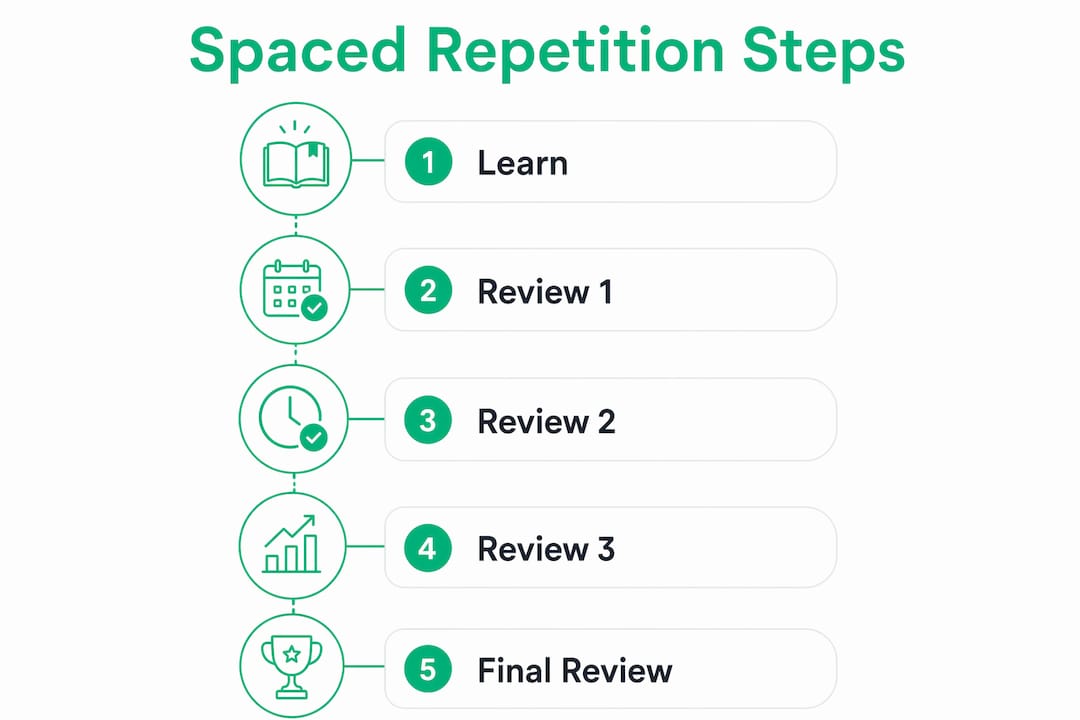
The 1-3-7-14 rule spaces reviews on days 1, 3, 7, and 14 after learning. It builds in slightly longer gaps, making it better suited for material you need to retain for a month or more. A student preparing for the Bocconi Test in six weeks could start this schedule immediately after each study session.
The 10–20% rule
The 10–20% rule ties your review interval to your total retention window. If your exam is 30 days away, review every 3 to 6 days. If your exam is 10 days away, review every 1 to 2 days. This rule applies regardless of subject, as long as each review involves active retrieval rather than passive reading.
Here is a quick comparison of the three methods:
| Method | Review days | Best for |
|---|---|---|
| 2357 | Days 2, 3, 5, 7 | 4+ week prep windows |
| 1-3-7-14 | Days 1, 3, 7, 14 | 6+ week prep windows |
| 10–20% rule | Interval = 10–20% of retention window | Any timeline, flexible |
Pro Tip: Work backward from your exam date. Identify your last review day, then schedule all prior sessions using your chosen method. This prevents the common mistake of front-loading study and skipping final reviews.
Digital flashcard apps that use the SM-2 algorithm (the engine behind many popular spaced repetition tools) automate this scheduling entirely. They track your recall accuracy and adjust intervals without any manual calculation.
How to implement spaced repetition in your exam study
The method only works if your flashcards and habits support it. Most students who fail with spaced repetition make one of three errors: they design bad cards, they reread instead of recalling, or they compress intervals when time gets short.
Build atomic flashcards
Atomic cards with one fact per card are the foundation of effective spaced repetition. Complex cards that bundle multiple facts create false positives. You recall part of the card, feel like you know it, and mark it correct. The algorithm then extends the interval, and the forgotten part disappears from your schedule. One card, one fact, one clear answer.
Anchor sessions to your daily routine
Forming daily study habits anchored to existing routines is the most reliable way to stay consistent. Review cards after your morning coffee, during your commute, or right before dinner. The trigger does not matter. What matters is that the session happens at the same time every day without requiring a decision.
Mix topics within each session
Students typically study in topic blocks, reviewing all of one subject before moving to the next. Spaced repetition apps naturally interleave topics by shuffling cards from different subjects. This trains your brain to identify which concept applies in which context, a skill that directly improves exam performance. Mixing topics feels harder in the moment. That difficulty is the point.
Pro Tip: If you are using physical flashcards, shuffle your deck before each session. Randomizing the order forces context switching and prevents you from guessing answers based on position.
Avoid these common mistakes
- Rereading notes instead of testing yourself. Familiarity feels like mastery but produces poor recall on exams.
- Compressing intervals when the exam approaches. Shorter gaps reduce the memory-strengthening effect.
- Creating cards that are too vague or too complex. “What is economics?” is too broad. “What does GDP measure?” is testable.
- Skipping reviews when you feel confident. Confidence is not the same as durable memory.
How to build a spaced repetition exam prep plan
A structured plan turns the method into a schedule you can actually follow. Here is a practical approach for a six-week prep window.
- Week 1: Create 10 to 20 flashcards per day from your most recent study material. Start reviewing the previous day’s cards the next morning using the 2357 or 1-3-7-14 method.
- Week 2 and 3: Continue adding new cards daily. Your review load will grow, so budget 20 to 30 minutes per day for reviews before adding new material.
- Week 4: Reduce new card creation. Prioritize clearing your review queue. Falling behind on reviews is more damaging than not adding new cards.
- Week 5: Shift to consolidation. Run full review sessions and take at least two full practice exams to test knowledge transfer under timed conditions.
- Week 6: Stop adding new cards entirely. Focus only on reviews and exam simulations. Use the 10–20% rule to set your final review intervals.
For a compressed two-week plan, the approach changes. Start with the 10–20% rule immediately, reviewing every 1 to 2 days. Create no more than 10 cards per day. Prioritize the highest-yield topics first. Do not attempt to cover everything. Depth on core material beats shallow coverage of everything.
| Timeline | Daily new cards | Review frequency | Final week focus |
|---|---|---|---|
| 6-week plan | 10–20 cards | Every 2–3 days | Reviews only, practice exams |
| 2-week plan | 5–10 cards | Every 1–2 days | High-yield topics, reviews only |
A well-structured exam revision plan combines this schedule with clear topic priorities so you never waste a session on low-value material.
Key Takeaways
Spaced repetition outperforms cramming because it forces active retrieval at the exact moment memory starts to fade, which doubles or triples long-term retention.
| Point | Details |
|---|---|
| Core definition | Spaced repetition schedules reviews at expanding intervals to strengthen memory before it fades. |
| Retention advantage | Students using spaced repetition score up to 80% on delayed recall tests versus 36% for cramming. |
| Best scheduling methods | The 2357 method, 1-3-7-14 rule, and 10–20% rule each suit different exam timelines. |
| Flashcard design matters | Atomic cards with one fact each prevent false positives and keep intervals accurate. |
| Habit consistency | Anchoring daily reviews to an existing routine is the most reliable way to stay on schedule. |
Why most students misread their own progress
The biggest trap in spaced repetition is not the method itself. It is the feeling of familiarity that comes from rereading. When you read a page of notes and think “yes, I know this,” you are recognizing the material, not recalling it. Mistaking familiarity for mastery is the most common reason students underperform despite putting in hours of study.
I have seen this pattern repeatedly. Students spend weeks reviewing notes and feel prepared. Then they sit down for a practice test and cannot produce the answer without the page in front of them. The information was never stored deeply enough to be retrieved under pressure.
The fix is uncomfortable. You have to test yourself before you feel ready. You have to sit with the frustration of not knowing the answer and force your brain to search for it. That struggle is not a sign that the method is failing. It is the method working.
Start small. Create five cards today. Review them tomorrow. Add five more. The habit matters more than the volume in the first week. Once the routine is set, the system compounds. By week three, you will have a review queue that covers material from multiple weeks back, and your recall will be noticeably stronger than anything cramming ever produced.
The SuperMemo algorithm adapts to your individual memory pace, which means the system gets more efficient the longer you use it. That is the real advantage over fixed schedules. Patience with the process is not optional. It is the strategy.
— quentin
How Prepadmit supports your exam prep
Structured study only works when the material you practice matches what the exam actually tests. Prepadmit is built specifically for students preparing for the Bocconi Test, with official past papers, on-demand practice tests, and detailed answer corrections that show exactly where your knowledge breaks down.

Students using Prepadmit see an average score improvement of 34%, which reflects what happens when spaced repetition and active recall meet realistic exam conditions. The platform tracks your progress, ranks you against peers, and lets you practice by skill area so you can focus your review sessions on the topics that need the most work. Start your Bocconi prep with a platform designed by experts from HEC and Bocconi, at a fraction of the cost of private coaching.
FAQ
What is spaced repetition in simple terms?
Spaced repetition is a study method where you review material at increasing time intervals to strengthen memory before it fades. Each successful recall extends the next review gap.
How is spaced repetition different from cramming?
Cramming concentrates all study into one session, which produces short-term recall but poor retention. Spaced repetition spreads reviews over days or weeks, producing recall rates up to 80% on delayed tests versus 36% for cramming.
How many flashcards should I make per day?
Creating 10 to 20 cards per day works well for a six-week prep window. For a two-week plan, limit new cards to 5 to 10 per day and prioritize clearing your review queue over adding new material.
What happens if I miss a review session?
If you miss a session and forget a card completely, its interval resets to the beginning. Missing reviews regularly breaks the compounding effect of the method, so consistency matters more than volume.
Can spaced repetition work for any exam subject?
Yes. The 10–20% rule applies regardless of subject, as long as each review involves active retrieval. The method works for vocabulary, formulas, concepts, and analytical frameworks alike.
Recommended
Related articles
Ready to ace your admission test?
Discover PrepAdmit, the platform that helps you succeed at top university admission tests.
Discover PrepAdmit