University Entrance Exam Revision Plan That Works

University Entrance Exam Revision Plan That Works
A university entrance exam revision plan is a structured, prioritized schedule that maps every topic, allocates study time by difficulty, and builds in practice tests and rest so you walk into the exam ready. Most students treat revision as a vague intention rather than a system. That gap explains why some candidates improve dramatically while others plateau. Coursera recommends starting at least 3 months before your exam date, studying a minimum of 3 hours per week within a structured program that combines concept review and timed practice. The methods in this article, including the 70% planning rule, traffic light prioritization, and spaced repetition, give you that system.
What a university entrance exam revision plan actually requires

The University of Sydney advises students to identify topics, exam type, duration, and question format before writing a single study session into their calendar. This is the correct starting point. You cannot plan effectively if you do not know what you are planning for.
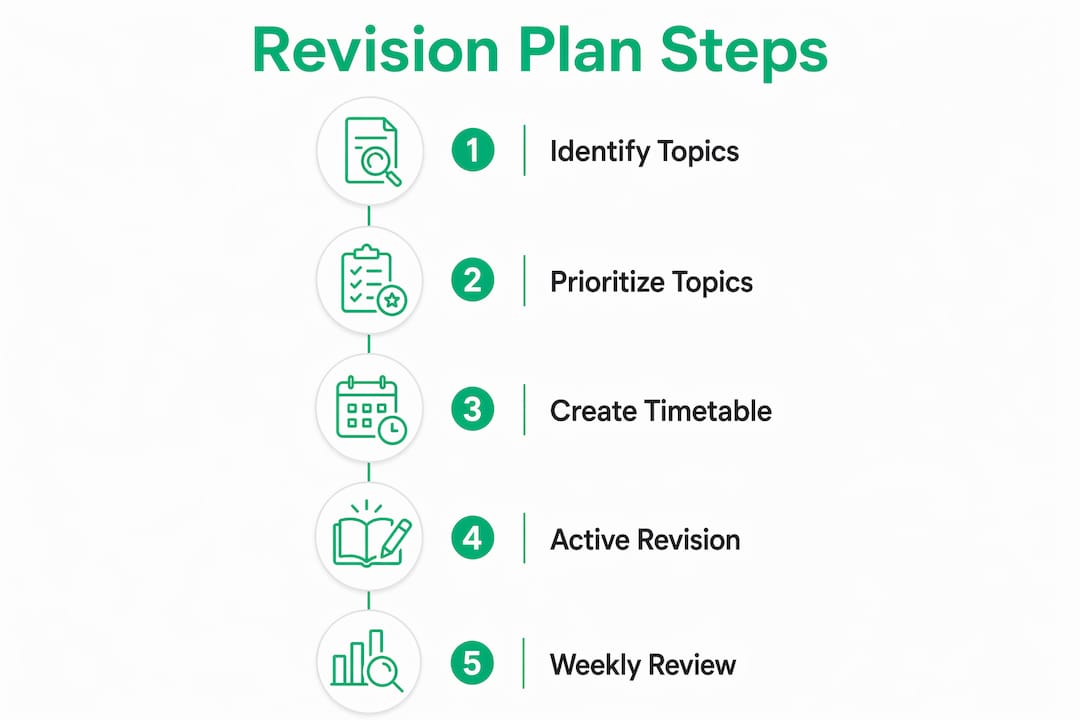
Begin by listing every subject and topic covered in your exam. For the Bocconi Test, this means mapping out the logical reasoning, mathematics, and reading comprehension sections explicitly. For other university admission tests, pull the official syllabus from the institution’s website and cross-reference it with past papers to confirm what actually appears.
Once you have your full topic list, categorize each item using the traffic light system:
- Red: Topics you struggle with or have not studied yet
- Yellow: Topics you partially understand but cannot apply consistently
- Green: Topics you can answer correctly under pressure
The BBC’s exam guidance confirms that traffic light ratings help students prioritize study time and sharpen terminology recall. The system works because it forces honesty. Most students overestimate their green topics until a practice question proves otherwise.
Pro Tip: After categorizing, count your red topics. If more than 40% of your list is red, you need to extend your preparation timeline or reduce the scope of what you plan to cover deeply.
Finally, note the exam format details: total time, number of questions, question types (multiple choice, open response, essay), and any penalty for wrong answers. These details directly shape how you practice and how you allocate revision time per topic.
How to build a realistic study timetable
A realistic revision schedule for exams is built on blocks, not hours. Study in 2.5 to 3 hour blocks with short breaks rather than scheduling every hour of your day. Hour-by-hour rigidity is one of the fastest routes to burnout.
Here is how to structure your weekly timetable:
- Map your available days. Count the weeks until your exam. Subtract any fixed commitments like school, sports, or family obligations.
- Apply the 70% rule. Only schedule 70% of your available study time. The remaining 30% acts as a buffer for disruptions, review overruns, and rest. Supertutor’s research confirms that the 70% rule produces higher plan completion and better retention than exhaustive schedules.
- Assign morning blocks to red topics. Your cognitive performance peaks in the morning for most people. CETT’s guidance on university entrance preparation recommends placing hardest topics in morning blocks and using afternoon sessions for yellow and green topic review.
- Schedule one full rest day per week. Rest is not optional. Top students who schedule at least one rest day weekly show better cognitive performance and lower fatigue going into exam week.
- Rotate subject order weekly. If Monday morning is always mathematics, your brain begins to associate that slot with dread. Rotating the order prevents this and keeps engagement higher.
- Reserve one session per week for a full mock test. Timed practice under real conditions is not optional. It is the only way to build genuine exam confidence.
| Schedule type | Approach | Outcome |
|---|---|---|
| Hour-by-hour rigid plan | Every hour assigned to a specific task | High burnout risk, low adherence after week 2 |
| 70% block schedule | 2.5-3 hour blocks, 30% buffer built in | Higher completion rate, more flexibility |
Pro Tip: Start each study session by spending 10 minutes reviewing the previous day’s notes before opening new material. This daily review habit, recommended by Supertutor’s study framework, reinforces retention without adding significant time.
What active revision techniques actually improve retention
Passive reading is the least effective study method for university entrance exams. Reading your notes feels productive but produces weak memory encoding. Active recall and spaced repetition are the methods that actually move information into long-term memory.
Active recall means testing yourself before you feel ready. Close your notes, write down everything you remember about a topic, then check what you missed. This process is more effective than re-reading the same page three times. You can use flashcards, blank-page recall, or practice questions to apply it.
Spaced repetition takes active recall and schedules it strategically. CETT’s research shows that revisiting topics at 1, 3, 7, and 21 days after initial study significantly reduces the forgetting curve. In practice, this means a topic you study on Monday gets a short review on Tuesday, again on Thursday, again the following Monday, and a final review three weeks later.
Past exam papers are the single most underused revision tool among pre-university students. CETT stresses that practicing with past papers under timed conditions trains you to recognize question patterns, manage time per question, and structure answers correctly. The role of mock exams in building this readiness cannot be overstated for competitive tests like the Bocconi Test.
Revision should prepare you for rephrased or differently worded questions. Memorizing key terminology reduces confusion when the exam uses unfamiliar phrasing for a concept you know well. — BBC exam guidance
Teaching a concept to someone else is another high-impact technique. If you can explain a topic clearly to a friend or even to yourself out loud, you have genuinely understood it. If you stumble, you have found a gap worth addressing.
Common revision plan pitfalls and how to avoid them
The most common reason revision plans fail is overambition. Students build schedules that assume perfect conditions and then abandon the plan entirely when one day goes wrong.
- No buffer time. Scheduling 100% of available hours leaves no room for illness, unexpected schoolwork, or low-energy days. The 70% rule exists precisely to solve this.
- Rigid hour-by-hour planning. A plan that assigns 9:00 to 10:00 to topic A and 10:00 to 11:00 to topic B collapses the moment you run 20 minutes over. Block scheduling is more resilient.
- Prioritizing new material over revision. Many students keep learning new content right up to the exam while neglecting to revisit what they already studied. The University of Sydney’s study skills research shows that measuring session outputs, such as completed practice questions rather than hours logged, keeps revision sessions productive and honest.
- Ignoring exam format in practice. Studying content without practicing under timed conditions means you arrive at the exam knowing the material but not knowing how to deploy it in 90 minutes or less.
- Never updating the plan. A revision schedule is a living document. If a topic takes twice as long as expected, the plan needs to shift. Students who treat the original schedule as fixed end up either rushing or skipping topics entirely.
The fix for all of these is simple: review your plan every Sunday. Assess what you completed, what you skipped, and what needs more time. Adjust the coming week accordingly.
How to adjust your plan as exam day approaches
The final four weeks before your exam require a different approach than the preparation phase. The goal shifts from learning to consolidating.
- Stop introducing new topics in the final two weeks. Any topic you have not studied by this point will not be mastered in time. Focus entirely on strengthening what you already know.
- Increase mock test frequency. Move from one mock test per week to two or three. Each test should be completed under full exam conditions: timed, no notes, no interruptions.
- Use the last week for light review only. Review formula sheets, key terminology lists, and your most common error types from past papers. Do not attempt to cram new content.
- Schedule rest the day before the exam. Light review in the morning, no studying after noon, and a full night of sleep. Fatigue on exam day costs more points than any last-minute revision gains.
- Prioritize subjects by exam date. If you have multiple exams, build a mini-schedule within the final weeks that sequences revision by which exam comes first, not by which subject you prefer.
The mental side matters here too. Anxiety before a high-stakes exam is normal. What separates prepared students is that their confidence comes from evidence: completed mock tests, tracked progress, and a plan they actually followed.
Key takeaways
A university entrance exam revision plan works when it combines honest topic prioritization, realistic scheduling with buffer time, and active recall methods practiced under timed conditions.
| Point | Details |
|---|---|
| Start 3 months out | Begin structured preparation at least 3 months before the exam with a minimum of 3 hours of study per week. |
| Use the traffic light system | Categorize every topic as red, yellow, or green to direct your time toward the areas that need it most. |
| Apply the 70% rule | Schedule only 70% of available study hours to build in buffer time and maintain plan adherence. |
| Practice with past papers | Timed mock tests under real conditions are the most reliable way to build exam confidence and time management. |
| Review and adjust weekly | Treat your revision schedule as a living document and update it every week based on actual progress. |
What I’ve learned about revision plans that actually hold up
I have seen students build beautiful, color-coded revision timetables that collapse by week two. The problem is almost never motivation. It is that the plan was designed for an idealized version of the student, not the real one.
The most durable revision plans I have encountered share one trait: they measure outputs, not hours. A session where you complete 20 timed practice questions and review every wrong answer is more valuable than three hours of passive note-reading. The University of Sydney makes this point directly, and it holds up in practice.
The other thing most articles will not tell you is that flexibility is a feature, not a weakness. Students who give themselves permission to shift a session when they are genuinely exhausted tend to maintain their plans longer than those who treat every deviation as a failure. The 70% rule is not just a scheduling trick. It is a psychological buffer that keeps you in the game.
For the Bocconi Test specifically, the students who improve most are the ones who treat every mock test as diagnostic data rather than a grade. They look at which question types they consistently miss, adjust their red-topic list, and shift their next week’s morning blocks accordingly. That feedback loop, plan, practice, adjust, is what separates a revision schedule from a genuine exam preparation strategy.
— quentin
Start your Bocconi Test preparation with Prepadmit
If you are preparing for the Bocconi Test, the strategies in this article work best when paired with realistic practice material.

Prepadmit is built specifically for Bocconi University applicants. The platform gives you access to official past papers, on-demand timed tests, and detailed answer corrections that show exactly where your preparation gaps are. Progress tracking and peer ranking let you measure improvement week over week, so your revision plan stays grounded in real data rather than guesswork. Students using Prepadmit improve their scores by an average of 34%. Visit Prepadmit to start practicing under real exam conditions today.
FAQ
How far in advance should I start my revision plan?
Start your university entrance exam revision plan at least 3 months before the exam date. Coursera recommends a minimum of 3 hours of structured study per week during this period, combining concept review with timed practice.
What is the 70% rule for study timetables?
The 70% rule means scheduling only 70% of your available study hours, leaving 30% as a buffer for disruptions and review overruns. Supertutor’s research confirms this approach produces higher plan completion rates than fully packed schedules.
How does spaced repetition work for exam revision?
Spaced repetition revisits a topic at increasing intervals after initial study: 1 day, 3 days, 7 days, and 21 days. This schedule reduces the forgetting curve and moves information into long-term memory more effectively than massed review sessions.
What should I do in the final week before my exam?
Limit study to light review of key terminology, formula sheets, and your most common error types from past papers. Avoid new material entirely and prioritize sleep, especially the night before the exam.
How do I know if my revision plan is working?
Measure session outputs rather than hours studied. Track completed practice questions, mock test scores, and which topics have moved from red to yellow or green on your traffic light list. Consistent score improvement on timed tests is the clearest signal your plan is working.
Recommended
Related articles
Ready to ace your admission test?
Discover PrepAdmit, the platform that helps you succeed at top university admission tests.
Discover PrepAdmit