Why Exam Simulation Boosts Results for Students

Why Exam Simulation Boosts Results for Students
Exam simulation is defined as practicing under realistic test conditions to improve both knowledge retention and test performance. Students who use this method consistently outperform peers who rely on passive review alone. The core reason why exam simulation boosts results is straightforward: it forces your brain to actively retrieve information rather than passively recognize it. Platforms like Prepadmit and tools like Quizlet have built entire preparation systems around this principle. The science behind it is clear, and the score gains are measurable.
Why exam simulation boosts results: the memory science
Active recall is the mechanism that makes exam simulation work. When you pull information from memory under pressure, you strengthen the neural pathway tied to that knowledge. Active recall strengthens retrieval pathways each time memory is accessed, binding it to a testing context for better real-exam performance.
Passive study methods like re-reading and highlighting create a false sense of mastery. The material feels familiar, so your brain signals that you know it. That signal is wrong. Students overestimate their learning when material feels easy during re-reading, and exam simulation disrupts this metacognitive illusion by forcing genuine recall.
The numbers confirm the gap. After one week, retrieval practice retained 61% of information compared to 40% for students who re-read the material. That 21-percentage-point difference compounds over a full semester of study.
“Failing during practice, followed by learning the correct answer, leads to stronger long-term retention than getting it right initially.” This is the concept of desirable difficulty, and it is one of the most counterintuitive findings in learning science.
Researchers call this the testing effect. Struggling to retrieve an answer, even incorrectly, primes the brain for deeper encoding when the correct answer arrives. The struggle is not a sign of weakness. It is the mechanism of learning.
- Active recall forces retrieval, strengthening memory pathways with each attempt.
- Desirable difficulty means wrong answers during practice lead to stronger retention later.
- Spaced simulation across multiple sessions prevents cramming and builds durable knowledge.
- Contextual encoding ties knowledge to exam conditions, improving recall on test day.
Pro Tip: Do not skip questions you find hard during practice. Wrong answers followed by correction produce stronger retention than easy correct answers. Lean into the struggle.
What emotional and psychological benefits does exam simulation offer?

Exam anxiety is a real physiological event. Stress responses like elevated heart rate and time pressure reduce performance during actual exams. Repeated simulation under realistic conditions acts as stress inoculation, gradually lowering that anxiety response.
Stress inoculation works the same way a vaccine does. You expose yourself to a controlled version of the stressor repeatedly until your nervous system stops treating it as a threat. Students who complete multiple timed mock exams before their actual test report lower anxiety and better focus on exam day.
Simulation also builds metacognitive accuracy. Metacognition means knowing what you actually know versus what merely feels familiar. Exam simulation calibrates confidence with accuracy in a way that passive study never can. You walk into the real exam knowing exactly where your gaps are.
Long exams also require physical and mental stamina. A student who has never sat through a three-hour timed test will fatigue faster than one who has practiced it. Simulation builds that endurance systematically.
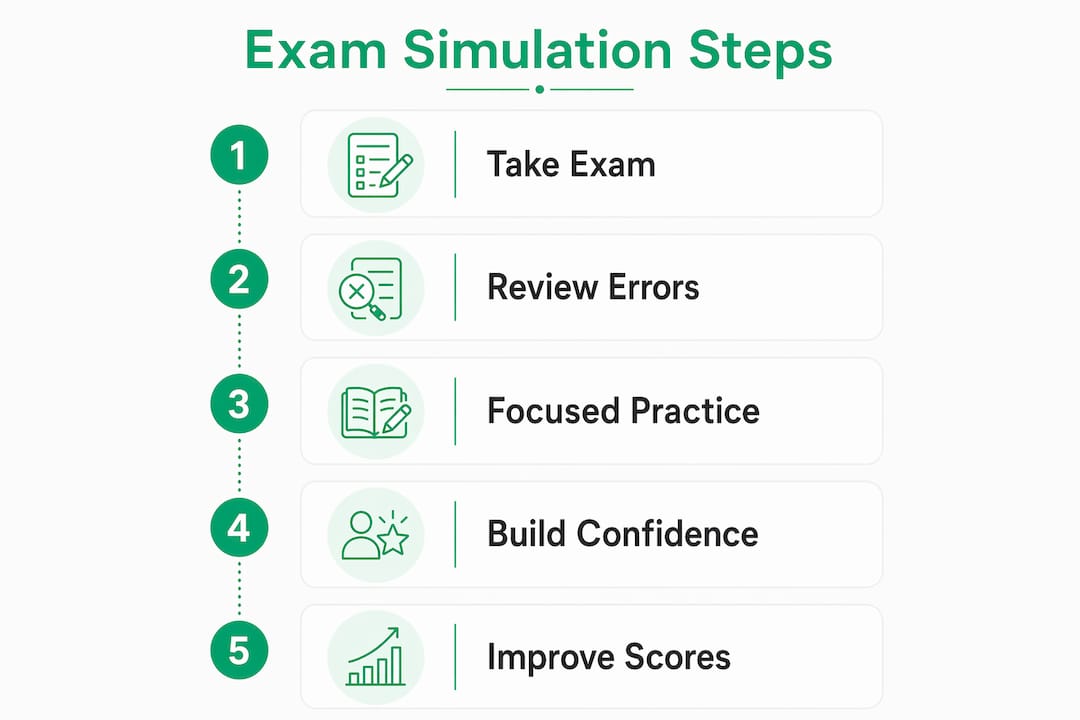
Here is a practical sequence for building psychological readiness through simulation:
- Start with a diagnostic mock. Take a full timed exam without any preparation. This sets your honest baseline.
- Review every error in detail. Do not just check answers. Understand why each wrong answer was wrong.
- Target weak areas with focused study. Use your error log to direct revision, not a general review.
- Retake a fresh mock after two weeks. Measure the gap between your first and second attempt.
- Schedule a final mock 2–3 days before the real exam. This sharpens timing and reduces last-minute anxiety.
Pro Tip: Schedule at least one full-length timed simulation in the same time slot as your actual exam. Your brain performs differently at 9 a.m. than at 3 p.m. Train at the right hour.
How does exam simulation compare to re-reading and passive review?
The evidence against passive study is consistent across decades of research. A meta-analysis shows students who test themselves achieve results about one letter grade higher than peers who rely on passive studying. One letter grade is the difference between admission and rejection at competitive universities.
| Study Method | Retention After One Week | Performance Outcome |
|---|---|---|
| Re-reading | 40% | Below average improvement |
| Highlighting and note-taking | Marginally above re-reading | Minimal score gains |
| Flashcard review (Quizlet) | Moderate | Good for isolated facts |
| Full exam simulation | 61% | Consistent score improvement |
| Simulation with error review | Highest | Approximately one letter grade gain |
Re-reading creates an illusion of mastery because recognition memory is easy. You see the word “photosynthesis” in your notes and your brain says “I know that.” But recognition is not the same as recall. On exam day, you need to produce the answer from nothing, not identify it in a list.
Flashcards, including those on Quizlet, are useful for isolated facts but limited for complex reasoning tasks. They do not replicate the time pressure, multi-step problem solving, or stamina demands of a real exam. Students who incorporate practice testing score 10–25% higher on exams compared to passive reviewing. That range represents the gap between a student who re-reads and one who simulates.
- Passive review builds recognition memory, not recall.
- Flashcards help with vocabulary but miss reasoning and pacing skills.
- Full simulation tests all skills simultaneously under real conditions.
- Error review after simulation provides clearer diagnostics than any passive method.
The university entrance exam revision plan that consistently works combines structured simulation with targeted error review, not general re-reading.
How to use exam simulations effectively to maximize your score
The most common mistake students make is treating mock exams as a final check rather than a training tool. The second mock exam predicts final results better than the first because it reveals genuine learning progress. The first mock is a baseline. The second is a measurement.
A successful simulation strategy follows a full loop. Take the exam under realistic conditions, review every error, do focused revision on weak areas, then retake a fresh exam. This full loop strategy is the difference between students who plateau and those who keep improving.
One critical pitfall: do not reuse the same mock exam. Repeating identical practice questions inflates scores without producing genuine cognitive mastery. Your brain memorizes the answers, not the reasoning. Fresh, syllabus-aligned questions are necessary for reliable improvement.
Timing matters too. Run a full mock 7–10 days before your exam to identify remaining gaps. Run a shorter, confidence-building simulation 2–3 days before to sharpen timing without adding stress. The role of mock exams in Bocconi test success follows exactly this pattern: diagnostic early, confirmatory late.
- Use a quiet, timed environment for every simulation. No phone. No music.
- Work through every wrong answer before moving to the next study session.
- Rotate between different mock papers to avoid answer memorization.
- Track your score trend across multiple mocks, not just your best result.
- Combine flashcard review for vocabulary with full simulations for reasoning and pacing.
Pro Tip: Keep an error log. Write down every question you got wrong, why you got it wrong, and the correct reasoning. Review this log the night before your exam. It is the most targeted revision tool you have.
Key Takeaways
Exam simulation boosts results because it forces active retrieval, builds stress tolerance, and provides diagnostic clarity that passive study methods cannot match.
| Point | Details |
|---|---|
| Retrieval beats re-reading | Students using retrieval practice retain 61% of material after one week versus 40% for re-readers. |
| Simulation reduces exam anxiety | Repeated timed practice inoculates students against stress responses on real exam day. |
| One letter grade improvement | Meta-analysis shows self-testing students consistently outperform passive study peers by one full grade. |
| Avoid reusing mock exams | Repeating identical questions inflates scores without building genuine mastery; use fresh papers. |
| Follow the full loop | Simulate, review errors, revise targeted gaps, then retake a fresh exam for real improvement. |
The thing most students get wrong about exam prep
Students treat preparation as an information problem. They think the goal is to read more, highlight more, and cover more material. That framing is wrong. Exam performance is a skill, not a knowledge inventory.
I have watched students spend weeks re-reading textbooks and still freeze on exam day. The material was in their heads. The problem was that they had never practiced producing it under pressure. Simulation is not just practice. It is performance training.
The other thing students underestimate is the diagnostic value of a mock exam. A bad score on a simulation is not a failure. It is a map. It tells you exactly where to spend the next two weeks. Students who treat every mock as a verdict rather than a tool waste the most valuable feedback they have.
Confidence built through simulation is also qualitatively different from confidence built through re-reading. One is earned through demonstrated performance. The other is an illusion. On exam day, only the earned kind holds up.
If you are preparing for a high-stakes university entrance exam, think of your mock exams as the actual training sessions and the real exam as the performance. Athletes do not skip practice and expect to perform. Neither should you.
— quentin
How Prepadmit helps you put exam simulation into practice
Prepadmit is built specifically for students preparing for the Bocconi Test, one of the most competitive university entrance exams in Europe. The platform delivers realistic mock exams drawn from official past papers, so every simulation matches the actual test format and difficulty.
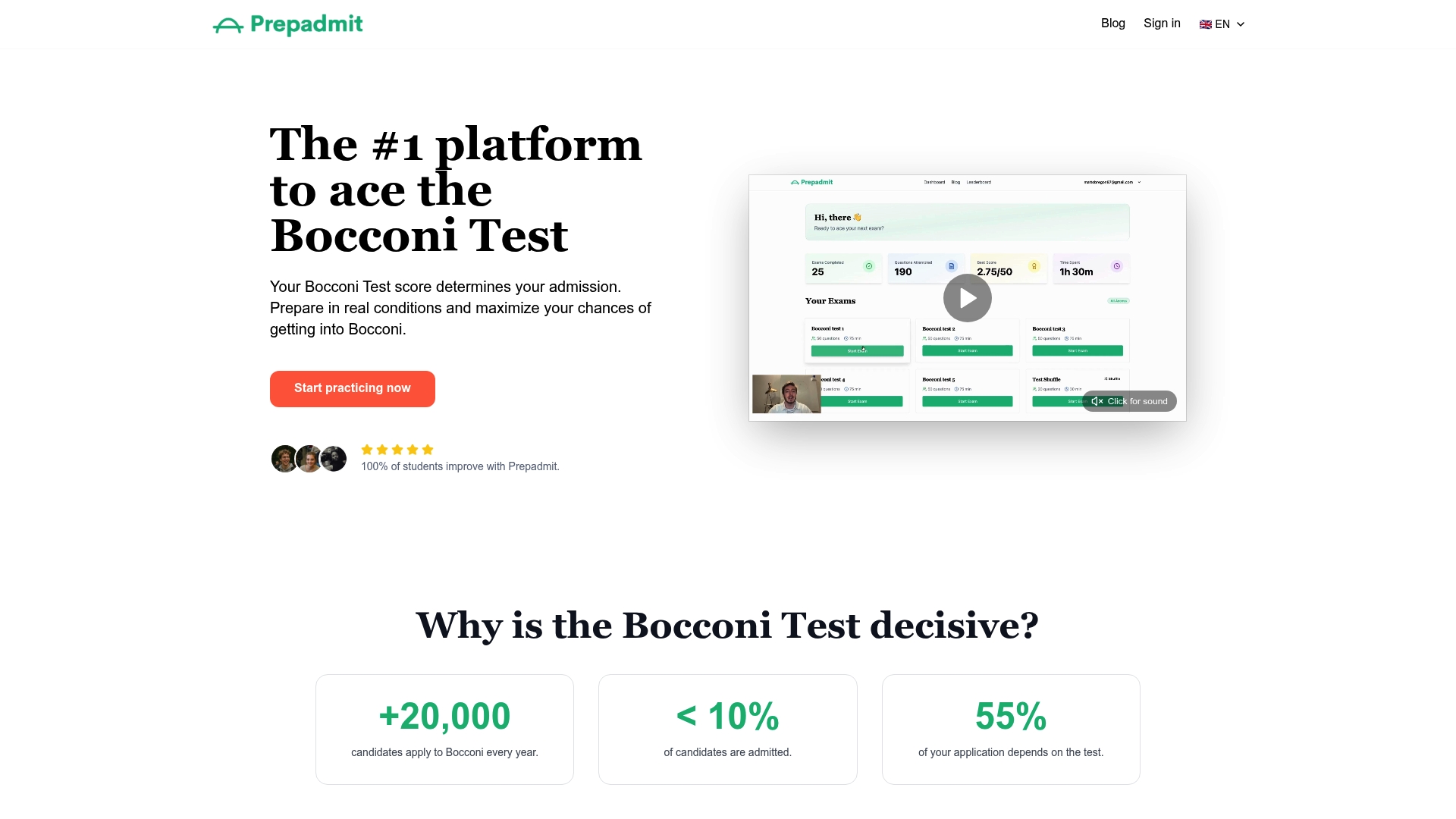
Prepadmit users gain access to detailed answer corrections, skill-specific practice modes, and a peer ranking system that shows exactly where you stand. The platform reports an average score improvement of 34% among its students. That result comes from structured simulation, not passive review. Students preparing for Bocconi can start practicing on Prepadmit with a system designed by experts from HEC and Bocconi University itself.
FAQ
Do mock exams actually improve final exam scores?
Yes. 90% of students perform better on final exams than on their first practice attempt, and students using practice testing score 10–25% higher than those using passive review.
How many mock exams should I take before the real test?
Take at least two full mocks: one 7–10 days before the exam as a diagnostic, and one 2–3 days before as a final confidence check. Use fresh question sets each time.
Why does failing practice questions help you learn?
Failing during practice primes the brain for stronger encoding when the correct answer is learned. This desirable difficulty effect produces more durable retention than getting answers right on the first try.
Is exam simulation better than using flashcards?
Flashcards build recognition memory for isolated facts. Full exam simulation trains reasoning, pacing, and stamina simultaneously. The two methods work best in combination, not as substitutes.
How does exam simulation reduce test anxiety?
Repeated exposure to realistic exam conditions lowers the physiological stress response over time. Stress inoculation through simulation prepares students psychologically so that the real exam feels familiar rather than threatening.
Recommended
Related articles
Ready to ace your admission test?
Discover PrepAdmit, the platform that helps you succeed at top university admission tests.
Discover PrepAdmit