Role of mock exams in test success for Bocconi aspirants

Role of mock exams in test success for Bocconi aspirants
You already know the Bocconi Test covers logic, math, and reading comprehension. But knowing the content is not enough. The real role of mock exams in test success is turning what you know into what you can actually do under pressure, in 100 minutes, with no second chances. Most students who fail the Bocconi Test are not unprepared in terms of knowledge. They are unprepared in terms of performance. This article explains why mock exams are the single most important tool in your preparation, what the research says, how to use them correctly, and where to find affordable options that actually work.
Table of Contents
- Why mock exams are essential for Bocconi test success
- Scientific evidence on mock exams improving test scores and reducing stress
- How to use mock exams effectively for the Bocconi test
- Affordable and reliable mock exam resources for Bocconi aspirants
- A fresh perspective: the real purpose of mock exams is not to measure you
- Prepare confidently with Prepadmit’s Bocconi test platform
- Frequently asked questions
Key Takeaways
| Point | Details |
|---|---|
| Active retrieval matters | Mock exams improve test success by practicing memory retrieval under realistic conditions. |
| Reduce anxiety | Familiarity from mocks helps lower stress and build confidence for test day. |
| Use official resources | Free reliable mocks from CISIA and trusted vendors offer effective preparation tools. |
| Follow a plan | Schedule mocks after diagnostics and focused study to maximize benefits. |
| Engage deeply | Serious practice with review cycles turns mock exams into learning opportunities, not just assessments. |
Why mock exams are essential for Bocconi test success
Knowing a concept and applying it under a ticking clock are two completely different skills. Mock exams force you to bridge that gap. When you sit down for a timed practice test, you are not just reviewing material. You are training your brain to retrieve information quickly, make decisions under pressure, and manage your time across 60 questions.
This is what researchers call the testing effect. Instead of passively reading notes, active retrieval during a practice test strengthens long-term memory far more effectively than restudying the same material. The act of trying to recall an answer, even when you get it wrong, creates stronger neural pathways than reading the correct answer in a textbook.
There is also the anxiety factor. The Bocconi Test is high stakes. For many Italian high school students, it is the first time they face a timed, penalized exam with university admission on the line. That pressure alone can tank your performance. Repeated exposure to mock conditions reduces test-day anxiety by making the format feel familiar rather than threatening.
Here is what mock exams specifically train you for in the Bocconi context:
- Endurance. Staying focused for 100 minutes is a physical and mental skill. You need to build it.
- Timing. The Bocconi Test penalizes wrong answers. Knowing when to skip a question is a strategy, not a guess.
- Pattern recognition. Repeated exposure to question types makes you faster and more accurate over time.
- Confidence. Each completed mock, even a rough one, proves you can get through the test.
“Students who regularly practice with mock tests develop stronger recall, lower anxiety, and perform significantly better on the actual exam than those who only review notes.”
If you are serious about Bocconi exam preparation strategies, mock exams are not optional. They are the core of your plan.
Scientific evidence on mock exams improving test scores and reducing stress
The science here is clear and consistent. Meta-analyses across multiple studies confirm that practice testing outperforms every other study method when it comes to long-term retention and actual exam performance.
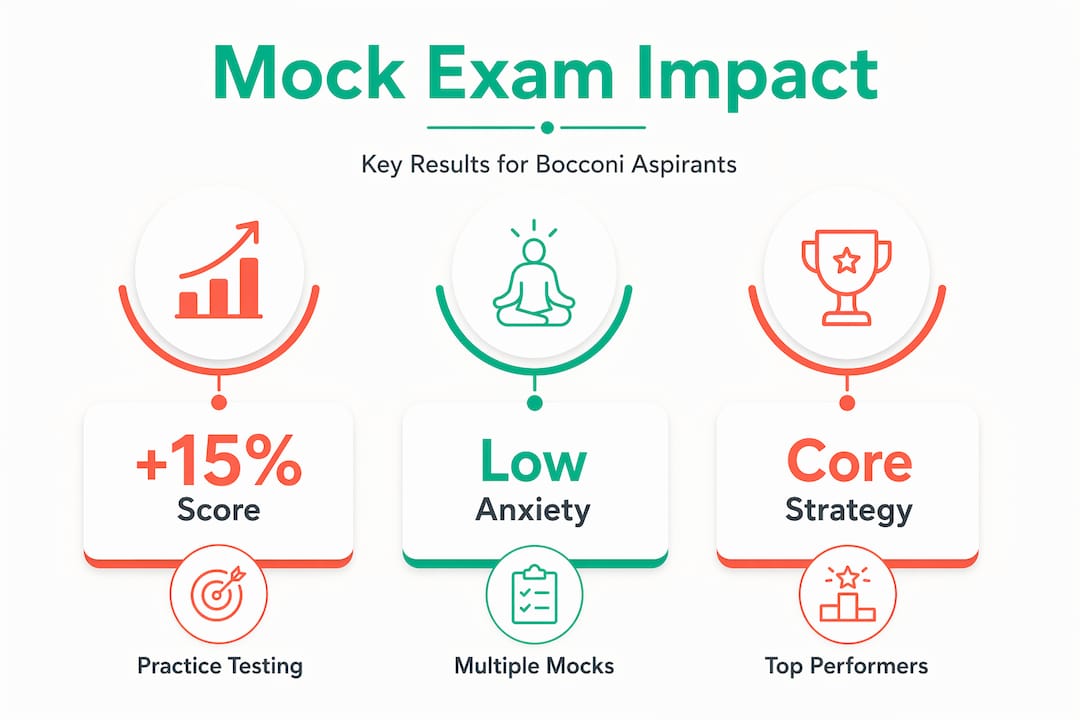
One of the most relevant findings: practice testing shows an average 15 percentage point improvement over restudying, with a positive effect on memory even under stress conditions (effect size g=0.45). That is not a small margin. In a competitive admissions test like Bocconi, 15 points can be the difference between admission and rejection.
What makes this especially relevant for you is the stress component. The Bocconi Test is not just a knowledge check. It is a performance under pressure. Research confirms that retrieval practice actually protects memory against stress, meaning students who have practiced with mocks retain more information on test day than those who have only reviewed their notes.

| Study method | Average score improvement | Effect on test anxiety |
|---|---|---|
| Restudying notes | Baseline | Minimal reduction |
| Practice testing | +15 percentage points | Significant reduction |
| Combined mock + review | Highest gains | Strongest anxiety drop |
Pro Tip: Do not just take a mock and move on. The review session after each mock is where the real improvement in Bocconi test performance happens. Spend at least as much time analyzing your errors as you did taking the test.
The data also shows that students who take multiple mocks see compounding gains. Your second mock will almost always be better than your first, not because you studied more, but because you have started to internalize the test’s rhythm and logic.
How to use mock exams effectively for the Bocconi test
Taking a mock exam is not the same as using it effectively. Most students take a test, check their score, feel good or bad about it, and move on. That approach wastes most of the value. Here is a structured method that actually works.
A well-designed 8-week Bocconi prep plan includes early diagnostics, intensive skill-building in the middle weeks, and full timed mocks in weeks 6 and 7. That structure exists for a reason. You need to build the foundation before you stress-test it.
Follow these steps for each mock exam cycle:
- Take a diagnostic test first. Before anything else, do a timed mock to see where you actually stand. Do not study for it. The goal is honest data, not a good score.
- Identify your three weakest areas. Look at your results by section. Is it numerical reasoning? Verbal logic? Reading comprehension? Focus your study time there.
- Do targeted skill drills for four to five weeks. Work on your weak spots specifically. Use timed section practice, not just full tests.
- Take a full timed mock in week 6. Simulate real conditions. No phone. No breaks beyond what the test allows. Treat it like the real thing.
- Do a deep error analysis immediately after. For every wrong answer, write down why you got it wrong. Was it a knowledge gap? A timing mistake? A misread question?
- Drill the specific error types you found. Do not review everything. Fix what is broken.
- Take a second full mock in week 7. Measure your improvement. Repeat the error analysis.
Pro Tip: Use the “timed exposure, then deliberate repair” method. First, take the mock under strict time pressure. Then, go back to every question you got wrong or skipped and solve it without the clock. This tells you whether your errors come from knowledge gaps or time pressure, and that distinction changes how you study.
The key principle behind Bocconi mock testing practice methods is that mocks are not assessments. They are training tools. Every wrong answer is information, not failure.
Affordable and reliable mock exam resources for Bocconi aspirants
You do not need to spend hundreds of euros on private tutoring to access quality mock exams. Several free and affordable options exist specifically for the Bocconi Test format.
Here are the most reliable free resources available:
- CISIA official platform. CISIA administers the Bocconi Test and provides official free practice simulations and question banks. These are the most accurate representation of real test content.
- Futura.study. Offers a free first online simulation with realistic timing and scoring, including the penalty system for wrong answers. Good for a first full-length mock.
- Past papers. Official past Bocconi tests are available and remain one of the best practice tools because they show exactly what the real exam looks like.
When choosing a mock resource, check for these features:
| Feature | Why it matters |
|---|---|
| 60 questions, 100-minute limit | Matches real test format exactly |
| Penalty for wrong answers | Trains you to manage guessing strategy |
| Section-by-section breakdown | Lets you identify weak areas accurately |
| Detailed answer explanations | Turns wrong answers into learning moments |
| Realistic difficulty level | Prepares you for actual test pressure |
Using multiple resources is smart. Different platforms phrase questions differently, which builds flexibility in your thinking. But always anchor your practice to official or well-reviewed content. Low-quality mocks with inaccurate questions can actually hurt your preparation by training you on the wrong patterns.
For affordable Bocconi practice resources, the combination of free official tools and a structured platform with detailed feedback gives you the best return on your time and money.
A fresh perspective: the real purpose of mock exams is not to measure you
Here is something most prep guides will not tell you. The biggest mistake students make with mock exams is treating them as assessments. They take the test, look at the score, and use that number to judge how ready they are. That is the wrong frame entirely.
Mock exams are not measuring tools. They are training tools. The score is almost irrelevant. What matters is what you do with the experience. A student who scores 60% on a mock but spends two hours analyzing every error and drilling the weak spots will outperform a student who scores 75% and moves on without review.
Serious engagement with mocks plus targeted review loops is what separates passing candidates from others, even when their initial scores look similar. The difference is not talent. It is process.
There is also a psychological dimension that rarely gets discussed. Every time you complete a mock under real conditions, you are rehearsing not just the content but your mental state. You are teaching your nervous system that this situation is manageable. That is not a soft benefit. It is a measurable one. Students who have completed five or more full mocks before the real test report significantly less anxiety on test day, because the experience is no longer new.
The cycle that works is simple: test, analyze, repair, retest. Not once. Repeatedly. Each loop tightens your performance and builds the kind of confidence that does not collapse under pressure. Mock improvements reflect strategy and mindset, not just knowledge. If your score is not moving, the problem is probably your review process, not your intelligence.
Treat every mock as a conversation with the test. It is telling you exactly what to fix. Your job is to listen.
Prepare confidently with Prepadmit’s Bocconi test platform
If you want to put everything in this article into practice, Prepadmit is built exactly for this.
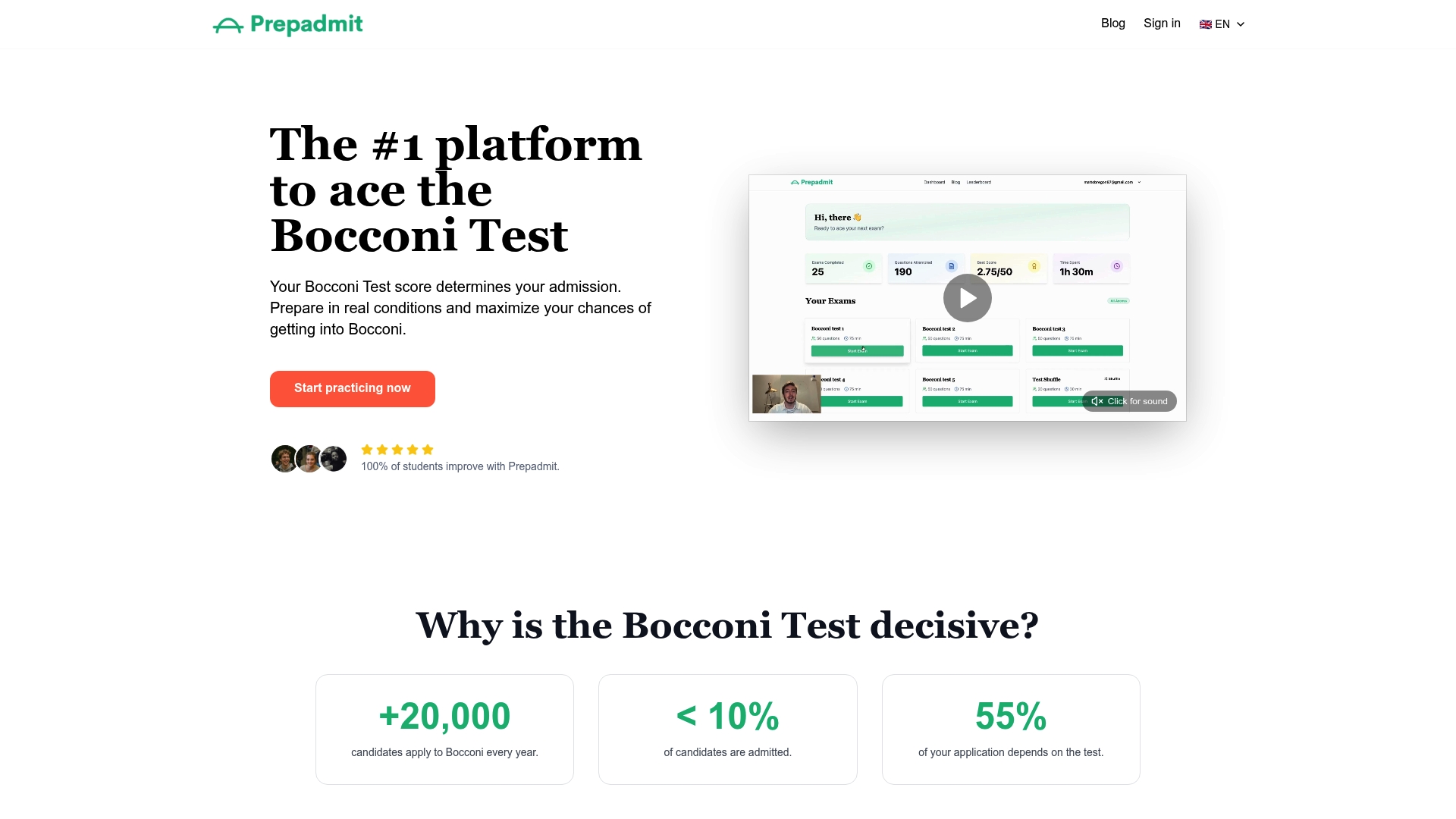
The Prepadmit Bocconi test platform gives you full-length timed mock exams that replicate official test conditions, detailed answer corrections that explain not just what is right but why, and skill-specific practice modes so you can drill your weak areas between mocks. You can track your progress over time and see how you rank against other students preparing for the same test. It was built by people who studied at HEC and Bocconi, so the content is accurate and relevant. It costs a fraction of private coaching, comes with a money-back guarantee, and students using it see an average score improvement of 34%. If you are following an 8-week prep plan, Prepadmit fits directly into that structure and gives you everything you need to execute it properly.
Frequently asked questions
How do mock exams improve performance on the Bocconi Test?
Mock exams improve performance by simulating test conditions, enabling active retrieval practice that strengthens memory and reduces anxiety through familiarity with the format and pressure.
Are there free, official mock exams available for Bocconi Test practice?
Yes. CISIA provides official free simulations and question banks that are accurate to the real Bocconi test format and difficulty level.
How often should I take mock exams during my Bocconi test prep?
A structured plan recommends taking full timed mocks in weeks 6 and 7 of an 8-week cycle, after completing diagnostics and targeted skill training in earlier weeks.
Can mock exams help reduce test anxiety for Bocconi applicants?
Yes. Retrieval practice protects memory under stress and repeated mock exposure desensitizes you to the pressure of the real test, leading to measurably lower anxiety on test day.
What makes mock exams most effective for improving scores?
Mock exams produce the best results when you engage seriously with review after each test, targeting specific errors and weak topics rather than just checking your score and moving on.
Recommended
Related articles
Ready to ace your admission test?
Discover PrepAdmit, the platform that helps you succeed at top university admission tests.
Discover PrepAdmit