After 5,740 Quit, Students: 4 Peer Comparison Moves Backed by Research

After 5,740 Quit, Students: 4 Peer Comparison Moves Backed by Research
Peer comparison can be a powerful engine for motivation, but only when the comparison is targeted and framed well. Get it wrong, and the same information that could push someone forward, makes them quit. Two studies anchor this pattern: the Motivation for Academic Social Comparison Scale, or MASCS, links a healthy comparison instinct to better exam scores, while a large online-course experiment found that seeing top performers caused widespread dropout. The fix comes down to who you compare against and how you present the gap.
TL;DR:
- Comparing oneself to similar, nearby peers within a realistic performance range can boost motivation, while contrasting against top scorers often leads to dropout.
- Showing a small, attainable gap to a peer just one or two ranks ahead encourages effort, but a large unbridgeable gap typically discourages persistence.
- Framing comparisons around skill growth and specific next steps sustains effort, whereas ability-based framing increases the risk of identity threat and disengagement.
- Use comparison data selectively by focusing on peers at a similar level, limiting visibility of large gaps, and pairing each comparison with a concrete, achievable goal.
- Regularly examining one peer slightly ahead and choosing one actionable strategy from their approach improves motivation without overwhelming the learner.
Table of Contents
- What Peer Comparison Motivation Actually Means
- Upward vs. Downward Comparison: Which One Actually Drives Effort
- The Research Behind Peer Comparison and Performance
- How Comparison Turns Into Motivation or Discouragement
- When Peer Comparison Helps and When It Backfires
- Practical Tactics to Use Peer Comparison Without Backfiring
- Measuring Your Own (or Your Team’s) Comparison Habits
- A Platform Built Around These Findings
- Comparing Yourself the Right Way, Every Week
- A Guided Way to Put This Into Practice
- Sources
What Peer Comparison Motivation Actually Means
Peer comparison motivation describes the boost or drag in effort that shows up when someone measures their own performance against other people’s. The concept traces back to Leon Festinger’s 1954 social comparison theory, which argued that people evaluate their abilities and opinions by looking at others, especially when no objective yardstick exists. A student without a clear sense of whether a practice score is “good” will look sideways at classmates before looking anywhere else.
Later research moved past Festinger’s original idea that comparison is a neutral, almost automatic self-check. A widely cited review of social comparison research reframed comparison as goal-directed and bidirectional: people often choose who to compare themselves to based on what they’re hoping to get out of it, whether that’s an accurate read on their skill, a boost to their ego, or a model to imitate. That distinction matters for anyone trying to use comparison deliberately instead of just being swept along by it.
Three motives tend to drive the behavior:
- Self-evaluation — figuring out where you actually stand, often against someone doing similar work.
- Self-improvement — picking a target slightly ahead of you to borrow strategies or pace.
- Self-enhancement — comparing against someone clearly behind you to feel better in the moment.
Identity and status shape which motive wins out. A first-generation college student sizing up classmates from more resourced backgrounds isn’t just checking scores. They’re also processing whether they belong in the room at all, which is why comparison research increasingly treats identity threat as a distinct variable rather than a footnote. Similarity matters too: people weigh comparisons more heavily when the other person shares their circumstances, age, or starting point, according to a PMC review on academic self-concept. A senior comparing herself to a first-year isn’t running the same psychological calculation as two students in the same cohort.
Upward vs. Downward Comparison: Which One Actually Drives Effort
Direction changes everything. Upward comparison, looking at someone who outperforms you, can sharpen effort and supply a concrete model for improvement. Downward comparison, looking at someone who underperforms you, tends to protect self-esteem but rarely pushes anyone to work harder.
Upward comparison only motivates when the gap appears closeable. A student who sees a friend scoring 15 points higher on a practice test might study harder. A student who sees someone scoring 40 points higher, with no visible path to closing that gap, tends to disengage instead. Perceived attainability is the hinge the whole effect swings on. Wharton’s Center for Leadership frames this directly in its guidance on using social comparisons to motivate teams, warning that winner-take-all comparisons often demotivate everyone who isn’t already near the top.
Downward comparison has its place, but it’s a mood repair tool, not a performance lever. Someone who just failed a practice exam might glance at a struggling peer to steady their confidence before trying again. That’s useful in the short term. It rarely translates into someone studying two extra hours that night.
Three factors decide which direction actually shows up and how strongly it lands:
- Similarity to the target — same course, same background, same starting score, all strengthen the comparison’s pull.
- Closeness or proximity — a rival one rank above you registers far more than someone at the very top of a leaderboard.
- Visibility of the performance gap — a clearly displayed number changes behavior more than a vague sense of “doing okay.”
Pro Tip: If you want comparison to motivate rather than discourage, compare yourself against the person one step ahead of you, not the highest scorer in the group. Closing a small gap feels achievable; closing a large one often doesn’t feel worth attempting.
The Research Behind Peer Comparison and Performance
The evidence here splits cleanly into two camps: studies showing comparison sharpens performance, and studies showing it drives people to quit entirely. Both camps are backed by real sample sizes, not just theory.
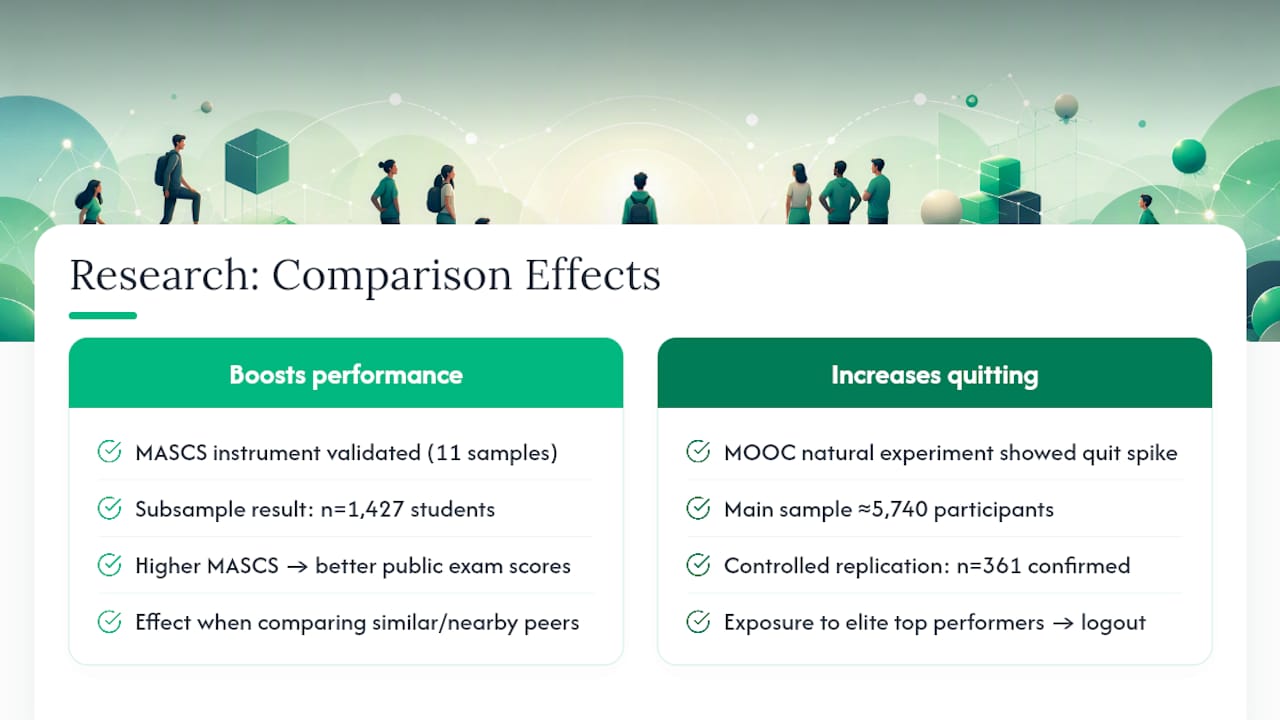
On the encouraging side, the MASCS instrument was validated across 11 samples and positively predicted subsequent academic performance. In a subsample of 1,427 students, higher MASCS scores, meaning a stronger inclination to engage in academic social comparison, predicted better outcomes on actual public exams, not just self-reported confidence. That’s a meaningful distinction. A lot of motivation research stops at how people feel; this one tracked what people scored.
The PMC review on academic self-concept adds nuance: comparison effects in classrooms depend heavily on which peers a student pays attention to. Students consistently weigh comparisons with similar, nearby peers more heavily than comparisons with distant high performers, which lines up with the attainability principle from the section above.
One of the more sobering findings in this space comes from a natural experiment inside a massive open online course. Researchers tracked what happened when learners were exposed to information about top-tier performers in the course.
The MOOC study found that exposure to elite performers caused a substantial increase in quitting, in a sample of roughly 5,740 participants. The effect replicated in a controlled follow-up with 361 participants, which rules out the possibility that the original result was a fluke tied to one course or one platform. Students who saw an unbridgeable gap between themselves and the top of the leaderboard didn’t try harder. They logged off.
That single study is arguably the most important data point in this entire discussion, because it directly contradicts the assumption baked into most leaderboard designs: that showing people how far ahead others are will spur them to catch up. Sometimes it does. Just as often, it convinces people the race isn’t worth running.
A separate thread of research, summarized in the same MASCS work, notes that most students naturally gravitate toward slightly upward comparisons rather than downward ones when given a choice. The problem arises when a platform, a classroom, or a manager overrides that natural instinct by broadcasting comparisons against the absolute top instead of the nearby field.
How Comparison Turns Into Motivation or Discouragement
The gap between “this made me study harder” and “this made me quit” comes down to three overlapping psychological processes.
Goal calibration happens first. Seeing a peer’s score doesn’t just provide information, it resets what “good” means. That recalibration can raise the bar in a useful way, prompting someone to aim higher, or it can make an existing effort feel inadequate by comparison.
Identity threat kicks in when the gap feels tied to something unchangeable rather than something fixable. If a comparison implies “you’re just not smart enough” rather than “you haven’t practiced the right material yet,” it stops functioning as useful feedback and starts functioning as a threat to be avoided, often by disengaging entirely.
Framing around effort versus ability decides which of those two paths a comparison takes. Comparisons framed around a growable skill, something a person can practice their way toward, tend to sustain effort even when the gap is real. Comparisons framed around fixed talent or innate aptitude tend to trigger the identity threat response instead.
A short list of what separates motivating comparison from demoralizing comparison:
- Comparisons framed as skill gaps (“you need more practice on this topic”) sustain effort better than comparisons framed as ability gaps (“you’re not a math person”).
- Comparisons paired with a specific next action outperform comparisons that leave the person staring at a number with no path forward.
- Comparisons against a visible, nearby peer recalibrate goals upward without triggering identity threat the way comparisons against a distant top performer often do.
When Peer Comparison Helps and When It Backfires
Whether to show someone their rank against peers, or hide it entirely, depends on three contextual questions you can run through quickly before deploying any comparison feature.
- How similar is the comparison group? Comparing a beginner against beginners motivates. Comparing a beginner against the platform’s all-time top scorers usually doesn’t.
- How large is the visible gap? Small, closeable gaps prompt effort. Large, unbridgeable gaps prompt the same dropout pattern documented in the MOOC natural experiment.
- Is the framing growth-oriented? A dashboard that says “you’re 12 points behind the median in this skill area” reads very differently from one that just displays a raw leaderboard with no context.
The winner-take-all trap is the single most common mistake in comparison design. A leaderboard that only ever highlights the single top scorer rewards one person and silently discourages everyone else who checks it. Wharton’s guidance on this is blunt: broad-based motivation requires broad-based attainability, which means most people need to see a version of the leaderboard where winning still feels possible.
Three mitigations fix most of the damage:
- Shrink the comparison group to people at a similar stage, rather than the entire population of users.
- Show proximal benchmarks, meaning the person just one rank ahead, instead of the overall leader.
- Pair every comparison with a specific, attainable next step, so the gap comes with a plan attached rather than just a number.
Practical Tactics to Use Peer Comparison Without Backfiring
Turning this research into daily practice takes about four moves, and none of them require sophisticated tools, supported by student-led learning approaches that emphasize effective peer comparison.
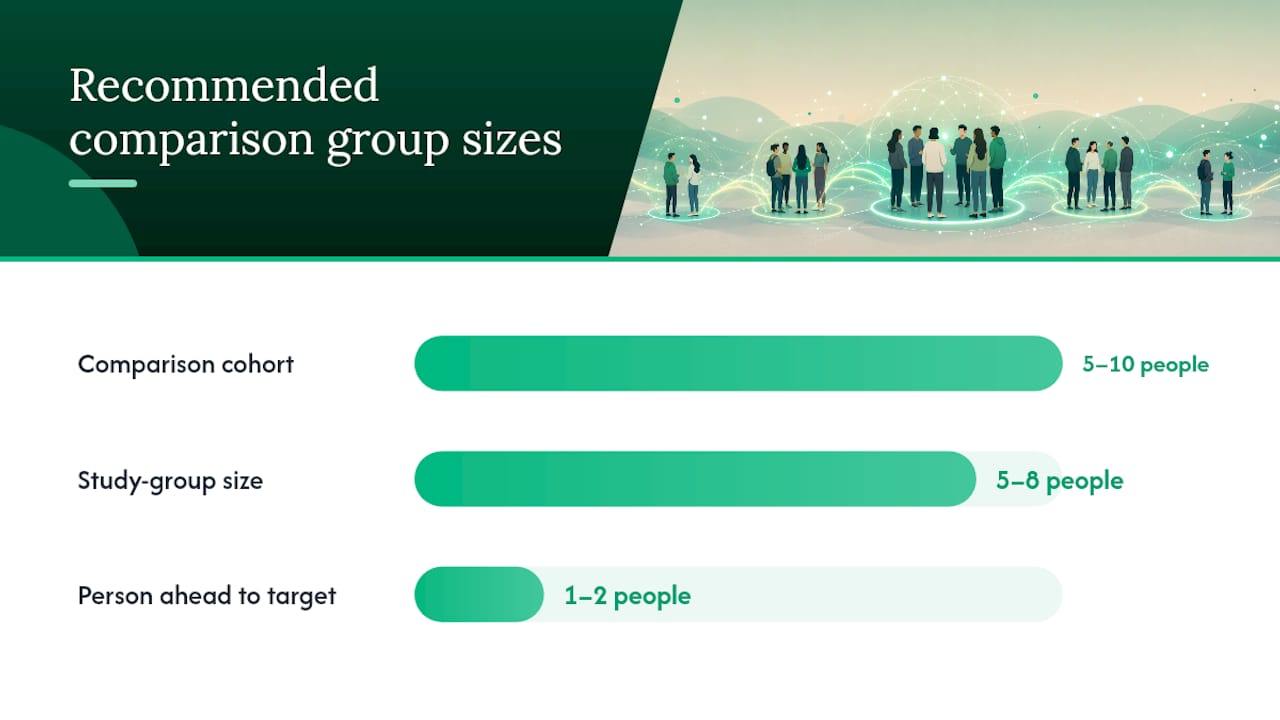
Shrink your comparison set first. Instead of comparing yourself to everyone taking a given exam nationally, find a study group or cohort of five to ten people at roughly your level. The MOOC dropout data makes clear that comparing against a massive, mostly-stronger population is where motivation collapses fastest.
Target the person just ahead of you, not the leader. If a practice platform shows a full ranked list, ignore the top of it. Look at whoever sits one or two spots above your current position and treat closing that specific gap as this week’s target.
Combine comparison with a micro-goal. A number alone rarely moves anyone. A number attached to a task does. “I’m eight points behind the median on quantitative reasoning, so this week I’ll work through twenty extra practice questions in that section specifically” converts a discouraging stat into a plan.
Use worked examples from someone slightly ahead. If a peer scored higher on a section, ask how they approached it, or review their reasoning if it’s available. This is where upward comparison earns its keep: not as a scoreboard, but as a source of concrete strategy.
A simple study-group protocol that applies these principles:
- Group size: five to eight people at a similar starting level.
- Weekly ritual: each person shares one specific area of improvement, not just an overall score.
- Comparison target: the median of the group, not the single highest scorer.
- Follow-up: everyone picks one task tied directly to their weakest area before the next session.
For anyone designing a leaderboard, whether for a classroom, a team, or a self-study group, the configuration matters more than the concept. Rank within tight performance bands rather than across the entire population, default the display to “person ahead of you” rather than “top scorer,” and attach a suggested next task to every rank shown. This structure lines up with the tactics recommended for building exam confidence through realistic benchmarking, which treats attainable targets as the foundation for sustained effort rather than a single big goal.
Pro Tip: Watch for a specific warning sign: a short-term spike in engagement that coincides with a rise in dropout or negative self-report. That pattern means the comparison is pushing a few people harder while quietly pushing many others out the door.
Timing and privacy deserve a mention too. Showing comparison data right before a high-stakes attempt, rather than steadily throughout preparation, tends to amplify anxiety rather than direct it usefully. And any comparison feature should let people opt into visibility rather than forcing exposure, since involuntary comparison against unfamiliar peers is exactly the setup that produced the MOOC quitting effect.
Measuring Your Own (or Your Team’s) Comparison Habits
Two validated instruments give you a starting point if you want to measure comparison tendencies rather than guess at them.
- MASCS (Motivation for Academic Social Comparison Scale) measures specifically how much someone is driven to compare their academic performance to classmates, and it has predicted real exam outcomes across large samples. It’s the more useful tool for education-specific contexts.
- INCOM (Iowa-Netherlands Comparison Orientation Measure) measures general comparison orientation, meaning how much someone compares themselves to others across any domain, not just academics. It’s broader and less predictive of specific exam performance, but useful for understanding overall personality-level comparison habits.
Beyond formal scales, three analytics proxies work almost as well for a self-study group or a small classroom: completion rate on practice sessions, dropout or disengagement after a comparison is shown, and score change on the next assessment following exposure to peer data.
If you want to test whether a specific comparison feature helps or harms, a lightweight A/B structure works: split a similar-sized group in two, show one half proximal peer comparisons and the other half no comparison data, then track completion and next-test performance over two to three weeks. Practical heuristics suggest looking for consistent directional effects across at least a few dozen participants per arm before drawing conclusions, since motivation effects are often noisy at small scale.
A Platform Built Around These Findings
A practice platform that takes this research seriously looks different from a simple leaderboard bolted onto a question bank. Progress tracking paired with peer ranking only helps when the ranking shows context, not just a raw number against the entire user base.
Some practice platforms approach peer ranking with the attainability principle: instead of showing every user where they stand against the single top scorer nationwide, the design leans on skill-specific practice modes and progress tracking so a student sees improvement against their own recent performance alongside a reasonably scoped peer group. Detailed answer corrections turn each comparison point into an actual next task, which is the piece most leaderboards skip entirely.
Comparing Yourself the Right Way, Every Week
The most useful habit I’ve come across in this research is embarrassingly simple: once a week, look at one peer slightly ahead of you, not the top performer, and pick exactly one thing they seem to be doing better. Then spend your next study session on that one thing. Nothing more.
Most people do the opposite. They check the leaderboard, see the gap to the top, feel a flash of motivation, and then quietly disengage a few days later when the gap hasn’t closed. The MOOC dropout data backs this up at scale: broad exposure to unreachable performance doesn’t sustain effort, it erodes it.
The uncomfortable truth is that comparison only works as a tool when you treat it like one, meaning you pick the target, you set the scope, and you attach a task to whatever number you see. Left on autopilot, comparison picks you instead. That’s usually when it starts working against you.
— quentin
A Guided Way to Put This Into Practice
If building your own comparison system from scratch feels like more setup than you want, a platform designed around these exact principles skips the guesswork. Prepadmit gives Bocconi Test candidates ranked practice within realistic peer groups instead of a raw leaderboard against every user on the platform, paired with skill-specific drills that turn each comparison into a concrete next task rather than a discouraging number.
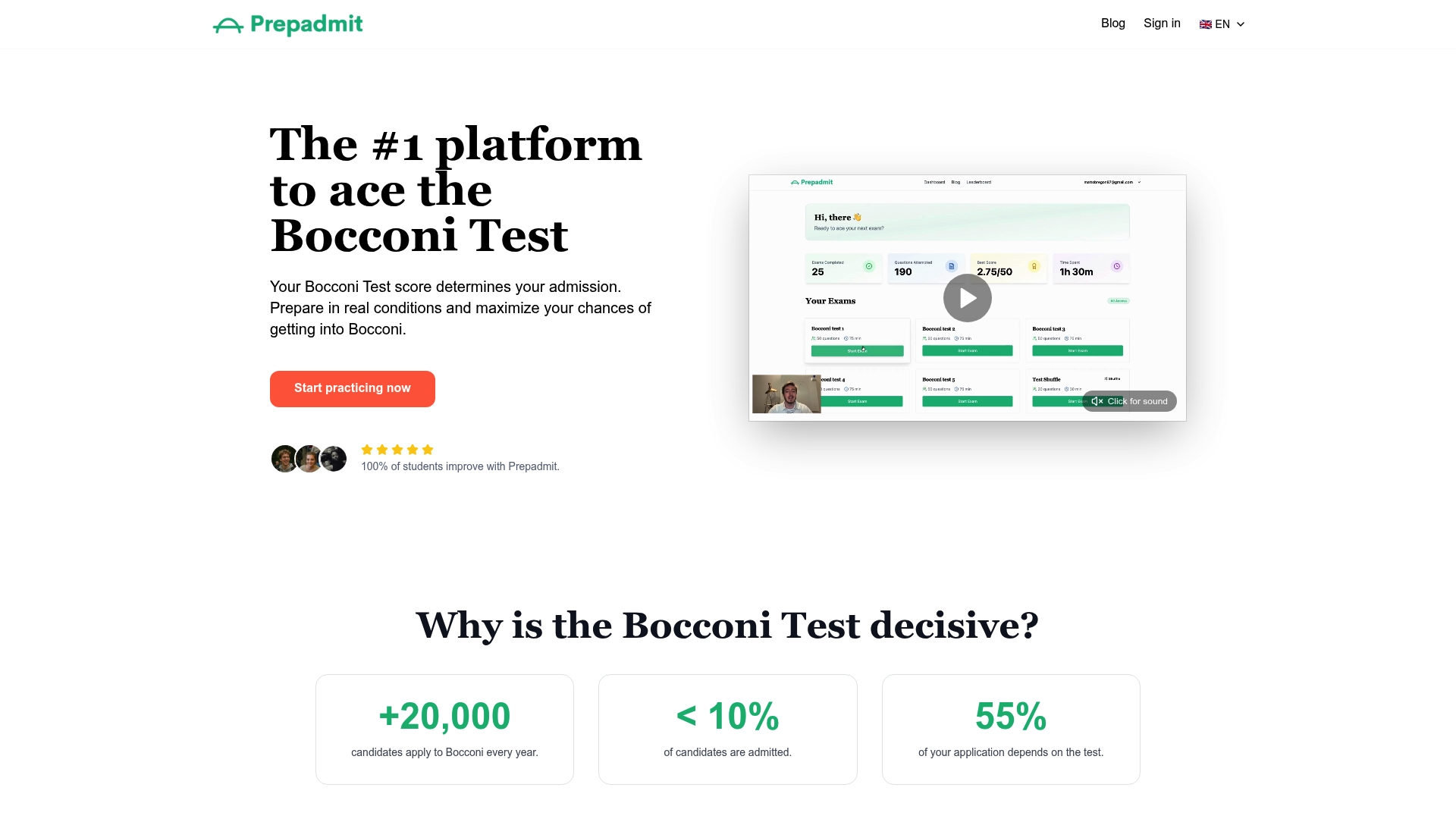
The platform’s official past papers and on-demand adaptive tests simulate real exam conditions, while detailed answer corrections and progress tracking let you see improvement against your own recent scores, not just against strangers at the top. Students who practice consistently on such platforms report notable score improvements, and the system typically costs less than private coaching. If your prep timeline is tight, whether you’re building a Bocconi study plan under time pressure or just starting to benchmark against realistic targets, check current score benchmarks and start a practice session on Prepadmit to see where you stand against peers who are actually comparable to you.
Sources
- Study showing discouragement by exposure to top performers (MOOC/natural experiment)
- Social comparison effects on academic self-concepts—Which peers matter most? (PMC review)
- Comparison in the classroom: motivation for academic social comparison predicts academic performance
- Nano Tool: Motivation 101: Encourage your team with social comparisons
Recommended
Related articles
Ready to ace your admission test?
Discover PrepAdmit, the platform that helps you succeed at top university admission tests.
Discover PrepAdmit