International Bocconi Student Success Examples: 2026 Guide

International Bocconi Student Success Examples: 2026 Guide
The best international Bocconi student success examples share one defining trait: students who combine hands-on consulting projects, active career service use, and deep peer network engagement consistently land the most competitive roles after graduation. SDA Bocconi’s MBA program draws students from over 30 nationalities, and that diversity creates a pressure-tested environment where career transformations happen fast. The stories of Majd Roufail, Apoorva Agarwal, Sherezade Chipana Alayo, and Irmak Ozbek each illustrate a specific strategy that any prospective student can study and replicate. If you are considering Bocconi, these examples are your clearest roadmap.
1. What practical projects and consulting experiences drive Bocconi student success?
Hands-on consulting projects are the single most reliable driver of career change at SDA Bocconi. Majd Roufail led three consulting projects focused on business growth and digital transformation, and those projects became the foundation of his transition into tech. Each project gave him a real client, a real problem, and a real deadline. That combination builds credibility that a classroom grade simply cannot replicate.
Bocconi’s curriculum uses business simulations to sharpen decision-making before students face real clients. Majd Roufail specifically credits pricing strategy simulations as a turning point in his consulting effectiveness. Simulations force you to make calls with incomplete information, which is exactly what clients expect. Students who treat simulations seriously arrive at real projects with a measurable head start.

Project leadership also changes how the professional world sees you. Leading a team through a client deliverable signals ownership, not just participation. Roufail’s three projects did not just build skills. They built a portfolio that hiring managers could evaluate directly. That is a concrete advantage in a competitive job market.
Pro Tip: Volunteer to lead at least one consulting project during your MBA, even if the role is not formally assigned. The leadership experience on your resume carries more weight than a team member credit.
2. How career services and alumni networks accelerate international students’ career transitions
Career services at SDA Bocconi are not optional extras. They are the mechanism through which students execute what the school calls the “triple jump”: changing geography, industry, and role at the same time. The triple jump requires aggressive networking, targeted internships, and structured career planning. Most MBA programs help students change one variable. Bocconi’s career infrastructure is built to handle all three simultaneously.
Apoorva Agarwal’s path to Amazon’s MBA Launch program illustrates this precisely. She used CV reviews and mock interviews through Bocconi’s career services to position herself for a role that required both a new geography and a new industry. The structured support removed the guesswork from her application process. She did not stumble into Amazon. She planned her way there.
Alumni networks extend the career services advantage beyond graduation. Bocconi alumni are active both in Milan and internationally, and they respond to outreach from current students at a high rate. The school’s reputation in European business circles means that a Bocconi connection opens doors that a cold email never would.
“The career services team helped me prepare not just for interviews, but for the entire process of repositioning myself in a new market. That support made the difference between applying and actually landing the role.” — Apoorva Agarwal, SDA Bocconi MBA graduate, on her path to Amazon’s MBA Launch program
- Register with career services in your first month, not your last semester.
- Book mock interviews before you feel ready. Early feedback is more useful than late polish.
- Attend every alumni networking event, even when the industry does not match your target. Connections compound.
- Use the internship placement team to identify roles that serve as a bridge between your current background and your target sector.
3. What personal resilience stories from international Bocconi students illustrate overcoming challenges?
Resilience is not a soft skill at Bocconi. It is a measurable competitive advantage. Sherezade Chipana Alayo postponed her MBA start after a family emergency forced her to take over full operations of her family’s business. Instead of treating the delay as a setback, she treated it as a leadership laboratory. She managed real operational pressure, made decisions under stress, and returned to Bocconi with a level of practical authority that most incoming students do not have.
That operational experience translated directly into her performance in Bocconi’s strategy courses. She could connect theoretical frameworks to decisions she had already made in the real world. Her classmates were learning concepts. She was recognizing patterns she had already lived through. That gap in perspective is exactly what admissions committees look for when they read application essays.
Successful international students consistently turn personal challenges into professional strengths. The pattern is not accidental. Bocconi’s admissions process selects for candidates who have faced real adversity and responded with structure, not panic.
- Document every leadership moment from your pre-MBA career, including the difficult ones. Admissions essays and interviews reward honest accounts of pressure and response.
- Treat operational setbacks as case studies. Write down what you decided, why, and what happened. That material becomes your most compelling interview content.
- Build emotional stamina before you arrive. The MBA curriculum is demanding, and students who have already managed high-stakes situations adapt faster.
Pro Tip: When writing your Bocconi application essay, lead with the hardest professional moment you have faced. Explain the decision you made and what you learned. Admissions readers remember specific stories far longer than general claims about leadership.
4. How student organizations and peer learning communities enhance Bocconi student success
Student clubs at SDA Bocconi are not resume padding. They are the primary venue where international students build visibility before they graduate. Irmak Ozbek, president of the Women in Business Club, organized events and peer learning sessions that gave her a leadership platform inside the school. That platform translated into alumni connections, speaking opportunities, and a professional brand that existed before she sent a single job application.
The human-centric leadership culture at Bocconi makes clubs especially effective. Irmak Ozbek emphasizes that sharing doubts openly within the student community is not a weakness. It is the mechanism through which peer learning actually works. Students who ask hard questions in club settings get answers from classmates who have already solved the same problems in different industries. That cross-sector knowledge transfer is one of Bocconi’s most underrated assets.
Exposure to 30+ nationalities inside the cohort sharpens structured thinking and builds adaptability. Students who engage actively with peers from different backgrounds develop problem-solving approaches that are more flexible than those built inside a single cultural context. That adaptability shows up directly in consulting projects and case interviews.
| Club benefit | How it works in practice |
|---|---|
| Pre-graduation network | Club events connect you with alumni before you need a job reference |
| Leadership visibility | Organizing events signals initiative to faculty and recruiters |
| Peer knowledge transfer | Cross-industry classmates solve problems you have not encountered yet |
| Confidence building | Presenting in a club setting prepares you for client presentations |
5. What strategic lessons can prospective students learn from these Bocconi success stories?
The clearest lesson from every Bocconi success story is that passive participation produces average results. Students who lead projects, run clubs, and use career services from day one consistently outperform those who wait for opportunities to appear. The school provides the infrastructure. The student decides how much of it to use.
- Combine academic preparation with active project and club involvement from the start of your first semester.
- Engage career services before you know exactly what role you want. Early conversations help you identify options you have not considered.
- Treat every setback, whether a delayed start, a failed interview, or a difficult project, as material for your professional narrative.
- Plan your career transition explicitly. Identify which of the three variables (geography, industry, role) you are changing and build your internship and networking strategy around that target.
- Use the non-EU student admission guide to understand the specific requirements and timelines that apply to your application.
SDA Bocconi’s blend of academic rigor with practical exposure prepares international students for career shifts that most programs cannot support. The students who succeed are not necessarily the ones with the strongest academic records. They are the ones who treat every resource the school offers as a tool with a specific purpose.
Networking and alumni engagement are as critical as academic performance for building the confidence and connections that open career doors. Students who wait until graduation to start networking consistently find that their classmates who started in month one have already filled the most visible roles.
Key Takeaways
International Bocconi student success is built on three concrete behaviors: leading hands-on projects, using career services early, and building peer networks through active club participation.
| Point | Details |
|---|---|
| Lead consulting projects | Project leadership builds a portfolio that hiring managers can evaluate directly. |
| Use career services from day one | CV reviews and mock interviews are the mechanism for executing the triple jump career move. |
| Join and lead student clubs | Club leadership creates pre-graduation visibility and alumni connections before you need them. |
| Turn setbacks into narrative | Operational challenges and delays become your strongest application and interview material. |
| Plan the triple jump explicitly | Identify which variable (geography, industry, or role) you are changing and build your strategy around it. |
What I actually think separates Bocconi’s top international students from everyone else
Most articles about MBA success focus on grades and rankings. I think that framing misses the point entirely. The students who get the most out of Bocconi are the ones who treat the program as a two-year sprint, not a two-year credential. They show up to every club meeting, take on every consulting project, and call alumni before they have a specific ask. That behavior is not natural for everyone, especially for international students who are still adjusting to a new city and a new language. But it is learnable.
The triple jump concept is real, and it is genuinely hard. Changing your country, your industry, and your role at the same time requires a level of planning that most people underestimate. The students I find most impressive are the ones who map out all three variables in their first month and then work backward from their target role to identify exactly which internship, which alumni contact, and which club position will move them closest to it. That is not luck. That is engineering.
Sherezade Chipana Alayo’s story resonates with me because it reframes what a setback actually is. A family emergency that forces you to run a business is not a gap in your resume. It is the most credible leadership experience you can bring into a strategy classroom. The students who recognize that and articulate it clearly in their essays and interviews have a genuine edge over candidates who have had smooth, uninterrupted careers. Bocconi’s admissions team knows the difference.
If you are preparing your application right now, the most useful thing you can do is write down every difficult professional moment you have had and ask yourself what decision you made and why. That exercise will give you more material for your essays and interviews than any MBA prep book.
— quentin
How Prepadmit helps you get to Bocconi first
Getting into Bocconi starts with passing the Bocconi Test. Prepadmit is built specifically for that exam, with official past papers, on-demand practice tests, and detailed answer corrections that show you exactly where your reasoning breaks down. The platform was developed by experts with backgrounds from HEC and Bocconi, so the content reflects what the actual test demands.
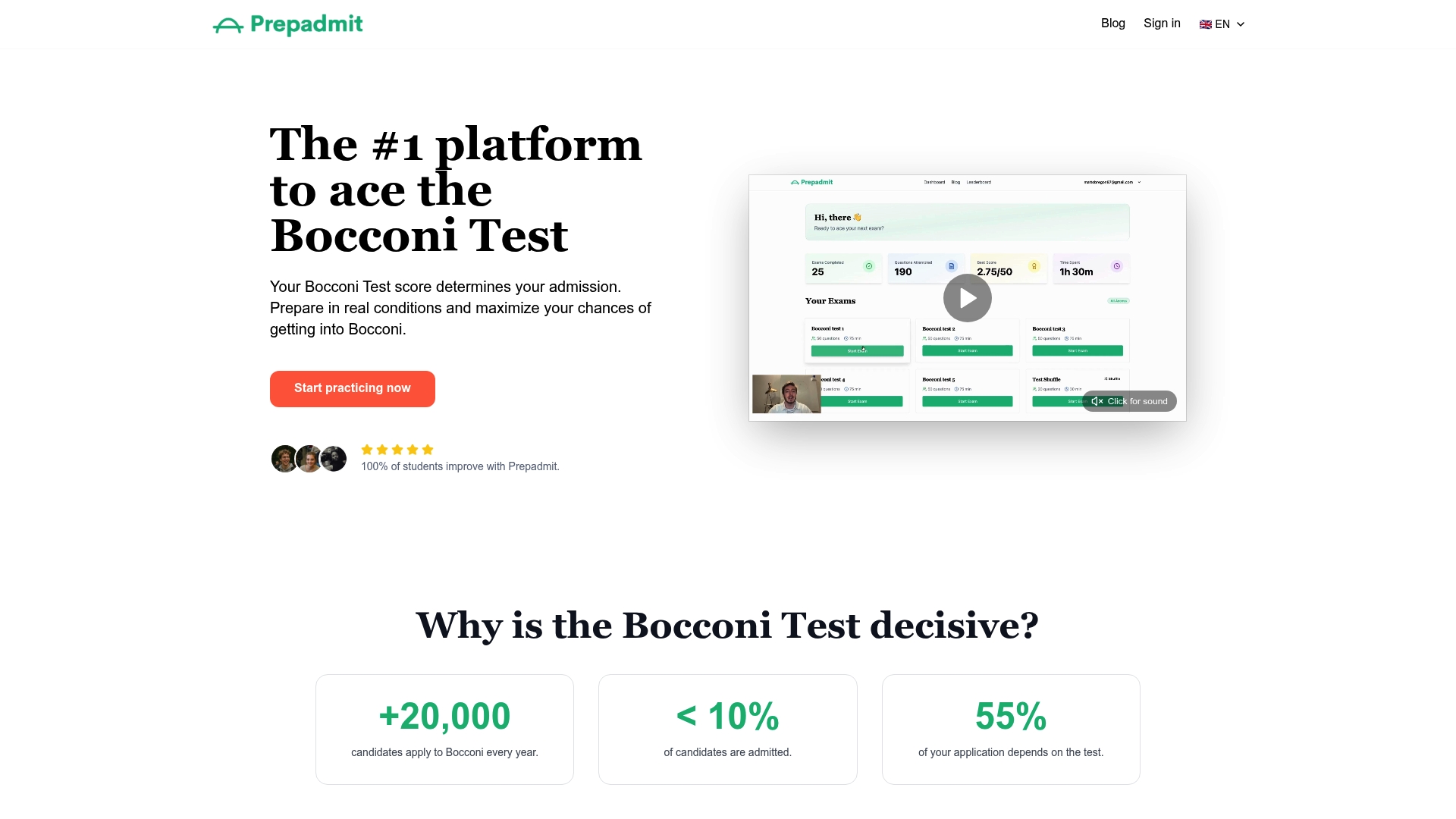
Prepadmit users see an average score improvement of 34%, and the leaderboard lets you benchmark your performance against other applicants in real time. That ranking context is something private tutoring cannot give you. The Bocconi Test preparation guide on the Prepadmit blog walks you through a step-by-step study plan. When you are ready to practice under real exam conditions, Prepadmit’s platform gives you the tools to do it at a fraction of the cost of private coaching.
FAQ
What makes international students succeed at SDA Bocconi?
The students who succeed most consistently lead consulting projects, engage career services early, and participate actively in student clubs. These three behaviors, combined, produce the career transitions that Bocconi is known for.
What is the triple jump career move at Bocconi?
The triple jump means changing your geography, industry, and role at the same time. Bocconi’s career services and internship infrastructure are specifically designed to support this kind of simultaneous transition.
How important are student clubs for Bocconi career outcomes?
Student clubs are a primary venue for building pre-graduation visibility and alumni connections. Club leadership roles signal initiative to recruiters and create networking opportunities that classroom performance alone cannot generate.
Can a setback before or during the MBA help my Bocconi application?
Yes. Admissions teams at Bocconi value candidates who have managed real operational pressure and can articulate what they learned. A well-framed setback story is often more compelling than a smooth career trajectory.
How do I prepare for the Bocconi Test as an international applicant?
Structured practice with official past papers and timed mock tests is the most effective preparation method. Prepadmit offers both, along with skill-specific practice modes and progress tracking designed for the Bocconi Test format.
Recommended
Related articles
Ready to ace your admission test?
Discover PrepAdmit, the platform that helps you succeed at top university admission tests.
Discover PrepAdmit