34% Score Lift: Stop Bocconi Calculation Errors With a Two Pass Routine

34% Score Lift: Stop Bocconi Calculation Errors With a Two Pass Routine
The fastest way to stop losing points to calculation errors on the Bocconi test is a two-pass answering routine paired with one verification habit: treat every numeric answer as provisional until you check it. Two immediate actions build that habit: run a 5-minute daily arithmetic drill, and use a fixed scratch-paper template on every timed simulation. Bocconi’s scoring and proctoring rules make these habits test-critical, not optional polish.
TL;DR:
- Building a routine that includes daily arithmetic drills and a fixed scratch-paper template helps reduce common calculation slips during the Bocconi test.
- Using a two-pass answering method and micro-checks can catch most errors before submitting answers, especially on high-pressure questions.
- Proper time management and careful reading of charts and data can prevent errors caused by rushing or misinterpreting information.
- Accurate entry into the GPA calculator requires selecting the correct grading scale, entering final grades only, and excluding non-academic subjects.
- Conducting a thorough error analysis after practice tests allows targeted drills that significantly improve performance by addressing specific mistake patterns.
Table of Contents
- What Are the Most Common Bocconi Calculation Mistakes?
- Beyond Arithmetic: Time, Reading, and Verification Failures
- How Do You Actually Stop Making These Errors?
- Don’t Let a GPA Calculator Error Undo Your Prep
- Avoid a Technical Glitch That Cancels Your Attempt
- Why an Error-Analysis Workflow Actually Moves Your Score
- Coach’s Note: Why Small Corrections Beat Extra Hours
- Practice the Same Routine Under Real Test Conditions
- Sources
- FAQ
What Are the Most Common Bocconi Calculation Mistakes?
Most errori di calcolo Bocconi candidates report fall into a short list of repeat offenders. They are not exotic. They are the same slips a tired brain makes under a ticking clock.
- Arithmetic slips: adding instead of subtracting, misplacing a decimal, or dropping a digit while copying a number from the screen.
- Decimal and percentage conversion errors: writing 15% as 0.15 in one step and then treating it as 15 in the next.
- Order-of-operations mistakes: solving left to right instead of respecting parentheses or exponents, especially under time pressure.
- Sign errors: losing a negative sign when a question involves a decrease, a loss, or a rate of change.
- Transcription errors: copying a number from a chart or passage onto scratch paper incorrectly, so the math is done on the wrong figure entirely.
Each error has a trigger. Arithmetic slips spike when you rush the last three questions of a section. Decimal errors spike when notation is inconsistent, so a personal shorthand (always write percentages as decimals before touching them) removes the ambiguity. Transcription errors spike during fatigue, usually in the final 15 minutes of a block. The fix starts with recognizing which trigger applies to you, because a generic fix for a specific habit rarely sticks.
Beyond Arithmetic: Time, Reading, and Verification Failures
Calculation mistakes rarely travel alone. They usually show up after a time-management failure or a reading error has already put you in a bad position.
Poor time allocation is the most common root cause. If you spend four minutes on a question that should take one, you arrive at the harder items already rushed, and rushed arithmetic is where slips happen. The Bocconi Online Test is built to measure efficiency under pressure, so a personal skipping strategy matters as much as subject knowledge.
Reading errors compound the damage. Misreading a chart axis, confusing a subtotal for a total, or pulling data from the wrong table column produces a calculation that is arithmetically perfect and factually wrong. Bocconi’s scoring penalizes guessing: a correct answer earns +1, a blank earns 0, and a wrong answer costs −0.2 (or −0.33 on certain critical-thinking items with three choices), according to Bocconi’s own test guidance. Skipping a question you cannot verify often beats guessing on it.
Pro Tip: If a chart-based question feels rushed, read the axis labels and units out loud in your head before touching a single number. Half of misread-data errors happen because a student solved the right equation on the wrong figure.
How Do You Actually Stop Making These Errors?
Fixing calculation errors is a matter of rehearsed procedure, not raw talent. Build the routine in practice so it runs on autopilot during the real test.
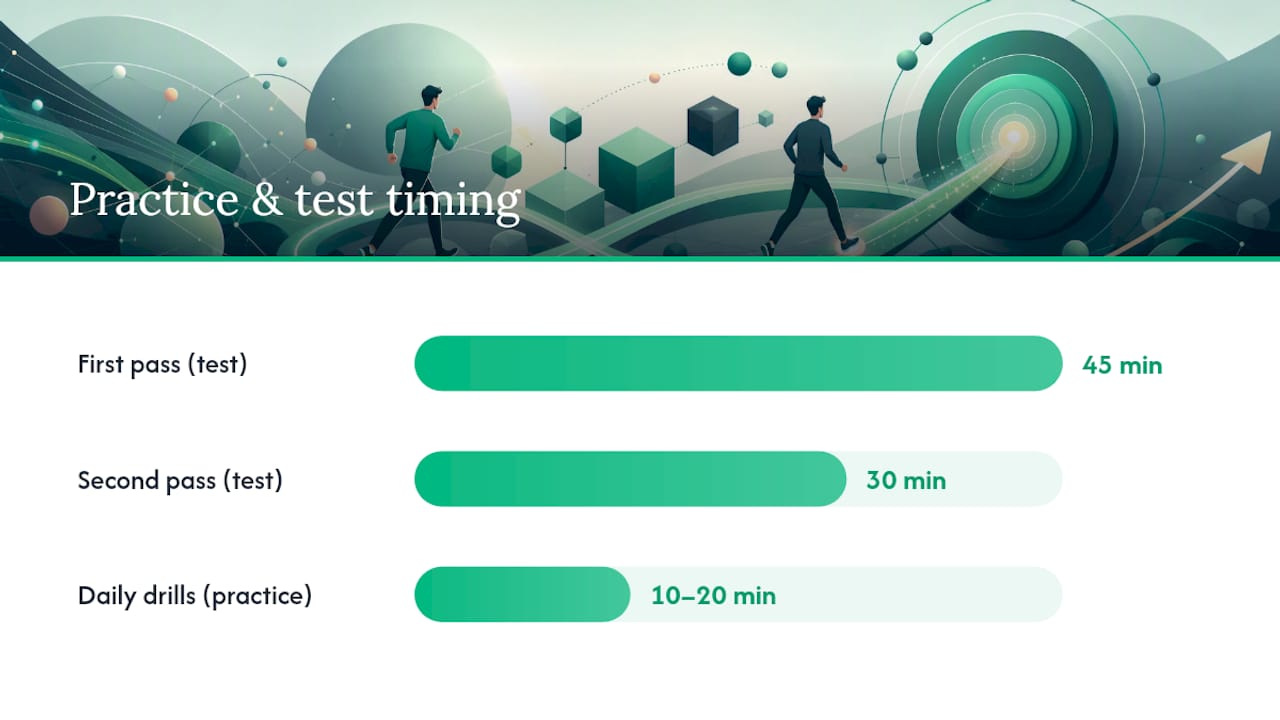
- Run short daily drills. Ten to twenty minutes of pure arithmetic, percent-to-decimal conversion, and chart-reading practice trains speed without triggering fatigue-driven mistakes.
- Standardize your notation. Decide once how you write percentages, negatives, and fractions on scratch paper, and never deviate mid-test.
- Adopt the two-pass method. On your first pass, spend about one minute per question, answer what you know cold, and flag anything uncertain. On your second pass, return only to flagged items with full attention.
- Use a transcription protocol. Write the question number, copy only the numeric data you actually need into a single column, do the calculation, then write your provisional answer beside the number before moving on.
- Run a micro-check. Reverse the operation or estimate the rough size of the answer. If you calculated 15% of 480 and got 172, a two-second estimate (10% of 480 is 48, so 15% should land near 72) catches the error instantly.
A two-pass timing plan tuned to Bocconi’s structure cuts panic-driven blunders because it removes the pressure of deciding, question by question, whether to move on. For a 75-minute section, block roughly 45 minutes for the first pass, and 30 minutes for verification and flagged items, adjusting as you learn your own pace.
Pro Tip: Practice this exact routine, timing and all, during at least two to three full timed simulations a week. A tactic you have only read about will not survive first contact with a real clock.
Don’t Let a GPA Calculator Error Undo Your Prep
Calculation mistakes do not only happen during the test. They also happen when applicants fill out Bocconi’s GPA calculator, and an entry error here can misrepresent months of academic work.
- Confirm you have selected the correct grading scale for your school system before entering a single grade.
- Enter final year grades only, not averages across multiple years.
- Exclude non-academic subjects such as Physical Education and Religion; IB candidates should also exclude TOK, CAS, and EE.
- Enter one subject per line, never combining grades or averaging them yourself.
Bocconi’s official GPA calculator guide flags these four points as the leading causes of applicant miscalculation. If your grading scale is missing from the tool or unclear, contact admissionsoffice@unibocconi.it well before the deadline rather than guessing. If you catch an entry error after submission, recalculate immediately and reach out to admissions. Waiting rarely helps.
Avoid a Technical Glitch That Cancels Your Attempt
A perfect calculation strategy means nothing if a technical or conduct issue invalidates your attempt before you finish. Test-day setup deserves the same rehearsal as your arithmetic.
- Check your camera framing, lighting, and internet connection well before your scheduled start time.
- Remove earbuds, secondary devices, and unauthorized notes from your desk and room.
- If the proctoring software fails or you disconnect, contact the Exam Desk immediately and document the failure with screenshots and timestamps.
- Understand that unauthorized devices or materials during the test can trigger invalidation, and invalidated attempts are generally non-refundable.
None of this is optional paperwork. It is the difference between a score that counts and an attempt that gets thrown out entirely.
Why an Error-Analysis Workflow Actually Moves Your Score
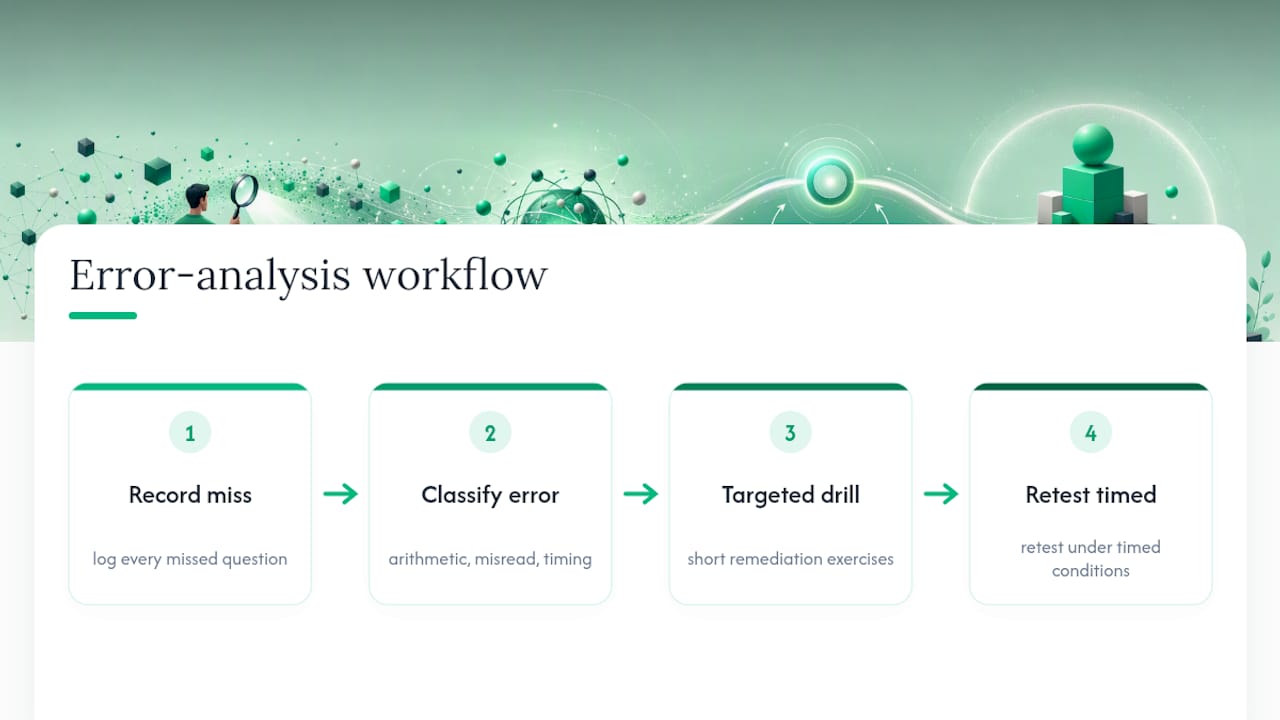
Students who log and classify their mistakes after every timed simulation convert scattered weaknesses into a targeted drill list, and that beats putting in more unfocused study hours. Students who followed a structured error-analysis routine saw an average 34% score improvement in practice.
The routine itself is simple: record every missed question, classify it by error type (arithmetic, misread data, timing), remediate with a short targeted drill, then retest under timed conditions to confirm the fix held.
Coach’s Note: Why Small Corrections Beat Extra Hours
Ten more hours of passive review rarely fixes a recurring mistake. Naming the exact error, drilling it once, and retesting it usually does. That is the leverage most students overlook, and it is faster than it sounds. For a deeper walk-through of turning score reports into a study plan, see how to interpret your Bocconi results.
— quentin
Practice the Same Routine Under Real Test Conditions
Reading about a two-pass strategy is not the same as running it against a clock with real Bocconi-style items in front of you. Some platforms give you full simulations built on official past papers, section-by-section timing that mirrors the real exam, and an error-analysis workflow that tags each miss by type so you know precisely what to drill next.

Some platforms also track your progress over time and rank you against other candidates preparing for the same test, so you can see whether your calculation-error rate is actually dropping or just feeling better. If you want a concrete read on where your errors are coming from, start with the numerical reasoning practice module, then work it into a weekly plan using this step-by-step preparation guide. You can also round out general study habits with these proven grade-improvement techniques. Run a timed diagnostic on Prepadmit this week and see exactly which error type is costing you the most points.
FAQ
What Are the Hardest Sections of the Bocconi Test?
Candidates most often struggle with numerical reasoning under time pressure and data-interpretation questions involving charts and tables, since both punish rushed reading as much as weak math.
What Types of Math Mistakes Show Up Most on the Test?
The most common types are arithmetic slips, decimal or percentage conversion errors, order-of-operations mistakes, sign errors, and transcription errors when copying numbers from a chart to scratch paper.
Can You Use a Calculator During the Bocconi Selection Test?
Bocconi’s official rules govern which tools are permitted during the online test, and using unauthorized aids or devices can invalidate your attempt, so always confirm allowed materials in the official instructions before test day.
What Is the Minimum Score to Get Into Bocconi Through the Online Test?
Bocconi’s scoring guidance states that scores below a certain threshold are not considered in the selection process. This threshold may vary each year depending on the applicant pool.
How Much Does Fixing Calculation Errors Actually Improve My Score?
Results vary by student, but Prepadmit users following a structured error-analysis workflow saw an average score improvement of 34% in practice, driven largely by eliminating repeat mistakes rather than adding more study hours.
Recommended
Related articles
Ready to ace your admission test?
Discover PrepAdmit, the platform that helps you succeed at top university admission tests.
Discover PrepAdmit