Boost Bocconi Test Scores 34% With an Error Analysis Workflow

Boost Bocconi Test Scores 34% With an Error Analysis Workflow
The three mistakes that lose the most points on the Bocconi test are poor time management, careless reading under pressure, and skipping the review of your own mock exams. A proper analisi errori Bocconi routine fixes all three: run timed simulations, log every wrong answer by cause, and drill only the weak spots your log reveals. Start today with one timed mock and an error log, not another passive study session.
TL;DR:
- Reviewing every wrong answer and categorizing errors by cause significantly improves score gains and helps identify specific weak spots to target.
- Full-length timed mocks and consistent error logging are crucial for improving pacing and avoiding common mistakes like rushing or careless reading.
- Students should tailor their practice frequency based on how much time remains before the test, with more mocks early on and tapering closer to exam day.
- Analyzing detailed score breakdowns and error patterns over multiple mocks reveals precise content gaps, not just vague weaknesses.
- Using analytics tools integrated into a structured prep platform provides deeper insights into error trends and pacing issues, boosting overall performance.
Table of Contents
- What Is Analisi Errori Bocconi and Why Most Students Skip It
- Concrete Strategies to Fix Each Bocconi Test Mistake
- How to Analyze Errors After a Practice Test: A Step-by-Step Workflow
- How Many Mock Exams Should You Take Before the Bocconi Test?
- Final Checklist and Exam-Day Quick Tactics
- How Is the Bocconi Test Structured and Scored?
- Common Conceptual Misunderstandings in Bocconi Test Sections
- Using Analytics Tools to Spot Deeper Error Patterns
- What Do Annotated Error Logs From Past Test Takers Look Like?
- Do First-Time Test Takers and Repeaters Make Different Mistakes?
- What I’ve Seen Work: A Quick Perspective on Error Analysis
- How Prepadmit Puts This Workflow Into Practice
- Sources
What Is Analisi Errori Bocconi and Why Most Students Skip It
Analisi errori Bocconi means error analysis: the practice of reviewing every wrong answer on a mock exam, sorting it by cause, and using that pattern to decide what to study next. Most students preparing for the Bocconi Test never do this. They take a mock, check the score, feel a jolt of relief or dread, and move to the next practice set without asking why they missed what they missed.
That’s the gap between students who improve fast and students who plateau. A wrong answer caused by rushing needs a different fix than a wrong answer caused by a real gap in your math. Treating them the same wastes weeks.
The most common mistakes students make preparing for the Bocconi Test
Six errors show up again and again in Bocconi test prep, according to guides that track common preparatory mistakes across cohorts of applicants.
- Time-management failures. Students spend eight minutes on one tough Quantitative question and run out of time for three easy ones later.
- Never simulating under real conditions. Practicing questions in isolation, without the 75 minute clock running, builds false confidence.
- Overfocusing on one subject. Verbal feels comfortable, so it eats study hours that Data Insights actually needs.
- Careless reading and chart misreads. Data Insights questions hide a “except” or a shifted axis that a rushed eye skips.
- Skipping post-mock review entirely. The score gets recorded, the wrong answers get ignored.
- Letting stress dictate pace. Anxiety after two hard questions in a row causes rushed guessing on the next five.
Each one is fixable on its own, but the students who lose the most points are usually stacking three or four of these at once.
Concrete Strategies to Fix Each Bocconi Test Mistake
Fixing each error requires a specific drill, not general “study more” advice. Here’s what actually corrects each one.
- Set a per-question time budget before you start. With 50 questions in 75 minutes, that’s roughly 90 seconds per question on average, though Data Insights items often need more and easy Verbal items need less. Decide your skip rule in advance: if you don’t have a real answer path after 60 seconds, mark it and move on.
- Run full-length timed drills, not fragments. A 20-minute study session on isolated Quantitative problems doesn’t train pacing. Block out the full 75 minutes at least once a week and treat the mock exam as the actual test.
- Build an error log with three columns: question type, cause, fix. Cause options are careless, conceptual, or time-related. Review this log every two or three mocks, not after every single one, so patterns have room to show up.
- Drill reading accuracy separately from content. Take five Data Insights charts and time yourself reading only the axes, units, and qualifiers before looking at the answer choices.
- Use a 60-second reset between hard questions. Breathe, look away from the screen, then re-enter with the next question fresh.
Pro Tip: Color-code your error log by cause. When one color dominates after three mocks, that’s the drill you do next, no debate.
How to Analyze Errors After a Practice Test: A Step-by-Step Workflow
Your score report is the real diagnostic tool, not just the final number. Bocconi’s own test reports break results down by subject area and question count, typically available within 48 hours of a mock, and that breakdown is where the analisi errori Bocconi process actually starts.
Walk through it in four steps.
- Read the section breakdown first. Quantitative, Verbal, and Data Insights each get their own score. A low Data Insights score with a strong Quantitative score tells you exactly where to spend tomorrow’s hour.
- Classify every miss. Careless errors (misread the question), conceptual errors (didn’t know the rule), and time-related errors (ran out of time or rushed) each get logged separately.
- Set one measurable target per weak area. “Cut Data Insights errors from six to three on the next mock” beats “get better at Data Insights.”
- Retest under timed conditions to confirm the fix held. A drill only counts as done when the next mock shows the error rate actually dropped.
Prepadmit reports that students following this kind of structured cycle, timed mocks plus targeted drills plus progress tracking, see an average score improvement of 34% compared to unstructured practice. That’s the difference between drilling randomly and drilling what your own data says to fix.
How Many Mock Exams Should You Take Before the Bocconi Test?
The right mock frequency depends on how many weeks remain before test day, not on a fixed number everyone should hit.
- Six or more weeks out: one full timed mock per week, paired with daily 20 to 30 minute drills targeting your weakest section from the error log.
- Three to five weeks out: two mocks per week, with a full review session between each one, not back to back.
- One to two weeks out: taper to one mock every four or five days. This is when rest starts mattering as much as repetition, echoing the long-term, steady approach Bocconi’s own faculty recommends over last-minute cramming.
- Final two or three days: no full mocks. Light review of your error log only, plus one short untimed pass through your weakest question type.
A sample two-week ramp: days 1, 4, and 8 are full mocks; days 2, 3, 5, 6, 9, and 10 are 25 minute targeted drills; days 7 and 11 are error-log review only; the final two days before the test are rest with a light skim of past mistakes. Adjust the exact days around your school schedule, but keep the ratio of one drill day for every mock day.
Final Checklist and Exam-Day Quick Tactics
Twenty four hours out, confirm your setup and your triage plan.
- Test your browser, internet connection, and ID documents the night before if you’re testing online.
- Spend the first 10 minutes scanning question types before committing to a pace.
- Mark and skip any question that takes longer than your budgeted time, then return only if minutes remain.
- Use the last five minutes to check flagged questions, not to start new ones.
How Is the Bocconi Test Structured and Scored?
The Bocconi online test is 50 multiple-choice questions across Quantitative, Verbal, and Data Insights, completed in 75 minutes total. Scoring penalizes wrong answers, typically minus 0.2 points, though some three-choice critical thinking items carry a steeper minus 0.33 penalty.
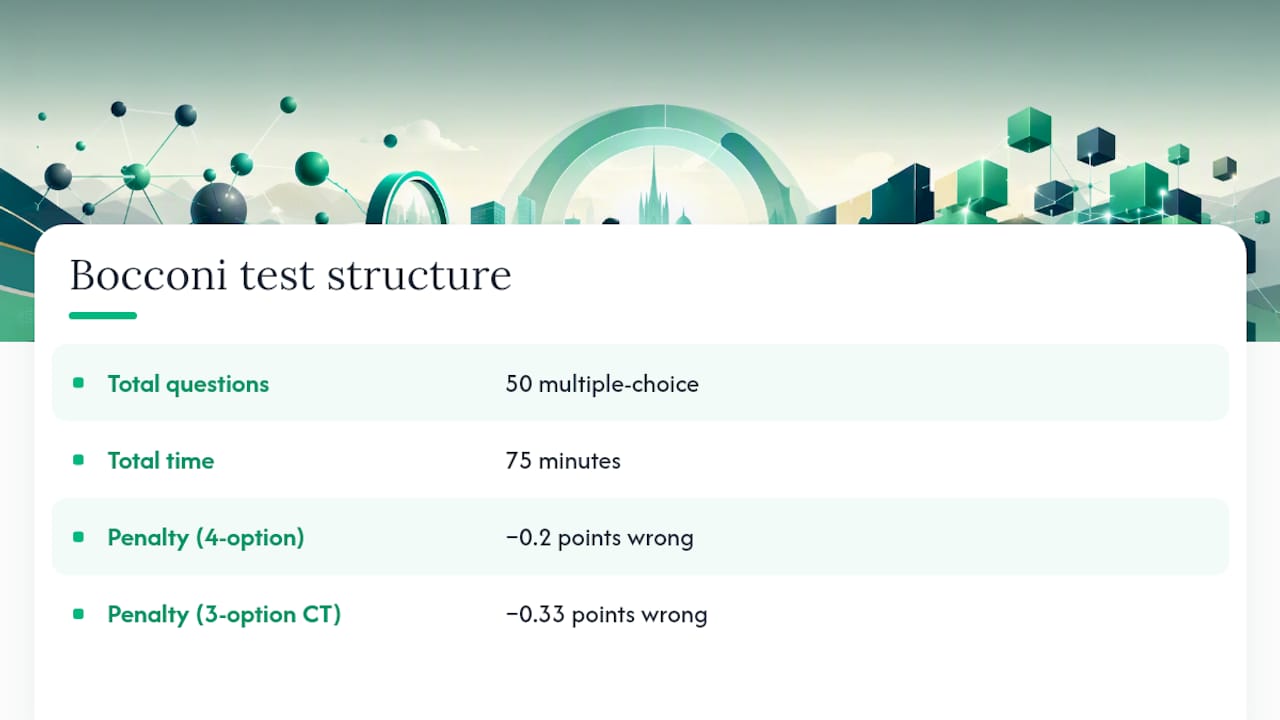
That penalty structure changes how you should approach uncertain questions. Guessing blindly on a four-option question with no idea of the answer usually costs you more in expectation than skipping it, but an educated guess after eliminating two options often still favors answering. The math shifts again on those three-choice critical thinking items, where the steeper penalty makes a pure guess riskier.
This is why pacing rules from the strategy section matter beyond just finishing on time. A rushed guess under time pressure isn’t just a wasted 90 seconds, it’s a direct point loss if it’s wrong. Students who understand the penalty structure going in tend to guess more selectively and skip more deliberately, which shows up as fewer careless errors in the post-mock log.
Common Conceptual Misunderstandings in Bocconi Test Sections
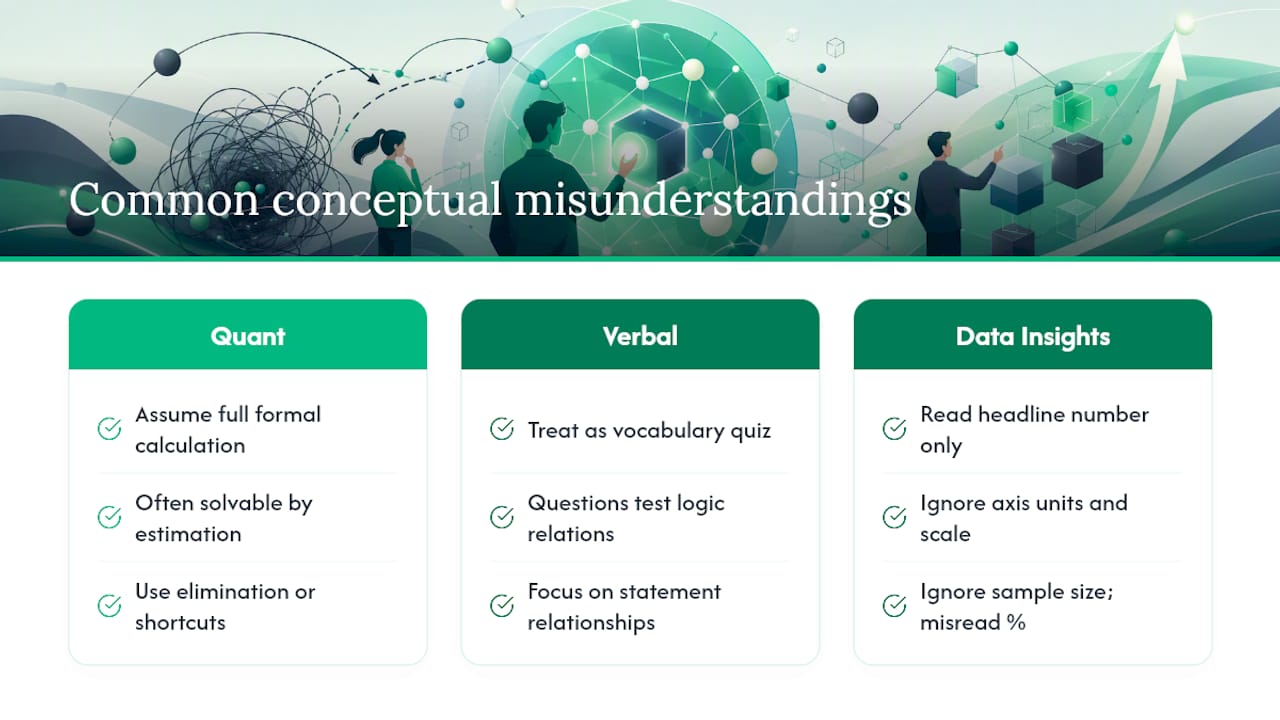
Certain misunderstandings recur across Quantitative, Verbal, and Data Insights sections regardless of a student’s overall math or reading level.
In Quantitative, students often assume every problem needs a full formal calculation, when many are built to be solved faster through estimation or elimination. In Verbal, the trap is treating the section like a vocabulary quiz, when most questions test logical relationships between statements rather than word knowledge alone. Data Insights causes the most confusion: students read a chart’s headline number without checking the axis units, the sample size, or whether a percentage is measuring a change or a total.
Another quiet misunderstanding is thinking the test rewards raw speed above accuracy. It doesn’t. The penalty structure means a correct answer earned in 90 seconds beats a wrong guess submitted in 20. Students who treat every question as a race tend to rack up careless errors that a slightly slower, more deliberate pace would have avoided.
Using Analytics Tools to Spot Deeper Error Patterns
A single mock tells you what you got wrong. Several mocks tracked over time tell you why. That’s the real value of progress-tracking tools built into a structured prep platform: they surface patterns a manual error log might miss, like a Data Insights error rate that climbs specifically in the last 10 questions of every mock, a sign of fatigue rather than a content gap.
Look for three things in any analytics view: score trend by section over multiple mocks, error type distribution (careless versus conceptual versus time), and performance by time-in-test rather than just overall accuracy. A student stuck at the same Quantitative score for three mocks in a row, despite drilling concepts, is often looking at a pacing problem the raw score doesn’t reveal. Peer ranking data adds another layer, showing whether a plateau is personal or reflects a genuinely hard question set that tripped up most test takers.
What Do Annotated Error Logs From Past Test Takers Look Like?
A well-built error log doesn’t just say “wrong.” It names the question type, the specific reason, and the fix. One example pattern from a repeat mock-taker’s log: “Data Insights, Q14, misread bar chart axis as percentage instead of raw count, careless, fix: read axis label before reading values.” Three entries later in the same log: “Quantitative, Q22, forgot to simplify fraction before comparing, conceptual, fix: redo simplification drills.”
The pattern that shows up most in these logs isn’t a single dramatic gap. It’s small, repeatable mistakes clustered in specific question formats. A student who logs five careless errors across three mocks, all involving misread units or qualifiers, doesn’t need more content study. They need five minutes of dedicated reading-accuracy practice before every Data Insights section. That’s the entire point of the analisi errori Bocconi habit: it turns a vague sense of “I’m bad at this section” into a specific, fixable behavior.
Do First-Time Test Takers and Repeaters Make Different Mistakes?
First-time test takers tend to lose points on pacing and format unfamiliarity. They don’t know how the 75-minute clock feels until they’re inside it, and they often burn too much time on the first few questions before realizing they need to move faster.
Repeaters usually have the format down. Their errors shift toward specific content gaps that survived a first attempt, and toward overconfidence on question types they got right before. It’s common for a repeater to rush through a section they did well on last time, only to make careless errors because they assumed familiarity meant safety. The fix differs too: first-timers benefit most from more timed mocks to build format comfort, while repeaters benefit more from a tight error log focused only on their specific recurring gaps, since they’ve already solved the general pacing problem.
What I’ve Seen Work: A Quick Perspective on Error Analysis
The pattern that shows up again and again isn’t lack of knowledge. It’s a Data Insights or Verbal error rate that never drops because nobody ever wrote down why the mistakes happened. One student who switched from taking mocks passively to logging and drilling by cause saw a measurable jump in section score within four mocks. Start the error log today, not after your next practice test.
— quentin
How Prepadmit Puts This Workflow Into Practice
Everything in this analisi errori Bocconi process, timed simulations, error classification, targeted drills, and progress tracking, is built directly into Prepadmit’s platform, so you’re not assembling a spreadsheet from scratch while also trying to study.
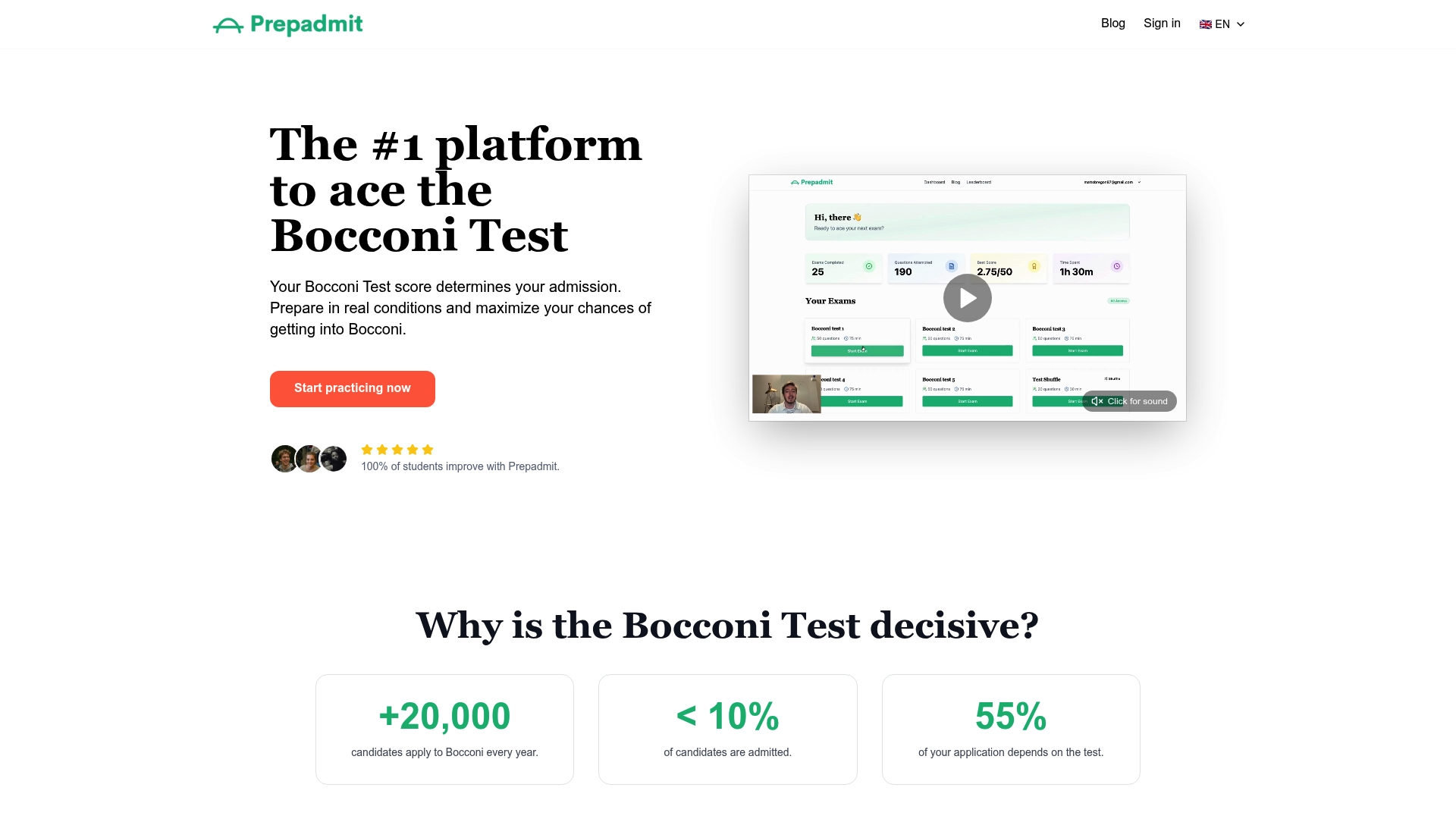
Full-length mocks mirror the real 75-minute format with official past papers, and each one comes with detailed answer corrections that show exactly why a question was missed, not just whether it was right. Skill-specific drill modes let you isolate Quantitative, Verbal, or Data Insights the moment your score report flags a weak area, and progress tracking plots your error trend across mocks so you can see whether a fix actually held. Prepadmit users following this structured cycle report an average score improvement of 34%, built by a team with backgrounds from Bocconi and HEC. If you’re ready to turn your next mock into real data instead of just a number, start a Bocconi Test simulation on Prepadmit and build your first error log this week.
Sources
- Online Bocconi test | Bocconi University
- Gli errori da evitare nel test di ammissione Bocconi: guida pratica
Recommended
Related articles
Ready to ace your admission test?
Discover PrepAdmit, the platform that helps you succeed at top university admission tests.
Discover PrepAdmit