Bocconi Test Confidence Building Techniques That Work

Bocconi Test Confidence Building Techniques That Work
Bocconi test confidence building techniques are defined as mastery-based practices that convert repeated timed performance into psychological certainty before test day. The Bocconi Test runs 75 minutes under live online proctoring, and its score counts for 55% of your admission decision. That weighting means confidence is not a soft skill here. It is a scoring variable. Psychology Today identifies mastery experience as the single strongest driver of real confidence, which means timed mock exams, targeted error review, and environment rehearsal are the exact tools you need. This guide walks you through each one.
How to use mastery experience with timed mock exams to build Bocconi test confidence
Mastery experience is the psychological process by which completing a task under real conditions updates your brain’s estimate of your own capability. Albert Bandura, who developed self-efficacy theory, identified it as the most reliable source of confidence. Applied to the Bocconi Test, this means one thing: you must practice under timed, full-length conditions, not just study content.
Here is how to build that mastery loop in four steps:
- Take a full timed mock exam first. Before you study any content, sit a complete 75-minute test under real conditions. This gives you a baseline score and, more importantly, a concrete list of where your confidence gaps actually are. Many students skip this and spend weeks studying the wrong sections.
- Log every error with its root cause. After each mock, write down each wrong answer and label it: was it a knowledge gap, a timing error, or a misread question? This error-log loop is what converts mistakes into mastery evidence rather than discouragement.
- Run targeted mini-sets on your weak areas. Take 10 to 15 questions from your weakest section under timed conditions. Repeat until your accuracy on that specific question type improves. This is calibrated practice, not random drilling.
- Repeat the full mock every 10 to 14 days. Each repeat gives you a new data point showing progress. Progress is the raw material of confidence. Without it, you are guessing at your own readiness.
Confidence is not a mood. It is evidence. Every timed mock you complete adds to that evidence base, and your brain responds by reducing pre-test anxiety automatically.
Pro Tip: Keep a single running document called your “error log.” After every practice session, add the question type, your mistake, and the rule you missed. Review it for five minutes before each new session. This habit alone closes confidence gaps faster than any content review.

Which test sections should you prioritize for confidence building?
Not all sections carry equal weight, and not all sections penalize guessing equally. Knowing both facts changes how you allocate your preparation time.
| Section | Approximate weight | Penalty for wrong answer | Confidence strategy |
|---|---|---|---|
| Mathematics | ~35% of questions | Lower penalty | Practice speed; attempt most questions |
| Numerical reasoning | ~15% of questions | Lower penalty | Focus on process accuracy under time pressure |
| Reading comprehension | ~25% of questions | -0.33 per wrong answer | Eliminate two options before guessing |
| Critical thinking | ~15% of questions | -0.33 per wrong answer | Skip if fewer than two options eliminated |
| English language | ~10% of questions | Varies | Use grammar tools like Grammarly for prep |
Mathematics and numerical reasoning together represent roughly half the test. They also carry lower penalties, which means practicing these sections aggressively and attempting most questions is statistically sound. The differential penalty system changes the calculus for reading and critical thinking. A wrong answer there costs you 0.33 points, so blind guessing destroys your score over time.
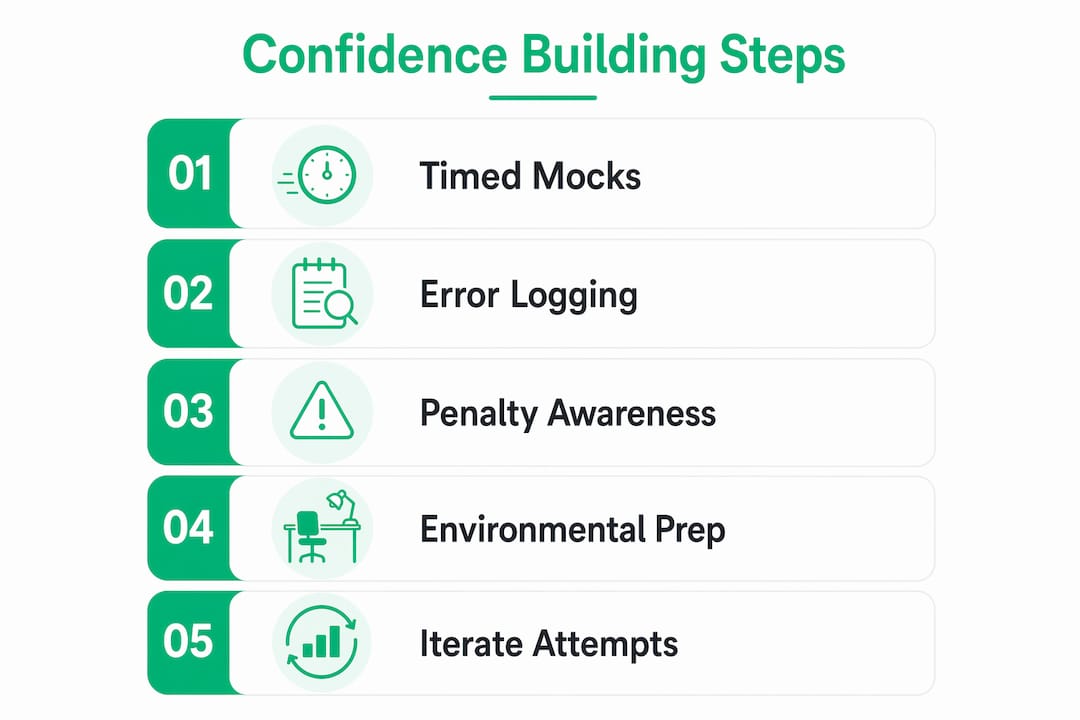
The confidence strategy for reading sections is elimination, not intuition. If you can rule out two of four options, the expected value of guessing turns positive. If you cannot, skipping is the higher-confidence move. Training yourself to make that call quickly is a skill, and it is one you build through strategic guessing practice rather than content study alone.
How to prepare your test environment and manage test-day anxiety
The Bocconi Test is taken online under live proctoring. That setup introduces a category of anxiety that has nothing to do with your knowledge: technical anxiety. A frozen webcam or unstable internet connection 10 minutes before your test starts can unravel weeks of preparation.
Here is what to rehearse before test day:
- Webcam and lighting check. Sit in your test spot and run a video call. Confirm your face is fully visible, the background is clean, and the lighting does not create shadows or glare.
- Internet stability test. Run a speed test and confirm your connection holds for at least 90 minutes without drops. If your home Wi-Fi is unreliable, identify a backup location in advance.
- Screen and browser setup. Know which browser the proctoring platform requires. Clear your cache, disable extensions, and test screen sharing before the day itself.
- Noise and interruption control. Tell anyone in your home about your test window. Put your phone on silent and place it out of reach. Environmental noise is a documented source of mid-test distraction.
“Rehearsing test day environment reduces technical anxieties that undermine confidence. Technical setup uncertainty frequently causes test-day stress, so pre-checks build psychological safety.” — Bocconi Entrance Exam 2026
Research on anxiety management supports reappraisal as a practical technique. Instead of trying to eliminate pre-test nerves, label them as excitement. The physiological state is identical; the cognitive label changes your performance response. Students who say “I am excited” before a test consistently outperform those who try to calm down.
Pro Tip: Run one full mock exam with your webcam on, your phone away, and your timer set exactly as it will be on test day. Treat this technical check like a scored rehearsal. The goal is zero surprises on the real day.
What strategic answering tactics help maintain confidence and optimize scores?
Timing and guessing decisions are the two places where confident students separate themselves from anxious ones. Both are trainable skills.
On timing, the Bocconi Test gives you 75 minutes for approximately 50 questions. That works out to roughly 1.5 minutes per question. The correct approach is not to spend 1.5 minutes on every question. It is to spend 30 to 45 seconds on questions you recognize immediately, bank that saved time, and use it on harder problems later.
Here is a four-step decision process for each question:
- Read and classify. In the first 10 seconds, decide whether this is a fast question or a slow one. Fast questions are those where you recognize the method immediately.
- Attempt fast questions first. Move through the test once, answering only questions you can solve quickly. This builds momentum and banks time.
- Apply calibration reps on harder questions. Pause, predict which options you can eliminate, and decide whether to attempt or skip based on the penalty structure. For math, attempt if you have a method. For reading, attempt only if you have eliminated at least two options.
- Return to skipped questions with remaining time. Use your banked time on the harder problems. You are now less rushed and more accurate.
Common process mistakes that destroy confidence mid-test include spending more than three minutes on a single question, second-guessing answers you were initially certain about, and skipping the review pass entirely. Each of these is a habit, and each is correctable through self-assessment exam prep that forces you to practice the decision process, not just the content.
How to build durable confidence by iterating test attempts
Single-attempt preparation is the most common mistake Bocconi applicants make. The test allows multiple attempts per academic year, and each attempt is a confidence-building opportunity if you treat it correctly.
Here is what a structured 30-day preparation cycle looks like:
- Days 1 to 3: Take a full timed mock. Score it. Build your error log. Identify your two weakest sections.
- Days 4 to 14: Run daily targeted mini-sets on your two weakest sections. Spend 30 to 45 minutes per day. Review every mistake the same day.
- Days 15 to 17: Take a second full timed mock. Compare your score to the baseline. Update your error log with new patterns.
- Days 18 to 25: Shift focus to your next two weakest areas. Maintain your strongest sections with two to three questions per day.
- Days 26 to 28: Take a third full timed mock. This is your confidence confirmation test. A score improvement here is direct evidence of readiness.
- Days 29 to 30: Rest and environment rehearsal only. No new content. Run your technical check and review your error log summary.
| Milestone | Action | Confidence outcome |
|---|---|---|
| Day 1 baseline mock | Identify real weak areas | Replaces guesswork with data |
| Day 15 second mock | Measure section improvement | Converts effort into evidence |
| Day 28 third mock | Confirm readiness | Builds pre-test psychological safety |
| Daily error log review | Reinforce corrected patterns | Prevents confidence erosion from repeat mistakes |
The recommended practice plan converts mistakes into mastery systematically. Students who follow this cycle enter test day with three data points showing improvement, not just a feeling of readiness. That distinction matters. Feelings fluctuate. Data does not.
Multiple test attempts work the same way. Your first real attempt is a dry run. Your second is a calibrated performance. Mock exam practice that mirrors this iteration cycle prepares you to treat each attempt as a learning event rather than a final judgment.
Key takeaways
Bocconi test confidence builds through timed mastery practice, penalty-aware guessing, and environment rehearsal, not through passive content review alone.
| Point | Details |
|---|---|
| Mastery experience drives confidence | Complete timed full-length mocks and log errors to convert performance into evidence. |
| Section priority shapes prep time | Focus on math and numerical reasoning first; apply elimination rules to reading sections. |
| Environment rehearsal reduces anxiety | Run a full technical check with webcam and timer before test day to eliminate surprises. |
| Strategic answering protects your score | Use calibration reps to decide between attempting and skipping based on penalty levels. |
| Iteration builds durable readiness | Follow a 30-day cycle with three mock exams and daily targeted review to track real progress. |
Why most confidence advice for the Bocconi Test misses the point
Most advice on test confidence tells you to believe in yourself or stay positive. That advice is not wrong. It is just incomplete. Confidence that is not grounded in actual performance data collapses the moment a hard question appears on screen.
What I have seen work, consistently, is students who practice alongside discomfort rather than waiting until they feel ready. Feeling ready is not a prerequisite for practicing under real conditions. It is the outcome of doing so. That distinction changes everything about how you should structure your preparation.
Timed practice outperforms untimed study by a margin that surprises most students. Many students who score well on untimed practice sets lose significant points on the real test because they have never trained their pacing. The false confidence from untimed study is one of the most common reasons capable students underperform.
Environment rehearsal is the most underrated technique on this list. Students who have sat at their test desk, run their webcam, and completed a full mock in those exact conditions walk into test day with a psychological advantage that no amount of content review can replicate.
Treat your first real Bocconi attempt as a learning event. The test allows multiple attempts, and the data from your first sitting is more valuable than any practice session. Students who approach early attempts with curiosity rather than dread improve faster and score higher on subsequent attempts.
— quentin
Build your Bocconi test confidence with Prepadmit
Prepadmit is built specifically for students who want to apply these techniques with real Bocconi test materials. The platform offers full-length timed mock exams that simulate live proctoring conditions, detailed error analytics that power your error-log loop, and skill-specific practice modes for every section of the test.
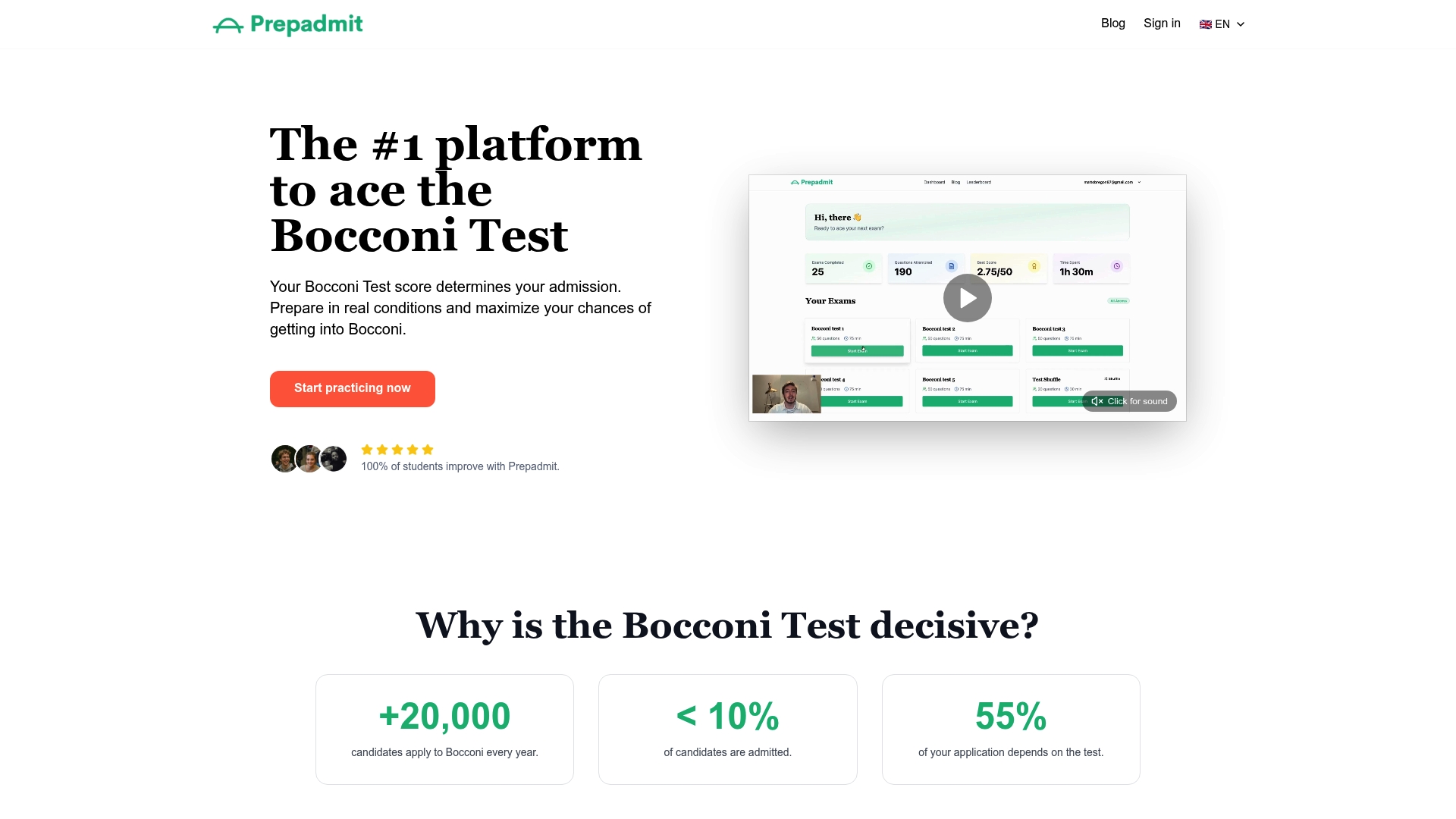
Students using Prepadmit improve their scores by an average of 34%, and the platform costs a fraction of private coaching. Every feature on the platform, from practice resources to peer ranking, is designed to give you the evidence-based confidence that actually holds up on test day. Start your preparation at Prepadmit and take your first timed mock today.
FAQ
What are the most effective confidence building techniques for the Bocconi Test?
Timed full-length mock exams combined with a structured error-log review are the most effective methods. Mastery experience, defined as completing tasks under real conditions, builds stronger confidence than content study alone.
How does the Bocconi Test penalty system affect guessing strategy?
Reading and critical thinking sections carry a -0.33 penalty per wrong answer, so you should only guess after eliminating at least two options. Mathematics sections have lower penalties, making it statistically sound to attempt most questions.
How many mock exams should I take before the Bocconi Test?
At minimum, take three full timed mocks spaced across a 30-day preparation cycle. Each mock gives you a new data point showing improvement, which is the foundation of real pre-test confidence.
Can I retake the Bocconi Test if my first attempt goes poorly?
Yes. The Bocconi Test allows multiple attempts per academic year. Treating your first attempt as a calibrated dry run rather than a final judgment reduces anxiety and improves performance on subsequent sittings.
How do I reduce technical anxiety before the online Bocconi Test?
Run a full environment rehearsal with your webcam, lighting, and internet connection at least two days before the test. Completing a timed mock in your actual test setup eliminates the technical unknowns that cause last-minute stress.
Recommended
Related articles
Ready to ace your admission test?
Discover PrepAdmit, the platform that helps you succeed at top university admission tests.
Discover PrepAdmit