What Is Self-Assessment Exam Prep and How It Works

What Is Self-Assessment Exam Prep and How It Works
Most students think self-assessment exam prep means taking a practice test and checking a score. It doesn’t. Knowing what is self-assessment exam prep means understanding it as a diagnostic tool that tells you where your knowledge breaks down, not just whether you passed a practice run. Done right, self-assessment test preparation reshapes your entire study strategy by surfacing specific gaps, calibrating your readiness, and giving you a clear action plan before exam day. This article explains the concept, the benefits, and practical steps to use it effectively.
Table of Contents
- Key Takeaways
- What is self-assessment exam prep and how it differs from practice tests
- The benefits of self-assessment in exam preparation
- How to conduct effective self-assessment exam prep
- When and how to integrate self-assessment into your study strategy
- Common misconceptions about self-assessment exam prep
- My take on self-assessment as a study tool
- How Prepadmit supports your self-assessment preparation
- FAQ
Key Takeaways
| Point | Details |
|---|---|
| Self-assessment is diagnostic | It identifies knowledge gaps, not just scores, giving you a clear revision roadmap. |
| Retrieval practice boosts retention | Testing yourself actively improves memory recall significantly more than re-reading notes. |
| Simulate real conditions strictly | Timing, environment, and no references must mirror the actual exam to get accurate results. |
| Error analysis beats test volume | Reviewing why you missed questions matters more than taking more tests, especially near exam day. |
| Integrate at every study phase | Use baseline, interim, and final self-assessments to track progress and sharpen your focus. |
What is self-assessment exam prep and how it differs from practice tests
Self-assessment exam prep is a structured, timed evaluation process you use to measure your own readiness for an exam. The goal isn’t to get a high score. The goal is to produce reliable diagnostic data about your strengths and weaknesses so you can study smarter.
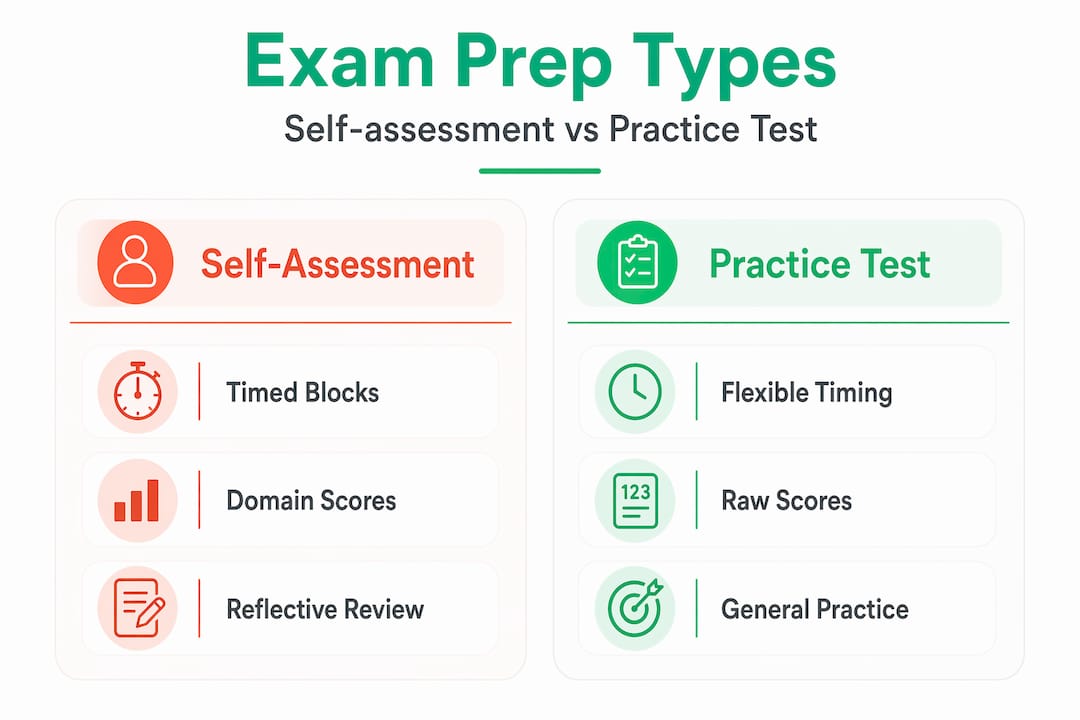
That distinction separates self-assessment from the average practice test. A practice test is often untimed, pulled from third-party sources, and taken without systematic review afterward. Self-assessment exams, by contrast, are built to mirror the real test as closely as possible. The NBME self-assessment, for example, contains approximately 200 questions divided into four timed blocks of 50 questions each, with 75 minutes per block at standard pace, directly replicating the actual exam format.
The BOC self-assessment exam follows a similar model, designed specifically to reflect the competency areas tested on the board certification exam. These aren’t glorified quizzes. They use real testing conditions to help you see exactly how you would perform under pressure.
Here is a clear comparison of both approaches:
| Feature | Self-assessment exam | Standard practice test |
|---|---|---|
| Timing | Strictly timed blocks | Often untimed or flexible |
| Scope | Mirrors full exam structure | Varies by question set |
| Feedback | Detailed score reports by domain | Basic correct/incorrect |
| Purpose | Diagnose readiness and gaps | General review and practice |
| Source | Official or expert-designed | Third-party or self-created |
Pro Tip: Before starting any self-assessment, treat it like the real exam. Phone off, timer running, no notes. The accuracy of your results depends entirely on how strictly you simulate exam conditions.
The benefits of self-assessment in exam preparation

The cognitive case for self-assessment test preparation is strong. Retrieval practice improves retention by 50% after one week compared to passive studying methods like re-reading or highlighting. When you force your brain to retrieve information under pressure, the memory trace becomes stronger and more durable.
But the benefits of self-assessment exams go beyond memory. Consider what structured self-assessment actually does for you:
- Identifies real gaps. You may feel confident about a topic until a timed question proves otherwise. Self-assessment reveals that gap before the real exam does.
- Builds professional judgment. Answering questions under realistic conditions trains you to think like an examiner, not just a student.
- Reduces false confidence. Students who only review notes often overestimate their readiness. A timed self-assessment corrects that illusion quickly.
- Targets your revision. A score report broken down by domain tells you exactly where to spend your next study hours.
- Improves exam technique. Practicing under real timing conditions builds pacing skills that no amount of reading can replicate.
The importance of exam prep through self-assessment is not just about knowledge. It’s about being ready in a way that translates under pressure. There is a real difference between knowing material and performing under timed, stressful conditions. Self-assessment closes that gap.
How to conduct effective self-assessment exam prep
Knowing how to prepare for self-assessment makes the difference between data you can use and a score that tells you nothing useful. Follow these steps to get the most out of every self-assessment session.
-
Set up a real exam environment. Strict timing and environment simulation prevents inflated readiness perception. Sit at a desk, use only materials allowed in the real exam, and start a timer. No exceptions.
-
Complete the full assessment in one sitting. Splitting it across two days distorts your results. Fatigue is part of the real exam experience, and your self-assessment should capture that.
-
Score your work using official mark schemes. Students who self-grade with official schemes better understand examiner expectations, which improves both technique and confidence. Official mark schemes reveal point allocation logic that generic answer keys miss entirely.
-
Analyze every wrong answer, not just your score. Write down why you missed each question. Was it a knowledge gap, a misread question, or a timing mistake? Each has a different fix.
-
Categorize your errors by domain. Group your mistakes into topics or skill areas. This turns a list of wrong answers into a targeted revision plan.
-
Schedule your next study block based on the results. Don’t review topics you already know well. Direct your time toward the domains where your self-assessment exposed the most errors.
-
Repeat at intervals. One self-assessment gives you a snapshot. Multiple assessments over time show you a trajectory, which is far more useful for exam confidence.
Pro Tip: Keep a dedicated error log where you write each missed question, the correct answer, and the reason you got it wrong. Reviewing this log the week before your exam is one of the highest-value study activities you can do.
When and how to integrate self-assessment into your study strategy
Timing your self-assessments correctly matters as much as taking them at all. Most students benefit from three phases.
- Baseline assessment: Take one self-assessment at the start of your study period. This shows you your starting point before any targeted preparation.
- Interim assessment: Take a second one halfway through. Compare your domain scores to your baseline. Improvement signals working strategies. Flat scores signal areas that need a different approach.
- Final assessment: Complete a final one about one to two weeks before the exam. This is your last major diagnostic checkpoint, not a confidence boost exercise.
Here is a simple framework for timing your self-assessments across a ten-week study period:
| Study week | Self-assessment activity | Focus |
|---|---|---|
| Week 1 | Baseline self-assessment | Identify starting gaps and priority areas |
| Week 5 | Interim self-assessment | Measure progress and adjust study plan |
| Week 8 or 9 | Final self-assessment | Confirm readiness and finalize revision targets |
| Week 10 | Error log review only | No new tests. Review past mistakes only. |
In the final week before the exam, the most effective approach is not taking more tests. Quality review of a few mock tests is more effective than high volume without reflection. At that point, you already have the data. What you need is to deeply understand your error patterns, not add new data points.
Self-assessment also works best alongside other study tools. Mock exams in test success play a complementary role, providing realistic full-length simulations that reinforce what your self-assessments diagnose.
Common misconceptions about self-assessment exam prep
The biggest mistake students make is treating their self-assessment score as a prediction of their final grade. It isn’t. Self-assessment scores are diagnostic, not predictive. The value lies in analyzing errors and understanding why questions were missed, not in what the number at the top of the score report says.
Here is a perspective worth keeping in mind:
“Clarity about why you are getting questions wrong is more useful than confidence from a high self-assessment score. Overconfidence from a single good result is one of the most common reasons students underperform on the actual exam.”
A second misconception involves content sharing. The BOC self-assessment exam is designed solely for individual use, and sharing its content violates Code 3.9 of the BOC Standards of Professional Practice. Most official self-assessments carry similar restrictions. Using leaked or shared exam content doesn’t prepare you. It gives you a false readiness signal based on material you’ve already seen.
The third misconception is that more tests always mean better preparation. Volume without reflection is wasted time. Taking ten self-assessments and ignoring the error patterns produces less learning than taking three and analyzing each result carefully.
My take on self-assessment as a study tool
I’ve worked with a lot of students who come to self-assessment the wrong way. They take the test, see a decent score, and feel ready. What they’ve actually done is confirm what they already know, not discover what they don’t.
In my experience, the most effective self-assessment study strategies all share one habit: structured error analysis. Not just noting what was wrong, but writing down the exact reasoning error that led to the wrong answer. That process is uncomfortable. It forces you to confront gaps you’d rather ignore. But it’s also where the real preparation happens.
I’ve also seen students who skip baseline assessments entirely, starting self-assessment only in the final two weeks. That’s a missed opportunity. The earlier you know your gaps, the more time you have to close them. One early self-assessment, reviewed carefully, can redirect weeks of study toward the areas that actually matter.
My honest advice: stop treating self-assessment as a score-checking exercise. Use it the way a doctor uses a diagnostic test. The number matters less than what the result tells you to do next. That mindset shift is what separates students who improve steadily from those who keep studying hard without improving much.
— quentin
How Prepadmit supports your self-assessment preparation
If you’re preparing for the Bocconi Test, the principles of self-assessment exam prep don’t need to stay theoretical. Prepadmit is built around exactly these ideas: realistic simulations, detailed score feedback, and tools that help you understand your errors, not just count them.
The platform offers on-demand tests built on official past papers, timed to mirror real exam conditions. After each session, you receive detailed answer corrections and domain-level breakdowns that tell you precisely where to focus your revision. Progress tracking lets you measure improvement across multiple self-assessments over time, just like the baseline-to-final framework described in this article. Prepadmit was developed by experts from HEC and Bocconi, and students report an average score improvement of 34%. If you want self-assessment tools that actually translate to results on the Bocconi Test, start your prep with Prepadmit today.
FAQ
What is self-assessment exam prep?
Self-assessment exam prep is a structured, timed method of evaluating your own exam readiness by taking exams that simulate real test conditions and analyzing the results to identify specific knowledge gaps.
How does self-assessment differ from a practice test?
Self-assessment exams are timed, officially designed, and provide domain-level score reports. Standard practice tests are often untimed and offer limited diagnostic feedback beyond basic scoring.
How often should you use self-assessment during exam prep?
Most students benefit from three self-assessments: one at the start to set a baseline, one midway to measure progress, and one about two weeks before the exam to confirm readiness.
Do self-assessment scores predict your final exam grade?
No. Self-assessment scores are diagnostic, not predictive. Their value comes from understanding why you missed questions, not from using the score as a forecast of exam-day performance.
What is the most important step after completing a self-assessment?
Error analysis. Write down each missed question, identify the type of mistake, and group errors by topic area to build a targeted revision plan for your remaining study time.
Recommended
Related articles
Ready to ace your admission test?
Discover PrepAdmit, the platform that helps you succeed at top university admission tests.
Discover PrepAdmit