Language Skills and Bocconi Admission: 2026 Guide

Language Skills and Bocconi Admission: 2026 Guide
Many applicants researching the role of language skills in Bocconi admission walk away with the wrong idea. They assume a high IELTS score will give them an edge in the rankings, or that learning Italian is required before applying. Neither is true. Language proficiency at Bocconi functions as a gate, not a score. You either meet the threshold or you do not. Understanding this distinction changes how you prepare, what you prioritize, and how you avoid expensive delays during enrollment.
Table of Contents
- Key takeaways
- The role of language skills in Bocconi admission
- How Bocconi evaluates applicants
- Why language skills still matter beyond the test
- Practical tips for managing language requirements
- Comparing accepted English certificates for Bocconi
- My take on language prep and Bocconi admission
- Start your Bocconi prep the right way
- FAQ
Key takeaways
| Point | Details |
|---|---|
| Language is pass/fail | English proficiency does not boost your admission ranking. It unlocks enrollment after you are admitted. |
| IELTS or TOEFL required | You need IELTS 6.5 or TOEFL 88 to complete enrollment, not to rank competitively. |
| Admission is test and GPA driven | Your ranking depends 55% on your entrance test score and 45% on your GPA. Language sits outside this formula. |
| Italian is optional but valuable | Italian is not required for admission or coursework, but it matters for internships, networking, and daily life in Milan. |
| Submit certificates early | Upload your language certificate at application time to avoid delays after you receive an offer. |
The role of language skills in Bocconi admission
Let’s clear up the biggest misconception first. Language proficiency is not a selection criterion at Bocconi. It does not appear in your admission score. It does not make your application more competitive than another student’s. What it does is determine whether you can actually enroll once you have been admitted.
Bocconi requires all incoming students to demonstrate English proficiency before finalizing enrollment. The accepted minimum is an IELTS Academic score of 6.5, with no individual section falling below 6.0, or a TOEFL iBT score of at least 88. These are non-negotiable. A student who scores below these thresholds and cannot present an accepted certificate risks losing their place, even after receiving an admission offer.
This is a nuance most applicants miss entirely. You could rank in the top 5% of applicants and still be blocked from enrolling if your language documentation is missing or insufficient. That is the real weight of language proficiency at Bocconi. Not competitive. But absolutely critical.
Pro Tip: If your current IELTS or TOEFL score is close to the minimum, retake the test before submitting your application. Cutting it too close on a pass/fail requirement is an unnecessary risk.
How Bocconi evaluates applicants
Here is how the numbers actually break down when Bocconi ranks applicants.
| Factor | Weight |
|---|---|
| Bocconi Online Test / SAT / ACT | 55% |
| High school GPA | 45% |
| English language certificate | Pass/fail prerequisite |
Your admission ranking is built entirely from your entrance test score and your academic record. English proficiency does not add points. It simply confirms you meet the minimum academic communication standard for a university that teaches entirely in English.
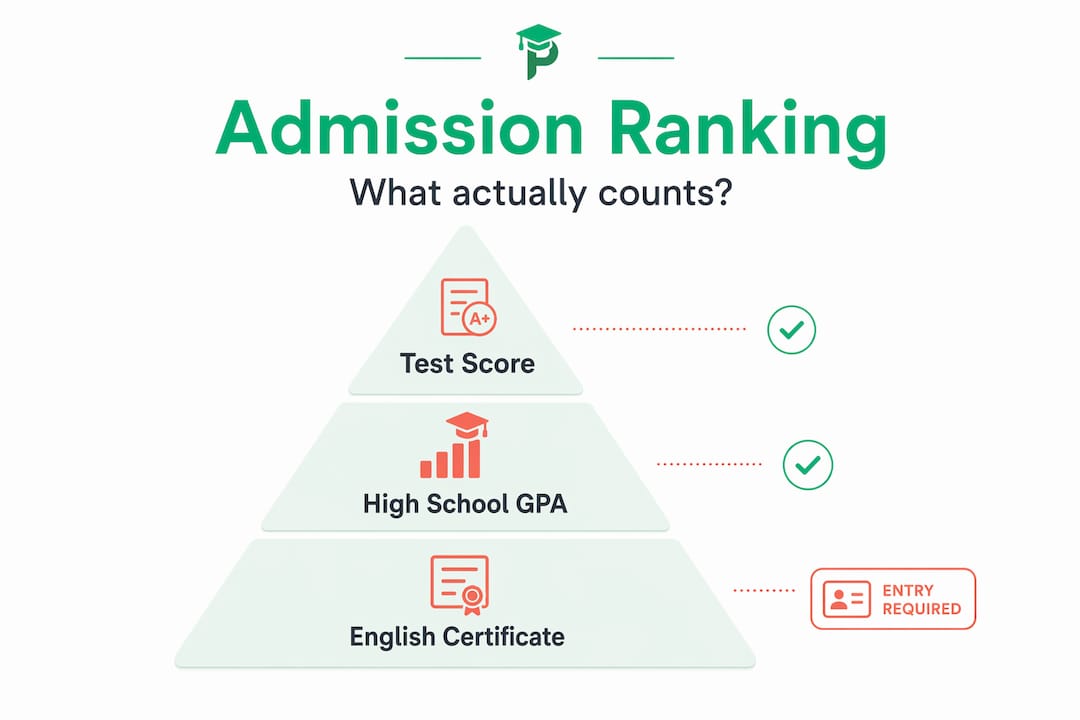
This matters because it tells you exactly where to spend your preparation time. If you are strong in math and reasoning but your IELTS score is already above 6.5, you should be putting the bulk of your effort into the Bocconi Online Test, not language study. The entrance test, which emphasizes mathematics and reasoning, is what moves your ranking up or down. Language is the floor, not the ceiling.
A few things worth knowing about how this plays out in practice:
- Applicants who meet the English threshold during the application process face fewer administrative hurdles during enrollment.
- Students who delay language certification until after receiving an offer sometimes run into tight timelines before the enrollment deadline.
- Native English speakers from qualifying countries (US, UK, Canada, Australia, Ireland) are typically exempt from the language certificate requirement, though you should confirm this with Bocconi directly.
Pro Tip: Treat your language certificate the same way you treat your transcript. Get it early, keep a copy, and upload it the moment the application portal opens.
Why language skills still matter beyond the test
Here is where the story gets more interesting. Even though English proficiency is pass/fail for admission purposes, language skills shape your entire experience at Bocconi and in Milan.

Bocconi runs its undergraduate and graduate programs primarily in English. Your academic survival depends on reading complex case studies, writing analytical essays, and participating in group discussions. An IELTS score of 6.5 gets you through the door, but the students who thrive are the ones who can write clearly, argue concisely, and engage confidently in class. The certificate proves a baseline. Your actual ability carries you through the degree.
Then there is Italian. It is not required for admission, and you can technically complete your degree without speaking a word of it. But approximately 59% of Italian residents report some English knowledge, and functional fluency is considerably less common. In real terms, that means:
- Grocery stores, pharmacies, and local government offices often operate primarily in Italian.
- Bureaucratic processes like registering your address or dealing with healthcare require at least basic Italian to navigate without help.
- Internship and job applications at Italian firms frequently favor candidates who can communicate locally.
- Social integration with Italian students and local communities happens much more naturally when you have conversational Italian.
- Networking events, particularly in traditional industries like finance, consulting, and manufacturing, often mix Italian and English depending on the room.
“Italian is not mandatory for studies, but it is crucial for local networking and opens doors that would otherwise stay closed to international students.”
The students who build basic Italian alongside their degree tend to leave Bocconi with a much stronger local professional network and more career options in the Italian and European markets.
Practical tips for managing language requirements
The process of actually submitting language documentation has tripped up more applicants than you might expect. Here is how to handle it cleanly.
Start early with your language test. Do not wait until after you receive a Bocconi admission offer to book your IELTS or TOEFL. Test centers fill up, results take time to arrive, and uploading certificates early smooths out the entire enrollment process. Treating this as a last-minute checkbox is where delays happen.
Know the accepted tests and plan accordingly. Not all English tests are equal in Bocconi’s eyes. IELTS Academic and TOEFL iBT are the most widely accepted. Cambridge English Qualifications and the Duolingo English Test are also recognized, though score requirements differ. Check the current Bocconi admissions page to confirm which tests are accepted for your intake year, since policies can update.
Combine your prep strategically. If you are still building your English skills, you can actually align your test preparation with your Bocconi entrance test prep. Both the IELTS reading sections and the Bocconi Online Test require analytical reading under time pressure. Practicing with dense, argument-based texts helps both.
Common mistakes to avoid:
- Assuming your school’s medium of instruction in English automatically exempts you from the certificate requirement. It usually does not.
- Submitting a certificate that has expired. Most language tests are valid for two years.
- Using a TOEFL score from the paper-based version when Bocconi specifies TOEFL iBT.
- Waiting until enrollment to realize your score falls short of the 6.0 minimum per section, even if your overall IELTS score looks acceptable.
Pro Tip: Book your language test at least three months before your Bocconi application deadline. This gives you time to retake it if your score falls short.
Comparing accepted English certificates for Bocconi
Choosing the right English test depends on your timeline, budget, and test-taking strengths.
| Test | Minimum Score | Validity | Notes |
|---|---|---|---|
| IELTS Academic | 6.5 overall, 6.0 per section | 2 years | Widely accepted, paper and computer options |
| TOEFL iBT | 88 | 2 years | Strong choice for US-style standardized test takers |
| Cambridge C1 Advanced | 180–199 (C1 level) | No expiry | Good for students already in Cambridge exam tracks |
| Duolingo English Test | Score threshold varies | 2 years | Affordable and fast results, growing acceptance |
According to study abroad language test data, IELTS Academic and TOEFL iBT remain the most recognized options globally, which also makes them the safest choices if you plan to apply to multiple universities.
A few things to keep in mind when deciding:
- IELTS Academic is the default recommendation for European university applications.
- TOEFL iBT suits applicants who have already been preparing for US-style standardized tests.
- Cambridge C1 Advanced has no expiry date, which is a genuine advantage if you passed it during secondary school.
- The Duolingo English Test is the most affordable and delivers results fastest, but confirm acceptance with Bocconi before relying on it.
My take on language prep and Bocconi admission
I have seen a lot of applicants burn time worrying about the wrong things. They spend weeks on advanced English vocabulary drills while their Bocconi Online Test practice is almost nonexistent. That imbalance is a real problem, because the entrance test is what determines your ranking.
What I have learned is that clarity about what each requirement actually does changes everything. Once you understand that language certification is pass/fail and not a ranking factor, you stop over-investing there and start directing energy where it actually moves the needle.
My honest advice: if your English is already solid and you test above 6.5 on a practice IELTS, lock in that certification early and shift your focus almost entirely to the Bocconi Test. If your English needs work, address it, but do not let it consume your entire prep timeline.
On Italian, I think most students underestimate how much it would help them. The people I have seen thrive in Milan are not always the ones with the highest admission scores. They are the ones who could walk into a local networking event, hold a basic conversation in Italian, and leave with actual contacts. That skill does not show up on any application. But it shows up in careers.
— quentin
Start your Bocconi prep the right way
Understanding the language requirements is one piece of the puzzle. The bigger piece is your score on the Bocconi Online Test, and that is where real preparation makes the difference.
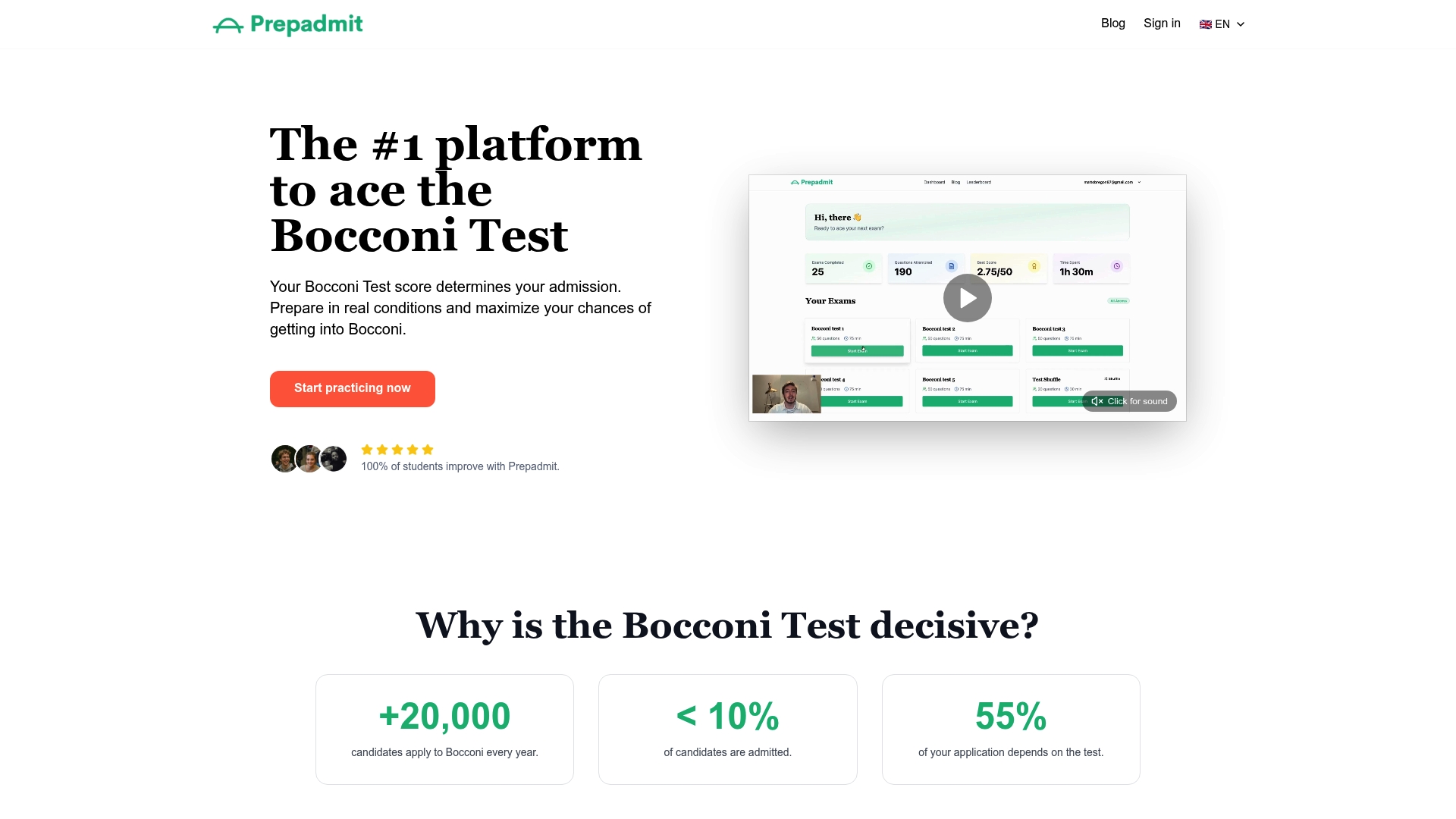
Prepadmit is built specifically for students targeting Bocconi admission. The platform uses official past papers and on-demand tests to replicate real exam conditions, so you know exactly what to expect on test day. You get detailed answer corrections, skill-specific practice modes, and a live ranking against other applicants so you can see where you actually stand. Students on Prepadmit improve their scores by an average of 34%. The platform was developed by experts from HEC and Bocconi, and it costs a fraction of private coaching. If you are serious about admission, this is where you start.
FAQ
What is the language requirement for Bocconi admission?
Bocconi requires an IELTS Academic 6.5 (minimum 6.0 per section) or TOEFL iBT 88 for enrollment. This is a pass/fail prerequisite and does not affect your admission ranking.
Does English proficiency affect your Bocconi ranking?
No. Your admission ranking is based 55% on your entrance test and 45% on your GPA. English proficiency is a separate enrollment condition.
Is Italian required for Bocconi admission or coursework?
Italian is not required for admission or to complete your degree. However, basic Italian skills significantly improve internship prospects, networking, and daily life in Milan.
Which English tests does Bocconi accept?
Bocconi accepts IELTS, TOEFL, Cambridge English, and the Duolingo English Test, each with defined minimum score thresholds.
When should you submit your language certificate?
Submit your language certificate at the time of application. Waiting until after admission can delay enrollment, and late submissions create avoidable administrative problems before the enrollment deadline.
Recommended
Related articles
Ready to ace your admission test?
Discover PrepAdmit, the platform that helps you succeed at top university admission tests.
Discover PrepAdmit