Bocconi on-demand test advantages: Your complete guide
Bocconi on-demand test advantages: Your complete guide
Getting into Bocconi University is competitive. The admission test is your single biggest lever, and the Bocconi on-demand test advantages are real enough to change how you prepare, what you spend, and how many chances you get. Most students spend weeks agonizing over which test format to choose without fully understanding what each one actually costs them in time, money, and stress. This guide breaks down exactly how the on-demand format works, what it saves you, and how to use it to your advantage before you book your first attempt.
Table of Contents
- Understanding the Bocconi admission test and formats
- Cost and accessibility advantages of the on-demand format
- Flexible scheduling and multiple attempts to improve scores
- Why focusing on math and strategic guessing matters
- Head-to-head comparison: on-demand vs on-campus Bocconi test
- Our take: the on-demand format rewards preparation, not luck
- How Prepadmit helps you use every advantage
- Frequently asked questions
Key Takeaways
| Point | Details |
|---|---|
| Flexible multiple attempts | You can take the Bocconi on-demand test up to 4 times per year, helping improve your score before deadlines. |
| Significant cost savings | Online testing eliminates travel and accommodation expenses compared to on-campus testing. |
| Focus on math section | Nearly half the test questions are math, which offers the biggest opportunity for score gains. |
| Smart guessing strategy | Guessing in math is neutral; guessing in reading carries penalties, so skip if unsure. |
| Book slots early | Test slots near application deadlines fill fast, so schedule your attempts well in advance. |
Understanding the Bocconi admission test and formats
Before you can use the on-demand format well, you need to understand what you are actually being tested on. The Bocconi Test lasts 75 minutes with 50 multiple-choice questions covering four areas: mathematics, reading comprehension, critical thinking, and numerical reasoning.
Here is how the test breaks down:
- Mathematics: 24 questions (48% of the total test)
- Reading comprehension: roughly 10 questions
- Critical thinking: roughly 8 questions
- Numerical reasoning: roughly 8 questions
Scoring is not simple. You earn +1 for each correct answer. Wrong answers carry penalties that vary by section. Math wrong answers cost you 0.2 points. Reading and critical thinking wrong answers cost you 0.33 points each. Skipping a question costs nothing.
The minimum passing score is 17 out of 50. But that number is misleading. In practice, a score below 35 rarely leads to an offer. If you are aiming for a scholarship or a competitive program, you need 40 or above. That is the real target.
Now, the format question. You have two options: the on-demand online test and the traditional on-campus test held in Milan. Both test the same content with the same scoring rules. The difference is everything else: cost, location, scheduling, and how many times you can realistically attempt it. Students focused on improving performance in the Bocconi test consistently find the on-demand route gives them more control over the outcome.
Cost and accessibility advantages of the on-demand format
The on-demand test costs 60 euros per attempt. You can take it up to four times per academic year. That is a maximum of 240 euros for four shots at the test, from your own home.

Compare that to the on-campus option. The on-demand test eliminates travel and accommodation costs that on-campus testing requires, especially for international students. A round-trip flight to Milan, two nights in a hotel, ground transport, meals, and possibly a visa can easily add 600 to 1,200 euros to a single attempt. If you live outside Europe, that number climbs higher.
Key cost and access benefits of the on-demand format:
- No travel costs. You test from home, wherever you are in the world.
- No visa required. For students in countries that need a Schengen visa just to visit Italy, this removes a significant barrier.
- Flexible test window. You can start your test anytime between 00:00 and 23:59 on your booked day. If you are sharpest at 10 AM or 9 PM, you choose.
- Familiar environment. Testing at home removes the stress of an unfamiliar room, a new city, and jet lag.
- Multiple affordable attempts. Four attempts at 60 euros each is far cheaper than one on-campus attempt with travel costs.
“For students outside Italy, the on-demand format is not just more convenient. It is the only financially realistic way to attempt the test more than once.”
Pro Tip: Book your test slot well in advance. Slots near application deadlines fill up fast, and losing your preferred date because you waited too long is an avoidable mistake. Treat your booking like a flight reservation.
If you want to save costs with the online Bocconi test, the math is straightforward. Four on-demand attempts cost less than one on-campus attempt for most international students.
Flexible scheduling and multiple attempts to improve scores
The ability to take the test up to four times is one of the strongest Bocconi on-demand test advantages. But most students do not use this strategically. They book one attempt, hope for the best, and scramble if the score falls short.
Here is a smarter approach:
- Take your first attempt early. Use it as a real diagnostic. You will learn more from one real test than from ten practice sessions.
- Review your results section by section. Bocconi provides your score breakdown. Look at where you lost the most points and adjust your preparation.
- Space your attempts by at least two to three weeks. You need time to actually improve, not just repeat the same mistakes under pressure.
- Target your weakest section with focused practice. If math is dragging your score down, that is where your next two weeks go.
- Use your final attempt when you are genuinely ready. Do not waste it just because the deadline is approaching.
The test can be taken up to 4 times per year, with no same-day or consecutive-day retakes. That rule actually helps you. It forces a gap between attempts, which means you have time to improve between each one.
Pro Tip: Treat each attempt as its own preparation cycle, not just a retry. Set a specific score goal for each attempt. Going from 32 to 37 to 42 across three attempts is a realistic and common progression for students who prepare with purpose.
Effective Bocconi test preparation is not about cramming before one attempt. It is about building skills over multiple cycles, using each test result as data.
Why focusing on math and strategic guessing matters
Mathematics is 48% of your test. That is not a minor section. It is the section. Math represents nearly half of all questions and carries a lower penalty for wrong answers than reading or critical thinking.
Here is what that means in practice:
- 24 math questions at +1 correct, -0.2 wrong. If you guess on 5 questions and get 2 right and 3 wrong, your net gain is +2 minus 0.6, which equals +1.4. Guessing is statistically neutral to slightly positive in math.
- Reading and critical thinking at -0.33 per wrong answer. The math changes here. Guess on 5 questions, get 2 right and 3 wrong: +2 minus 0.99 equals +1.01. The margin is thinner. Only guess if you can eliminate at least two wrong options.
- Skipping is always safe. If you genuinely have no idea, skip. A zero beats a negative.
“Your math score is the engine of your Bocconi result. Weak math cannot be compensated by strong reading. Strong math, however, can carry an average reading performance to a competitive total.”
This is why math-focused Bocconi prep strategies matter so much. Students who spend 60% of their preparation time on mathematics and 40% on the other sections consistently outperform those who spread effort evenly. The point distribution rewards this approach.
For reading and critical thinking, the strategy is different. Work through the passage carefully. If you can eliminate two of the four options with confidence, guess from the remaining two. If you cannot, skip. The penalty is too steep for random guessing.
Head-to-head comparison: on-demand vs on-campus Bocconi test
The on-demand and on-campus tests charge similar base fees, but total costs diverge sharply once you add travel and accommodation for the on-campus option. Here is a clear comparison:
| Feature | On-demand online test | On-campus test (Milan) |
|---|---|---|
| Base fee | 60 euros per attempt | Comparable base fee |
| Travel required | No | Yes, to Milan, Italy |
| Accommodation | Not needed | Required for most students |
| Visa needed | No | Possibly yes |
| Test timing | Any time 00:00 to 23:59 | Fixed schedule |
| Attempts per year | Up to 4 | Limited by travel logistics |
| Total cost (international) | 60 to 240 euros | 700 to 1,500+ euros |
| Technical risk | Internet/device dependent | Controlled environment |
| Stress factors | Home comfort | Unfamiliar city and room |
| Score improvement potential | High, due to multiple retakes | Lower, fewer practical attempts |
The on-campus format has one real advantage: a controlled environment with no risk of internet issues or technical problems on your end. That is a legitimate concern. But for most students, especially those outside Italy, the on-demand advantages far outweigh that single risk. A stable internet connection and a quiet room are manageable. A 1,000-euro trip to Milan for a single attempt is not.
Our take: the on-demand format rewards preparation, not luck
Here is something most guides will not tell you. The on-demand format does not just save you money. It changes the psychology of the test entirely.
When you have one shot and a plane ticket attached to it, you test under pressure that has nothing to do with your actual ability. You are tired from travel. You are in an unfamiliar room. You are anxious because failure means wasted money and a long trip home. That pressure does not measure how well you know the material. It measures how well you perform under logistical stress.
The on-demand format removes that noise. You test in your own space, at your best time of day, with the ability to try again if something goes wrong. That is not a softer version of the test. It is a fairer one.
The students who struggle with the on-demand format are usually the ones who treat flexibility as permission to be underprepared. They book an attempt without serious practice, score poorly, and feel like the format failed them. It did not. Flexibility only helps if you use the time between attempts to actually improve.
Four attempts is not a safety net. It is a preparation system. Use each attempt as a checkpoint, not a gamble.
How Prepadmit helps you use every advantage
If the on-demand format gives you up to four attempts, you need a preparation system that helps you improve between each one.
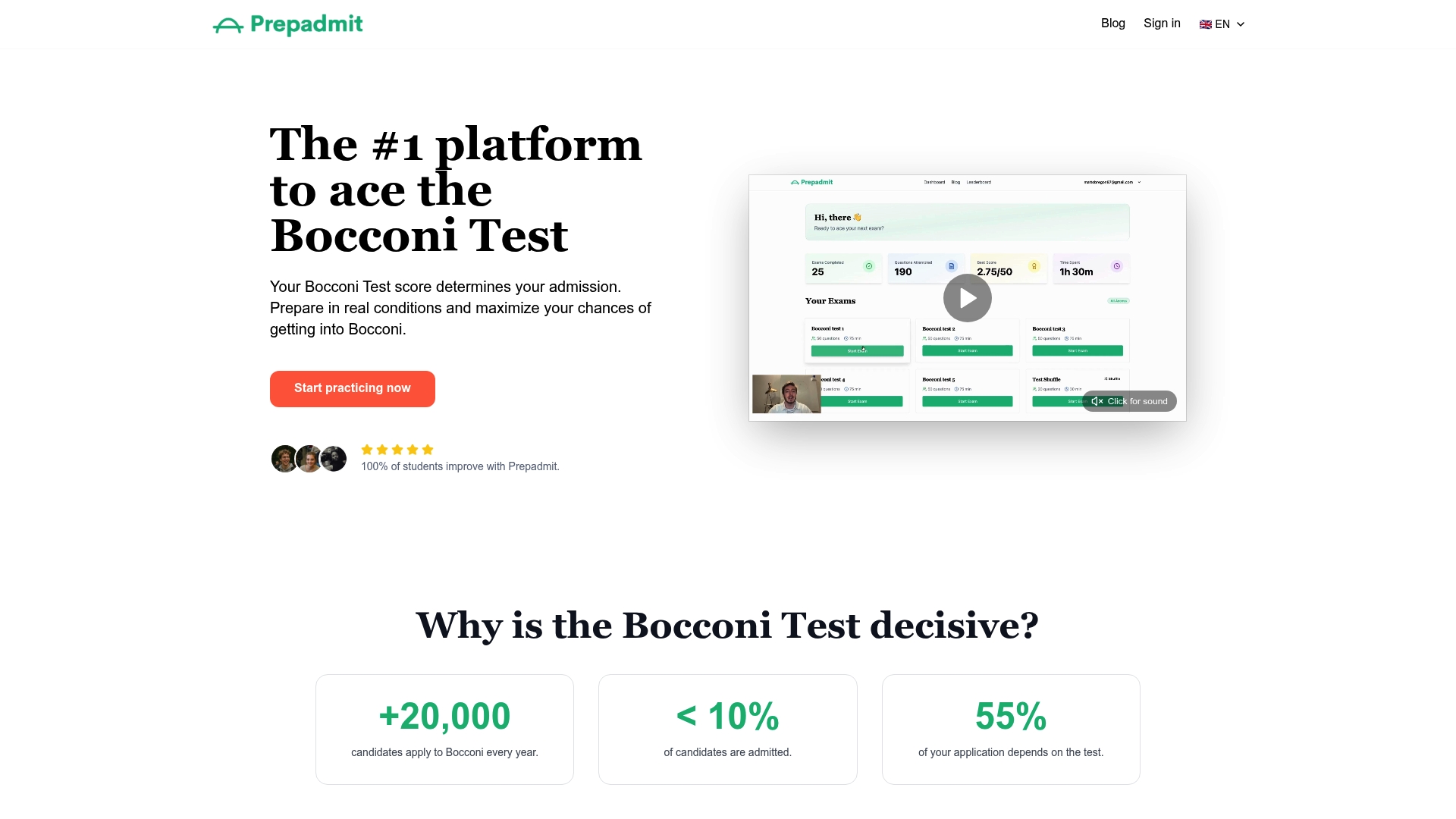
Prepadmit is built specifically for the Bocconi Test. The platform uses official past papers and on-demand practice tests that mirror real exam conditions, so you know exactly what to expect before your first attempt. Detailed answer corrections show you not just what you got wrong, but why. Skill-specific practice modes let you target math, reading, or critical thinking separately. Progress tracking and peer ranking tell you where you stand. Students using Prepadmit improve their scores by an average of 34%. The platform costs a fraction of private coaching and comes with a money-back guarantee. If you are serious about Bocconi, this is where your preparation starts.
Frequently asked questions
How many times can I take the Bocconi on-demand test per year?
You can take the test up to 4 times per academic year, but not on the same day or on consecutive days.
Is the Bocconi on-demand test cheaper than the on-campus exam?
Yes. The on-demand format eliminates travel costs, making it significantly more affordable for most students, especially those outside Italy.
What is the minimum competitive score I should aim for on the Bocconi test?
Aim for 40 or above. Students scoring 40 or higher have the strongest admission profiles and the best chances at scholarships.
Can I choose the test date for the on-demand Bocconi test?
Yes. Once you book a day, you can start your test anytime between 00:00 and 23:59 on that date, giving you full control over your schedule.
Recommended
Related articles
Ready to ace your admission test?
Discover PrepAdmit, the platform that helps you succeed at top university admission tests.
Discover PrepAdmit