Bocconi MAT Test Prep: What to Study and How to Simulate It
Bocconi MAT Test Prep: What to Study and How to Simulate It
For Bocconi Test success, the highest-return move is to run a full timed official simulation now. That single test tells you more than a week of scattered review. Here, “mat test prep” means Bocconi Test preparation: timed simulations under real exam conditions, math-heavy drills, detailed corrections, and progress tracking, not generic analogy-style practice.
Two things to do this week:
- Take the official 50-question, 75-minute simulation to set your baseline score.
- Note which section cost you the most time or points, since that becomes week one of your study plan.
Realistic timing and item-level feedback expose weaknesses faster than any textbook chapter review.
Key Takeaways
Bocconi Test scores improve fastest when timed official simulations, math-weighted drills, and tracked error data replace untimed, unstructured review.
| Point | Details |
|---|---|
| Start with a baseline mock | Take the official 50-question, 75-minute simulation before building any study plan. |
| Weight math heavily | Mathematics makes up about 48% of the test, so drill time should reflect that ratio. |
| Respect sequential navigation | Screens lock after three questions, so pace decisions at the screen level, not question by question. |
| Prevent technical failures | Run a full system check and device backup 48 hours before the exam to avoid cancellation risk. |
| Track the right metrics | Use Prepadmit’s progress dashboards to follow section scores, time-per-question, and peer percentile across mocks. |
Table of Contents
- What Is the Bocconi Test Structure and Timing?
- How Do You Practice Realistically for the Bocconi Test?
- How Long Should You Study for the Bocconi Test?
- What Technical Setup Do You Need on Test Day?
- When Should You Guess on the Bocconi Test?
- How Should You Track Errors and Adjust Your Study Plan?
- How Do You Prepare Mentally for the Bocconi Test?
- What Mistakes Should You Avoid During the Test?
- How Can You Simulate Real Test Conditions at Home?
- What I’ve Learned From Tracking Mock Test Progress
- Get Realistic Bocconi Simulations With Detailed Corrections
- Frequently Asked Questions
- Sources
What Is the Bocconi Test Structure and Timing?
The test is 50 multiple-choice questions in 75 minutes, roughly 1.5 minutes per question. That pace leaves almost no room for second-guessing, which is exactly why timed practice matters more here than in most entrance exams.
The official section breakdown looks like this:
- Mathematics: 24 questions, roughly 48% of the test
- Numerical reasoning: 6 questions, about 12%
- Critical thinking: 9 questions, about 18%
- Reading comprehension: 11 questions, about 22%
Math alone decides nearly half your score. If your study hours don’t reflect that ratio, your prep plan is already misaligned before you open a single practice question.
Navigation adds a wrinkle most first-time takers miss: questions appear three per screen, and once you advance, you cannot go back. The official instructions also require a pre-test system check, a working lockdown browser, valid identification on hand, and adherence to a maximum attempts policy. Miss any of these and you risk losing an attempt before you answer a single question.
How Do You Practice Realistically for the Bocconi Test?
Realistic practice means matching the actual test on three fronts: timing, question order, and feedback quality. Untimed review teaches you content. Timed, scored mocks teach you to perform under the same pressure you’ll face on test day, which is a different skill entirely.
Here’s a sequence that works for most applicants:
- Take the official simulation first to establish your baseline and confirm you understand the interface.
- Starting around week 8 of your prep window, schedule one full timed mock per week under real conditions.
- Fill the days between mocks with short, targeted drills weighted toward math: algebra, functions, geometry, probability, and statistics, since that’s where most of the test’s points live.
- After each session, log your section score, time per question, and error category rather than just your total.
- Compare your peer percentile across mocks to see whether gains are real or noise.
That tracking loop, mock, review, targeted drill, retest, is the mechanism behind measurable score gains rather than vague “more practice” advice. On-demand tests with detailed, item-by-item corrections do something untimed practice sets can’t: they show you not just that you missed a question, but why, and whether the mistake was conceptual, careless, or time-pressure driven.
Skill-specific drill modes let you isolate a weak topic (say, probability) and hammer it in short bursts instead of wading through a full mixed set to find three relevant questions. For dedicated math practice, targeted drills on Bocconi-specific topics save time versus generic problem sets.
Pro Tip: Don’t just track your score. Track your time-per-question variance across mocks. A shrinking spread usually predicts a rising percentile before your raw score catches up.
How Long Should You Study for the Bocconi Test?
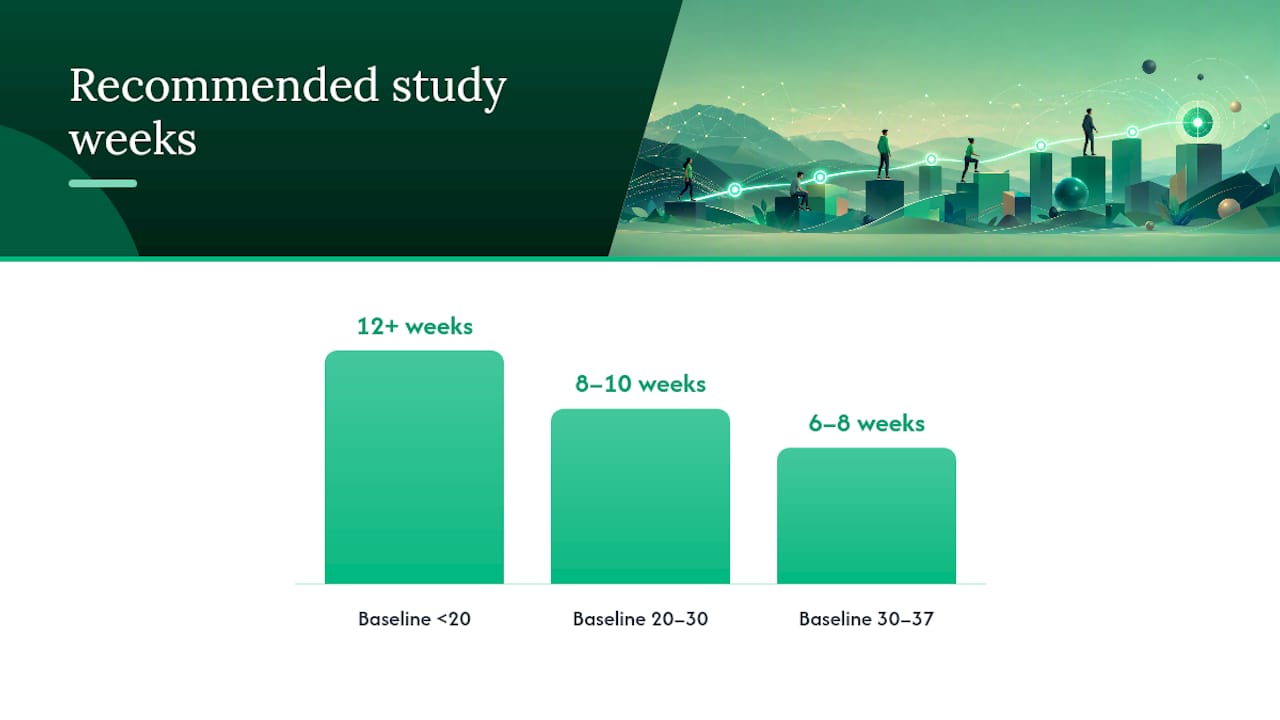
Your baseline score should set your timeline, not the calendar. A student scoring below 20 on a diagnostic mock typically needs 12 or more weeks to close the gap. Someone in the 20 to 30 range can often get there in 8 to 10 weeks, while a strong starting score of 30 to 37 may only need 6 to 8 weeks of focused refinement, according to prep-timeline guidance built from common study patterns.
A 10-week plan built around that logic looks like this:
- Weeks 1 to 2, diagnostic and foundations. Take the baseline mock, review every miss, and rebuild core math concepts you got wrong for the wrong reasons.
- Weeks 3 to 6, build phase. Daily 30 to 60 minute drill blocks focused on your weakest topics, plus one untimed full-length set per week to build stamina.
- Weeks 7 to 9, mixed timed practice. Shift to full timed mocks weekly, alternating with shorter skill drills that target whatever error category dominated your last mock.
- Week 10, consolidation. Light review only, one final simulation four to five days before the exam, then rest.
A sample weekday micro-schedule during the build phase: 20 minutes of math drills in the morning, a 40-minute reading or critical-thinking set in the evening, and a 10-minute review of yesterday’s mistakes before bed. On weekends, run the full timed mock.
Space your official attempts so you have time to actually learn from mistakes between them rather than repeating them. Save your final, highest-confidence attempt for when your score trend is clearly upward, not flat. For a broader week-by-week breakdown, a step-by-step preparation guide can help you adapt the phases above to your own calendar.
What Technical Setup Do You Need on Test Day?
Most test-day disasters have nothing to do with math. They’re technical. The official instructions note that tests can be canceled for a failed proctoring launch or a lost audio and video stream, which makes prevention one of the highest-leverage things you can do before exam day.
Run through this checklist at least 48 hours out:
- Complete the full system check: operating system, webcam, microphone, and screen sharing permissions.
- Launch the lockdown browser once, fully, rather than just confirming it installs.
- Clear your desk, set a neutral background, and keep valid identification within reach for the room scan.
- Have a backup device charged and ready, and use a wired internet connection if you can get one.
- Save Bocconi’s technical support contact information somewhere you can find it fast, not buried in an email thread.
Pro Tip: The day before your exam, run a “full launch” simulation, start to finish, including the system check and ID scan. Practicing the process removes one more variable from test day itself.
When Should You Guess on the Bocconi Test?
Guessing strategy on the Bocconi Test comes down to a simple trade: expected value versus time cost. Since scoring penalizes wrong answers differently across sections, blind guessing everywhere is a losing habit, but so is leaving blanks out of caution.
A workable heuristic:
- In math and numerical reasoning, guess once you’ve eliminated at least one option; the odds shift enough in your favor to justify it.
- In reading comprehension and critical thinking, only guess after eliminating at least two options, since these questions often hinge on subtle wording that a partial elimination won’t catch.
- Apply a 30-second elimination routine: scan for obviously wrong answers first, then decide to guess, skip, or commit based on how many options remain.
- If you’re still unsure after 30 seconds, mark your best guess and move on rather than let one question eat your remaining screen time.
Because you cannot revisit previous screens, this decision has to happen in the moment, not “I’ll come back to it.” Build the habit during timed mocks so it’s automatic under real pressure.
How Should You Track Errors and Adjust Your Study Plan?
Raw practice hours don’t predict score gains nearly as well as what you do with your mistakes. The most useful habit is logging every miss by category, not just marking it wrong and moving on.
Three metrics predict improvement better than your total score does: a rising section-correct percentage over successive mocks, a shrinking spread in your time-per-question, and a climbing peer percentile on full-length simulations. Track those three across every mock, and you’ll spot plateaus before they cost you weeks.
When you review a missed question, sort it into one of three buckets: conceptual (you didn’t know the method), careless (you knew it but rushed or misread), or time-pressure (you understood it but ran out of time to finish). Each bucket demands a different fix. Conceptual gaps need targeted content review. Careless errors need slower, deliberate practice on easier sets before you speed back up. Time-pressure errors need screen-level pacing drills, not more content study.
Revisit your error log weekly, not daily. Daily swings are mostly noise. A weekly view shows whether your algebra error rate is actually dropping or whether last week’s good mock was a fluke. If one error category keeps recurring after two weeks of targeted drills, that’s a signal to change the drill itself, not just repeat it harder.
How Do You Prepare Mentally for the Bocconi Test?
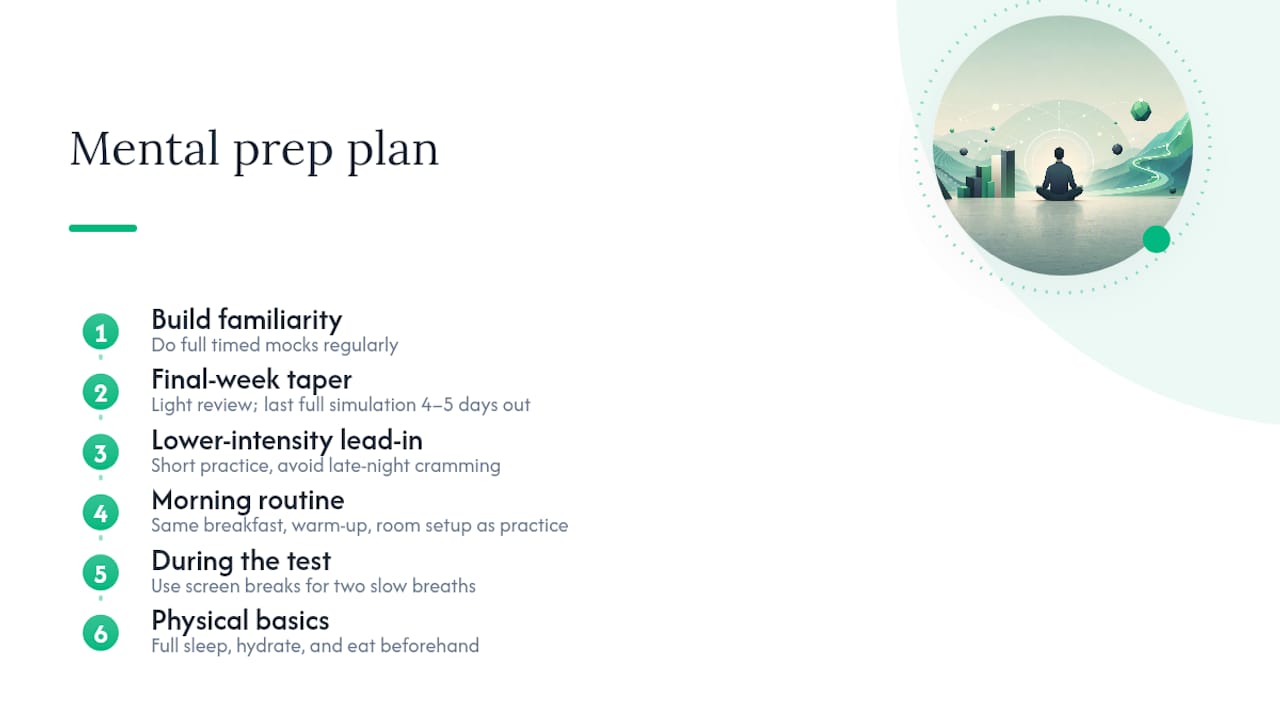
Test anxiety usually comes from uncertainty, not difficulty. The fix isn’t a pep talk. It’s familiarity. If you’ve run enough full timed mocks, the real exam feels like another one of your practice sessions instead of a unique high-stakes event.
In the final week, taper your workload rather than cramming. A light review schedule with one last simulation four or five days before the test, followed by lower-intensity practice, tends to leave you sharper than grinding until midnight the night before.
On the morning of the test, keep your routine boring and familiar: same breakfast, same warm-up routine, same room setup you practiced with. Novelty adds cognitive load you don’t need. If you feel your pulse spike mid-test, use the natural break between screens to take two slow breaths before reading the next set of questions rather than rushing straight into them.
Physical basics matter more than most students expect. A full night of sleep beats a late study session almost every time, since fatigue slows reading comprehension and numerical reasoning more than most content gaps do. Hydrate and eat something substantial beforehand. A test that runs 75 minutes straight through, with no scheduled breaks, is not the moment to discover you’re hungry at question 30.
What Mistakes Should You Avoid During the Test?
Most point losses on the Bocconi Test come from process errors, not knowledge gaps. Recognizing the common ones ahead of time is often worth more than one extra week of content review.
The biggest one: spending too long on an early question because it feels solvable “if you just had two more minutes.” With sequential navigation locking your answer once you advance, that time is gone whether or not you finish, and it eats into screens you haven’t reached yet.
A close second is misreading reading comprehension and critical thinking prompts under time pressure. These questions are written to reward careful reading, and skimming for keywords instead of parsing the actual claim is a fast way to miss questions you’d otherwise get right.
A third: ignoring your own pacing checkpoints. If you told yourself math should take roughly 36 minutes and you’re at minute 50 with ten questions left, that’s a signal to shift into guess-and-move mode, not push through at the same pace.
Finally, don’t let one canceled or unusually hard screen shake your composure for the rest of the test. A tough question is data, not a verdict on how the rest of the exam will go.
How Can You Simulate Real Test Conditions at Home?
The closer your practice environment matches exam day, the more your practice scores will predict your real score. That means replicating constraints, not just content.
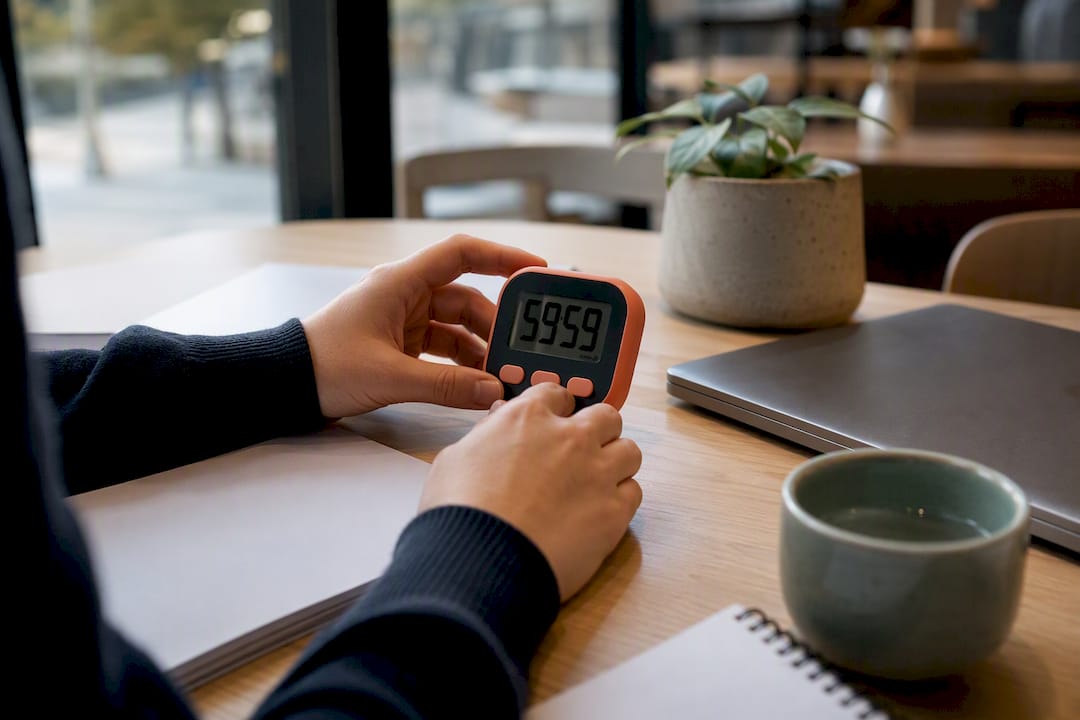
Set a hard 75-minute timer with no pausing, matching the official timing structure. Sit at the same desk you’ll use on test day, in the same room, with the same lighting. Remove your phone from the room entirely rather than just silencing it. If you’re using a platform with screen-by-screen navigation, resist the urge to check answers before moving on, since the real test won’t let you go back either.
Timed simulation works because it trains your brain to allocate attention under a ticking clock, a skill that untimed review simply doesn’t build. Run your mock at the same time of day you’re scheduled to test, if you can, since alertness patterns shift throughout the day and you want your peak focus lined up with exam time. For a walkthrough of what a properly structured mock actually involves, this breakdown of a real Bocconi simulation covers the setup in more detail.
What I’ve Learned From Tracking Mock Test Progress
The students who improve fastest aren’t the ones who grind the most hours. They’re the ones who treat their early mocks as diagnostic tools rather than failures.
I once watched a student’s math score stall for three straight mocks until her error log showed the same pattern: every missed question involved probability. Two weeks of targeted drills on that single topic, tracked mock over mock, moved her section score up noticeably. Measure the same metrics every time, and use your first few attempts to learn, not to judge yourself. Save your best effort for when the trend line is already pointing up.
Get Realistic Bocconi Simulations With Detailed Corrections
Prepadmit gives you what a stack of generic practice books can’t: exam simulations built from official past papers, scored on-demand tests, and item-by-item corrections that show exactly why you missed each question, not just that you did.
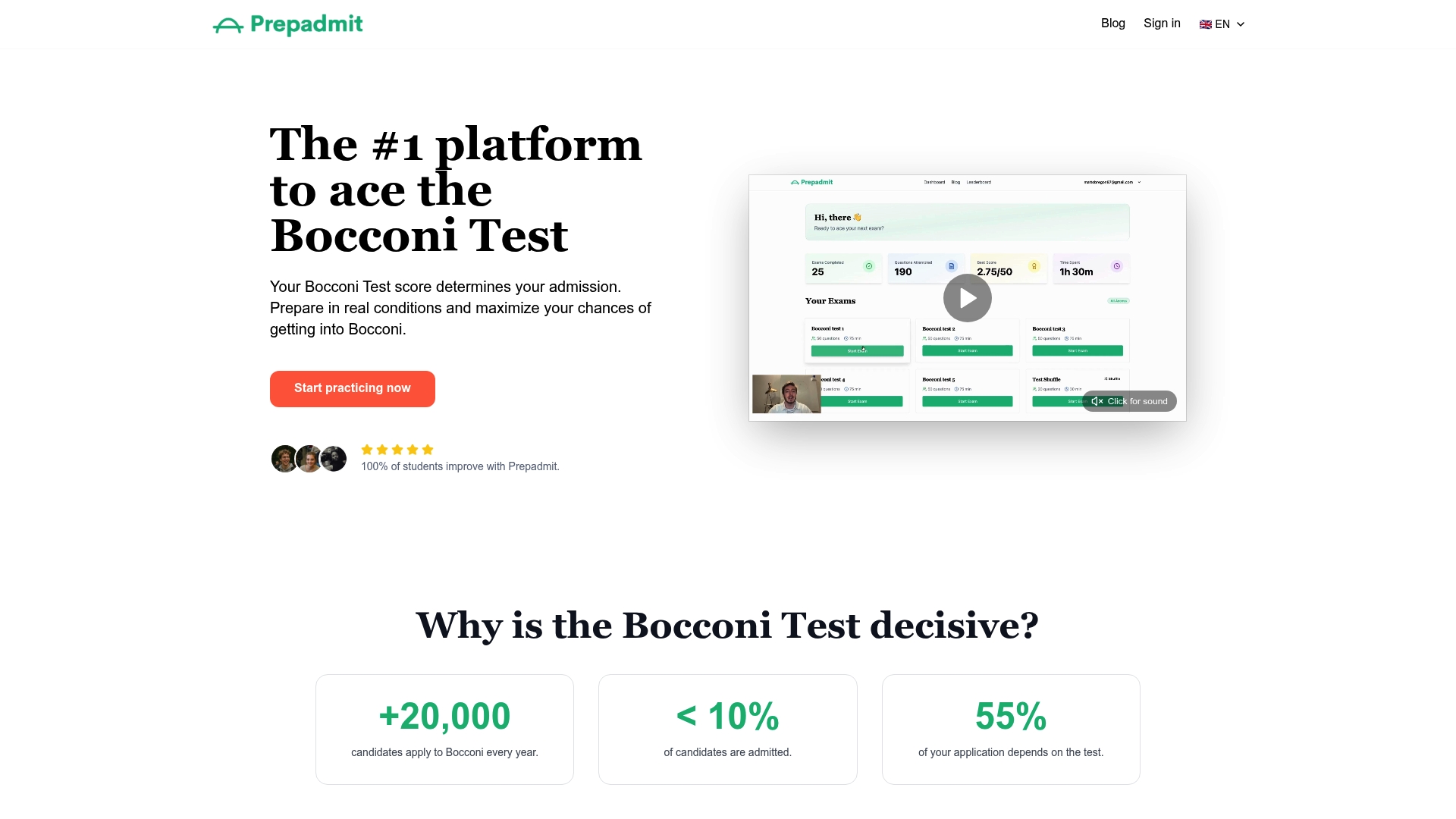
The platform was built by a team with backgrounds from HEC and Bocconi, and it’s designed as a lower-cost alternative to private coaching without cutting the features that actually move your score. Beyond simulations, you get skill-specific drill modes for weak topics, progress dashboards that track section scores and time-per-question, and peer ranking so you know where you stand before test day, not after. Testimonials from past applicants point to the same pattern this article covers: tracked, timed, targeted practice beats untimed review every time.
If you’re ready to see where you actually stand, start with a diagnostic simulation on Prepadmit and build your study plan from real data instead of guesswork about what to review next.
Frequently Asked Questions
What does “mat test prep” mean for the Bocconi Test? It refers to structured Bocconi Test preparation: official timed simulations, math-heavy targeted drills, detailed answer corrections, and progress tracking, rather than generic untimed study.
How many questions are on the Bocconi Test, and how much time do you get? The test has 50 multiple-choice questions completed in 75 minutes, roughly 1.5 minutes per question.
Can you go back to a previous question on the Bocconi Test? No. Questions appear three per screen, and once you advance, you cannot return to a previous screen, so pacing decisions need to happen before you move forward.
How many weeks should you spend on Bocconi Test prep? Most students need several weeks of structured preparation, with longer durations generally recommended for those starting from a lower baseline score.
Should you guess on questions you’re unsure about? In math and numerical reasoning, guess once you’ve eliminated at least one option. In reading and critical thinking, only guess after eliminating at least two, since penalties and question design differ by section.
Sources
Verify test structure, rules, and technical requirements directly from Bocconi before test day.
- Online Bocconi test — Bocconi University (admissions)
Recommended
- Bocconi Test Simulation: What a Real Mock Looks Like (2026) — PrepAdmit Blog
- Bocconi Math Exercises: Targeted Drills and Timed Mocks — PrepAdmit Blog
- How to Prepare for the Bocconi Test: A Step-by-Step 2026 Guide — PrepAdmit Blog
- Bocconi Test Prep — Official Practice Exams & Score Booster | Prepadmit
Related articles
Ready to ace your admission test?
Discover PrepAdmit, the platform that helps you succeed at top university admission tests.
Discover PrepAdmit