What Is Exam Simulation Training? A Clear Guide

What Is Exam Simulation Training? A Clear Guide
What is exam simulation training?
Exam simulation training replicates real exam conditions as closely as possible. That means fixed timing, sequential questions, no pausing, and the same pressure you will face on test day. The goal is not just to review material. It is to train your brain to retrieve information under constraints, the same way the actual exam will demand.
The key distinction is active retrieval versus passive recognition. Reading notes or highlighting text lets you recognize information when you see it. Simulation forces you to pull that information from memory without prompts. Retrieval practice builds stronger neural pathways than passive recognition methods, and that difference shows up directly in exam scores.
Here is what a well-designed exam simulation includes:
- Timed sections that mirror the official exam’s pacing
- Sequential question order with no ability to skip and return freely
- No pausing so stamina and focus are trained alongside knowledge
- Interface mimicry that matches the look and feel of the real test
- Pressure exposure to acclimate you to test-day stress before it counts
- Performance feedback broken down by skill area so you know exactly where to improve
Exam simulation enforces exam-like constraints to build active retrieval skills rather than passive recognition. The result is improved readiness, better time management, lower anxiety, and more accurate self-assessment of where you actually stand.

How simulation-based training developed over time
Simulation as a training method predates digital technology by centuries. The history is worth knowing because it explains why the method is trusted across so many high-stakes fields today.
- Middle Ages: Surgical skill practice on animal cadavers represented an early form of task simulation in medicine.
- 1600s–1700s: Task trainers and birthing simulators appeared in medical education.
- 1911: Mrs. Chase, the first nursing manikin, was developed for clinical training.
- 1929: Edwin Link built the first flight simulator, the Link Trainer, for pilot instruction.
- 1956: The first commercially available business training simulation, The Top Management Decision Game, was created by the American Management Association.
- Late 20th century: Aviation and military sectors formalized simulation as a core training requirement, not an optional supplement.
- 2000s–2010s: Healthcare adopted simulation widely, including for licensing exams like the Objective Structured Clinical Examination (OSCE). The Accreditation Council for Graduate Medical Education now requires residency programs to provide simulation training.
- Present: Digital platforms have extended simulation to professional certification exams in accounting, IT, language testing, and university admissions.
The pattern across all these fields is the same. Simulation moved from an experimental method to a required standard once the evidence for its effectiveness became too strong to ignore.
Pro Tip: If you are preparing for a high-stakes exam, look at how the field’s top certification bodies structure their own simulation requirements. That tells you exactly what fidelity level your practice needs to match.
How does exam simulation work in practice?
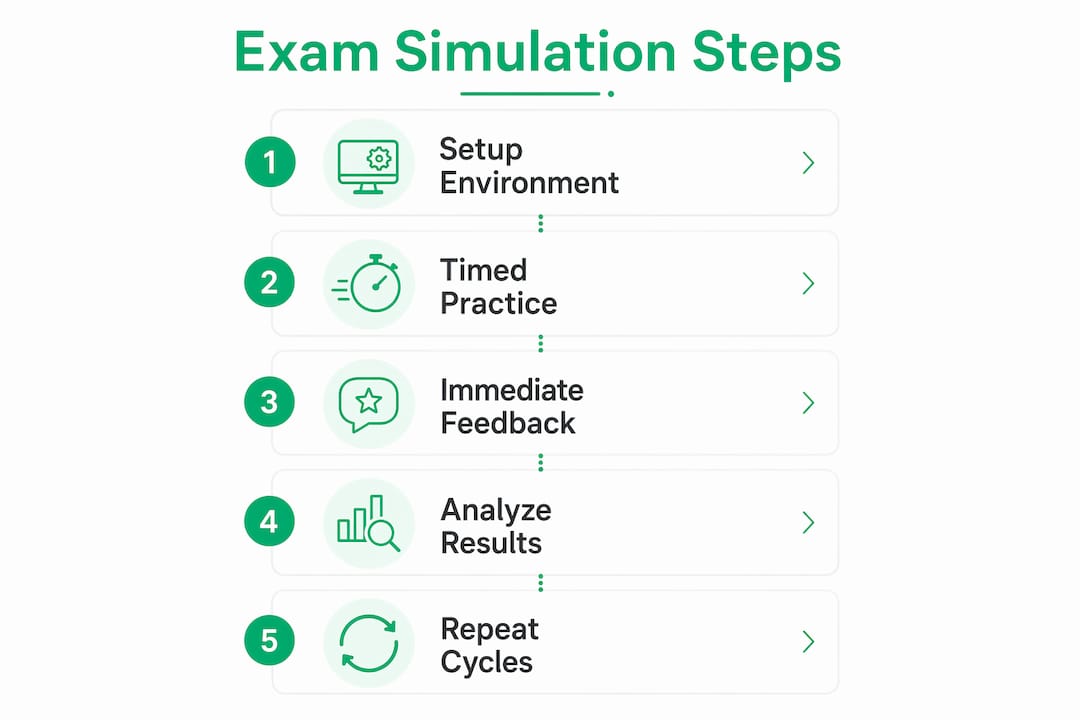
The mechanics of exam simulation training go beyond simply taking a practice test. Design choices determine whether a simulation actually trains you or just tests you.
A well-built simulation mirrors the official exam’s interface, question format, and time limits precisely. Real exam mode simulations that forbid pausing and mirror official test interfaces are what build stamina and time management skills. When you can pause, you break the cognitive load training that makes simulation effective. The discomfort of working through fatigue in a simulation is exactly the preparation you need.
The technology behind simulations varies by field:
- Digital exam platforms replicate browser-based or software-based test interfaces with locked navigation
- Physical task trainers in healthcare use anatomically correct models for procedural skills
- Full-body manikins range from low-fidelity anatomic models to high-fidelity simulators with realistic physiological responses
- Standardized patient encounters use trained actors to simulate real patient interactions for clinical exams
- Virtual reality environments are increasingly used for team-based and procedural training
Feedback is where simulation separates itself from a simple self-quiz. Immediate scoring, detailed answer explanations, and analytics broken down by topic area let you act on your results rather than just note them. Combining flashcards for foundational knowledge with regular exam simulations creates a study system that builds both knowledge and test readiness together.
Simulation fidelity, meaning how closely the practice environment matches the real exam, directly affects how well skills transfer to test day. A simulation that looks and feels different from the actual exam trains you for the wrong experience.

Pro Tip: Always complete at least a portion of your simulations at the same time of day as your scheduled exam. Your cognitive performance has a circadian rhythm, and training at 9 AM when your exam is at 9 AM matters more than most students realize.
What are the core benefits of exam simulation training?
The advantages of exam simulation training are not theoretical. They are grounded in how memory, stress, and performance actually work.
- Stronger memory retention: Retrieval practice builds durable neural connections that passive study cannot replicate. When you retrieve an answer under pressure, that memory trace becomes more resistant to forgetting.
- Better time management: Working through a full timed simulation teaches you how long each question type actually takes, not how long you think it takes.
- Reduced test anxiety: Repeated exposure to exam pressure acclimating you to the stress response. Stress inoculation through simulation reduces physiological anxiety responses on test day by making the experience familiar rather than threatening.
- Exam stamina: Sitting through a full-length simulation trains your ability to sustain focus for the entire test duration, not just the first hour.
- Accurate self-assessment: Students who only review material tend to overestimate their readiness. Simulation gives you objective data on where you actually perform, not where you feel comfortable.
- Targeted improvement: Performance analytics broken down by skill area show you exactly which topics need more work, so your study time goes where it matters.
“The core purpose of exam simulation is to bridge knowledge and performance readiness by identifying gaps, improving time management, and reducing test anxiety via familiarization.” Purpose of exam simulations
Medical students using simulation-based preparation show higher pass rates on OSCE exams, with active retrieval practice and realistic exam conditions cited as the primary drivers. The same pattern holds across fields from aviation to professional certification. Prepadmit’s own data suggests improved scores for students who use its simulation-based preparation system for the Bocconi Test, though precise improvement metrics are not provided.
Which industries rely on exam simulation training?
Simulation training is not limited to academic exams. It is a standard preparation method across any field where high-stakes assessment determines who is qualified to practice.
- Medical education: All graduating medical students in the United States must complete a simulated patient encounter to pass the United States Medical Licensing Examination. OSCEs are a required component of many health professions training programs. Healthcare simulation training accelerates expertise development through deliberate practice and immediate feedback in realistic, high-stakes scenarios.
- Aviation: Pilot certification has required simulator hours for decades. The Federal Aviation Administration mandates specific flight simulator training hours for commercial pilot licensing, and full-motion simulators replicate emergency scenarios that cannot safely be practiced in real aircraft.
- Military and defense: Combat simulation, tactical decision exercises, and mission rehearsal tools are standard across all branches of the U.S. military. The goal is the same as in medicine: train for high-pressure performance before the stakes are real.
- Manufacturing and engineering: Technical skills validation for roles involving complex machinery uses physical simulators and virtual environments to certify competency before workers operate actual equipment.
- Professional certification: Exams like the CPA (Certified Public Accountant), CompTIA IT certifications, and language proficiency tests such as the CELPIP use timed exam simulation as a core preparation strategy. The CELPIP exam, for example, offers full-length practice exams online that mirror the official test format precisely.
- University admissions: Competitive entrance exams for institutions like Bocconi University require candidates to practice under real test conditions. Platforms like Prepadmit replicate the Bocconi Test format using official past papers, giving students the closest possible preparation experience.
The common thread across all these fields is that the exam or assessment carries real consequences. Simulation is how professionals and students prepare when getting it wrong on the first try is not an option.
What does the research say about exam simulation effectiveness?
The evidence for simulation training is not anecdotal. It comes from cognitive science, educational research, and field-specific outcome studies.
The foundational principle is the distinction between recognition and retrieval. Recognition is what happens when you see a correct answer and identify it. Retrieval is what happens when you generate the answer from memory with no prompts. Retrieval practice builds stronger neural pathways than recognition-based study, and simulation is the most complete form of retrieval practice available.
Key research findings:
- Time engaged with simulation-based testing software accounts for 38% of the variance in healthcare exam final scores, making it one of the strongest predictors of performance identified in the literature.
- Practice testing rated highest utility for complex material, outperforming traditional methods like rereading or highlighting in controlled studies.
- Stress inoculation research shows that repeated exposure to exam-like pressure modulates nervous system responses, preventing the heart rate spikes and anxiety that disrupt performance on test day.
- Medical education experts advise treating simulation training as central to exam preparation rather than an optional supplement, based on outcome data from healthcare certification programs.
38% of the variance in healthcare exam final scores is explained by time spent with simulation-based testing software.
The research on timing and repetition is also clear. A single simulation close to exam day is far less effective than distributed practice across weeks. Spacing simulations out, reviewing feedback carefully after each one, and tracking improvement over time produces the compounding gains that passive review cannot.
Why feedback and assessment make simulation training work
Simulation without feedback is just a timed test. The feedback loop is what turns performance data into actual improvement.
Effective feedback in exam simulation operates on two levels. The first is immediate: you see which questions you got wrong, with explanations of why the correct answer is correct. The second is analytical: you see patterns across multiple simulations, identifying which skill areas consistently cost you points. University entrance exam feedback used correctly can redirect your entire study plan toward the gaps that matter most.
Assessment in simulation training also serves a metacognitive function. Most students are poor judges of their own readiness when they rely on passive review. Simulation gives you an objective score, and comparing that score to your subjective confidence level reveals whether you are calibrated accurately. Students who discover they are overconfident can adjust before test day. Students who discover they are underconfident can approach the exam with more composure.
Peer ranking adds another layer. Knowing where your score sits relative to other candidates preparing for the same exam gives you a realistic benchmark, not just an abstract percentage. Prepadmit’s leaderboard feature does exactly this for Bocconi Test candidates, turning individual performance data into a competitive context.
What are the common challenges with exam simulation training?
Simulation training is effective, but it is not without real limitations that students should plan around.
Access and cost are the most common barriers. High-fidelity simulation tools, particularly in healthcare and aviation, require significant investment in equipment and trained facilitators. For individual exam candidates, the challenge is finding platforms that offer genuine fidelity at a reasonable price.
Overconfidence from low-fidelity practice is a subtler problem. If the simulation does not closely match the real exam’s interface, timing, and question style, students may perform well in practice and poorly on test day. The gap between a generic practice test and a true simulation can be significant.
Misuse of practice mode is common. Many students pause simulations, look up answers mid-test, or skip questions they find difficult. This breaks the cognitive training that makes simulation work. Allowing pausing or practice mode reduces effectiveness by interrupting the stamina and retrieval training the method depends on.
Neglecting review is another frequent mistake. Completing a simulation and moving on without analyzing the results wastes most of the preparation value. The score tells you how you did. The review tells you why and what to do next.
Simulation fatigue can set in if students run full-length simulations too frequently without spacing them out. The research on spaced practice is clear: distributed sessions with recovery time between them outperform massed practice. Spaced repetition combined with simulation produces better long-term retention than either method alone.
Best practices for getting the most from exam simulation training
The difference between students who improve dramatically with simulation and those who plateau usually comes down to how they use it, not how much.
Start with a diagnostic simulation. Run a full-length simulation before you begin structured studying. The results tell you exactly where your baseline is and which areas need the most attention. Guessing at your weaknesses wastes time.
Treat every simulation as the real exam. No pausing. No looking things up. No stopping early. The value of simulation comes from the constraints, and relaxing them even once trains the wrong habits. Timed practice tests build the pacing instincts that untimed review never develops.
Review every wrong answer in detail. Do not just note that you got a question wrong. Understand why the correct answer is correct and why your answer was not. This is where the learning actually happens.
Space your simulations across weeks, not days. Running a simulation every day for a week produces diminishing returns. Running one every five to seven days, with focused topic review in between, compounds your improvement over time.
Track your scores by skill area across sessions. A single score tells you little. A trend line across five or six simulations tells you whether your weak areas are improving, holding steady, or getting worse under pressure.
Pro Tip: After each simulation, write down the three question types that cost you the most points. Address those specifically before your next simulation. Targeted review between sessions is what separates students who improve from those who just repeat the same mistakes.
Exam simulation boosts results most reliably when students treat it as a structured training cycle rather than a one-time check-in.
How does exam simulation compare to traditional study methods?
Traditional study methods, including rereading notes, highlighting, and summarizing, are not useless. They build familiarity with material. The problem is that familiarity is not the same as retrieval ability, and exams test retrieval.
The core difference is cognitive demand. Rereading a chapter feels productive because the material looks familiar as you go through it. That feeling of fluency is misleading. When the exam asks you to produce the answer without the chapter in front of you, familiarity does not help. Simulation trains the specific cognitive skill the exam actually tests.
| Study Method | Cognitive Process | Exam Relevance |
|---|---|---|
| Rereading notes | Recognition | Low |
| Highlighting | Recognition | Low |
| Flashcards | Retrieval (single item) | Moderate |
| Practice questions | Retrieval (applied) | High |
| Full exam simulation | Retrieval under timed pressure | Highest |
Time management is another gap. Traditional study does not teach you how to pace yourself across a full exam. Students who have read every chapter but never completed a timed simulation frequently run out of time on test day, not because they lack knowledge but because they have never practiced allocating it.
Anxiety response is the third difference. Traditional study does not expose you to the physiological stress of exam conditions. Simulation does, repeatedly, until the stress becomes manageable. Students who have completed multiple full-length simulations walk into the real exam with a familiar experience rather than an unknown one.
The most effective preparation combines both. Use traditional methods to build foundational knowledge, then use simulation to convert that knowledge into exam performance. Mock exams serve as the bridge between knowing the material and being able to perform under real conditions.
Key Takeaways
Exam simulation training outperforms passive study because it forces active retrieval under timed pressure, the exact cognitive demand of the real exam.
| Point | Details |
|---|---|
| Active retrieval over recognition | Simulation forces memory retrieval, building stronger neural pathways than rereading or highlighting. |
| Simulation time predicts scores | Time spent with simulation-based testing software accounts for 38% of the variance in healthcare exam final scores. |
| Feedback drives improvement | Reviewing performance data by skill area after each simulation is what converts practice into targeted progress. |
| Fidelity determines transfer | The closer the simulation matches the real exam’s interface and constraints, the better skills transfer to test day. |
| Combine with spaced review | Spacing simulations across weeks and reviewing weak areas between sessions produces compounding gains over time. |
Recommended
Related articles
Ready to ace your admission test?
Discover PrepAdmit, the platform that helps you succeed at top university admission tests.
Discover PrepAdmit