What Is an Exam Question Bank? A Student's Guide

What Is an Exam Question Bank? A Student’s Guide
An exam question bank is defined as a centralized repository of assessment questions, each tagged with metadata such as subject, difficulty level, and cognitive category, to support consistent and fair exam construction. Students preparing for competitive entrance exams use question banks as structured study tools, not just random practice sets. The industry term for this resource is an “item bank,” and understanding how it works gives you a real edge. This guide covers the exam question bank definition, how these banks are organized, their benefits, and how to use them effectively for entrance exam prep.
What is an exam question bank and how does it work?
An exam question bank is a structured digital repository of standardized questions tagged by topic, difficulty, and cognitive level, enabling consistent exam construction across multiple test sessions. Each question in the bank carries metadata: the subject it covers, the cognitive skill it tests (recall, analysis, evaluation), the difficulty rating, and the question format. This metadata is what separates a question bank from a simple list of practice problems.

The cognitive tagging system most question banks use follows Bloom’s Taxonomy, a six-level framework that classifies questions from basic recall at the bottom to synthesis and evaluation at the top. A question asking you to define a term sits at level one. A question asking you to compare two economic models sits at level four or five. That distinction matters because entrance exams like the Bocconi Test test multiple cognitive levels simultaneously.
Question banks exist in both digital and physical formats, but digital exam question banks now dominate because they allow automated filtering, randomized delivery, and instant feedback. Physical binders of past questions cannot adapt to your performance. A digital bank can.
How are question banks organized and categorized?
Question banks organize content through metadata tagging, and that structure is what makes them useful for both students and exam creators. Every question carries at least four data points: subject area, specific topic, difficulty rating, and cognitive level. Some banks also tag questions by question format and estimated completion time.
The most common question formats found in entrance exam banks include multiple choice questions (MCQs), true/false questions, short answer questions, and essay prompts. Each format tests a different cognitive skill.
| Question Format | Cognitive Skill Tested | Typical Use Case |
|---|---|---|
| Multiple choice (MCQ) | Recall and recognition | Fast screening of broad topic knowledge |
| True/false | Basic comprehension | Checking factual understanding quickly |
| Short answer | Application and analysis | Testing ability to explain concepts |
| Essay/open response | Synthesis and evaluation | Assessing depth of argument and reasoning |
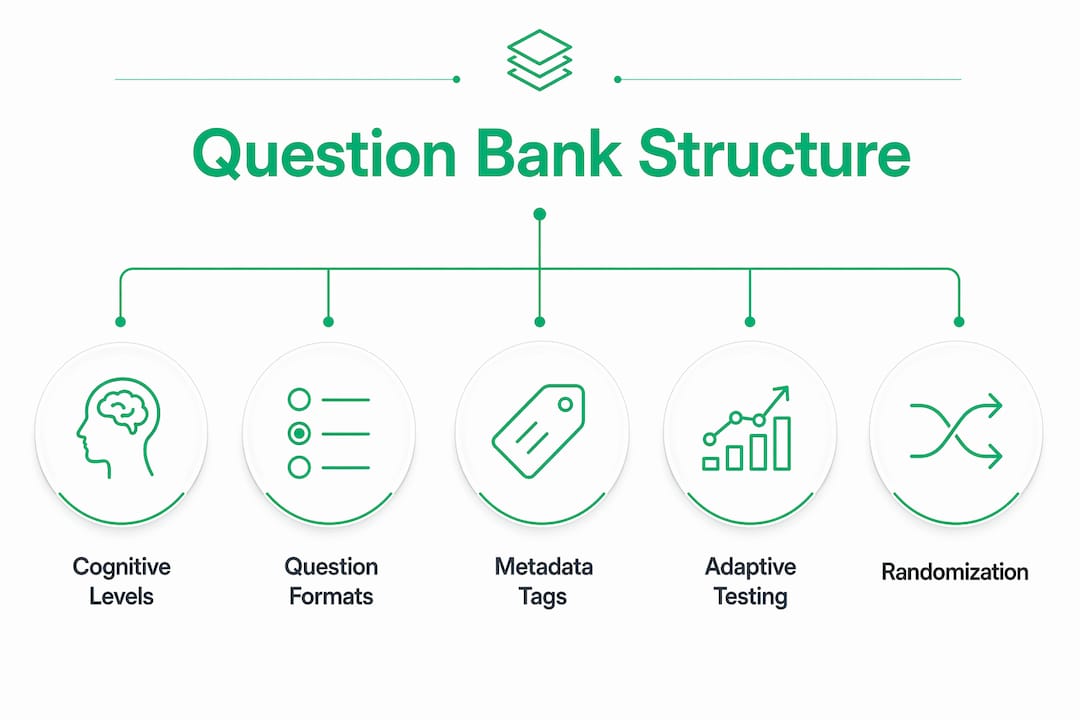
Diverse question formats allow comprehensive assessment across cognitive domains. That means a single question bank session can test your factual knowledge and your reasoning ability in the same sitting.
The organizational structure also enables adaptive and randomized testing. When a bank knows a question’s difficulty rating, it can serve you harder questions as you improve, or randomize the order to prevent pattern memorization. This is the foundation of adaptive testing, where the exam adjusts in real time to your performance level.
Pro Tip: Filter your practice sessions by cognitive level, not just topic. Spending 20 minutes on analysis-level questions in one subject builds more exam readiness than 20 minutes of mixed recall questions across five subjects.
What are the benefits of question banks for entrance exam prep?
Question banks give students three advantages that standard textbook review cannot: diagnostic feedback, variety, and progress tracking. Each one directly addresses a common failure point in entrance exam preparation.
Diagnostic feedback tells you not just whether you got a question wrong, but why. AI-driven explanations in modern digital question banks reduce test anxiety by familiarizing students with question patterns and providing targeted feedback on each mistake. That feedback loop turns every wrong answer into a study session.
Variety through randomization solves one of the biggest problems in self-study: memorization fatigue. When you see the same questions in the same order, you start recognizing patterns rather than understanding concepts. Randomized question delivery and feedback loops encourage conceptual understanding over rote recall. You learn the material, not the sequence.
Progress tracking and peer ranking add a motivational layer that solo study lacks. Seeing your score improve across sessions, or seeing where you rank against other students preparing for the same exam, gives you concrete evidence that your preparation is working.
Here is a summary of the core benefits:
- Diagnostic accuracy: Immediate, question-level feedback identifies weak topics faster than end-of-chapter reviews.
- Retention improvement: Large item pools with automated tracking improve retention by exposing you to more question variations on the same concept.
- Reduced repetition fatigue: Randomized delivery prevents the “I’ve seen this before” shortcut that kills real learning.
- Adaptive difficulty: Banks that use item response theory (IRT) serve harder questions as your skills grow, keeping practice challenging without being discouraging.
- Exam simulation: Practicing under timed, exam-like conditions with real question formats builds the mental stamina entrance exams demand.
Pro Tip: Choose a question bank that includes detailed written explanations for every answer, not just a correct/incorrect indicator. The explanation is where the learning happens.
How do educators use question banks to build fair exams?
Educators use question banks to solve two problems at once: saving time and maintaining fairness. Valid and reliable measurement of learning outcomes requires vetted, categorized questions aligned with learning objectives. A bank of pre-approved questions makes that possible without rebuilding every exam from scratch.
The process educators follow when using a question bank typically looks like this:
- Define the exam blueprint. The blueprint maps which topics appear on the exam and in what proportion. A Bocconi Test prep exam might allocate 30% of questions to quantitative reasoning and 20% to verbal comprehension.
- Filter questions by blueprint requirements. The educator selects questions from the bank that match each domain and difficulty level specified in the blueprint.
- Apply psychometric standards. Item response theory models adjust difficulty dynamically and improve diagnostic accuracy. Questions with poor discrimination scores (those that high performers and low performers answer at the same rate) get flagged for revision or removal.
- Randomize for fairness. Different students receive different question orders, or different questions drawn from the same topic pool, reducing the advantage of sharing answers between test sessions.
- Review and update the bank. After each exam cycle, item statistics get reviewed and the bank gets updated. Questions that were too easy, too hard, or ambiguous get revised.
Exam blueprints aligned to item banks ensure proportional coverage of all required topics, maintaining the legal defensibility and validity of high-stakes exams. For students, this means the entrance exam you face was built with a structured process, not assembled randomly. Understanding that process helps you study more strategically.
How to use a question bank effectively as a student
Using a question bank well requires a plan. Sitting down and answering questions in random order for an hour is better than nothing, but it is not the most efficient path to a higher score.
- Start with a diagnostic session. Answer 20–30 questions across all topics without filtering. Your results reveal which areas need the most work before you specialize.
- Match difficulty to your current level. Filtering by cognitive difficulty lets you study progressively from recall to analysis. Start at the difficulty level where you get roughly 60–70% of questions right. That zone produces the most learning.
- Use skill-specific or adaptive modes. If the platform offers adaptive testing, use it. IRT-based adaptive modes adjust question difficulty based on past performance, so every session targets your actual skill gap rather than your comfort zone.
- Combine question bank practice with timed tests. Question bank sessions build knowledge. Timed practice tests build the speed and stamina you need on exam day. Both are necessary.
- Review every wrong answer with its explanation. Do not move on after marking an answer incorrect. Read the explanation, identify the concept you missed, and note it for a focused review session later.
- Rotate topics to prevent fatigue. Spending three hours on the same subject in one sitting produces diminishing returns. Rotate between two or three topics per session to keep retention high.
The exam simulation approach works best when you treat each question bank session as a mini-exam, not a casual browse through practice problems.
Key Takeaways
A question bank is most effective when students use metadata filtering, adaptive modes, and timed simulation together, not as separate tools.
| Point | Details |
|---|---|
| Definition of a question bank | A centralized repository of questions tagged by topic, difficulty, and cognitive level for consistent exam use. |
| Metadata drives study efficiency | Filter by cognitive level and difficulty to target your actual skill gap, not your comfort zone. |
| Randomization prevents memorization | Randomized delivery builds conceptual understanding and reduces the pattern-recognition shortcut. |
| Adaptive modes personalize practice | IRT-based systems adjust difficulty in real time, keeping every session productive as your skills grow. |
| Combine with timed simulation | Question bank practice builds knowledge; timed mock exams build the speed and stamina entrance exams require. |
Why I think most students use question banks wrong
Most students treat a question bank like a checklist. They work through questions in order, mark their score, and move on. That approach misses the entire point of the tool.
The real value of a question bank is in its metadata. When you filter by cognitive level and difficulty, you stop practicing randomly and start practicing strategically. I have seen students spend weeks on a question bank and make almost no progress because they never filtered below the surface. They answered hundreds of recall-level questions and felt productive, but the entrance exam tested analysis and synthesis. The mismatch was invisible until exam day.
The second mistake is skipping explanations. A wrong answer with no follow-up is a wasted opportunity. The explanation is the actual lesson. Students who read every explanation, even for questions they got right, consistently outperform those who only check the score.
The third mistake is using a question bank in isolation. A bank without mock exam simulation is like training for a marathon by only doing strength exercises. Both matter. The bank builds your knowledge base. The timed mock exam builds your ability to perform under pressure. Neither replaces the other.
If you are preparing for a competitive entrance exam, treat your question bank as a diagnostic instrument first and a practice tool second. Let the data tell you where to focus, then use timed simulation to test whether your preparation is actually working.
— quentin
How Prepadmit puts question bank practice to work
Students preparing for the Bocconi Test need more than a generic question bank. They need questions built specifically for that exam, with explanations written by people who know exactly what Bocconi assesses.
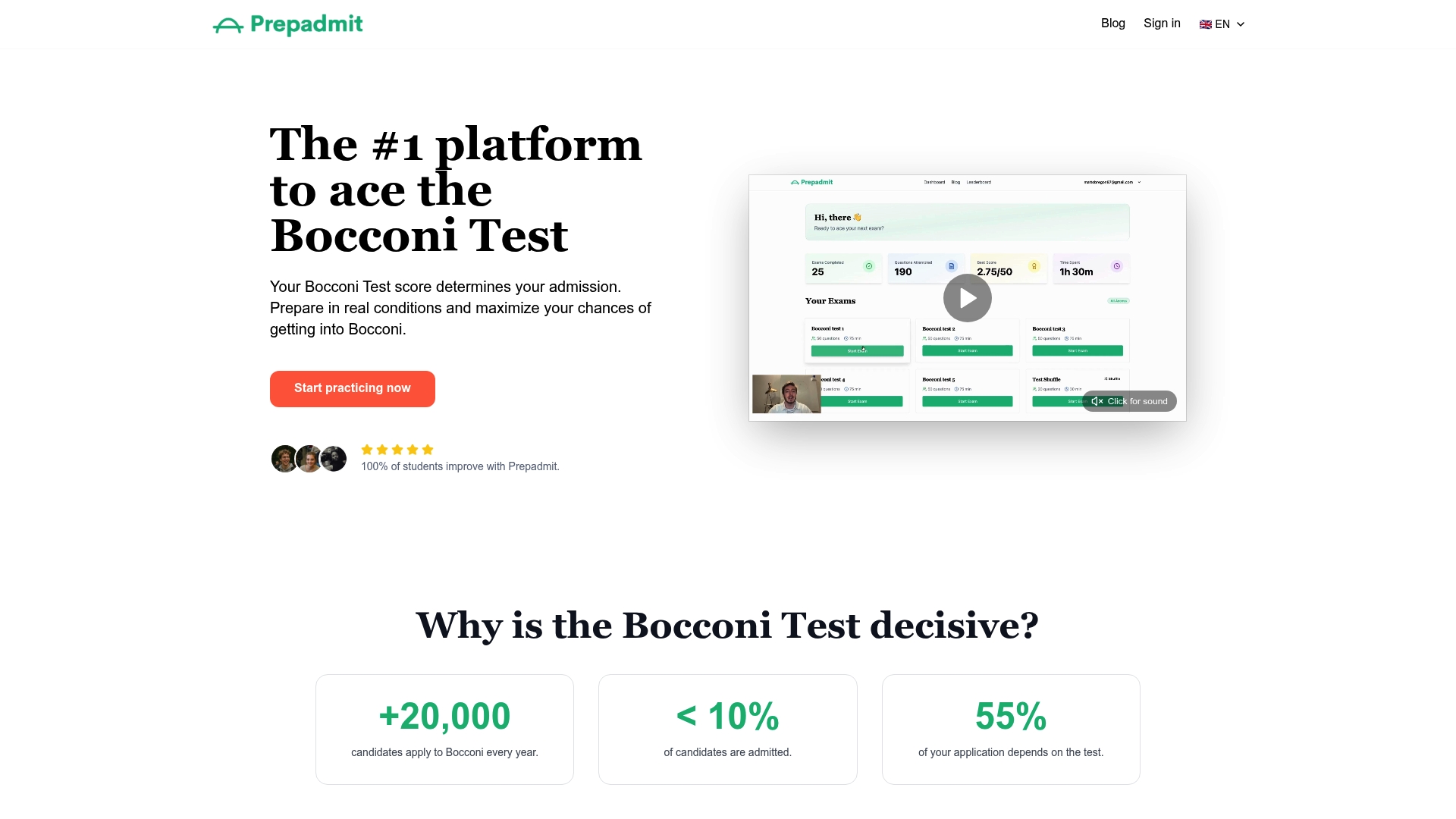
Prepadmit offers a curated question bank and mock testing platform built around official Bocconi past papers and on-demand tests. Each question carries metadata for skill-specific filtering, and the platform tracks your progress and ranks you against other students preparing for the same exam. Prepadmit was developed by experts from HEC and Bocconi, and the platform reports an average score improvement of 34% for students who complete the full preparation program. You can access the platform and start practicing today without committing to private coaching fees.
FAQ
What is the difference between a question bank and a practice test?
A question bank is a repository of individual questions organized by metadata. A practice test is a curated selection of questions from that bank, assembled to simulate a real exam session.
How many questions should a good entrance exam question bank have?
A high-quality question bank contains enough questions to support randomized delivery without repetition across multiple sessions. The exact number varies by exam, but banks with hundreds of items per topic area provide the most variety and the most reliable diagnostic data.
Can a question bank replace a tutor for entrance exam prep?
A question bank with AI-driven explanations and adaptive difficulty covers much of what a tutor provides, including targeted feedback and progressive difficulty. It does not replace the personalized strategy a skilled tutor offers, but it delivers consistent, scalable practice at a fraction of the cost.
What cognitive levels should I focus on in a question bank?
Match your starting level to where you score 60–70% correct, then work upward through the cognitive levels. Progressively harder questions build deeper understanding and prepare you for the analysis and synthesis questions that entrance exams prioritize.
Are digital question banks better than printed past papers?
Digital question banks offer adaptive difficulty, randomized delivery, and instant feedback that printed past papers cannot provide. Past papers remain useful for full-length simulation, but a digital bank gives you more targeted, data-driven practice between those sessions.
Recommended
Related articles
Ready to ace your admission test?
Discover PrepAdmit, the platform that helps you succeed at top university admission tests.
Discover PrepAdmit