24 Math Questions, 55/45 Weighting: Bocconi Score Trends for Applicants

24 Math Questions, 55/45 Weighting: Bocconi Score Trends for Applicants
Fifty questions, 75 minutes, and a scoring system that punishes guessing more than it rewards ambition. Since mathematics makes up 24 of the 50 questions on the standard variant, your study hours belong there first.
TL;DR:
- Performing well in math is crucial since nearly half of the test questions focus on algebra, functions, geometry, and probability, which significantly impact your total score.
- Bocconi’s scoring penalizes wrong answers more heavily on questions with fewer options, especially on three-choice critical thinking items, so guessing should be reserved for when you can confidently eliminate options.
- The final ranking depends on a weighted combination of test score and high school GPA, with the test accounting for 55% and GPA 45%, making both elements important for maximizing your chances.
- Bocconi runs three sessions with varying competitiveness, and higher scores are generally needed for Early and Winter due to larger applicant pools and more available seats.
- Improving your score entails full-pause practice under exam conditions, focusing especially on math, and using official past papers and detailed error analysis to guide targeted study efforts.
Table of Contents
- Analisi Trend Punteggi Bocconi: How the Scoring Actually Works
- Why Do Bocconi Cutoffs Shift From Session to Session?
- What Does Your Score Mean for Your Application Strategy?
- How to Actually Improve Your Bocconi Score
- What Backs Prepadmit’s Approach to Test Prep
- A Final Word on Chasing the Number
- Where to Practice Before Your Next Session
- Sources
- FAQ
Analisi Trend Punteggi Bocconi: How the Scoring Actually Works
Understanding Bocconi scores starts with the penalty structure, because it changes how you should answer every single question. A correct answer earns +1, a blank earns 0, and a wrong answer costs you −0.2. There’s one exception worth memorizing: three-option critical thinking items carry a steeper −0.33 penalty for a wrong guess, since the lower number of choices makes random guessing more tempting and Bocconi built the penalty to offset that.
The online test breaks down like this on the standard variant:
- Mathematics: 24 questions (nearly half the test)
- Reading comprehension: 11 questions
- Numerical reasoning: 6 questions
- Critical thinking: 9 questions
The law variant shifts weight away from math toward logic and verbal reasoning, so if you’re targeting the law program, your prep priorities look different from a standard-track applicant’s.
Statistic Callout: Your final admission ranking never rests on the test alone. Bocconi combines the selection test score at 55% with your GPA from the third-last and second-last high school years at 45%, then ranks roughly 3,000 available bachelor’s program seats against that blended number.
Here’s a simple example. Say you score 38/50 on the test and hold a GPA equivalent to 90/100. Your combined ranking score lands around 82.3 out of 100. Run this math on your own practice results and you’ll see immediately whether your GPA is carrying you or your test score is.

One more threshold matters beyond the general 17/50 floor: some programs, including the AI-focused track, impose their own subject-specific minimums on top of the baseline cutoff. Check the specific program page before you assume a passing total score is enough.
Why Do Bocconi Cutoffs Shift From Session to Session?
Bocconi runs three selection sessions each cycle, Early, Winter, and Spring, and they are not equally competitive. Roughly 90 to 95% of available seats get filled across the Early and Winter sessions, while only 5 to 10% remain for Spring. That imbalance alone explains most of the year-to-year volatility you’ll notice if you compare admitted scores across sessions.
A few forces drive the shifts:
- Candidate volume changes by session, with Early and Winter drawing the largest and most prepared applicant pools.
- Program popularity fluctuates. A track that trends upward one year pulls its effective cutoff higher, independent of any change in test difficulty.
- Because mathematics carries such heavy weight on the standard variant, small differences in math performance create large swings in total score, which widens the spread of results Bocconi has to rank.
Bocconi doesn’t publish a fixed cutoff score the way some standardized tests do. Instead, admission depends on where your combined ranking falls relative to every other applicant in that session for that program. That means a 34/50 might clear the bar comfortably in one session and fall short in another, purely because of who else applied.
Pro Tip: Don’t chase a mythical “safe” number. Instead, track your own percentile trend across multiple full-length practice tests. If your combined ranking estimate keeps landing in the top third of your practice pool session after session, you’re in solid position regardless of what any single cutoff rumor claims.
If official cutoff data isn’t published for your target program, the safest inference is to assume Early and Winter sessions require a stronger relative performance simply because more seats, and more competition, concentrate there. Spring becomes a numbers game with far less room for error.

What Does Your Score Mean for Your Application Strategy?
A single test attempt doesn’t lock you in. Bocconi lets you choose which attempt to present for each session, and if you upload multiple valid scores, the portal automatically uses your best one for ranking. That rule changes how you should think about retesting.
- High GPA, marginal test score: Your GPA is already pulling weight at 45%. A retest aimed at even modest math gains can meaningfully lift your combined ranking, since you’re not depending on the test alone.
- Lower GPA, strong test score: Your test performance is your main lever. Book Early or Winter if you can, since that’s where most seats and the strongest relative standing are available, and treat Spring as a true backup rather than a first plan.
- Multiple valid attempts: Take advantage of the up-to-four-attempt allowance for the cycle and let the portal select your best result. There’s no penalty for trying again.
- Program-specific minimums: If you’re applying to a track with an extra threshold, like the math minimum on the AI-focused program, treat that subscore as a separate goal from your overall total.
Applicants coming in with SAT or ACT scores should still verify how those interact with Bocconi’s own admissions criteria for their specific program, since equivalency rules can differ by track and shouldn’t be assumed to substitute cleanly for the Bocconi test itself.
How to Actually Improve Your Bocconi Score
Fix your practice conditions before you fix your content knowledge. The test allows no going back to previous questions, so every practice run should replicate that constraint exactly: 75 minutes, 50 questions, no revisiting. Simulating this constraint changes real behavior. It cuts down on reckless last-minute guessing and forces better time discipline under the penalty rules.
- Prioritize mathematics first. Since it’s 24 of 50 questions on the standard variant, master algebra, functions, analytic geometry, and probability and statistics before polishing weaker sections that carry less weight.
- Run full mocks in matched blocks. Practice a concentrated 24-question math block inside a full-length mock rather than isolated drills, so your brain experiences the same fatigue and switching cost you’ll face on test day.
- Build an error-analysis log. For every missed question, record the error type, the root cause, and the specific corrective drill. Track your average score gain per error category fixed, not just your raw total.
- Apply guessing heuristics tied to the penalty structure. On four-option questions, a partially educated guess is usually worth the −0.2 risk. On three-option critical thinking items, the −0.33 penalty means you should only guess when you’ve genuinely eliminated one option.
- Use your official score report. It arrives within 48 hours and breaks results down by subject area, which tells you exactly where to spend your next study block instead of guessing.
Pro Tip: Give yourself an 8 to 12 week runway before your target session. Weeks one through four go to concentrated math review, weeks five through eight to full timed mocks with error logging, and the final stretch to targeted drills on whatever your last three mocks flagged as weakest.
What Backs Prepadmit’s Approach to Test Prep
Prepadmit built its platform around the same mechanics covered above: official past papers, on-demand simulations under real time constraints, detailed answer corrections, and skill-specific practice modes. Progress tracking and peer ranking dashboards let you see where you stand before test day arrives, not after.
- Developed by a team with relevant expertise in admissions and test preparation
- Simulations replicate the test’s 50-question, 75-minute format with no backtracking
- Users report an average score improvement over time
That last figure is Prepadmit’s own reported outcome from its user base, not an independent study, but it lines up with what the error-analysis approach above predicts: targeted math correction produces outsized gains relative to the effort invested.
A Final Word on Chasing the Number
Score analysis matters, but Bocconi’s Strategic Plan 2026 to 2030 signals something worth remembering: the university is explicitly pairing human-centered skills with AI readiness in how it frames its future. A test score gets you into the ranking conversation. Math fluency, disciplined simulation, and smart attempt selection are what actually move you inside it.
— quentin
Where to Practice Before Your Next Session
Reading about scoring mechanics only gets you so far. The gap between knowing that math is 24 of 50 questions and actually converting that knowledge into points closes through repetition under real conditions.
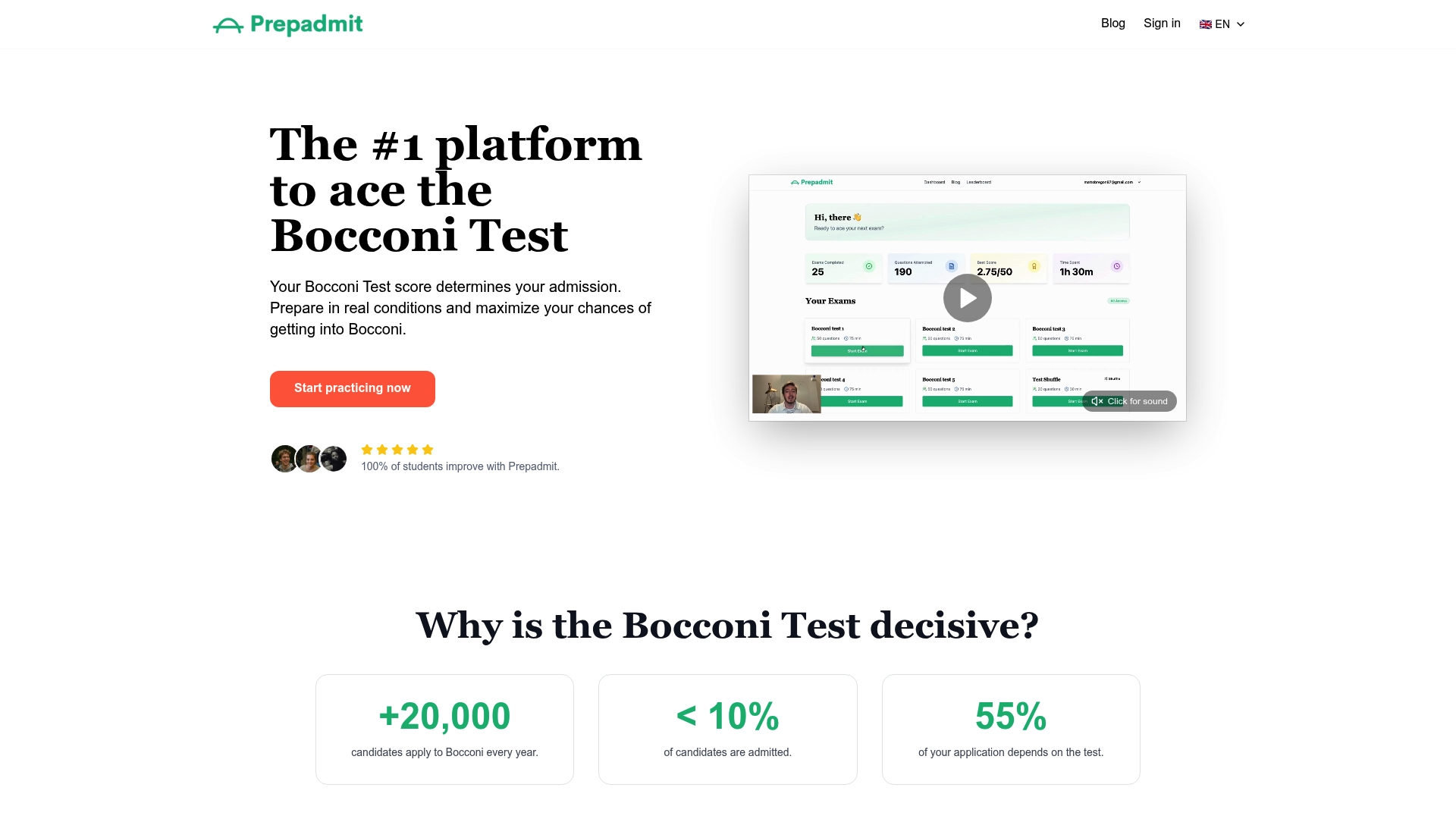
Prepadmit gives you the same no-backtracking, 75-minute format described above, built on official past papers instead of generic practice questions, so your mocks actually predict your real result. Its skill-specific practice modes let you isolate math weaknesses the way this article recommends, and its detailed answer corrections turn every missed question into a specific, logged fix rather than a vague sense of “I should study more.” For a full breakdown of a realistic study timeline, the step-by-step preparation guide walks through pacing week by week, and if your test date is close, the 8 to 12 week acceleration plan compresses the same priorities into a shorter runway. If you’re ready to start simulating under real conditions, access the full preparation platform and begin your first timed mock this week.
FAQ
What Counts as a Good Score on the Bocconi Test?
There’s no single published cutoff, since your final ranking depends on how your combined score compares to other applicants in your session and program. A score comfortably above the 17/50 minimum threshold, paired with strong math performance, gives you the best shot at a competitive ranking.
What Is the Minimum Score to Be Considered for Admission?
Applicants scoring below 17 out of 50 are not considered at all, regardless of GPA. Some programs add their own subject-specific minimums on top of that baseline.
Is Bocconi Genuinely Hard to Get Into?
The test’s scoring penalties, tight 75-minute window, and heavy math weighting make it demanding by design, and the ranking formula means your GPA can’t fully compensate for a weak test result. Competition concentrates in the Early and Winter sessions, where most of the available seats get assigned.
What Is Bocconi’s Acceptance Rate?
Bocconi does not publish a single official acceptance rate, since admission odds vary by program, session, and applicant pool each year. What’s clear is that seat availability is uneven across sessions, with the vast majority filled in Early and Winter rather than Spring.
Recommended
Related articles
Ready to ace your admission test?
Discover PrepAdmit, the platform that helps you succeed at top university admission tests.
Discover PrepAdmit