Stop Losing Bocconi Points: Quick Trap Cues and 10 Question Drills

Stop Losing Bocconi Points: Quick Trap Cues and 10 Question Drills
The traps that drain the most points on the Bocconi test are unit-mismatch problems, percentage-of-a-percentage phrasing, weighted-average shortcuts, conditional-probability wording, and graph questions that mix totals with parts. The single best defense on test day is a flag-and-move habit: if you can’t spot the trick in the first read, mark the question, check every unit and axis label once more, and move on rather than burning time. Practice simulations are built around drilling exactly this reflex.
TL;DR:
- Recognizing mismatched units like minutes and hours early can prevent miscalculations and avoid falling into trap questions that test conversion skills.
- Percentage-of-percentage questions are deceptive because they are multiplicative and require rewriting sequential changes, not simple addition or subtraction.
- Weighted-average traps often involve unequal group sizes; answers outside the expected weighted range indicate incorrect calculations or ignoring necessary weighting.
- Identifying conditional probability cues like “given that” is critical to calculating correct probabilities and avoiding overestimating the sample space.
- After practice, tracking trap categories helps focus future drills, as most errors tend to cluster around one or two specific question types.
Table of Contents
- What “domande trappola test bocconi” really means for your score
- Top 5 trap types and how to catch each one
- Training your trap detection: drills, timing, and error review
- Your exam-day anti-trap checklist
- Real trap questions from past Bocconi tests, explained
- Why trap questions are designed this way in the first place
- Managing stress so you don’t hand traps an easy win
- The misconceptions that make trap questions worse than they need to be
- Turning every wrong answer into a future point
- Why focused error analysis beats more hours of unfocused study
- How a dedicated platform turns trap recognition into a repeatable skill
- Sources
- FAQ
What “domande trappola test bocconi” really means for your score
When students search “domande trappola test bocconi,” they’re usually looking for a list of tricky question types. That’s fair, but the more useful frame is understanding why Bocconi builds trap questions into a fixed-time, penalty-scored format in the first place. The traps aren’t random. They’re a direct consequence of how the exam is structured.
The online Bocconi test runs 75 minutes for 50 multiple-choice questions, with questions mixed by topic and difficulty rather than grouped neatly by subject. That mixing alone creates a trap: you never know if the next question is a thirty-second arithmetic check or a five-minute reasoning puzzle, so pacing errors compound fast.
Scoring makes the stakes sharper. Bocconi awards +1 for a correct answer, 0 for an omitted one, and −0.20 for a wrong answer. That penalty rewards educated elimination and punishes blind guessing, which is exactly what trap questions are designed to provoke when you’re rushing.
Navigation adds the final layer. Questions appear in sequential groups, and you cannot backtrack once you click Next. That single rule changes everything about strategy:
- A rushed guess is permanent the moment you advance past its group.
- Decoy answers work because they match the number a fast, careless read produces.
- Time sunk into one trap question can never be recovered later in the section.
Top 5 trap types and how to catch each one
Each of these traps recurs across official sample materials and practice sets. Learn the detection cue, and the trap loses most of its power.
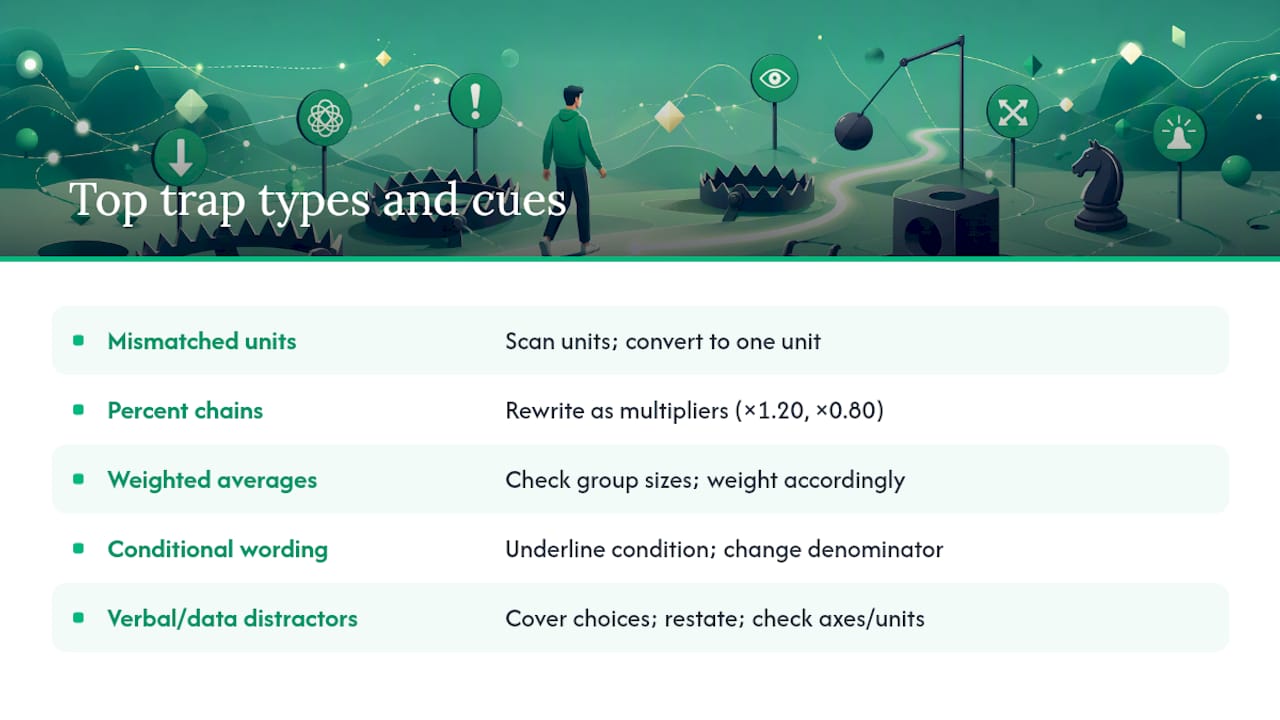
1. Missing or mismatched units. A question gives you minutes, then asks for an answer in hours, or mixes kilometers with meters mid-problem. The detection cue is simple: scan every number for a unit word before you touch the math. If you see minutes, hours, meters, and kilometers all in the same paragraph, convert everything to one unit before you set up the equation, not after.
2. Percentage-of-a-percentage phrasing. “A price increased by 20%, then decreased by 20%” does not return you to the original price, and Bocconi knows most students assume it does. The tell is multiplicative language stacked in sequence. Rewrite each step as a fraction multiplication (×1.20, then ×0.80) instead of doing the arithmetic in your head. It takes five extra seconds and eliminates the entire trap.
3. Weighted-average traps. These hide unequal group sizes inside a question that reads like a simple average. If a class of 30 students averages 70 and a class of 10 averages 90, the combined average is not 80. The detection cue is any question mentioning two or more groups with different sizes feeding into one average. Check that your answer falls between the two extremes and closer to the larger group’s value. If it doesn’t, you added instead of weighting.
4. Conditional probability wording. Phrases like “given that” or “if the first card is red” signal that the sample space has shrunk. Students who skip this cue calculate the unconditional probability and get a plausible but wrong number. Underline the condition the moment you see it, and rewrite the denominator before you touch the numerator.
5. Verbal and data distractors. In reading passages, wrong answers often use language lifted almost word-for-word from the text but shift the meaning slightly, or claim something the passage never actually states. In charts, the trap is mismatched units on two axes or a question asking about a percentage change when the graph only labels raw totals. Bocconi’s own sample materials lean heavily on this format, with verbal passages and abstract matrix items designed to reward careful rereading over quick pattern matching.
Pro Tip: Before you answer any data question, cover the answer choices and restate in your own words what the chart or passage actually says. If your restatement doesn’t match any answer exactly, you’ve probably spotted the trap already.
Training your trap detection: drills, timing, and error review
Recognizing a trap in a book is easy. Recognizing it in question 34 with eleven minutes left is a different skill entirely, and it only comes from structured repetition.
Build your week around two kinds of sessions:
- Daily micro-sessions: 20 questions in 15 minutes, all pulled from a single trap category (only percentage traps, or only conditional probability, for example). This isolates the pattern until it becomes automatic.
- Weekly full simulations: a complete 50-question run under the real 75-minute limit, followed immediately by review while the reasoning is still fresh.
After every simulation, run a short error-analysis pass. For each wrong answer, write down the trap type, the exact phrase or number that should have tipped you off, and then build a 10-question drill targeting that specific trap before your next session. This tagging habit is what separates students who plateau from students who keep improving, since it turns a wrong answer into a repeatable fix rather than a one-time embarrassment.
Pacing matters as much as accuracy. Spend 60 to 70 seconds on your first pass through any question. If the path to the answer isn’t clear by then, flag it and move on immediately rather than second-guessing.
Pro Tip: Keep a running tally of your flagged questions by trap type across every practice session. After three or four sessions, you’ll usually see one trap category dominating the list, which tells you exactly where your next week of drilling should go.
Your exam-day anti-trap checklist
Print this or memorize it. It won’t teach you anything new, but it will stop you from forgetting what you already know under pressure.
- The night before, sleep on time and do a light warm-up round of 10 easy questions, nothing new or hard.
- At your seat, read the full question before looking at answer choices, and check every unit and axis label first.
- Eliminate at least one distractor before committing to an answer, even when you feel confident.
- If no clear path appears within your first pass, flag the question and move on without hesitation.
- In your second pass, spend remaining time on flagged items, and guess only after eliminating at least one option, never blindly.
Two lines to keep in your head walking into the test room: check units and conditions before you calculate, and flag anything unclear on the first pass instead of freezing on it.
Real trap questions from past Bocconi tests, explained
Official Bocconi sample materials include worked examples that show exactly how these traps get built. One recurring pattern in the Guida alla prova di Valutazione involves a geometry question that gives you a triangle’s perimeter and one angle, then asks for an area, pushing you toward a formula that needs a side length you haven’t actually calculated yet. Students who jump straight to the area formula for a triangle without first deriving the missing side pick the decoy answer almost every time. The fix is mechanical: list what you’re given, list what the formula needs, and confirm every input exists before you calculate anything.
Abstract reasoning items follow a similar logic. A matrix of shapes will show a rule that seems to apply across rows, but the actual pattern runs diagonally or shifts on the last column. The official simulation materials include several matrices built exactly this way, and the trap works because most students lock onto the first rule they spot and stop checking for a second one.
Verbal passages carry a subtler version. A question asks “which statement is false” after a dense paragraph, and one answer choice simply isn’t mentioned in the passage at all. Students confuse “not stated” with “false” and pick it anyway, when the actual false statement is a claim the passage explicitly contradicts elsewhere. That distinction, between something absent and something wrong, is one of the most repeated traps in the verbal section.
Why trap questions are designed this way in the first place
Trap questions aren’t cruelty for its own sake. They exist because Bocconi needs a way to separate students who understand a concept from students who’ve memorized a formula without understanding when it applies. A question that only tests whether you know the area formula for a triangle tells the admissions committee very little. A question that tests whether you notice a missing side length tells them a lot more about how you’ll handle unfamiliar problems in an actual classroom.
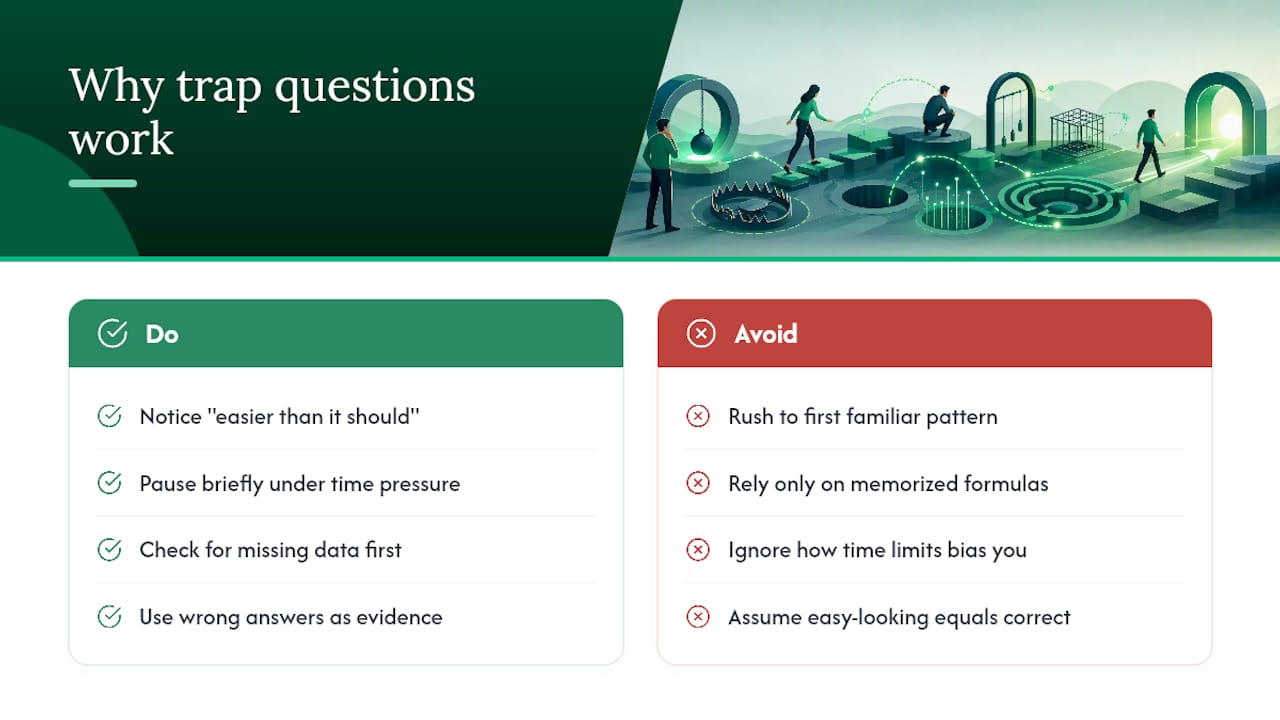
The psychology behind most traps relies on a simple assumption: under time pressure, most people default to the first pattern that matches rather than checking whether it’s the correct pattern. Test designers know this, so they build in an answer choice that rewards exactly that shortcut. It’s the same principle behind optical illusions. Your brain isn’t broken when it falls for one. It’s doing what brains do under pressure, filling gaps with the most familiar explanation available.
This is also why time limits matter so much to how traps function. A question that would be trivial with unlimited time becomes genuinely hard when you have roughly 90 seconds to spend on it, because the fast, familiar-looking path is often the wrong one. Recognizing that a question feels easier than it should is, counterintuitively, one of the most reliable trap signals you can train yourself to notice.
Understanding this doesn’t make the traps disappear. It does change how you approach them. Instead of treating a wrong answer as bad luck, you start treating it as evidence of exactly which shortcut your brain reaches for first, which is information you can train against.
Managing stress so you don’t hand traps an easy win
Stress doesn’t just feel bad during a test. It actively degrades the specific skill you need most against trap questions: careful, deliberate rereading. Under pressure, your brain narrows its attention and defaults to pattern matching, which is precisely the mode that trap questions are built to exploit.
A few habits reduce that risk without requiring any new content knowledge. Controlled breathing between question groups, even four seconds in and four seconds out, resets your attention enough to catch a unit mismatch you’d otherwise skim past. Building your practice sessions under the same time pressure you’ll face on test day matters more than most students expect, since your brain learns to stay calm at a pace it’s rehearsed rather than one it’s meeting cold for the first time.
Physical basics still carry weight here too. A rushed morning with no breakfast and a late night beforehand raises your baseline stress before you’ve read a single question, and that baseline stress is what makes a percentage trap or a conditional-probability trap land instead of getting caught.
One underrated tactic: decide in advance how you’ll handle the moment you get stuck. Students without a plan tend to freeze or rush, both of which increase trap errors. Students who’ve rehearsed “if I don’t see a path in a pass, I flag and move” treat that moment as routine instead of a crisis, because they’ve hit it a hundred times in practice already.
The misconceptions that make trap questions worse than they need to be
The biggest misconception is that trap questions require more knowledge to beat. Almost none of them do. A percentage-of-a-percentage trap and a straightforward percentage question test identical math skills. The only difference is whether you slow down enough to notice the sequencing.
A second common belief is that skipping a hard-looking question is always the safe move. Sometimes the opposite is true. A question that looks intimidating because of dense wording can be a straightforward calculation once you strip the language away, while a question that looks simple is exactly where a weighted-average or conditional trap tends to hide. Difficulty as it appears and difficulty as it actually is are not the same thing on this test.
Students also tend to assume that “not stated in the passage” and “contradicted by the passage” mean the same thing when a verbal question asks which statement is false. They don’t, and mixing the two up is one of the most repeated errors in the verbal section.
Finally, many students believe more practice hours automatically produce a better score. Hours matter far less than what happens with each wrong answer. Two students can log the same number of practice questions, and the one who tags every mistake by trap type and drills that specific weakness will improve faster than the one who just keeps grinding through new questions without ever revisiting old errors.
Turning every wrong answer into a future point
The review you do after a practice test matters more than the test itself. Answering 50 questions and moving on without analysis wastes most of the value those 50 questions could have given you.
Build a simple log: question type, trap category, what the correct detection cue should have been, and how many seconds you spent before getting stuck. Patterns show up fast. Most students find that two or three trap categories account for the majority of their errors, which means the next week of practice has an obvious focus instead of a vague “study more math” plan.
Retest that specific trap category within a few days, while the memory of the mistake is still sharp. Waiting weeks to revisit a weak spot lets the same trap catch you again, because the detection cue never got reinforced. A tighter loop between mistake, analysis, and retest is what separates a score that plateaus from one that keeps climbing across multiple practice cycles.
Track your flagged-question rate over time too, not just your raw score. A dropping flag rate on a stable time budget usually means your trap recognition is genuinely improving, even before your total score reflects it.
Why focused error analysis beats more hours of unfocused study
Deliberate practice works because it targets the exact gap between what you know and what trips you up, then closes that gap with immediate feedback. Grinding through generic questions for hours skips the feedback loop entirely, so the same trap keeps ambushing you weeks later. Pairing timed simulations with trap-tagged error review is simply a more efficient use of limited study time than volume alone. That’s the reasoning behind this practice structure, and it’s the reasoning worth trusting over “just do more questions.”
— quentin
How a dedicated platform turns trap recognition into a repeatable skill
Reading about traps helps, but catching them at question 37 with the clock running is a different skill, and it only comes from practicing under real conditions. The platform provides official past-paper simulations that mirror the actual 75 minute, 50 question format, timed mock exams that force the same pacing decisions you’ll face on test day, and detailed corrections that break down exactly which trap type caught you on each miss.
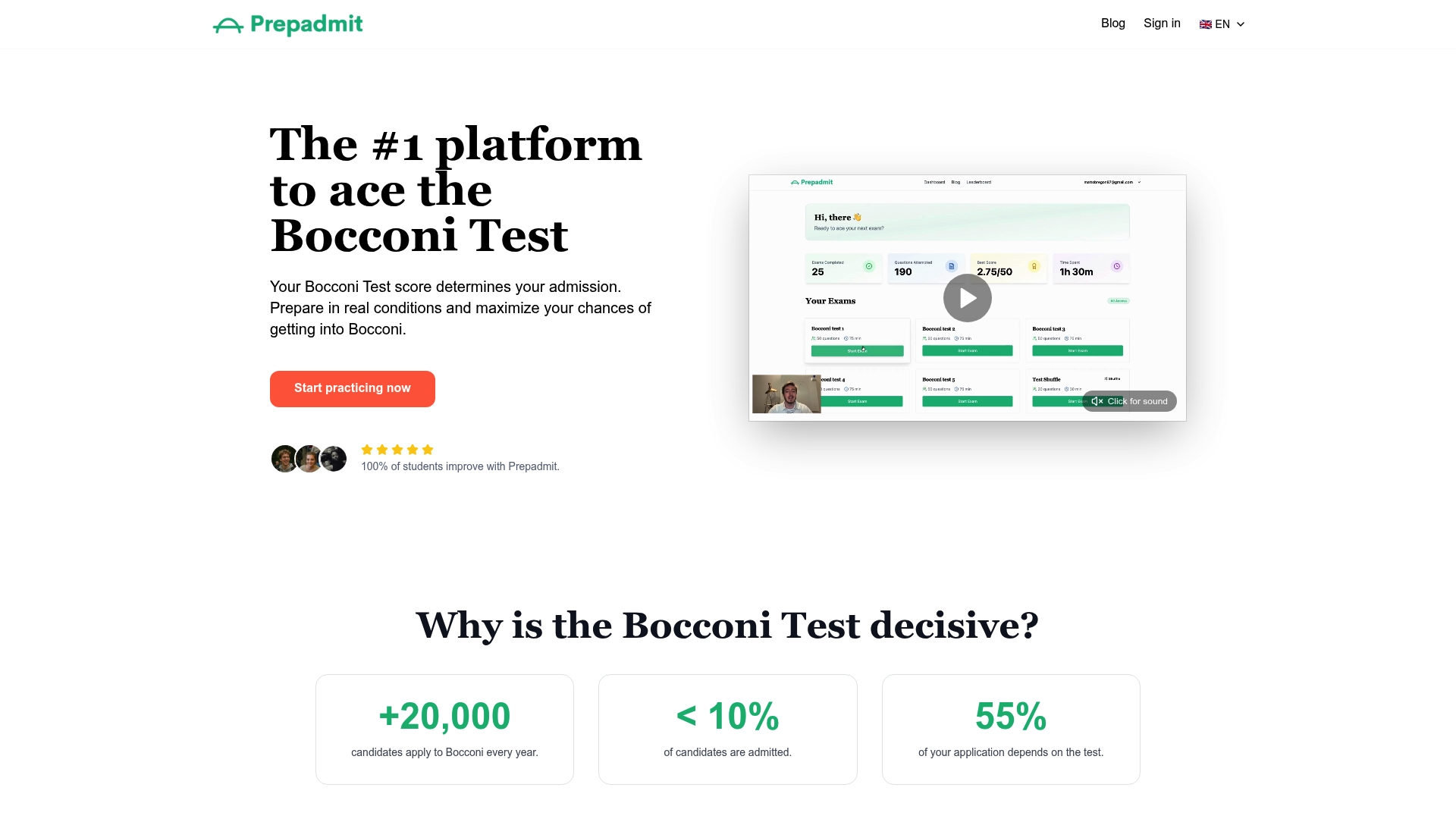
The error-classification workflow described earlier in this guide, tag the trap, write the cue, drill it, isn’t just theory on Prepadmit. It’s built into the platform’s progress tracking, so you can see which trap categories are shrinking over time and which still need another round of targeted drills. Combine that with peer ranking to know where you actually stand, and the daily micro-session habit turns into measurable progress instead of guesswork. Start with a timed mock on Prepadmit and see which trap category shows up most in your first error log.
Sources
FAQ
What types of questions are on the Bocconi entrance test?
The test covers quantitative reasoning (including plane and analytical geometry), verbal reasoning with reading passages, and abstract or logical reasoning with pattern and matrix items.
How many questions are on the Bocconi selection test?
The Bocconi selection test has 50 multiple-choice questions to complete in 75 minutes.
What counts as a good score on the Bocconi test?
Practice resources and industry guides suggest a competitive result is often around the mid-30s or higher out of 50, though the exact competitive threshold shifts by admissions cycle.
How hard is the Bocconi test really?
The content itself, basic math, reading comprehension, and pattern recognition, isn’t advanced, but the strict 75-minute time limit and −0.20 penalty for wrong answers make careless trap mistakes far more costly than the underlying difficulty suggests.
Can you go back to change an answer during the test?
No. Bocconi shows questions in sequential groups, and once you click Next you cannot return to previous questions, which is exactly why a flag-and-move strategy on your first pass matters so much.
Related articles
Ready to ace your admission test?
Discover PrepAdmit, the platform that helps you succeed at top university admission tests.
Discover PrepAdmit