Exam Readiness Assessment: What Students Need to Know

Exam Readiness Assessment: What Students Need to Know
An exam readiness assessment is a diagnostic and predictive tool that measures a student’s preparedness before a high-stakes exam by identifying knowledge strengths, exposing skill gaps, and forecasting likely outcomes. This is not the same as a standard achievement test. A readiness assessment tells you where you stand before the exam, not after. For students targeting the Bocconi Test, this distinction matters enormously. Knowing your weak areas six weeks out gives you time to fix them. Knowing them the night before does not.
What is exam readiness assessment and how does it work?
An exam readiness assessment is a diagnostic and predictive tool that is distinct from achievement tests. It guides learning sequencing and confirms prerequisite mastery before a student advances to harder material. Think of it as a GPS recalculation. You enter your destination, the system checks your current position, and it reroutes you based on where you actually are, not where you think you are.
Readiness assessments come in several formats. Mock exams replicate the full test experience under timed conditions. Quizzes target specific skill domains. Diagnostic surveys map self-reported confidence against objective performance. Each format serves a different purpose, but all share one goal: replacing guesswork with evidence.

Pre-assessments provide a low-stakes environment that reduces anxiety while revealing genuine strengths and gaps early. This matters because students who discover weaknesses early can address them systematically. Students who skip the assessment phase often study what they already know, which feels productive but wastes time.
How readiness scoring works: methods and thresholds
Readiness scoring is not a simple percentage. The most reliable systems use Item Response Theory (IRT), a psychometric model that estimates a student’s latent ability based on which questions they answer correctly, not just how many. IRT accounts for question difficulty and domain weight, giving a more accurate picture than raw scores alone.
The scoring thresholds matter. An 80% readiness score correlates with over 95% pass probability. Scores below 70% signal the need for urgent intervention. These are not arbitrary cutoffs. They reflect the statistical relationship between practice performance and real exam outcomes across large student populations.
Domain-level scoring adds another layer of precision. A student can score 75% overall and still be at serious risk if that score hides a critical weakness in a heavily weighted section. Domain-level mastery is more predictive of passing than overall percentage. This is why readiness assessments that break scores down by subject area are far more useful than single composite scores.
| Readiness score range | Predicted pass probability | Recommended action |
|---|---|---|
| 85% and above | Very high | Maintain pace, focus on weak domains |
| 75%–84% | High | Target weak sections, increase timed practice |
| 65%–74% | Moderate | Intensive review of low-scoring domains |
| Below 65% | Low | Full diagnostic reset, structured study plan |
Pro Tip: Never rely on a single readiness score. Run assessments across multiple sessions and track the trend. A rising score over three sessions is more meaningful than one high score after a good day of studying.
What are the real signs of exam readiness?
Feeling ready and being ready are two different things. Students often suffer from the illusion of competence, where familiarity with material creates a false sense of mastery. You recognize the answer when you see it, but you cannot produce it independently. That gap is dangerous in a timed exam.
True readiness shows up in five evidence-based ways:
- Scoring 80% or above on delayed practice tests. Tests taken 24–48 hours after studying measure durable knowledge, not short-term recall. Spaced testing is the most reliable signal of genuine retention.
- Explaining concepts without notes. If you can teach a topic clearly to someone else, you understand it. If you need to check your notes first, you have memorized it, not learned it.
- Identifying your weakest topics accurately. Students who can name their weak areas without prompting demonstrate the metacognitive awareness that separates high scorers from average ones.
- Practicing with new question types and getting them right. Repeated exposure to the same questions inflates confidence. Novel questions test real understanding.
- Showing consistent scores across multiple sessions. Converging performance over several mock exams is a stronger readiness signal than one exceptional result.
Pro Tip: Take a full mock exam without reviewing your notes the day before. If your score holds steady compared to your previous session, your knowledge is durable. If it drops significantly, you are relying on short-term memory.
How readiness assessments improve preparation and outcomes
Readiness assessments do more than measure. They direct. A student who knows their score in each domain can build a study plan that targets the areas with the highest return. This is the core logic behind adaptive learning systems, which dynamically prioritize study time based on weak topics weighted by exam importance. The result is fewer hours wasted on material already mastered.
The impact on exam performance is concrete. Mock board examinations significantly improve content familiarity, subject mastery, and time management across multiple exam subjects. Students who complete structured mock exams before high-stakes tests consistently outperform those who rely on passive review alone.
Timed practice is a specific benefit that readiness assessments make visible. Many students know their material but run out of time on the actual exam. A readiness assessment that tracks time-per-question reveals this problem before it costs points. Timed practice tests build the pacing instincts that no amount of reading can replicate.
Anxiety reduction is a real outcome too. Students who have completed multiple mock exams under realistic conditions report lower stress on exam day. Familiarity with the format, timing, and question style removes the element of surprise. The exam feels like a session they have already done, not an unknown event.
Practical steps to assess your readiness for the Bocconi Test
Assessing readiness for the Bocconi Test requires a structured approach, not a single practice session the week before. Here is how to do it effectively:
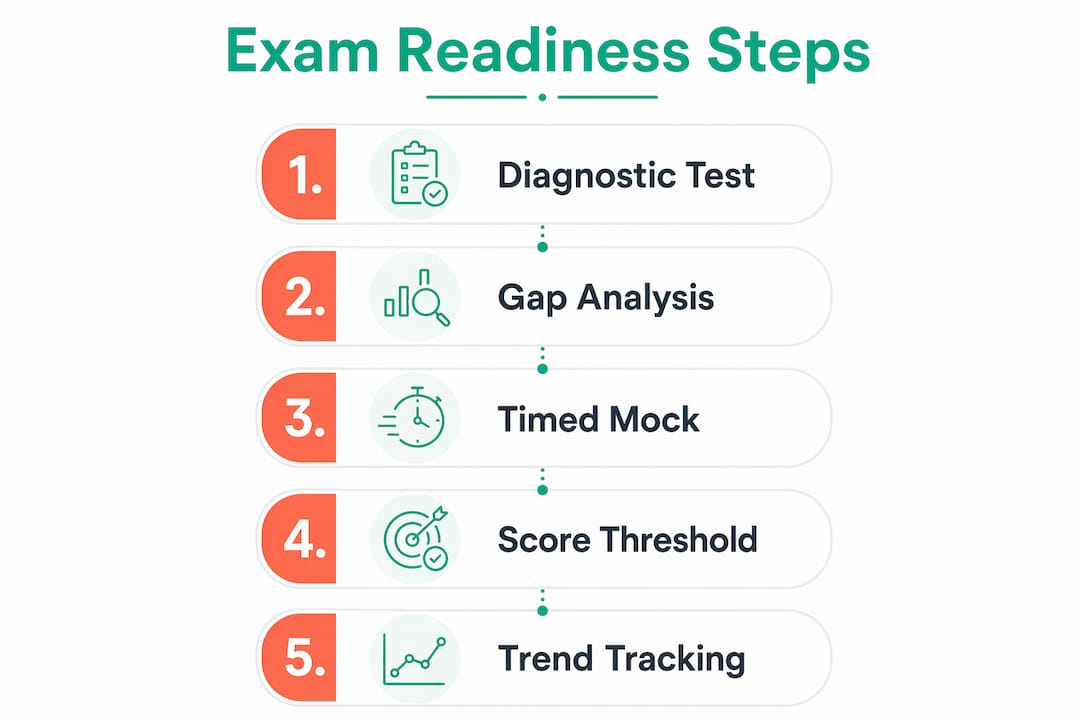
- Start with a baseline assessment on day one. Take a full mock exam before you begin studying. The score will be low, and that is the point. You need an honest picture of your starting position to measure progress accurately.
- Break your score down by domain. The Bocconi Test covers multiple skill areas. Identify which sections pulled your score down and rank them by how heavily they are weighted in the exam blueprint.
- Build a study plan around your weakest, highest-weight domains. Spend the most time where the exam rewards it most. A revision plan built on readiness data is far more efficient than a generic week-by-week schedule.
- Retest every 7–10 days. Repeated testing spaced over days, not immediately after studying, gives you accurate data on what you have actually retained. Single-session scores are unreliable.
- Use official practice exams and realistic simulations. The Bocconi Test has a specific format and question style. Practice with materials that match the real exam. Prepadmit offers official past papers and on-demand tests built to replicate actual exam conditions, with an average score improvement of 34% reported across its users.
- Check your technical setup before the exam. Confirm your exam environment meets all requirements well in advance. Technical issues on exam day are avoidable and costly.
Exam simulation is not just practice. It is the closest thing to the real experience you can get before the actual test date.
Key Takeaways
A readiness assessment is the single most reliable tool a student can use to turn preparation time into actual exam performance.
| Point | Details |
|---|---|
| Start with a baseline | Take a full mock exam before studying to establish an honest starting score. |
| Use domain-level scoring | Overall scores can hide critical weaknesses in heavily weighted exam sections. |
| Test with a delay | Scores taken 24–48 hours after studying measure durable knowledge, not short-term recall. |
| Track trends, not single scores | Converging performance across multiple sessions is the strongest readiness signal. |
| Build a targeted study plan | Prioritize weak domains that carry the most weight in the exam blueprint. |
Why I think most students assess readiness the wrong way
Most students treat readiness as a feeling. They study until they feel confident, then they stop. The problem is that confidence and competence do not always move together. I have seen students walk into high-stakes exams feeling fully prepared, then struggle with questions that required applying knowledge in unfamiliar ways. The feeling of readiness is not the same as the evidence of readiness.
The most common mistake is testing too soon after studying. You review a topic, take a quick quiz, score well, and move on. But that score reflects recognition, not recall. The illusion of competence is strongest right after studying, which is exactly when your score is least reliable.
What actually works is consistent, domain-level tracking over time. Not one big mock exam two days before the test. Not a confidence check after each chapter. A regular rhythm of timed, full-length assessments spread across your preparation period, with scores broken down by subject area so you always know exactly where you stand.
The students who perform best on the Bocconi Test are not always the ones who studied the most hours. They are the ones who studied the right things at the right time, guided by objective data. A readiness-driven approach to mock exams is the clearest path from preparation to admission.
— quentin
Prepadmit: built for Bocconi Test readiness
Prepadmit is the dedicated preparation platform for students targeting Bocconi University. It gives you access to official past papers, on-demand mock exams, and detailed answer corrections that show exactly where your score breaks down by domain.
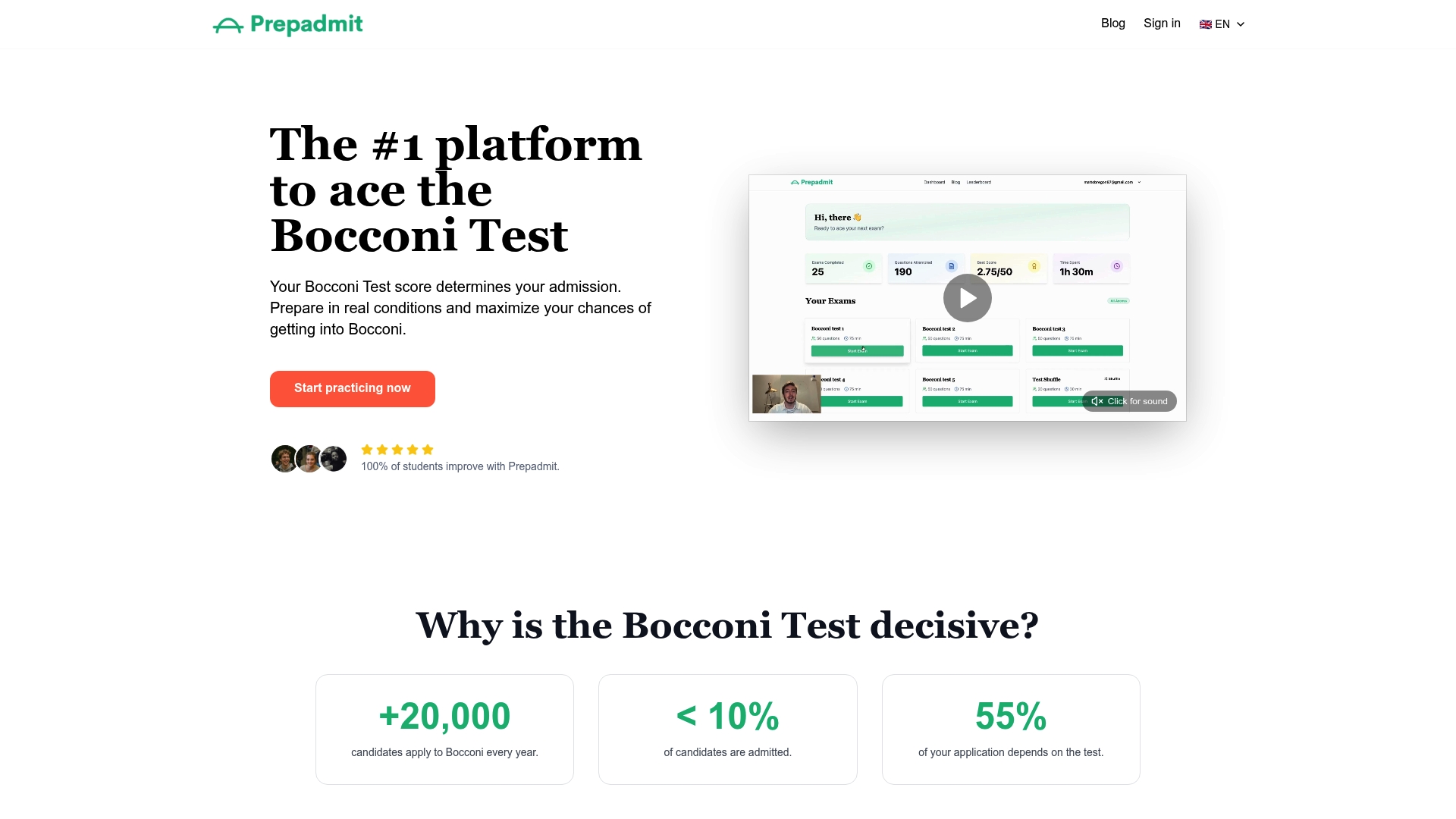
The platform tracks your progress over time, ranks you against other Bocconi Test candidates, and helps you focus your study time on the areas that matter most. Students who use Prepadmit report an average score improvement of 34%. The platform was built by experts from HEC and Bocconi, and it costs a fraction of private coaching. If you are serious about your Bocconi Test preparation, Prepadmit gives you the readiness data and practice tools to compete at the highest level.
FAQ
What is an exam readiness assessment?
An exam readiness assessment is a diagnostic tool that measures a student’s baseline knowledge, identifies skill gaps, and predicts likely exam performance before a high-stakes test. It differs from achievement tests because it guides preparation rather than evaluating final results.
What readiness score do I need to pass the Bocconi Test?
An 80% readiness score correlates with over 95% pass probability in psychometric modeling. Scores below 70% signal the need for significant additional preparation before attempting the real exam.
How often should I take a readiness assessment?
Retesting every 7–10 days gives the most reliable data. Repeated testing spaced over multiple sessions measures durable knowledge and shows whether your score trend is rising, flat, or declining.
What is exam readiness scoring based on?
Reliable readiness scoring uses Item Response Theory (IRT), which estimates latent ability based on question difficulty and domain weight, not just the number of correct answers.
Why does domain-level scoring matter more than my overall score?
A strong overall score can hide a critical weakness in a heavily weighted exam section. Domain-level mastery aligned with the exam blueprint is the most accurate predictor of passing.
Recommended
Related articles
Ready to ace your admission test?
Discover PrepAdmit, the platform that helps you succeed at top university admission tests.
Discover PrepAdmit