Verify Your Bocconi Score and Turn Section Counts into a Study Plan

Verify Your Bocconi Score and Turn Section Counts into a Study Plan
Your official Test Score Report, available in your webtesting personal area within about 48 hours of testing, is the only record that matters. Download the report, save your Reference Number, and upload both to the application portal right away.
TL;DR:
- Scores below 17 are only used for initial review and do not guarantee admission, as ranking within the pool determines final inclusion.
- The total score depends on question weights, with correct answers earning one point, wrong answers deducting 0.20 to 0.33 points, and omissions scoring zero.
- Your test score report becomes available within 24 to 48 hours and must be downloaded, saved, and uploaded with the correct Reference Number to avoid application issues.
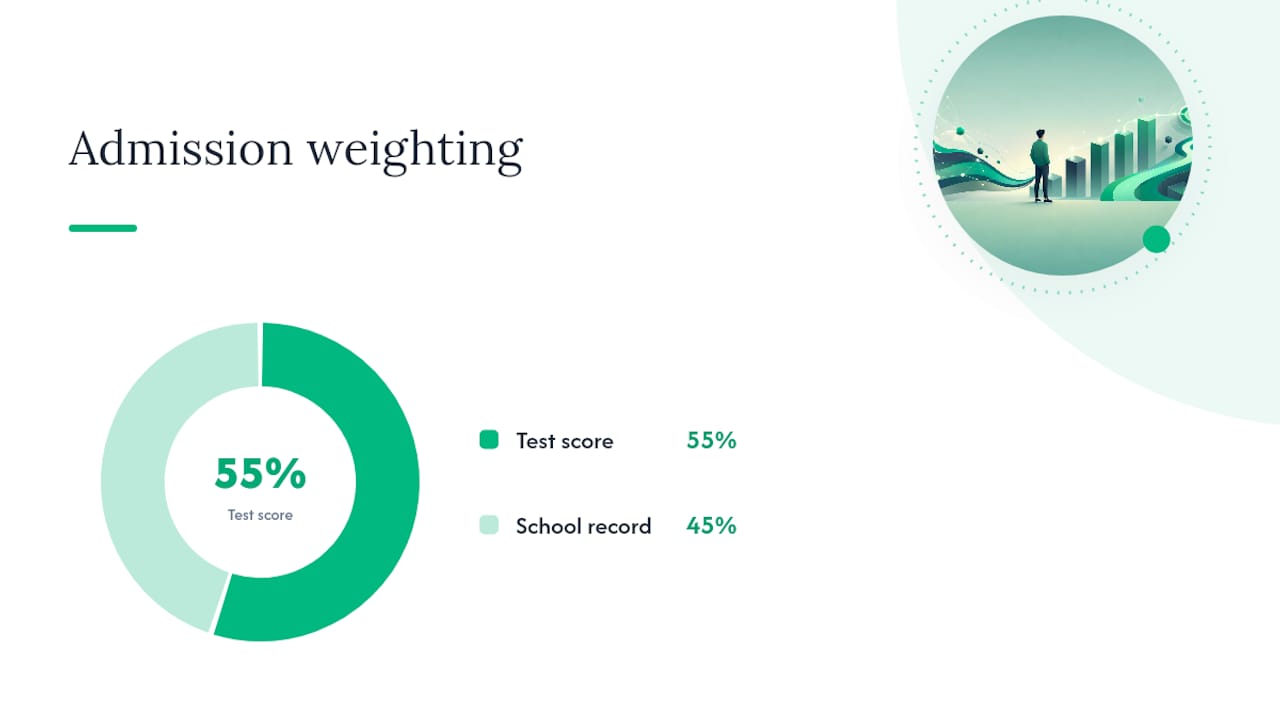
- The Bocconi admission ranking combines 55% test score with 45% secondary school record, so a strong GPA can offset a lower test score.
- Analyzing your section performance helps identify whether timing, knowledge gaps, or guessing strategies are causing errors, guiding targeted preparation.
Table of Contents
- Interpretare Risultati Test Bocconi: How the Score Is Calculated
- What Is the Minimum Qualifying Bocconi Test Score?
- Where Do You Find Your Test Score Report, and What Does It Show?
- How Does Bocconi Build the Final Admission Ranking?
- What Do Your Per-Section Scores Actually Reveal?
- What Administrative Mistakes Can Invalidate Your Test?
- What Should You Do in the First 72 Hours After Results?
- An Experienced Test Coach’s Take on Reading Your Report
- How to Improve Before Your Next Bocconi Test Attempt
- Sources
Interpretare Risultati Test Bocconi: How the Score Is Calculated
Reading your Test Score Report starts with understanding the arithmetic behind the number on the page. Bocconi does not simply count correct answers. Every question carries a different weight depending on how you answer it, and that weight changes your final score in ways that surprise a lot of test takers on their first attempt.
The official scoring rules are straightforward once you see them laid out:
- A correct answer earns one point.
- An omitted question earns zero points, no penalty.
- A wrong answer deducts 0.20 points on standard items.
- Some critical thinking questions with three options deduct 0.33 points for a wrong answer.
The test consists of multiple-choice questions to be answered within a timed session, with topics presented in a mixed order rather than grouped by subject, and that mixed order matters strategically. You might hit a tough quantitative reasoning item right after an easy reading comprehension question, and the interface will not let you go back once you move forward.
Those penalty sizes change how you should guess. On a standard question, if you can eliminate even one of four options, the math favors guessing over leaving it blank. On the three-option critical thinking items with the harsher −0.33 penalty, you need more confidence before you gamble. A completely blind guess on those items is close to a break-even bet at best, so skipping is often the smarter move when you have no idea.
What Is the Minimum Qualifying Bocconi Test Score?
There is a minimum qualifying score required to enter the selection process; candidates scoring below this threshold do not qualify for admission consideration.
Clearing 17 does not mean you are safe. It only means your file gets reviewed alongside everyone else’s. Bocconi’s programs, particularly the more competitive ones, admit based on where you land in the ranking, not on whether you crossed a single fixed line.
A few practical takeaways follow from this:
- Treat 17 as the floor, not the target. Competitive programs often require scores well above minimum to have realistic admission odds.
- If your practice scores hover near 17, plan for a retake before you plan your application strategy.
- Check target ranges for your specific program rather than assuming one number applies everywhere. Our guide on what counts as a good Bocconi test score breaks down realistic benchmarks by program selectivity.
Where Do You Find Your Test Score Report, and What Does It Show?
Your report lands in your webtesting personal area within roughly 24 to 48 hours after you finish the test. If that window passes and nothing appears, do not assume the worst. Log back in, check your notifications, and if it is still missing after 48 hours, contact webtesting support directly with your test date and time.
The report itself is a PDF, and it contains more than a single number:
- Your total score, calculated using the scoring rules above.
- Subject-area scores, showing performance broken out by section.
- Counts of correct, incorrect, and omitted answers for each area.
- A Reference Number, a 10-character alphanumeric code that identifies this specific attempt.
Once you have the PDF, download it, save it with a clear file name like your name and test date, and upload it to the Bocconi application portal along with the Reference Number entered exactly as printed.
How Does Bocconi Build the Final Admission Ranking?
Your test score does not stand alone. Bocconi’s admission formula weighs the test at 55% and your secondary school record at 45%. A strong transcript can soften a mediocre test score, and a strong test score can offset a less impressive GPA, but neither factor alone decides the outcome.
Seat availability adds another layer. Each program has a limited number of spots, and selection happens in rounds. Where your combined score lands relative to other applicants in your round, not just relative to the minimum threshold, determines whether you get an offer.
A few things follow from this structure:
- Two candidates with identical test scores can land in different outcomes if their school records differ.
- Later selection rounds may have fewer seats left, so an earlier application with a solid score often has an advantage.
- If you land near the cutoff, consider accepting a provisional offer or waitlist spot while keeping your options open elsewhere.
The diagnostic report and the final ranking are two different things. The report tells you how you performed. Only the completed admissions and immatriculation process determines whether you have a seat.
What Do Your Per-Section Scores Actually Reveal?
The subject-area breakdown is the single most useful part of your report for planning what comes next. A weak numerical reasoning score paired with a strong reading score tells a very different story than a uniformly average performance across every section, and each story points to a different fix.
Start by separating your errors from your omissions. A section with many wrong answers and few omissions suggests a knowledge gap. A section with many omissions and few wrong answers usually points to a timing problem. You ran out of time before you ran out of ability.
- High wrong-answer count in one section: revisit fundamentals in that content area before your next attempt.
- High omission count with strong accuracy elsewhere: practice pacing so you reach every question.
- Consistent moderate performance everywhere: focus on speed drills rather than content review.
Because the test interface does not allow backtracking, a candidate who spends too long second guessing early questions often pays for it later in the section with lower accuracy from rushing. Our breakdown of how the 55/45 weighting converts into a benchmark walks through how to translate this section data into a target score for your next attempt.
Pro Tip: If your omission count is high in a section you actually know well, the problem is not knowledge. It’s pacing. Time yourself on that section alone during practice, separate from the full simulation, until the clock stops being the enemy.
What Administrative Mistakes Can Invalidate Your Test?
Bocconi runs post-test verification on proctoring data after every session. Missing audio or video streams, or violations of testing rules during the session, can lead to an invalidated attempt. Bocconi communicates this to the candidate directly, and in some cases a free retake is available.
Your Reference Number is the thread that connects your report to your application. Enter it incorrectly, and your score report can become disconnected from your file, effectively leaving your application incomplete even though you took the test.
If something goes wrong, act fast:
- Contact webtesting support immediately with your test date, time, and any error messages.
- Save screenshots, confirmation emails, and timestamps before you do anything else.
- Keep a copy of the Test Score Report PDF separate from the application portal upload.
- Ask directly about rebooking or free retake eligibility rather than assuming you know the policy.
What Should You Do in the First 72 Hours After Results?
The hours right after you get your score report matter more than most candidates realize. A rushed upload or a mistyped Reference Number can quietly derail an otherwise strong application.
Follow this sequence:
- Immediately: download your Test Score Report PDF and verify every field, especially the Reference Number, matches what appears in your webtesting account.
- Within 48 to 72 hours: confirm the application portal actually received and linked your upload. If it is missing, contact support with exact timestamps of your original submission.
- Decide your path: compare your score against your target program’s realistic range, then choose between submitting this score or scheduling a retake.
- Build a plan: use your per-section breakdown to design a focused study block rather than a generic review of everything.
Roughly 24 to 48 hours is the standard window for report availability, and administrative errors like a bad upload or mistyped code are common but fixable if you catch them early. The candidates who lose ground are usually the ones who wait a week to check.
An Experienced Test Coach’s Take on Reading Your Report
Numbers on a page do not tell you how to feel, and that is where most candidates go wrong first. A score sitting right at 17 or just above it triggers panic in some students and false confidence in others. Neither reaction is useful. The honest read is that you cleared a floor, nothing more, and the ranking is what actually decides your fate.
What I find most telling in a score report is not the total. It is the shape of the errors. A candidate who omits fifteen questions has a different problem than one who answers everything and gets a third wrong. The first needs pacing work. The second needs content review. Coaches who treat every low score the same way waste a student’s remaining prep time.
On timeline, be realistic. Meaningful score gains usually take several weeks of targeted practice, not a weekend cram session. Plan your retake date around that reality, not around anxiety to move fast.
— quentin
How to Improve Before Your Next Bocconi Test Attempt
If your score report points to gaps in timing, content, or guessing strategy, the fix is structured repetition under real exam conditions, not more passive review. Prepadmit built its platform around exactly that gap: official past papers, on demand simulations that mirror the actual 50 question, 75 minute format, and detailed answer corrections that show you why an answer was wrong, not just that it was.
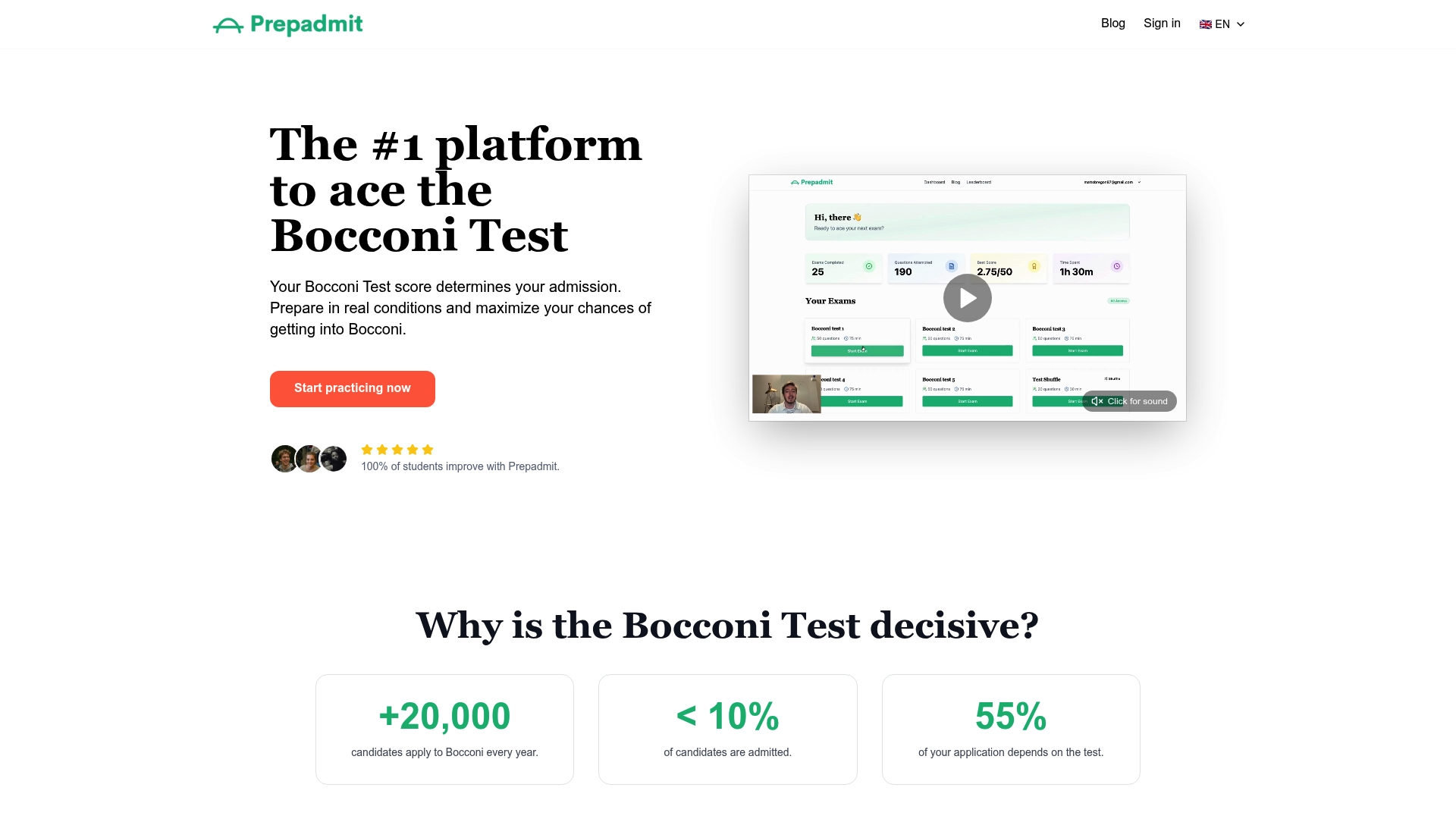
The platform tracks your progress across attempts and ranks you against peers preparing for the same test, so you can see whether your per-section weaknesses are closing or lagging. Prepadmit reports an average score improvement of 34% among students who train on the platform, backed by a money-back guarantee, and it costs a fraction of private coaching. For a step-by-step approach to turning your report into a study plan, our guide on preparing for the Bocconi test walks through the full sequence, and students building general test-day strategy may also find value in this standardized test study framework.
Start at Prepadmit to see where your practice scores stack up, or check your standing on the leaderboard before you commit to a retake date.
Sources
Recommended
Related articles
Ready to ace your admission test?
Discover PrepAdmit, the platform that helps you succeed at top university admission tests.
Discover PrepAdmit