Bocconi Applicants: Recover Points in 48 Hours, Fix Test Navigation

Bocconi Applicants: Recover Points in 48 Hours, Fix Test Navigation
Fix these specific errors first and you’ll recover the most points on the Bocconi test. The mistakes that hurt candidates most are rushing decisions on the timed screens, guessing without doing the math, skipping a full timed simulation, and overlooking a room or device rule that invalidates the whole attempt. The single most urgent action is running one complete, realistically timed simulation this week and confirming your setup matches the official rules before you schedule a scored attempt.
TL;DR:
- Candidates must complete at least one full, timed simulation to accurately gauge pacing and ensure setup compliance before attempting the test for scoring.
- Running an average of 90 seconds per three-question screen helps avoid timing errors that can significantly damage overall scores.
- Misreading questions, skipping data verification, or neglecting technical setup details can invalidate attempts and cost valuable points, especially under strict rules.
- Guessing on three-option critical thinking items often results in a net loss due to steeper penalties, making careful elimination and strategic guessing essential.
- A structured 6 to 8-week practice plan focused on full simulations, error analysis, and technical checks improves performance more than sporadic studying or last-minute preparations.
Table of Contents
- Common Errors Students Make on the Bocconi Test
- Why These Mistakes Cost More Than You Think
- How to Fix Each Mistake Before Test Day
- The Technical and Room Checklist That Prevents Invalidation
- A 6 to 8 Week Practice Plan That Actually Works
- Resources Worth Using Before You Sit the Real Test
- The One Habit That Separates Passing Candidates
- How Prepadmit Helps You Fix These Exact Mistakes
- Sources
- FAQ
Common Errors Students Make on the Bocconi Test
Most candidates lose points to habits that feel harmless in the moment but compound fast under the test’s specific format. Recognizing them in your own practice is the first step to fixing them.
- Timing tunnel vision. A student hits a tough probability question and burns two full screens (six questions worth of time) trying to force a solution, then rushes the last ten items of the section.
- Guessing on instinct instead of math. Some candidates treat every question like a coin flip, not realizing that a wrong guess on a three-option critical thinking item costs more than leaving it blank.
- Distracted or skimming reading. Reading a data table too fast and missing a footnote that changes the unit of measurement is a classic, silent point-killer.
- Treating practice attempts as disposable. Because scored attempts are limited, students who never run a full, timed mock exam show up to their first real attempt not knowing how their pacing actually holds up.
- Ignoring proctoring rules until test day. Waiting until the morning of the test to check webcam angles, room lighting, or browser permissions is how avoidable technical issues turn into invalidated attempts.
Each of these looks small in isolation. Stacked together across 50 questions in 75 minutes, they are usually the real gap between a candidate’s practice scores and their actual result.
Why These Mistakes Cost More Than You Think
The Bocconi test scores +1 for a correct answer, 0 for a blank one, and a penalty for a wrong answer, according to the official admission information. Most wrong answers cost −0.2, but critical thinking items with only three answer options carry a steeper −0.33 penalty. Undergraduate candidates scoring below 17 points total are not considered for admission, which means a handful of careless penalties can push a borderline score under the line.
The navigation format makes this worse. Questions appear in screens of three, and once you click “Next,” you cannot go back, according to the Instructions and Rules of Conduct. Two-pass strategies that work on paper-based exams simply do not exist here. And if your webcam feed, room setup, or device configuration violates the rules, your entire attempt can be invalidated after the fact, sometimes when recordings are reviewed weeks later.
How to Fix Each Mistake Before Test Day
You cannot eliminate every risk, but you can build habits that neutralize most of them. Here’s the sequence that works:
- Set a hard per-screen time budget. With 50 questions in 75 minutes, you have roughly 90 seconds per question, or about 4.5 minutes per three-question screen. Decide this number before you start, not while you’re staring at question 23.
- Apply an expected-value rule to guessing. If you can eliminate at least one of four standard options, a guess is usually worth the risk under the −0.2 penalty. On a three-option critical thinking item, the math flips: a −0.33 penalty against a +1 gain means blind guessing is close to break-even at best, and often a net loss once you factor in wasted time.
- Build a two-pass reading habit for data questions. Read the question stem first, then the table or chart, then the stem again before answering. This single habit catches most unit and scope errors.
- Run a 5-second final sweep before clicking Next. Confirm all three answers on the screen match what you intended before you commit, since there is no going back.
- Practice under mild stress on purpose. Do at least one timed simulation in a slightly uncomfortable setting (less sleep, background noise) so exam-day adrenaline feels familiar instead of destabilizing.
For more detail on the math behind guessing decisions, see this breakdown of Bocconi test penalties and guessing tactics.
Pro Tip: Time yourself on a single practice screen of three questions, not the whole test. If you consistently blow past 4.5 minutes on one screen, that’s your real bottleneck, not your overall pacing.

The Technical and Room Checklist That Prevents Invalidation
Room-setup invalidations happen more often than most candidates expect, and the trigger is usually something small: an extra door visible in frame, a second monitor left on, or a phone sitting on the desk. The official rules are specific, and they are worth treating as non-negotiable.
- Device and browser: close every unrelated application, disable any virtual machine software, and use a single monitor only.
- Room setup: sit facing a closed door with a neutral background, and make sure no other person or device is visible or audible during the session.
- Allowed items: a valid ID, one pen, and blank paper.
- Forbidden items: headphones, smartwatches, and any secondary screen.
- If something goes wrong: note the exact time and issue immediately and contact Bocconi’s technical support through the official channel before attempting to restart anything on your own.
Cancelled or invalidated tests may not qualify for a fee refund, according to the official rules, which is exactly why a 48-hour setup check matters more than another hour of content review. A full walkthrough of what to bring and verify is covered in this test-day setup checklist.
A 6 to 8 Week Practice Plan That Actually Works
Random practice sessions rarely fix the pattern of errors above. A structured cycle does.
- Week 1: diagnostic simulation. Take one full-length, timed mock under real conditions. Don’t study beforehand. This is your baseline, not a test of readiness.
- Weeks 2 to 3: gap-focused drills. Pull your weakest topic areas from the diagnostic and drill them in short, timed bursts rather than long unfocused study sessions.
- Weeks 4 to 6: full simulations plus review. Alternate a full-length timed simulation with a detailed review session where you categorize every miss as a timing error, a careless error, or a content gap.
- Weeks 7 to 8: taper and confirm setup. Reduce volume, sharpen pacing, and re-run your technical and room checklist so nothing is left to chance on test day.
Your official score report, available roughly 48 hours after a real attempt, breaks results into correct, incorrect, and omitted counts by section, according to Bocconi’s admissions information. Use that breakdown, not just your gut feeling, to decide what to drill next.
Resources Worth Using Before You Sit the Real Test
Start with the primary source: the Instructions and Rules of Conduct is the only document that fully covers proctoring and room setup, and skipping it is how avoidable invalidations happen.
Beyond that, a good simulator needs to reproduce three things exactly: the same 3-question sequential screens, the same 75-minute clock, and the same scoring penalties, not a simplified version of them. A simulator that lets you skip back and forth between questions trains you for a test format that differs from the actual Bocconi test navigation.

An error-analysis workflow, where you tag every miss by cause and track it over weeks, tends to speed up improvement more than raw volume of questions. Prepadmit builds its platform around exactly this combination: realistic simulations using official past papers, detailed answer corrections, skill-specific drill modes, and progress tracking against peers, as described on the Prepadmit platform.
The One Habit That Separates Passing Candidates
Content knowledge matters, but it’s rarely the deciding factor. The candidates who consistently pass are the ones who treat their test-day setup and pacing as seriously as their math review. Run the full test end-to-end, under the exact timing and navigation rules, before you ever sit a scored attempt. Fix your room and device configuration days in advance, not the morning of.
Prepadmit’s own data indicates that this kind of error analysis workflow can lead to a notable improvement in scores, which tracks with what the test architecture itself rewards: fewer wasted screens, fewer panic guesses. In the next 48 hours, run one timed mock and check your setup against the official checklist. That’s the whole plan.
— quentin
How Prepadmit Helps You Fix These Exact Mistakes
Official past papers and a stopwatch will get you partway there, and a local tutor can help with content gaps, but neither one replicates the exact screen-by-screen pressure of the real Bocconi test. That specific gap, matching the sequential navigation and scoring penalties exactly, is what Prepadmit was built to close.
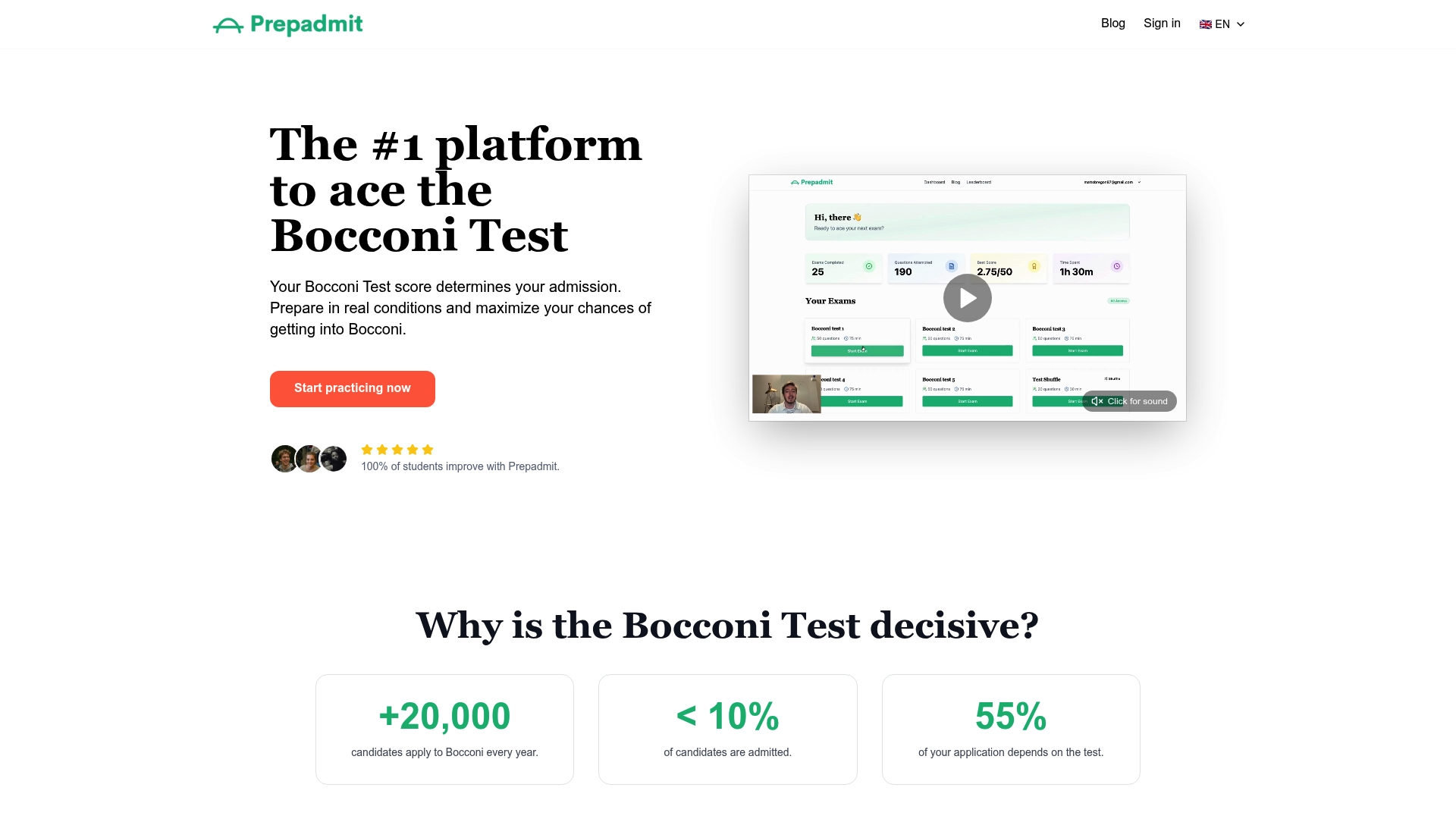
Some online platforms provide:
- Simulations based on official past papers, designed to mirror the timing and navigation of the real test
- Detailed answer corrections that show where and why points may have been lost
- Skill-specific practice modes to target areas revealed by score reports
- Progress tracking and peer ranking features to inform your preparation
- Money-back guarantees offered by some services
If you want to see how your current pacing holds up under real conditions, access the full preparation and run a diagnostic simulation before your next scored attempt.
FAQ
What Counts as a Good Score on the Bocconi Test?
There’s no single published “good score” threshold beyond the minimum. Undergraduate candidates with a total score below 17 points are not considered, so treat 17 as the floor, not the target, since admission is competitive and higher scores improve your standing.
How Hard Is the Bocconi Test, Really?
The content difficulty is manageable for most strong high school students, but the test architecture, three-question screens with no way back and a strict 75-minute clock, is what actually trips people up. Candidates who never practice under those exact conditions tend to underperform their content knowledge.
How Many Times Can I Retake the Bocconi Test?
Attempts are limited, which is exactly why treating every one as disposable is a mistake. Plan your schedule so you have at least one attempt purely for learning and calibration before your qualifying attempts, rather than using your only chances as cold, unpracticed sits.
What Kinds of Questions Appear on the Bocconi Test?
The exam mixes topics across a single 50-question, 75-minute session rather than separating them into distinct timed sections, according to Bocconi’s official instructions. Expect a blend of logical reasoning, math, reading comprehension, and critical thinking items, some of which carry the steeper −0.33 penalty for wrong answers.
Recommended
Related articles
Ready to ace your admission test?
Discover PrepAdmit, the platform that helps you succeed at top university admission tests.
Discover PrepAdmit