Why Practice Tests Improve Scores for University Exams
Why Practice Tests Improve Scores for University Exams
Most students preparing for university entrance exams spend the majority of their time rereading notes and highlighting textbooks. It feels productive. The material looks familiar, and that familiarity gets mistaken for learning. The science tells a very different story. Understanding why practice tests improve scores comes down to how your brain actually stores and retrieves information under pressure. Research shows that active retrieval through testing outperforms passive review in almost every measurable way, and students who build their preparation around practice exams consistently outperform those who do not.
Table of Contents
- Key takeaways
- Why practice tests improve scores: the testing effect
- Beyond memorization: what practice tests actually train
- Why feeling lost during practice is a good sign
- How to use practice tests effectively step by step
- Individual differences and the limits of practice testing
- My honest take on why students avoid practice tests
- Start practicing the right way with Prepadmit
- FAQ
Key takeaways
| Point | Details |
|---|---|
| Testing beats rereading | Active retrieval produces far stronger long-term retention than reviewing the same material passively. |
| Transfer gains are real | Practice tests help you answer new question formats, not just memorize the exact content you drilled. |
| Struggle signals growth | Difficulty during retrieval is a sign your brain is working. Discomfort in practice means learning is happening. |
| Feedback closes the gap | Analyzing errors after each test, not just completing tests, is what drives score improvement. |
| Spacing multiplies results | Spreading practice tests across weeks leads to dramatically higher recall than cramming sessions. |
Why practice tests improve scores: the testing effect
The phrase “practice tests improve scores” is widely repeated in study guides, but the underlying mechanism has a specific name in cognitive science: the testing effect. Also called retrieval practice, it refers to the finding that actively pulling information from memory during a test encodes it more durably than reading the same information again.
The landmark study most cited in this area is Roediger and Karpicke’s 2006 research, which demonstrated that students who used retrieval practice retained approximately 61% of material one week later, compared to only 40% for students who spent the same time restudying. That is not a small edge. For a high-stakes university entrance exam, the gap between 61% and 40% retention can be the difference between an acceptance and a rejection.
Why does this happen? When you reread your notes, your brain receives the information passively. It feels smooth and familiar. But that fluency is misleading. Learners overestimate retention after rereading precisely because familiarity mimics understanding. Testing breaks that illusion. Every time you try to retrieve an answer and succeed, or even struggle and fail, you are forging stronger neural connections around that concept.

Here is a direct comparison between the two approaches:
| Study method | Immediate feeling | One-week retention | Exam readiness |
|---|---|---|---|
| Rereading / restudying | Fluent, confident | Low (~40%) | Weak |
| Retrieval practice / testing | Effortful, uncertain | High (~61%) | Strong |
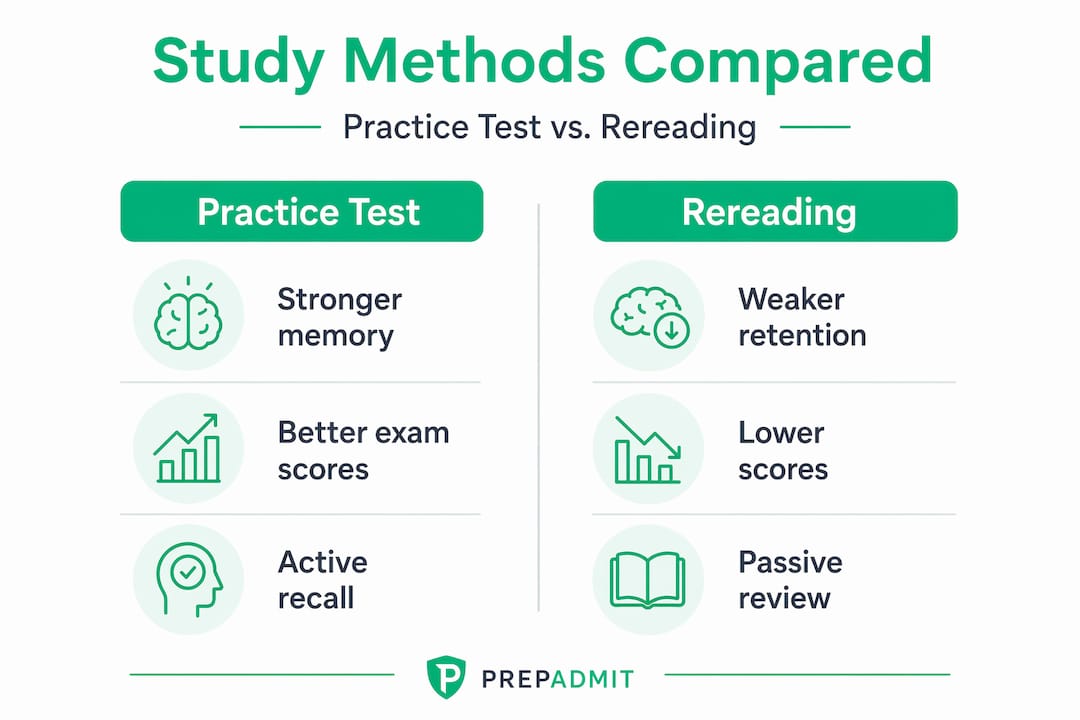
The takeaway is clear. The method that feels better in the moment produces worse results later. The method that feels harder produces the scores you are actually aiming for.
Pro Tip: After completing a chapter or topic, close everything and write down everything you can remember from scratch. This free-recall exercise is one of the fastest ways to activate the testing effect without needing a formal practice exam.
Beyond memorization: what practice tests actually train
The importance of practice exams goes well beyond locking in specific facts. A 2018 meta-analysis on test-enhanced learning found that the gains from retrieval practice transfer to new questions on the same concepts, not just the exact questions you practiced. This matters enormously for university entrance exams, where you cannot predict the precise phrasing or structure of every question you will face.
Practice tests also train a category of skills that pure studying simply cannot develop. These include:
- Pacing under time pressure. Knowing the content is not the same as being able to apply it within a time limit. Regular timed practice builds the mental stamina to work at the right speed without panicking.
- Format familiarity. University entrance exams often have specific question structures, scoring rules (including penalties for wrong answers), and answer formats. Repeated exposure reduces surprise on test day.
- Exam endurance. Sitting through a two-hour exam requires mental energy. Realistic practice conditions that simulate the actual exam environment prepare your brain and body for the real demands of the test.
- Error recognition. Practice tests reveal the types of mistakes you make repeatedly, whether they are conceptual misunderstandings, calculation errors, or careless slips under time pressure.
- Confidence calibration. Students who have completed many practice exams walk in with a realistic, grounded sense of what to expect. That reduces anxiety significantly.
The role of feedback deserves its own emphasis here. Completing a practice test and then moving on without reviewing your errors is the single most common way students waste their practice time. Using each test result as a diagnostic tool for where to focus your next study session is where the real improvement happens.
Pro Tip: After every timed practice session, categorize your errors into three buckets: concept gaps (you did not understand the material), pacing errors (you rushed or ran out of time), and careless mistakes (you knew it but slipped up). Each type needs a different fix.
Why feeling lost during practice is a good sign
Here is something most students get wrong. When a practice test feels difficult and they cannot remember answers clearly, they interpret that as proof that they have not studied enough. In reality, that struggle is exactly what learning looks like from the inside.
Robert Bjork, a cognitive psychologist at UCLA, developed the framework of desirable difficulties to explain this. His work shows that effortful retrieval strengthens memory storage precisely because the brain has to work harder to reconstruct the information. Conditions that feel easy (like rereading familiar notes) produce high fluency but low storage strength. Conditions that feel difficult (like trying to recall something without looking at your notes) produce low fluency but high storage strength.
“The very act of retrieving information changes the probability that you will be able to retrieve it in the future — and that probability increases dramatically when retrieval is difficult.” — Robert Bjork
This reframes the discomfort of a hard practice test. It is not a sign of failure. Productive failure during practice, followed by reviewing correct answers, actually primes better encoding than answering everything correctly on the first try.
The most common desirable difficulties worth building into your study plan include spaced practice (spreading test sessions across weeks rather than cramming), retrieval without prompts (no notes, no partial answers), and delayed feedback (reviewing answers at the end of the session rather than question by question). Each of these feels less comfortable. Each of them works.
How to use practice tests effectively step by step
Knowing that practice tests are effective is the starting point. Knowing how to use them correctly is what actually moves your score. Here is a structured approach that works for university entrance exam preparation:
- Complete a diagnostic test first. Before you study anything intensively, take one full practice exam under timed conditions. This gives you a baseline score and shows you exactly which areas need the most attention.
- Study targeted content. Use your diagnostic results to prioritize topics. Do not spread effort equally across everything. Focus on the areas where your scores were lowest.
- Take a second practice test after one to two weeks. Do not retake the same test. Use a different set of questions on the same concepts to test real retention, not memory of a specific test.
- Build an error log. After every test, record every wrong answer with the reason you missed it. Identifying knowledge gaps and targeting them specifically prevents you from repeating the same errors indefinitely.
- Revisit your error log before the next test. Spend focused review time specifically on the problem areas you logged, not on topics you already know well.
- Space your tests over weeks, not days. Spaced retrieval practice produces roughly 80% recall after one week compared to under 30% for massed repetition. The timing of your tests matters as much as the number of tests.
- Simulate real exam conditions every time. Use the exact time limits, work in silence, avoid checking answers mid-test, and treat each session as if it counts.
Pro Tip: Track your score on each practice test and plot it over time. Seeing a visible upward trend is a powerful motivator, and it also tells you when a plateau has set in so you can adjust your approach before the real exam.
Individual differences and the limits of practice testing
The evidence for the benefits of practice tests is strong, but it is worth being honest about the fact that not every student responds identically to the same methods.
Research on the testing effect consistently shows meaningful average gains across populations, but variation between individual learners is real. Students with high test anxiety, for example, may initially experience worsened performance under timed practice conditions before adapting. Students with certain learning differences may benefit from modified formats or additional support alongside retrieval practice.
The conclusion here is not that practice tests are unreliable. The conclusion is that they work best when treated as diagnostic tools, not just performance benchmarks. If your scores are not improving after several test cycles, the problem is not the practice testing method. It likely means your error analysis and targeted review cycles need adjustment. The most effective students combine practice testing with honest self-assessment and a willingness to change what is not working.
My honest take on why students avoid practice tests
I have watched a lot of students choose rereading over practice tests, and the reason is almost never laziness. It is that practice tests feel discouraging. You sit down, try to answer questions, get a lot of them wrong, and walk away feeling like you know nothing. That feeling is uncomfortable. So students go back to their notes, where everything looks familiar and manageable.
The problem is that comfort and learning are not the same thing. I have seen students spend weeks highlighting and rereading and still fall apart on test day because they never trained the specific skill of retrieving knowledge under pressure. The familiarity from rereading is real, but it does not survive time pressure and unfamiliar question formats.
What actually works is leaning into the discomfort of getting things wrong during practice. Every wrong answer on a practice test that you then correct and understand is worth more than ten correct answers you already knew. The struggle is not a sign that you are unprepared. It is the preparation itself.
If you are preparing for a university entrance exam, the most important shift you can make is treating practice tests as your primary study method and everything else as support for that work. Your notes exist to help you understand what you got wrong. Not the other way around.
— quentin
Start practicing the right way with Prepadmit
If you are preparing for the Bocconi Test, the science above is not just theoretical. It is exactly how Prepadmit is built. The platform gives you access to official past papers, on-demand timed tests, and detailed answer corrections that walk you through every mistake.
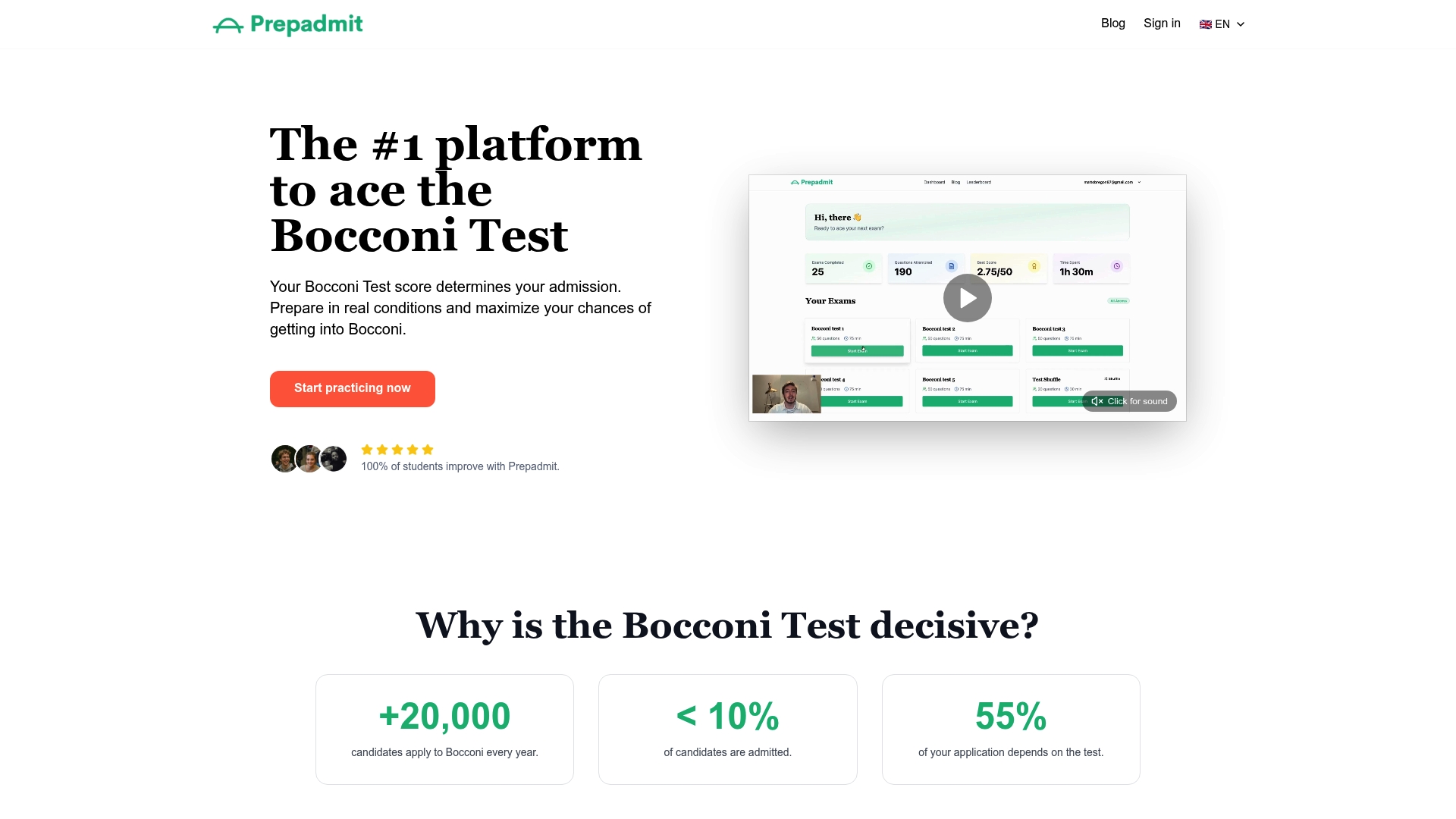
Students using Prepadmit see an average score improvement of 34%, which is what consistent, structured practice testing with real feedback actually produces. You can start your preparation today and use the platform’s progress tracking and peer ranking features to see exactly where you stand and what to work on next. For a deeper look at how mock exams drive results specifically for Bocconi aspirants, the role of mock exams guide is a strong next read.
FAQ
Why do practice tests help more than rereading?
Practice tests require your brain to actively retrieve information, which strengthens memory storage far more than passively reading the same material again. Research shows retrieval practice produces about 61% retention after one week compared to 40% for restudying.
How many practice tests should I take before my exam?
There is no single number, but spaced practice over several weeks produces the best results. Taking tests every one to two weeks with focused error review between sessions outperforms cramming many tests into a short period.
Do practice tests help with test anxiety?
Yes. Repeated exposure to realistic exam conditions builds familiarity with the format and time pressure, which reduces uncertainty and anxiety on test day. The key is practicing under the same conditions as the real exam, not in a relaxed, open-note environment.
What should I do after finishing a practice test?
Review every wrong answer and categorize your errors by type: concept gaps, pacing issues, or careless mistakes. This error analysis process turns each test into a targeted study plan for your next session.
Are practice tests effective for all students?
The testing effect is well-supported across most learner populations, but individual results vary. Students with high anxiety or certain learning differences may need adapted approaches. Treating practice tests as diagnostics rather than pure performance measures helps personalize the method to your specific needs.
Recommended
Related articles
Ready to ace your admission test?
Discover PrepAdmit, the platform that helps you succeed at top university admission tests.
Discover PrepAdmit