Bocconi Self-Study Advantages: Your 2026 Guide

Bocconi Self-Study Advantages: Your 2026 Guide
Self-study is the most direct preparation route for Bocconi University admission because the entire evaluation rests on just two measurable factors: your test score and your GPA. Bocconi’s admission weights split 55% to the test score and 45% to GPA, with no essays, interviews, or extracurricular assessments involved. That binary structure makes self-study a precise fit. You know exactly what to work on, and you can dedicate every study hour to moving those two numbers. With an admission rate of 10–20% and over 90% of graduates employed within six months, the stakes are high and the payoff is real.
1. Bocconi self-study advantages start with the admission model
Bocconi’s admission system is unusually straightforward. No essays, interviews, or extracurriculars factor into your application. The decision comes down entirely to your test score and your converted GPA. That clarity is a gift for self-studiers.

Most university applications require students to split their energy across personal statements, recommendation letters, and activity lists. Bocconi removes all of that. You can put 100% of your preparation time into the two metrics that actually determine your outcome.
Self-directed learning works best when the target is specific and measurable. Bocconi gives you exactly that. Students who build a focused study plan around the test format and their GPA trajectory are working with the same information admissions officers use.
- No essays to write or revise
- No interviews to prepare for
- No extracurricular portfolio to build
- Two clear metrics: test score and GPA
Pro Tip: Map your current GPA conversion to Bocconi’s scale before you start studying. Knowing your GPA standing tells you how much pressure your test score needs to carry.
2. Cost savings make self-study a practical choice
Annual tuition at Bocconi runs approximately €16,700, so controlling preparation costs matters. Private coaching programs for competitive university admissions can cost thousands of euros. Self-study cuts that expense dramatically.
The cost advantage compounds when you factor in merit scholarships. Bocconi awards scholarships automatically based on your application round and test results, with scholarships covering 30–100% of tuition depending on performance. A strong test score achieved through self-study can offset years of tuition costs.
Platforms like Prepadmit offer on-demand mock exams and detailed answer corrections at a fraction of what private coaching costs. The return on a well-executed self-study plan is hard to beat.
3. Flexible scheduling lets you target your weak areas
Self-study gives you full control over your calendar. You decide when to drill math, when to review analytical reasoning, and when to take a full mock exam. That flexibility is not available in fixed-schedule group courses.
The Bocconi test includes 4 sections, 50 questions, and a 75-minute time limit, with a maximum of 4 attempts per cycle. Knowing the format lets you build a study schedule that mirrors real test conditions. You can repeat the sections where you lose the most points until your accuracy improves.
Applicants who self-study can also adjust their pace based on school workload. During exam periods, they scale back. During breaks, they push harder. That kind of responsiveness is not possible in a structured course.
Pro Tip: Use a weekly review log. After each practice session, write down the question types you missed most. Revisit those types first in your next session.
4. Early application timing rewards disciplined self-studiers
Applying in the Early round maximizes both admission and scholarship chances. Merit scholarships are awarded automatically based on round and score, with no separate application required. Students who plan their self-study timeline around the Early session deadline give themselves the best possible outcome.
90–95% of places fill by the end of the Winter session. Waiting for the Spring round is a real risk. Self-studiers who start early in the academic year can be test-ready before the Early session opens.
This timing advantage is one of the clearest self-study benefits. You set your own deadline, and you work backward from it. No external course schedule forces you to rush or wait.
5. Building genuine math skills, not just test tricks
Programs like BEMACS, BAI, and BIEF require strong quantitative foundations, not surface-level test strategies. Students who rely only on memorized shortcuts often struggle once they arrive on campus. Self-study done right builds the actual math fluency those programs demand.
The distinction matters. A student who understands why a formula works will score better on unfamiliar questions than one who memorized a pattern. Self-study forces you to work through problems until you understand them, not just until you can recognize the answer.
This is where self-directed learning creates a long-term advantage. The skills you build preparing for the Bocconi test carry directly into your first-year coursework.
6. Common self-study challenges and how to handle them
Self-study has real risks. Procrastination is the most common. Without a teacher or class schedule holding you accountable, it is easy to delay practice sessions until the week before the test.
The fix is structure. Treat your study plan like a class. Set specific days and times for practice, and track your completion rate each week. Students who delay self-study often miss the Early session entirely, which cuts their scholarship chances significantly.
Other common challenges include:
- Inconsistent practice volume: Studying intensely for two weeks then stopping for three weeks produces poor results. Consistent daily or every-other-day practice outperforms cramming.
- Overconfidence after one good mock score: One strong result does not mean you are ready. Aim for consistent performance across multiple full-length practice tests.
- Neglecting GPA: The test gets most of the attention, but GPA carries 45% of the admission weight. Protecting your school grades during preparation is not optional.
- Ignoring stress management: Burnout is real. Build rest days into your plan and treat them as part of the preparation, not a break from it.
7. How self-study compares to other preparation methods
Self-study is not the only option, but it is the most cost-effective and flexible one for most Bocconi applicants. The table below shows how it compares to other common approaches.
| Preparation method | Cost | Flexibility | Focus on Bocconi format | Motivation source |
|---|---|---|---|---|
| Self-study | Low | High | Fully customizable | Internal discipline |
| Group prep course | Medium | Low | Partially aligned | Peer and instructor |
| Private tutoring | High | Medium | Depends on tutor | External accountability |
| Hybrid (self + tools) | Low to medium | High | High with right resources | Mixed |
Group courses offer peer motivation and a set schedule, which helps students who struggle with self-discipline. Private tutoring provides personalized feedback but at a cost that is hard to justify when the admission criteria are this specific. A hybrid approach, combining self-study with a platform like Prepadmit, captures the benefits of both without the cost of private coaching.
Pro Tip: If you find self-motivation difficult, set a weekly check-in with a study partner who is also applying to Bocconi. Shared accountability costs nothing and works.
8. Study tips for the 2026 Bocconi test
These tips apply directly to the 2026 admission cycle:
- Start with a diagnostic test. Take a full mock exam before you begin studying to identify your baseline score and your weakest sections.
- Prioritize math and analytical reasoning. These sections carry the most weight for competitive programs. Spend at least 60% of your study time here.
- Use mock exams that simulate real conditions. Timed, full-length practice tests build the stamina and pacing skills the actual test requires.
- Track your GPA conversion early. Bocconi converts grades from different national systems. Knowing your converted GPA before you apply removes a last-minute surprise.
- Learn basic Italian. All main programs are taught in English, but Italian helps with daily life, internships, and social integration in Milan.
- Plan your attempt schedule. With up to 4 attempts allowed, map out when you will take each one. Leave room to improve between attempts without running out of time before the Early session.
Key takeaways
Self-study is the most effective preparation method for Bocconi admission because it aligns directly with the university’s two-metric evaluation system of test score and GPA.
| Point | Details |
|---|---|
| Admission is binary | Bocconi evaluates only test score (55%) and GPA (45%), making focused self-study the ideal fit. |
| Early timing is critical | 90–95% of seats fill by the Winter session; self-studiers must plan to apply in the Early round. |
| Scholarships reward high scores | Merit awards covering 30–100% of tuition are automatic for strong early-round applicants. |
| Math fluency beats test tricks | Programs like BEMACS and BIEF require real quantitative skill, not memorized shortcuts. |
| Structure prevents failure | Consistent daily practice and GPA protection are the two habits that separate successful self-studiers. |
Why I think self-study is the right call for most Bocconi applicants
I have seen students spend thousands on prep courses and still underperform on test day. I have also seen students who built a disciplined self-study plan, used quality mock exams, and walked in with genuine confidence. The difference was not money. It was focus.
Bocconi’s admission model actually rewards the self-studier. There is no hidden component, no subjective essay score, no interview where nerves can cost you. The test and your GPA are the whole story. That is rare, and it is worth taking seriously.
The students who struggle with self-study are usually the ones who treat it as optional until it becomes urgent. Starting in september or october of your final school year, working through the test format section by section, and protecting your GPA at the same time is not glamorous. But it works.
My honest advice: do not wait for a course to tell you what to study. You already know the format. You already know the two metrics. Build your plan around those facts, use a structured revision approach to stay on track, and treat the Early session deadline as your hard target. The students who get into Bocconi are not necessarily the smartest. They are the most prepared.
— quentin
Prepadmit: built for Bocconi self-study candidates
Prepadmit is an online test prep platform built specifically for the Bocconi admission test. It offers on-demand mock exams that replicate the real test format, detailed answer corrections, and progress tracking so you always know where you stand.
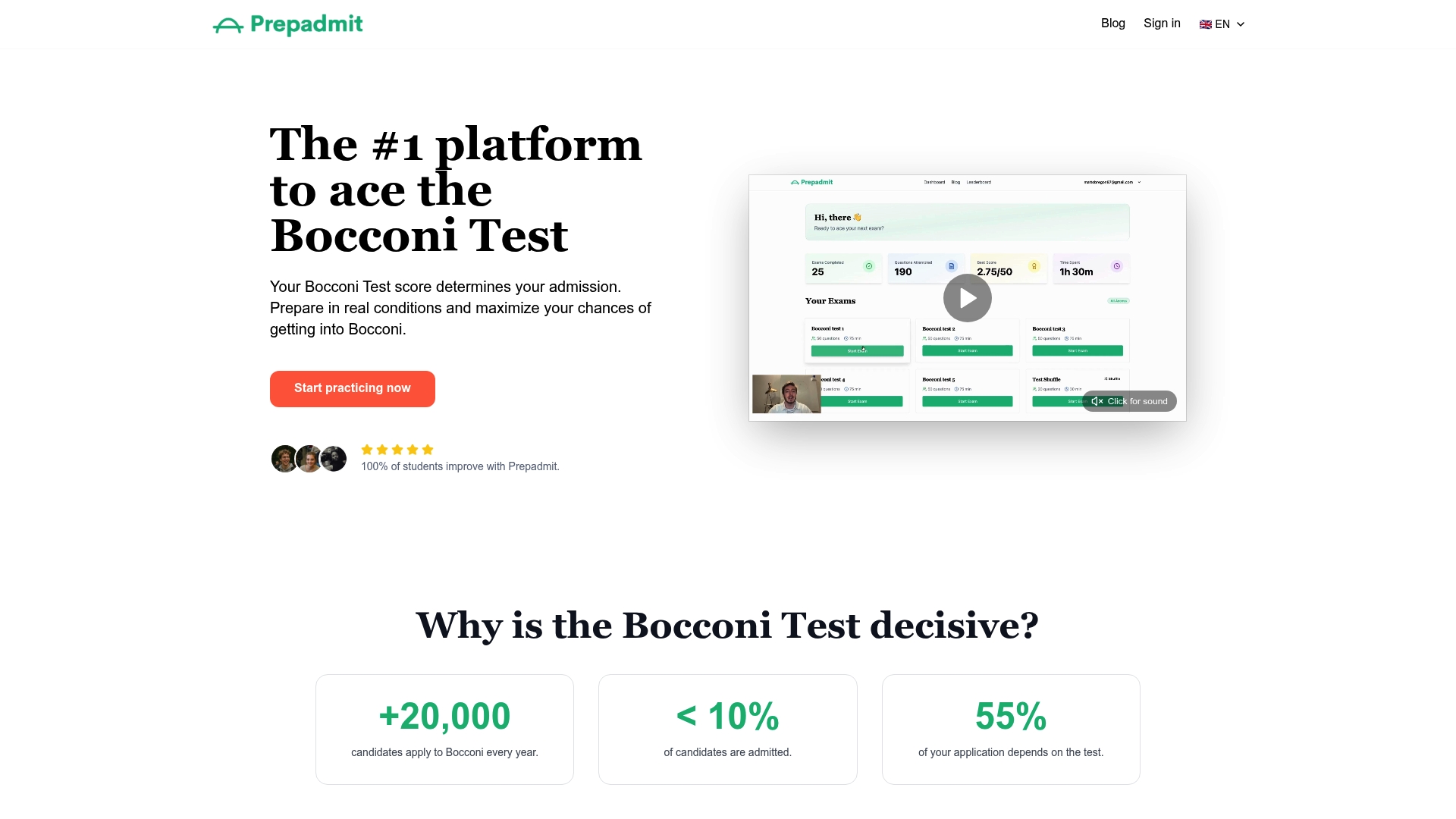
The platform was developed by experts from HEC and Bocconi, and students report an average score improvement of 34%. Prepadmit costs a fraction of private coaching, which makes it a natural fit for self-studiers who want structure without the price tag. A money-back guarantee backs every subscription. If you are preparing for the 2026 Bocconi test, start your preparation with tools that match the actual exam.
FAQ
What are the main Bocconi self-study advantages?
Self-study aligns perfectly with Bocconi’s admission model, which evaluates only test score and GPA. Students can focus entirely on these two metrics without splitting time across essays or extracurriculars.
How early should I start self-studying for the Bocconi test?
Start at least six months before the Early session deadline. Students who delay often miss the Early round, which carries the best scholarship and admission odds.
Can self-study really compete with private tutoring for Bocconi prep?
Yes. Bocconi’s admission criteria are specific and measurable, so a disciplined self-study plan using quality mock exams can match or outperform expensive tutoring for most applicants.
How does the Bocconi test format affect self-study planning?
The test has 4 sections, 50 questions, and a 75-minute limit, with up to 4 attempts per cycle. Knowing this lets you build a timed practice schedule that mirrors real conditions from the start.
Do merit scholarships require a separate application at Bocconi?
No. Bocconi awards merit scholarships automatically based on your application round and test score. Applying early and scoring well is all that is required.
Recommended
Related articles
Ready to ace your admission test?
Discover PrepAdmit, the platform that helps you succeed at top university admission tests.
Discover PrepAdmit