Why Exam Prep ROI Matters for University Admission

Why Exam Prep ROI Matters for University Admission
Exam prep ROI is defined as the measurable return a student gains from investing time and money into structured preparation, relative to the score improvements and admission outcomes that result. Why exam prep roi matters becomes clear the moment you compare two students with identical starting scores: one who studies randomly and one who follows a structured program. Structured exam prep reduces total study time by 30–40% while pushing completion rates from 30–40% up to 60–75%. That gap represents real admission chances, real scholarship dollars, and real career trajectories. Understanding the value of your preparation is not optional when you are targeting a competitive university like Bocconi.
Why exam prep ROI matters: the core formula
ROI in exam preparation is calculated by comparing total costs against measurable benefits. Getting this calculation right changes how you spend every study hour.
Total costs typically include:
- Exam registration fees
- Prep materials, courses, or platform subscriptions
- Opportunity cost of study time (hours spent studying instead of working or other activities)
Measurable benefits include:
- Score improvements and percentile gains
- Higher admission probability at target universities
- Scholarship eligibility unlocked by crossing score thresholds
- Long-term salary premiums tied to the credential or degree earned
The opportunity cost piece surprises most students. A $1,000 course saving 100 hours at $15 per hour effectively pays for itself by saving $1,500 in lost productivity. That means the course costs nothing in real terms. It actually generates a net gain before you even count the score improvement.
ROI is best measured by comparing salary premiums or admission gains to total prep costs, with payback periods typically falling within 3–24 weeks after the outcome improves. For a student admitted to Bocconi over a rejected peer, the payback is immediate and compounding over a four-year degree and career.
Pro Tip: Before you spend a single euro or dollar on prep materials, write down your target score, your current score, and the admission threshold for your university. That three-number gap is your ROI target.
What evidence shows about structured prep and success rates
The data on structured versus unstructured study is not subtle. Structured programs raise completion rates by 20–45 percentage points compared to self-study. That is not a marginal improvement. It is the difference between finishing your preparation and abandoning it three weeks before the exam.
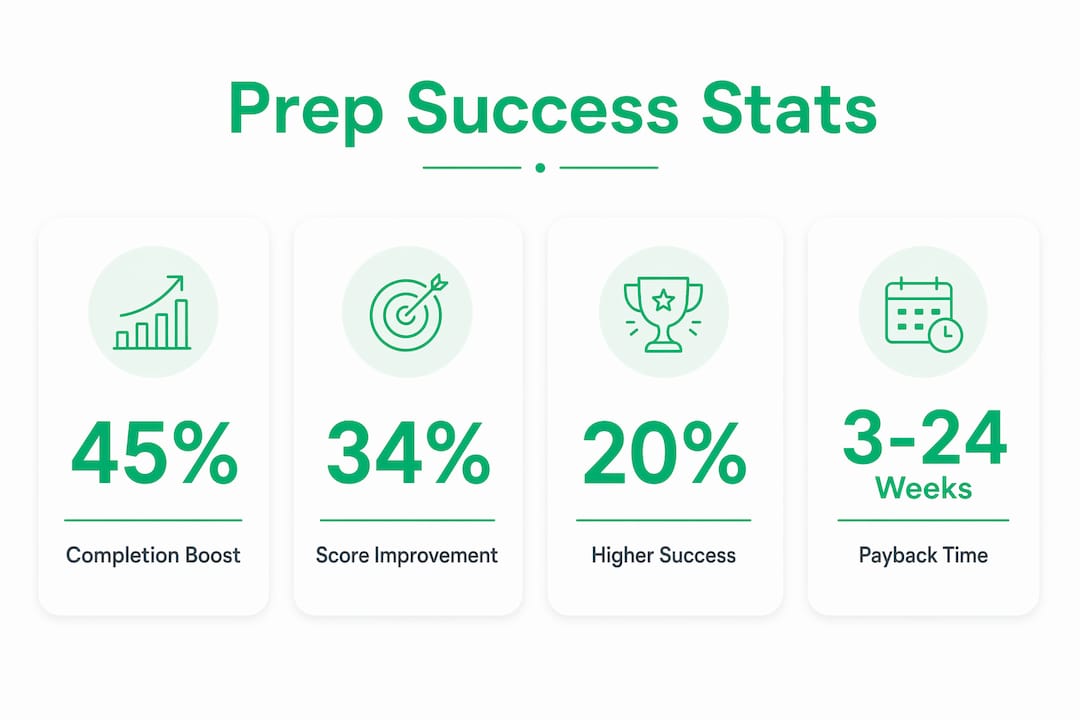
Score gains follow the same pattern. Students who use structured programs with timed practice, feedback loops, and targeted review consistently outperform students who read textbooks passively. Active recall is critical to identify knowledge gaps. Passive review creates false security and leads to poor performance under exam pressure.
The long-term career data reinforces the argument. Certified professionals have 40% higher callback rates and are promoted 8–12 months faster than peers without credentials. The principle applies directly to university admissions: the student who earns a place at a top institution gains access to a network, a brand, and opportunities that compound over decades.
- Structured prep cuts study time by 30–40% without cutting score gains
- Completion rates nearly double compared to self-directed study
- Score improvements translate directly into admission probability
- Long-term career returns dwarf the upfront prep investment
Pro Tip: Track your weekly practice test scores in a simple spreadsheet. A flat or declining trend after two weeks signals you need to change your study method, not just study more.
Why exam prep investment value is critical for top university applicants
Targeting a competitive university means your prep must align precisely with what that university actually tests. Credentials only generate high ROI when aligned with university or employer requirements. Studying the wrong material, even intensively, produces near-zero return. This is the most expensive mistake students make.

Bocconi, for example, uses a specific test format that rewards quantitative reasoning, logical analysis, and reading comprehension under time pressure. A student who spends months on general math review but never practices under timed conditions will underperform a student who spent half the time on exam simulation with real past papers. Format familiarity is a measurable advantage.
Active learning also protects your time. Effective exam preparation relies on active, focused learning over time, not endurance or last-minute cramming. Students who spread their prep across weeks with short, focused sessions retain more and arrive at the exam less stressed. Burnout is an ROI killer. It wastes weeks of prior effort and forces students to restart.
The scholarship angle deserves direct attention. Many top universities offer merit-based scholarships tied to admission test scores. Crossing a score threshold by even a few points can shift a student from full tuition to a partial or full scholarship. That single score improvement can be worth tens of thousands of dollars. No prep investment comes close to that return.
How can students maximize their exam prep ROI effectively?
Maximizing your return requires method, not just effort. The students who get the best results do not study the longest. They study the most efficiently.
Four strategies that consistently produce the highest ROI:
-
Match your prep to the actual exam format. Use official past papers and timed mock tests from the start. Timed practice tests build the decision-making speed the real exam demands. Generic study materials do not.
-
Target your weakest areas first. Efficient study targets weak topics with the highest probability of appearing on the test, shrinking prep time while maximizing score gains. Spending equal time on every topic is inefficient and unnecessary.
-
Use distributed practice, not marathon sessions. Short, focused sessions improve retention, reduce stress, and sharpen exam decision-making compared to cramming. A 45-minute focused session beats a 3-hour unfocused one every time.
-
Review every wrong answer with intent. Understanding why you got something wrong is more valuable than answering ten more questions correctly. Error analysis is where score gains actually happen.
Beyond study method, physical and mental condition affect performance directly. Sleep, nutrition, and scheduled rest days are not luxuries. They are performance inputs. A student who arrives at the exam rested and confident outperforms an equally prepared student who is exhausted.
Research your target university’s requirements before committing to any prep program. Knowing exactly what Bocconi expects lets you build a revision plan that wastes nothing.
- Confusing possibility with probability is a common error. Structured courses raise success probability significantly for students under time constraints. Possibility means you could pass. Probability means you likely will.
- Track progress weekly. Without data, you cannot tell if your method is working.
- Set a fixed exam date early. Deadlines create urgency and prevent indefinite prep drift.
Key Takeaways
Structured exam preparation is the highest-ROI study investment a competitive university applicant can make, because it raises completion rates, cuts study time, and directly improves admission outcomes.
| Point | Details |
|---|---|
| ROI formula for exam prep | Subtract total costs from measurable benefits including score gains, admission probability, and scholarship value. |
| Opportunity cost is real | A course saving 100 hours of study time pays for itself before you count any score improvement. |
| Structured prep doubles completion | Completion rates rise from 30–40% to 60–75% with structured programs versus self-study. |
| Align prep with the actual exam | Studying the wrong material produces near-zero ROI regardless of hours invested. |
| Active recall beats passive review | Identifying knowledge gaps through testing outperforms re-reading and builds real exam confidence. |
The uncomfortable truth about how students actually spend their prep time
Most students I have observed treat exam prep as a volume problem. They believe more hours automatically means better results. That belief is expensive and wrong.
The students who get into Bocconi are not always the ones who studied the most. They are the ones who studied the right things, in the right format, with honest feedback on every mistake. ROI thinking forces that discipline. When you frame prep as an investment with a measurable return, you stop wasting time on comfortable review and start doing the hard work of fixing actual weaknesses.
The other misconception I see constantly is treating prep cost as a pure expense. A student who spends $300 on a structured platform and gains admission to Bocconi has made one of the best financial decisions of their life. A student who spends nothing, fails the test, and reapplies a year later has paid far more in lost time, deferred income, and emotional cost. The “free” option is often the most expensive one.
Track your prep like an investor tracks a portfolio. Know your starting score. Set a target. Measure weekly. Adjust when results stall. That mindset produces better outcomes than any single study technique.
— quentin
Prepadmit: structured prep built for the Bocconi Test
Students targeting Bocconi need preparation that matches the actual exam, not generic test prep content.
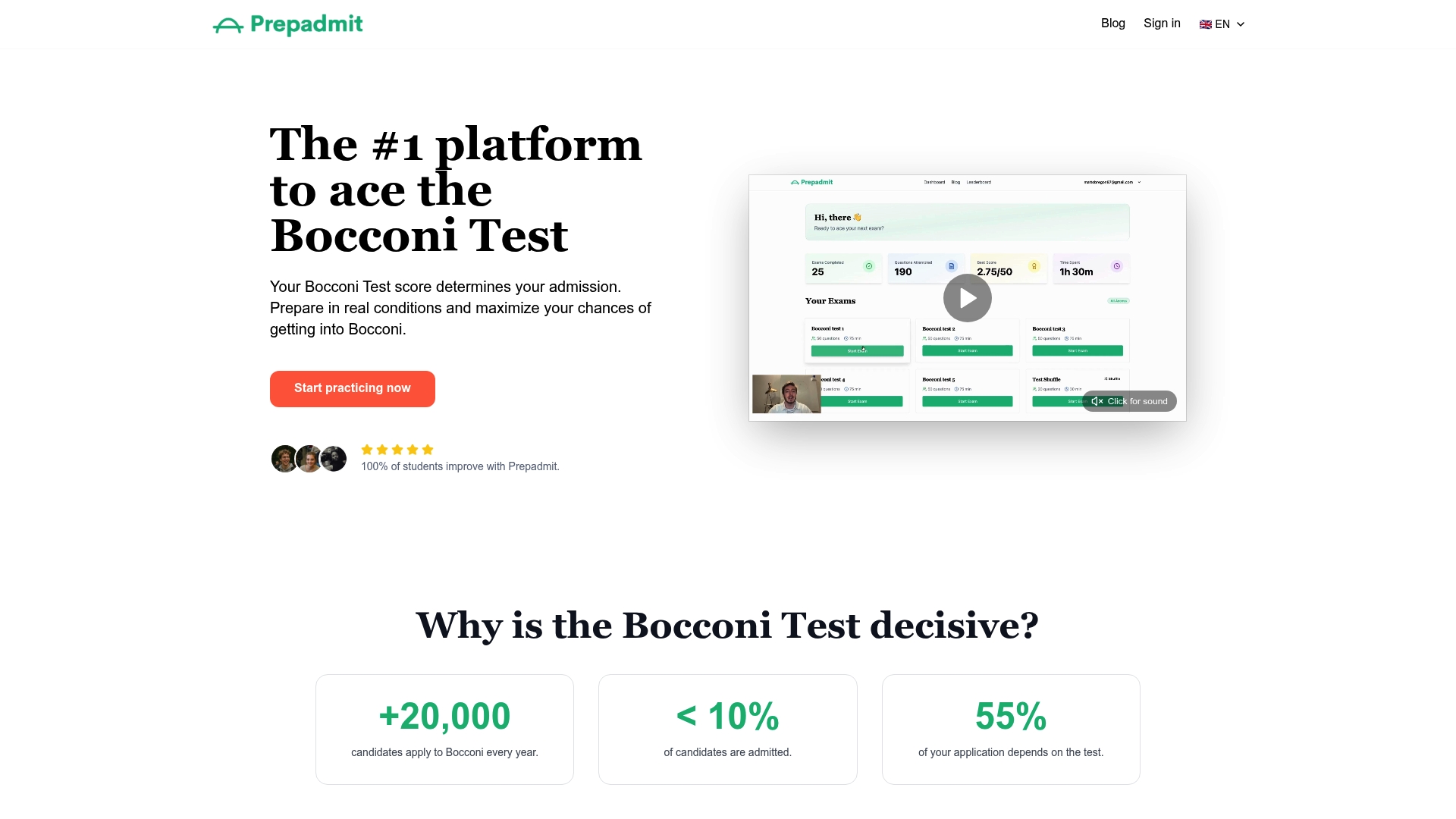
Prepadmit is built specifically for the Bocconi Test, with official past papers, on-demand timed mock exams, detailed answer corrections, and peer ranking so you always know where you stand. The platform reports an average score improvement of 34% for students who complete the program. Prepadmit costs a fraction of private coaching and comes with a money-back guarantee. If you want to put the ROI principles from this article into practice immediately, start your Bocconi prep with a platform designed by HEC and Bocconi graduates who have been through the same process you are facing now.
FAQ
What is exam prep ROI?
Exam prep ROI measures the return you get from investing time and money into preparation, calculated by comparing total costs against benefits like score improvements, admission probability, and scholarship value.
How much can structured prep improve my exam score?
Prepadmit reports an average score improvement of 34% for students who complete its structured program. Structured prep also raises completion rates from 30–40% to 60–75% compared to self-study.
How long does it take to recoup an exam prep investment?
Payback periods typically fall within 3–24 weeks after the outcome improves, whether through admission, scholarship eligibility, or career advancement tied to the credential.
Why does active recall matter more than re-reading?
Active recall forces you to retrieve information from memory, which reveals real knowledge gaps. Passive re-reading creates the feeling of understanding without building the retrieval strength needed under exam pressure.
How do I choose the right exam prep method for Bocconi?
Align your prep directly with the Bocconi Test format by using official past papers and timed simulations. Review the step-by-step Bocconi prep guide to build a plan that matches what the exam actually tests.
Recommended
Related articles
Ready to ace your admission test?
Discover PrepAdmit, the platform that helps you succeed at top university admission tests.
Discover PrepAdmit