University Admission Test Feedback Use: 2026 Guide

University Admission Test Feedback Use: 2026 Guide
Effective university admission test feedback use means analyzing your score breakdowns, identifying error patterns, and adjusting your study plan before your next attempt. Most students glance at their total score and move on. That single mistake costs them weeks of unfocused preparation. The students who gain admission to competitive universities treat every test result as a detailed map, not a verdict. This guide shows you exactly how to read that map and act on it.
What does university admission test feedback actually include?
Admission test feedback is the structured data your score report delivers after each attempt. It goes well beyond a single number. Understanding each component is the first step toward using it productively.
Most score reports include several distinct layers of information:
- Section scores: Separate scores for math, verbal, reading, or subject-specific areas. These tell you which broad domains need the most attention.
- Subscores and cross-test scores: Finer breakdowns within each section. A math section score might split into algebra, data analysis, and advanced math subscores.
- Percentile rankings: Your score relative to all other test takers. A 70th percentile score means you outperformed 70% of students who sat the exam.
- Question-type analysis: Some reports flag which question categories you answered correctly or incorrectly, such as inference questions versus vocabulary in context.
- Time-per-question data: A few platforms now show whether you spent too long on certain question types, revealing pacing problems.
The most important distinction to make early is between careless errors and knowledge gaps. A careless error is one you would get right on a second read with no additional study. A knowledge gap requires actual learning. Mixing these two categories together leads to wasted study time.
Pro Tip: After receiving your score report, go through every wrong answer and label it either “careless” or “gap.” This single step makes your next study session twice as targeted.

Percentile rankings deserve special attention. A raw score that looks low may still place you above the majority of applicants if the test was difficult that sitting. Always check the score range your target university considers competitive before deciding how much weight to give a percentile figure.
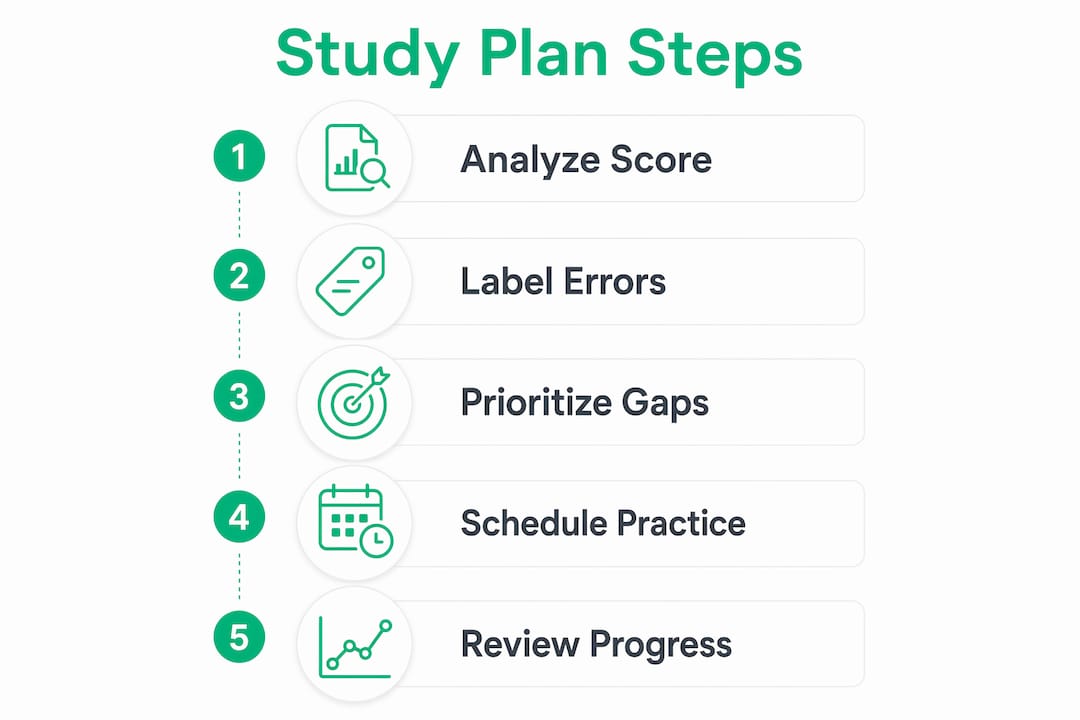
How to apply test feedback to build a focused study plan
Turning your score report into a study plan requires a clear sequence. Skipping steps leads to generic preparation that does not address your specific weaknesses.
- Rank your subscores from lowest to highest. Start your next study block with the weakest area. Do not begin with subjects you already handle well because it feels comfortable.
- Set a weekly time commitment and stick to it. Experts recommend 3–5 hours weekly of focused test prep, with full-length timed practice tests running approximately 3.5 hours each. Spread shorter sessions across the week for retention.
- Schedule deliberate practice drills by question type. If your subscore shows weakness in data interpretation, drill only data interpretation questions for two sessions before mixing question types again.
- Build an error log. After every practice session, write down each mistake, its cause, and the correct approach. Documenting each error’s cause prevents you from repeating the same mistakes across sessions.
- Plan your retake date before you start studying. About 66% of students improve their scores on a second attempt. Knowing your target date creates a deadline that keeps preparation on track.
- Reserve full-length timed tests for specific checkpoints. Do not burn through every available practice exam in the first month. Official practice exams should be saved for diagnostic use or tutor-guided sessions to preserve their simulation quality.
Pro Tip: Handwriting your error notes solidifies memory better than typing them into a digital document. Use a dedicated notebook for your error log.
The table below shows how to prioritize study time based on subscore gaps.
| Subscore gap from target | Recommended weekly focus | Practice format |
|---|---|---|
| More than 20 points | 60% of study time | Targeted drills, then mixed sets |
| 10–20 points | 30% of study time | Mixed question sets with timed review |
| Fewer than 10 points | 10% of study time | Full-length timed tests only |
Quality beats quantity at every stage. One well-reviewed practice test with deep error analysis delivers more improvement than three tests completed without review. Build your schedule around that principle.
What are the most common mistakes in using admission test feedback?
Most students make the same errors when they try to act on their score reports. Recognizing these patterns early saves months of wasted effort.
- Retaking too quickly without deep review. Sitting the exam again within weeks, without addressing the root causes of your errors, almost always produces a similar score. The feedback exists to change your preparation, not just your test date.
- Relying only on digital dashboards. Score analytics platforms are useful, but reading numbers on a screen without writing anything down reduces retention. Combine digital tools with a physical error log.
- Misreading percentile rankings. A percentile tells you where you stand among all test takers, not among applicants to your specific target university. Always cross-reference your percentile against your target school’s published middle 50% score range.
- Skipping timed simulation. Reviewing content without practicing under real time pressure creates a false sense of readiness. Timed practice tests replicate the cognitive load of test day in a way that untimed review cannot.
- Ignoring recurring error patterns. If the same question type appears in your error log three sessions in a row, that is a signal to stop and address the underlying concept before moving forward.
“Successful students treat their first test attempt as diagnostic feedback rather than a final judgment, using it to identify subject gaps and error patterns needing targeted intervention.” — Sparkl test prep research
The psychological trap here is real. A disappointing score feels personal. Students who let that feeling drive their next decision, whether by retaking immediately or by avoiding the score report altogether, consistently underperform students who sit down with the data and treat it as information. Admission test scores correlate moderately with long-term academic success (ρ = 0.40), which means they matter, but they are not fixed. Your response to the feedback matters more than the score itself.
What tools and resources help you get more from test feedback?
The right combination of tools turns a score report into a concrete study system. No single resource does everything well.
Diagnostic analytics platforms break your score report into visual charts by question type and time spent. These are most useful in the first 48 hours after receiving results, when you need a fast overview of where your performance dropped.
Full-length timed practice exams remain the gold standard for measuring real progress. They simulate test-day conditions, including fatigue and time pressure, in a way that short drills cannot. Platforms like Prepadmit offer exam simulation built around official past papers, which keeps the difficulty level realistic.
Tutors and coaching programs add the most value when they work directly from your score report rather than following a generic curriculum. A tutor who reviews your error log can identify patterns you missed and adjust the session in real time.
The table below compares common feedback tool categories by their primary strength.
| Tool category | Primary strength | Best used for |
|---|---|---|
| Score analytics dashboards | Fast visual overview of weak areas | First review after receiving results |
| Full-length timed practice tests | Realistic performance measurement | Progress checks every 3–4 weeks |
| Error log notebooks | Deep retention of corrected mistakes | Daily review after every practice session |
| Tutoring with score report review | Personalized pattern identification | Addressing persistent knowledge gaps |
- Mixing manual and digital review produces better retention than either method alone. Combining handwritten notes with digital feedback tools strengthens concept retention during preparation.
- Skill-specific practice modes let you isolate one question type and drill it repeatedly until your accuracy stabilizes before moving on.
- Peer ranking features give you a live benchmark. Knowing where you stand against other applicants helps you calibrate how much more preparation is realistic before your next attempt.
A solid entrance exam revision plan ties all these tools together into a weekly schedule with clear checkpoints. Without that structure, even the best tools sit unused.
Key Takeaways
Effective admission test feedback use requires analyzing error patterns, prioritizing weak subscores, and combining timed practice with written review to produce measurable score gains.
| Point | Details |
|---|---|
| Treat your first attempt as diagnostic | Use your initial score to map knowledge gaps, not to judge your ability. |
| Prioritize subscores, not total scores | Study your weakest subscore first; it produces the fastest overall improvement. |
| Write down every error and its cause | Handwritten error logs improve retention more than digital-only review. |
| Plan your retake before you start studying | About 66% of students improve on a second attempt when preparation is targeted. |
| Reserve official practice tests carefully | Save full-length official exams for diagnostic checkpoints, not daily practice. |
Why your score report is the most underused tool in test prep
Most students spend more time worrying about their score than studying it. I have seen this pattern repeat across hundreds of test prep cycles. A student receives a result that feels discouraging, closes the report, and immediately starts doing more practice questions. The score does not change much on the next attempt.
The students who improve significantly do something different. They spend the first two days after receiving results doing nothing but reading the report. They categorize every wrong answer. They look for patterns across question types. Only then do they open a practice book.
The data supports this approach. Top test-prep experts reframe the first attempt as a diagnostic tool, not a judgment. That reframe is not just psychological comfort. It is a practical instruction. Your score report tells you exactly where to spend the next four weeks. Ignoring it means guessing.
Strong test scores still matter, even as test-optional policies spread. Research from Yale Economics confirms that competitive scores enhance an applicant’s profile and are often favored by admissions committees when scores fall within or above a university’s middle 50% range. The feedback you receive after each attempt is your clearest path to reaching that range.
The psychological benefit is real too. Students who engage with their feedback report feeling more in control of their preparation. That confidence carries into test day.
— quentin
How Prepadmit helps you act on your test feedback
Knowing what your score report means is one thing. Having a system that turns that knowledge into daily practice is another.
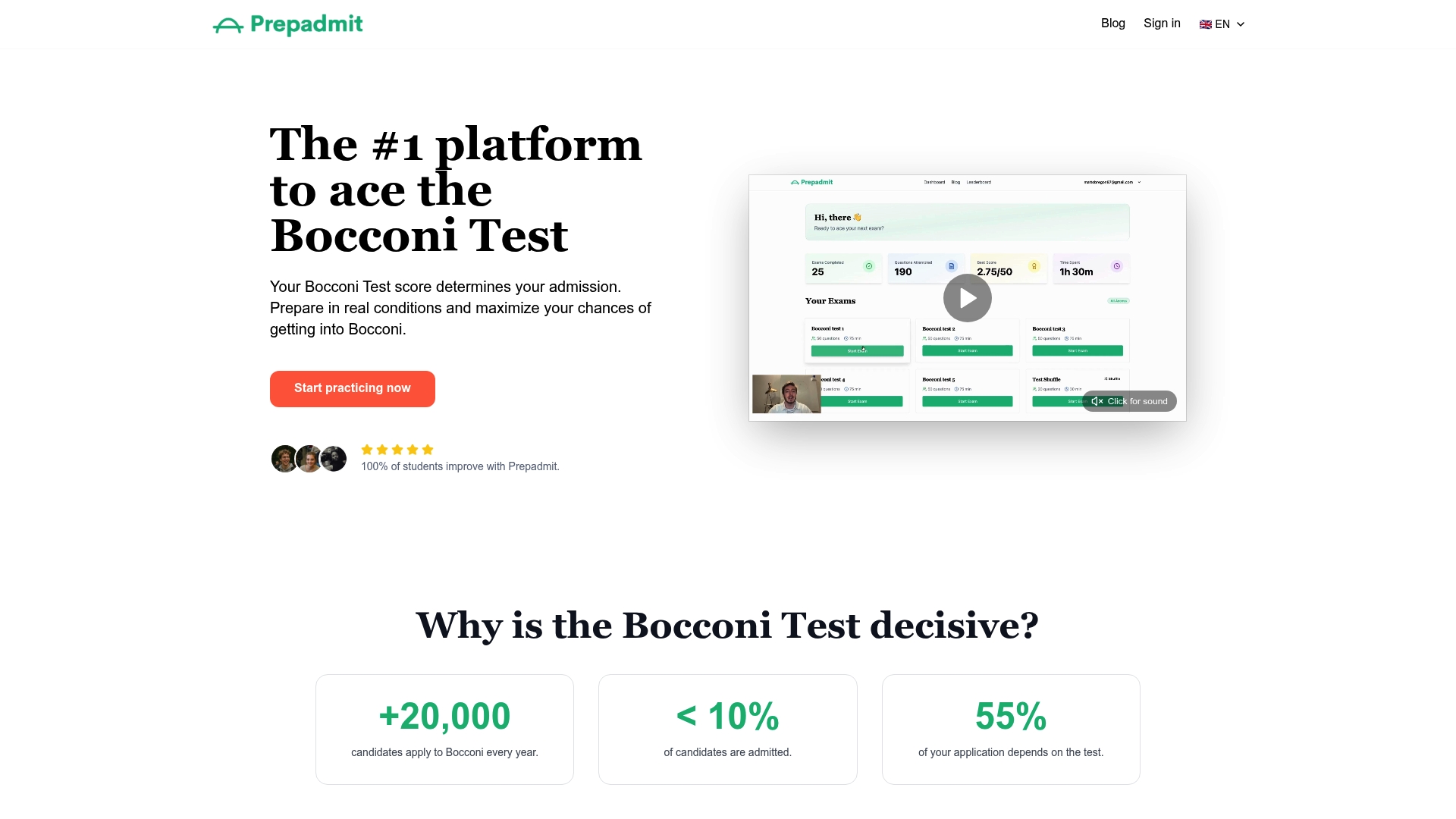
Prepadmit is built specifically for students preparing for the Bocconi Test, one of the most competitive university admission exams in Europe. The platform delivers detailed answer corrections after every practice session, skill-specific drills tied directly to your weak areas, and a peer ranking system so you always know where you stand. Students using Prepadmit report an average score improvement of 34%. Every practice test on the platform uses official past papers, so the difficulty stays realistic. Start your preparation on Prepadmit and turn your next score report into a concrete plan.
FAQ
What is university admission test feedback use?
University admission test feedback use is the process of analyzing your score report, identifying error patterns, and adjusting your study plan to improve performance on future attempts.
How do I know if my score is competitive enough?
Cross-reference your score against your target university’s published middle 50% score range. Strong scores within or above that range enhance your admissions profile even at test-optional schools.
How many times should I retake an admission test?
About 66% of students improve on a second attempt when they review their feedback thoroughly before retaking. Plan your retake date before you begin your next study cycle.
What is the difference between a careless error and a knowledge gap?
A careless error is one you would answer correctly on a second read with no additional study. A knowledge gap requires learning new material. Treating them the same way wastes study time.
How do I build a study plan from my score report?
Rank your subscores from lowest to highest, dedicate the majority of your weekly study time to your weakest area, and track every mistake in a written error log. Aim for 3–5 hours of focused prep per week with timed full-length tests at regular checkpoints.
Recommended
Related articles
Ready to ace your admission test?
Discover PrepAdmit, the platform that helps you succeed at top university admission tests.
Discover PrepAdmit